Global Music Market Highlights
| Market Size (2025) | USD 35 Billion |
| Forecast Size (2032) | USD 53 Billion |
| CAGR | 8.40% |
| Base Year | 2025 |
| Forecast Period | 2026-2032 |
| Largest Region | North America |
| Fastest Growing Region | Asia |
| Largest Segment | Streaming |
| Fastest Growing Segment | Live Music Events |
| Leading Companies | Spotify, Apple Music, Universal Music Group, Live Nation, Warner Music Group |
Global Music Market Size & Growth Rate (2026-2032)
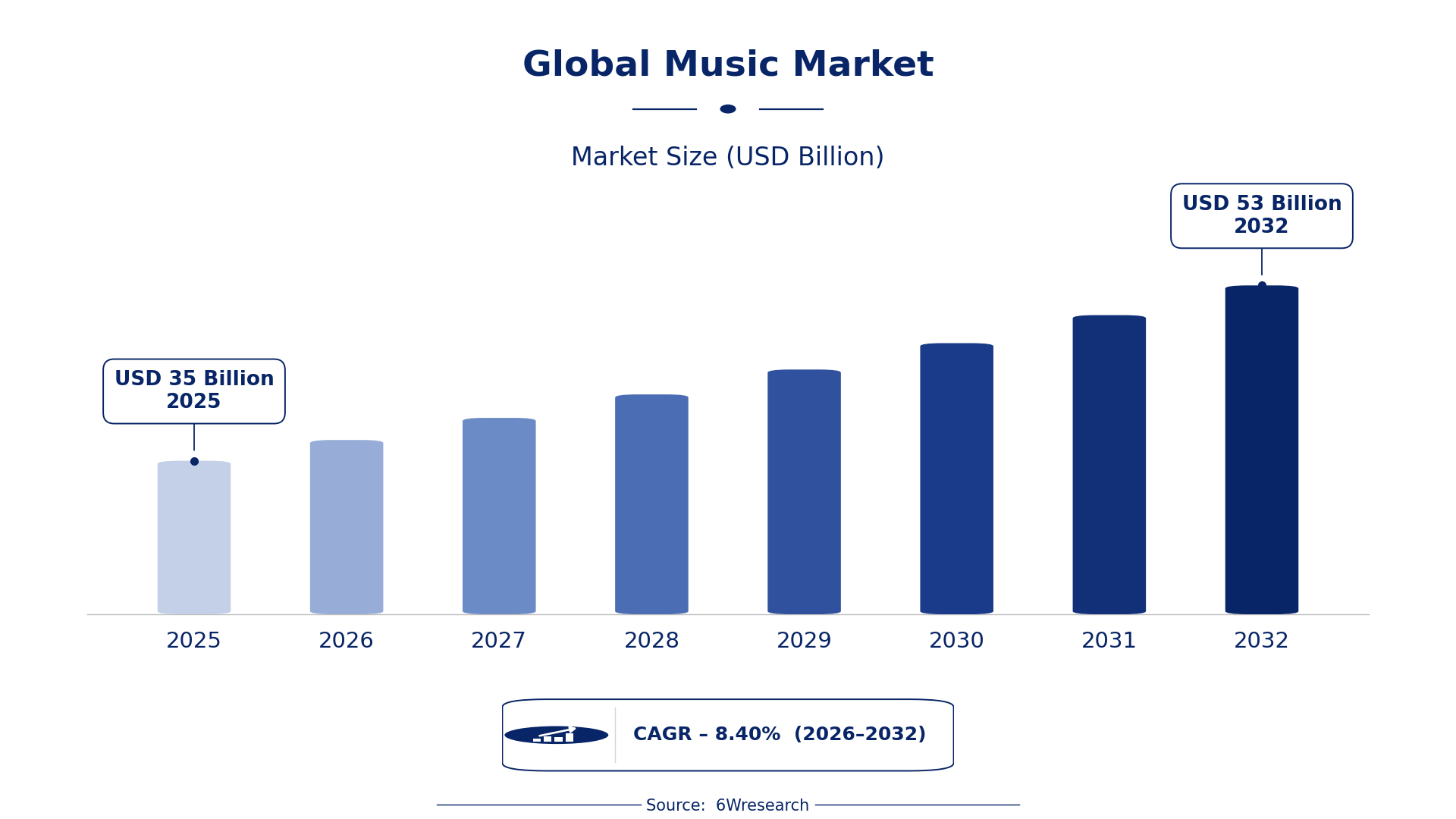
The Global Music Market was estimated at USD 35 Billion in 2025 and is projected to reach USD 53 Billion by 2032, growing at a CAGR of 8.40% from 2026 to 2032.
Global Music Market Synopsis
The Global Music Market is undergoing a dramatic transformation. As listeners shift from traditional consumption methods to digital platforms, the industry's structure is evolving swiftly. This transition is crucial not only for artists and labels but also for sectors like technology, hospitality, and retail that increasingly rely on music as a key touchpoint for consumer engagement.
An emerging focus on immersive live experiences and tailored content is reshaping revenue avenues within the Global Music Market. The integration of social media as a pivotal tool for artist promotion and fan engagement has magnified the direct-to-consumer model, fundamentally realigning the industry's landscape. This shift is not merely an evolution; it signifies a renaissance in how music is created, distributed, and monetized.
Global Music Market Year-wise Growth Rate and Key Drivers
This graph illustrates the annual growth rates of the Global Music Market from 2022 to 2032, highlighting a steady upward trajectory and projected expansion over the forecast period.
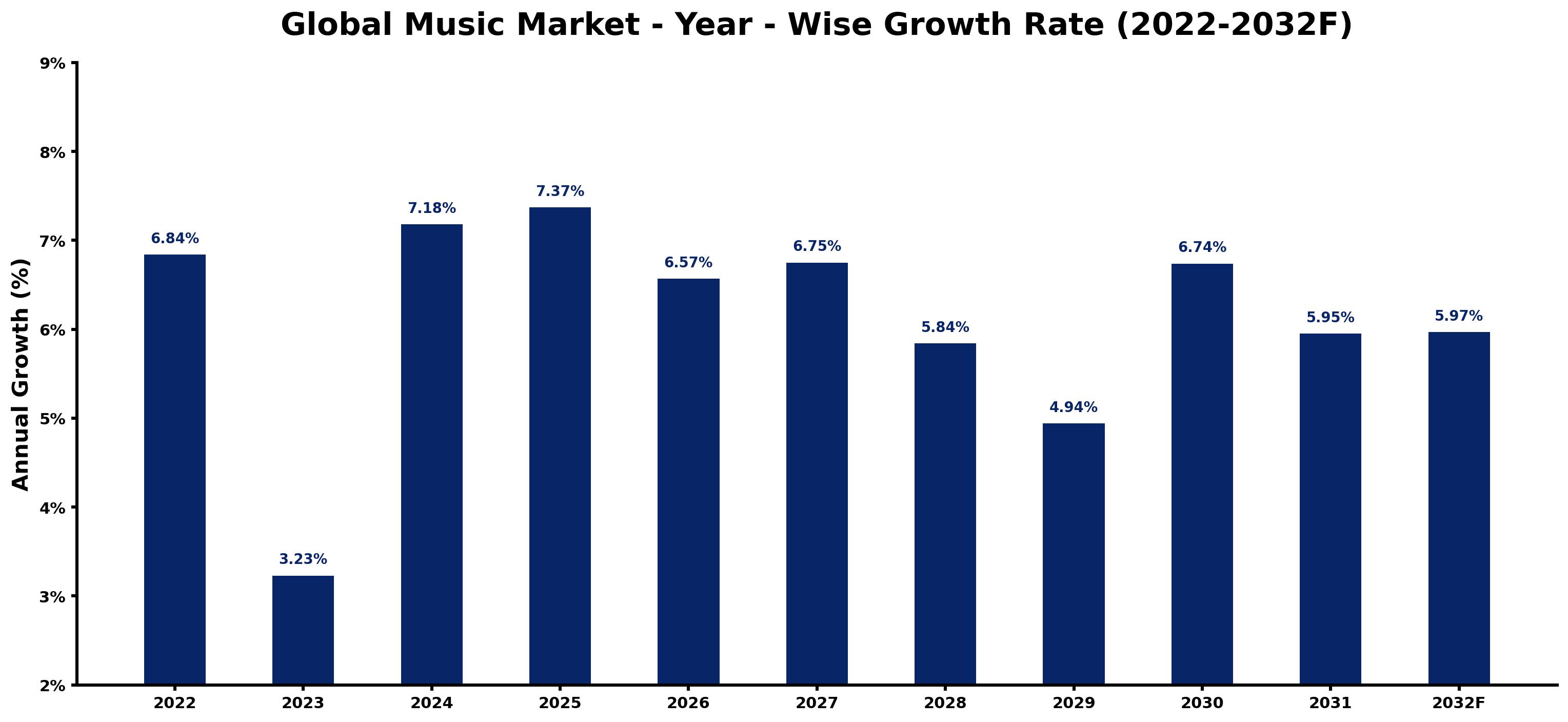
The table below presents the year‑wise growth rates along with the key drivers influencing the market
| Year | Growth Rate (%) | Major Drivers |
| 2022 | 6.84 | Streaming platforms are enhancing user experiences through a skilled workforce in music production. |
| 2023 | 3.23 | While competition among music streaming services intensifies, content licensing deals become critical. |
| 2024 | 7.18 | Sustainability in music production practices promotes ESG initiatives among major industry players. |
| 2025 | 7.37 | Investors are capitalizing on growth opportunities in the global music market worth $35 Billion. |
| 2026 | 6.57 | A shift toward new regulatory frameworks is changing how music distribution operates globally. |
| 2027 | 6.75 | Rising production budgets enable more innovative music videos and attract larger audiences. |
| 2028 | 5.84 | Independent record labels are gaining traction as audiences seek diverse music content. |
| 2029 | 4.94 | Streaming technology advancements enhance music delivery, creating innovative engagement metrics. |
| 2030 | 6.74 | Blockchain technology provides secure IP monetization, transforming revenue models in the music sector. |
| 2031 | 5.95 | Consumer preference shifts toward ad-supported revenue models as music access becomes more widespread. |
| 2032 | 5.97 | In North America, geographic expansion helps the global music industry reach $53 Billion in revenue. |
Note - Market size estimations and growth projections presented in this report are based on 6Wresearch's proprietary research methodology, combining internal industry data, secondary research, and primary validation, updated periodically to reflect current market conditions. As markets evolve rapidly, figures for certain industries may vary slightly and are intended as informed estimates rather than absolute figures. For the most current market sizing, we recommend validating figures with a 6Wresearch analyst.
Global Music Market Key Takeaways
Below are some of the specific key takeaways from the market, including:
- Streaming services lead with a share exceeding ~60% in 2025, reflecting consumer preference for on-demand access.
- Live music events are projected to grow at a CAGR of 12% from 2026 to 2032, highlighting a resurgence in audience engagement.
- Asia, particularly markets in China and India, shows rapid adoption, expected to witness a CAGR of 10.5% during the forecast period.
- The rise in digital royalties and licensing frameworks is creating new revenue models for artists, particularly in the streaming segment.
- Government initiatives favoring music education and local talent support are essential for sustaining the industry's growth and innovation.
Evaluation of Restraints in Global Music Market
The Global Music Market faces several restraints that could impede its potential growth. Notably, piracy continues to diminish revenues with industry estimates suggesting losses around $2.5 billion annually due to illegal downloads and streaming. For example, the Digital Millennium Copyright Act may impose strict penalties, yet enforcement has proven challenging, hindering its effectiveness. Moreover, traditional labels face ongoing pressure to adapt their revenue models amid the streaming revolution, raising concerns over artist compensation and sustainability.
Global Music Market Trends
One prominent trend reshaping the Global Music Market is the surge in music consumption via streaming platforms, which reported a 25% increase in subscribers year-over-year as of 2023. Companies like Spotify are not only expanding their playlists but also investing heavily in exclusive artist content, which bolsters user retention. Another noteworthy trend is the diversification of revenue streams, especially through virtual concerts. For instance, in 2022, Travis Scott's virtual concert in Fortnite attracted 27 million viewers, showcasing the potential of blending gaming and music. This amalgamation drives fan engagement and establishes new monetization avenues.
Global Music Market Opportunities
The landscape of the Global Music Market presents distinct opportunities for growth. For instance, the integration of virtual reality (VR) technologies into music experiences is set to expand significantly. Industry players like Oculus are partnering with artists to create immersive concert experiences, channeling a projected revenue of USD 5 billion in the coming years. Moreover, the demand for localized music content in emerging markets, particularly in Asia and Africa, is poised to create new revenue streams as global music entities seek to capture these diverse audiences.
Global Music Market by Format
Streaming commands leadership within the Global Music Market, holding a share of ~60% in 2025. In contrast, live music events are recognized as the fastest-growing segment, with an impressive CAGR of 12% from 2026 to 2032. The substantial dominance of streaming can be attributed to its convenience and global reach, as consumers increasingly favor access to vast music libraries over physical formats, transforming how music is consumed and monetized.
Global Music Market by Region
North America remains the largest region in the Global Music Market, accounting for ~40% share in 2025. Meanwhile, Asia is forecasted to be the fastest-growing region, projected to achieve a CAGR of 10.5% from 2026 to 2032. This growth trajectory is spurred by the increasing internet penetration and smartphone adoption in developing markets like India and Indonesia, significantly enhancing accessibility to diverse music genres and platforms.
Government Initiatives in the Global Music Market
The regulatory landscape affecting the Global Music Market has undergone significant changes to support growth and innovation. Various government initiatives are aimed at bolstering local artists, protecting intellectual property, and facilitating digital platforms.
- Ministry of Culture and Sports, Government of Qatar - “Music Development Fund”, 2020: This initiative provides funding for local artists and events, enhancing cultural exchange and local talent visibility.
- Australian Government, Department of Communications and the Arts - “Australia’s Music Industry Package”, 2019: This ongoing initiative aims to secure funding for music export programs, facilitating international market access for Australian artists.
- European Commission - “Creative Europe Media Programme”, 2021: An ongoing effort to support the European music and audiovisual sectors through funding and capacity-building activities that promote innovation and digital transformation.
- Federal Communications Commission, USA - “Net Neutrality Regulations”, 2023: A proposed framework aimed at ensuring that all internet traffic is treated equally, which could impact how streaming services deliver content.
Future Insights of the Global Music Market
As the Global Music Market continues to mature, an anticipated shift towards personalized music experiences is expected, influencing both consumption patterns and revenue generation. For instance, Spotify's integration of AI-driven playlists demonstrates a move toward tailored user engagement, enhancing listener satisfaction and retention. The industry may also witness increased utilization of blockchain technology for transparent royalty distribution, addressing longstanding concerns over artist compensation. By 2032, the demand for immersive music experiences through VR and AR platforms is projected to reshape the concert landscape, offering unique interactions that redefine audience participation.
Global Music Market Latest Developments
Recent activities in the Global Music Market highlight how key players are responding to evolving consumer needs and technological advancements. These developments indicate a proactive approach to enhancing user experiences and expanding market reach.
- Spotify recently launched a collaborative tool enabling artists to co-create and share tracks with fans, set to enhance community engagement and broaden its artist roster by early 2024.
- Apple Music is planning to introduce a feature that integrates live concert streaming directly into its platform, projected for mid-2025, allowing for real-time fan interactions.
- Universal Music Group announced an acquisition of a tech startup specializing in AI music composition, finalized in late 2023, which could revolutionize music creation and diversify its offerings.
- Live Nation is expanding its venue portfolio with two new concert sites in Asia by 2026, aimed at tapping into the region's growing music consumer base.
Global Music Market Key Players and Industry Positioning
The Global Music Market features a consolidated competitive structure, dominated by a few key players who have established significant market share through innovation and technology. These companies leverage their strengths to carve out distinct niches while often collaborating with emerging artists and platforms to drive growth.
| Leading Company | Core Strength | Strategic Focus |
|---|---|---|
| Spotify | Leading streaming platform with a vast music library. | Innovating with personalized playlists and exclusive content. |
| Apple Music | Integration with Apple’s ecosystem, providing seamless user experience. | Focus on high-fidelity audio and exclusive releases. |
| Universal Music Group | Extensive artist roster across multiple genres. | Investment in technology and partnerships to enhance artist opportunities. |
| Live Nation | Dominance in live event promotion and venue management. | Expansion into emerging markets to increase concert attendance. |
| Warner Music Group | Strong presence in both physical and digital distribution. | Emphasis on supporting independent artists through new platforms. |
The collaborative strategies employed by these players reinforce their market positions while simultaneously driving industry evolution, thereby enhancing user engagement and revenue potential.
Key Attractiveness of the Report
- 10 Years of Market Numbers
- Historical Data Starting from 2022 to 2025
- Base Year: 2025
- Forecast Data until 2032
- Key Performance Indicators Impacting the Market
- Major Upcoming Developments and Projects
Key Highlights of the Report:
- Global Music Market Outlook
- Market Size of Global Music Market, 2025
- Forecast of Global Music Market, 2032
- Historical Data and Forecast of Global Music Revenues & Volume for the Period 2022-2032
- Global Music Market Trend Evolution
- Global Music Market Drivers and Challenges
- Global Music Price Trends
- Global Music Porter's Five Forces
- Global Music Industry Life Cycle
- Historical Data and Forecast of Global Music Market Revenues & Volume
- Historical Data and Forecast of Global Music Market Revenues & Volume By Format for the Period 2022-2032
- Historical Data and Forecast of Global Music Market Revenues & Volume By Streaming for the Period 2022-2032
- Historical Data and Forecast of Global Music Market Revenues & Volume By Digital (except streaming) for the Period 2022-2032
- Historical Data and Forecast of Global Music Market Revenues & Volume By Physical Products for the Period 2022-2032
- Historical Data and Forecast of Global Music Market Revenues & Volume By Performance Rights for the Period 2022-2032
- Historical Data and Forecast of Global Music Market Revenues & Volume By Synchronization Revenues for the Period 2022-2032
- Historical Data and Forecast of North America Music Market Revenues & Volume By Format for the Period 2022-2032
- Historical Data and Forecast of North America Music Market Revenues & Volume By Streaming for the Period 2022-2032
- Historical Data and Forecast of North America Music Market Revenues & Volume By Digital (except streaming) for the Period 2022-2032
- Historical Data and Forecast of North America Music Market Revenues & Volume By Physical Products for the Period 2022-2032
- Historical Data and Forecast of North America Music Market Revenues & Volume By Performance Rights for the Period 2022-2032
- Historical Data and Forecast of North America Music Market Revenues & Volume By Synchronization Revenues for the Period 2022-2032
- Historical Data and Forecast of United States of America Music Market Revenues & Volume for the Period 2022-2032
- Historical Data and Forecast of Canada Music Market Revenues & Volume for the Period 2022-2032
- Historical Data and Forecast of Rest of North America Music Market Revenues & Volume for the Period 2022-2032
- Historical Data and Forecast of Latin America (LATAM) Music Market Revenues & Volume By Format for the Period 2022-2032
- Historical Data and Forecast of Latin America (LATAM) Music Market Revenues & Volume By Streaming for the Period 2022-2032
- Historical Data and Forecast of Latin America (LATAM) Music Market Revenues & Volume By Digital (except streaming) for the Period 2022-2032
- Historical Data and Forecast of Latin America (LATAM) Music Market Revenues & Volume By Physical Products for the Period 2022-2032
- Historical Data and Forecast of Latin America (LATAM) Music Market Revenues & Volume By Performance Rights for the Period 2022-2032
- Historical Data and Forecast of Latin America (LATAM) Music Market Revenues & Volume By Synchronization Revenues for the Period 2022-2032
- Historical Data and Forecast of Brazil Music Market Revenues & Volume for the Period 2022-2032
- Historical Data and Forecast of Mexico Music Market Revenues & Volume for the Period 2022-2032
- Historical Data and Forecast of Argentina Music Market Revenues & Volume for the Period 2022-2032
- Historical Data and Forecast of Rest of LATAM Music Market Revenues & Volume for the Period 2022-2032
- Historical Data and Forecast of Asia Music Market Revenues & Volume By Format for the Period 2022-2032
- Historical Data and Forecast of Asia Music Market Revenues & Volume By Streaming for the Period 2022-2032
- Historical Data and Forecast of Asia Music Market Revenues & Volume By Digital (except streaming) for the Period 2022-2032
- Historical Data and Forecast of Asia Music Market Revenues & Volume By Physical Products for the Period 2022-2032
- Historical Data and Forecast of Asia Music Market Revenues & Volume By Performance Rights for the Period 2022-2032
- Historical Data and Forecast of Asia Music Market Revenues & Volume By Synchronization Revenues for the Period 2022-2032
- Historical Data and Forecast of China Music Market Revenues & Volume for the Period 2022-2032
- Historical Data and Forecast of India Music Market Revenues & Volume for the Period 2022-2032
- Historical Data and Forecast of Japan Music Market Revenues & Volume for the Period 2022-2032
- Historical Data and Forecast of Rest of Asia Music Market Revenues & Volume for the Period 2022-2032
- Historical Data and Forecast of Africa Music Market Revenues & Volume By Format for the Period 2022-2032
- Historical Data and Forecast of Africa Music Market Revenues & Volume By Streaming for the Period 2022-2032
- Historical Data and Forecast of Africa Music Market Revenues & Volume By Digital (except streaming) for the Period 2022-2032
- Historical Data and Forecast of Africa Music Market Revenues & Volume By Physical Products for the Period 2022-2032
- Historical Data and Forecast of Africa Music Market Revenues & Volume By Performance Rights for the Period 2022-2032
- Historical Data and Forecast of Africa Music Market Revenues & Volume By Synchronization Revenues for the Period 2022-2032
- Historical Data and Forecast of South Africa Music Market Revenues & Volume for the Period 2022-2032
- Historical Data and Forecast of Nigeria Music Market Revenues & Volume for the Period 2022-2032
- Historical Data and Forecast of Egypt Music Market Revenues & Volume for the Period 2022-2032
- Historical Data and Forecast of Rest of Africa Music Market Revenues & Volume for the Period 2022-2032
- Historical Data and Forecast of Europe Music Market Revenues & Volume By Format for the Period 2022-2032
- Historical Data and Forecast of Europe Music Market Revenues & Volume By Streaming for the Period 2022-2032
- Historical Data and Forecast of Europe Music Market Revenues & Volume By Digital (except streaming) for the Period 2022-2032
- Historical Data and Forecast of Europe Music Market Revenues & Volume By Physical Products for the Period 2022-2032
- Historical Data and Forecast of Europe Music Market Revenues & Volume By Performance Rights for the Period 2022-2032
- Historical Data and Forecast of Europe Music Market Revenues & Volume By Synchronization Revenues for the Period 2022-2032
- Historical Data and Forecast of United Kingdom Music Market Revenues & Volume for the Period 2022-2032
- Historical Data and Forecast of France Music Market Revenues & Volume for the Period 2022-2032
- Historical Data and Forecast of Germany Music Market Revenues & Volume for the Period 2022-2032
- Historical Data and Forecast of Rest of Europe Music Market Revenues & Volume for the Period 2022-2032
- Historical Data and Forecast of Middle East Music Market Revenues & Volume By Format for the Period 2022-2032
- Historical Data and Forecast of Middle East Music Market Revenues & Volume By Streaming for the Period 2022-2032
- Historical Data and Forecast of Middle East Music Market Revenues & Volume By Digital (except streaming) for the Period 2022-2032
- Historical Data and Forecast of Middle East Music Market Revenues & Volume By Physical Products for the Period 2022-2032
- Historical Data and Forecast of Middle East Music Market Revenues & Volume By Performance Rights for the Period 2022-2032
- Historical Data and Forecast of Middle East Music Market Revenues & Volume By Synchronization Revenues for the Period 2022-2032
- Historical Data and Forecast of Saudi Arabia Music Market Revenues & Volume for the Period 2022-2032
- Historical Data and Forecast of UAE Music Market Revenues & Volume for the Period 2022-2032
- Historical Data and Forecast of Turkey Music Market Revenues & Volume for the Period 2022-2032
- Historical Data and Forecast of Rest of Middle East Music Market Revenues & Volume for the Period 2022-2032
- Global Music Market - Key Performance Indicators
- Global Music Market - Import Export Trade Statistics
- Global Music Market - Opportunity Assessment By Countries
- Global Music Market - Opportunity Assessment By Format
- 0
- Global Music Market - Top Companies Market Share
- Global Music Market - Top Companies Profiles
- Global Music Market - Comparison of Players in Technical and Operating Parameters
- Global Music Market - Strategic Recommendations
Markets Covered
The Global Music Market report provides a detailed analysis of the following market segments:
By Regions and Countries:
- North America
- Europe
- LATAM
- Middle East
- Asia
- Africa
By Format:
- Streaming
- Digital (except streaming)
- Physical Products
- Performance Rights
- Synchronization Revenues






































