Global Newspaper Market Highlights
| Market Size (2025) | USD 85 Billion |
| Forecast Size (2032) | USD 102 Billion |
| CAGR | 2.70% |
| Base Year | 2025 |
| Forecast Period | 2026-2032 |
| Largest Region | North America |
| Fastest Growing Region | Asia |
| Largest Segment | Digital |
| Fastest Growing Segment | Subscription |
| Leading Companies | The New York Times Company, News Corp, Gannett Co., Inc., Washington Post, Fairfax Media |
Global Newspaper Market Size & Growth Rate (2026-2032)
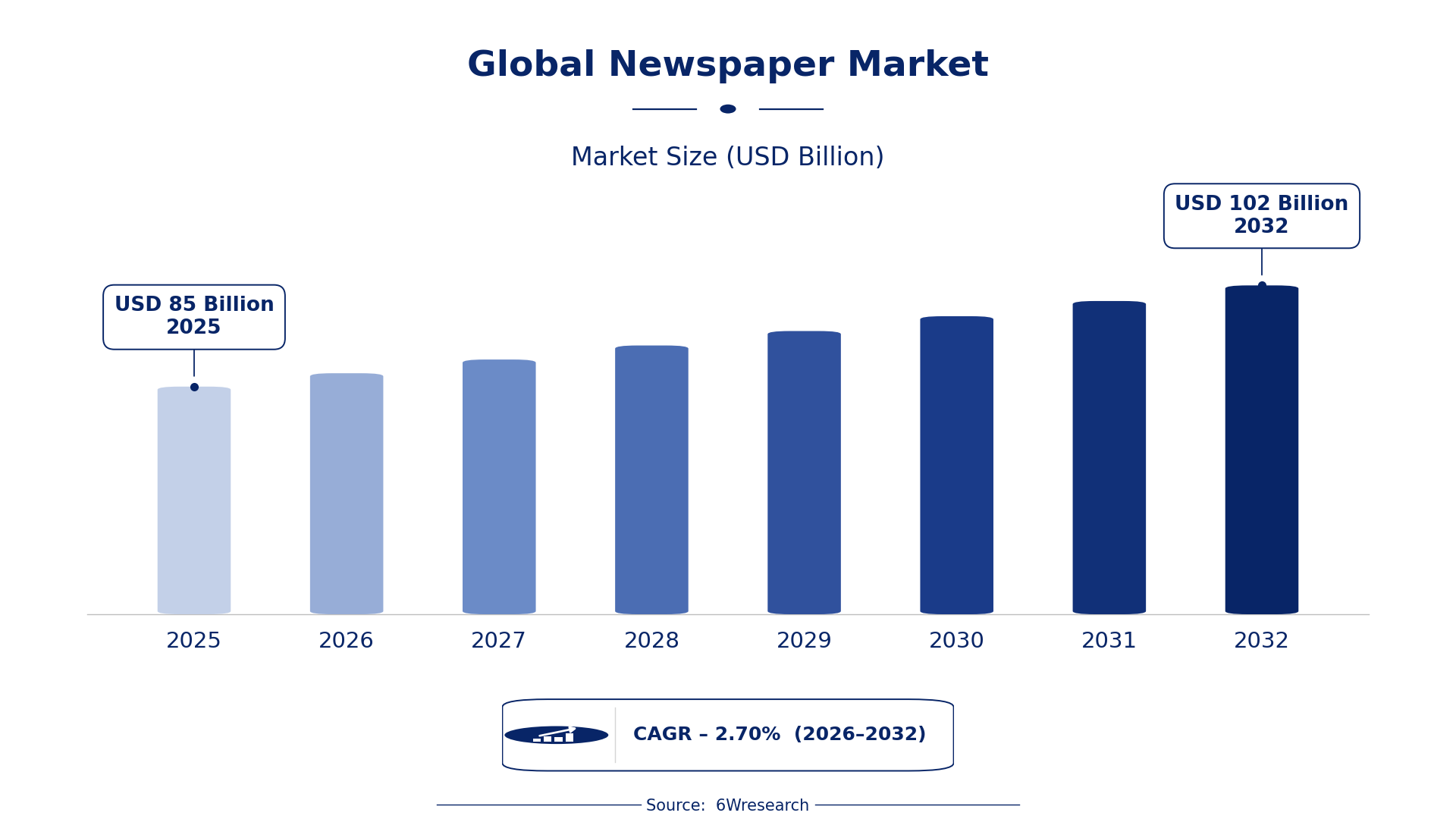
The Global Newspaper Market was estimated at USD 85 Billion in 2025 and is projected to reach USD 102 Billion by 2032, growing at a CAGR of 2.70% from 2026 to 2032.
Global Newspaper Market Synopsis
The Global Newspaper Market is at a pivotal moment as traditional print formats struggle against increasing digital penetration. Digital news consumption continues to transform the landscape, with substantial shifts in how content is delivered and monetized, reflecting profound changes in consumer behavior and preferences.
Key players are pivoting towards innovative digital strategies, often involving diversified revenue models that include subscriptions and advertising through online platforms. The market holds strategic importance due to its central role in public discourse and the dissemination of information essential for informed citizenship.
Global Newspaper Market Year-wise Growth Rate and Key Drivers
This graph illustrates the annual growth rates of the Global Newspaper Market from 2022 to 2032, highlighting a steady upward trajectory and projected expansion over the forecast period.
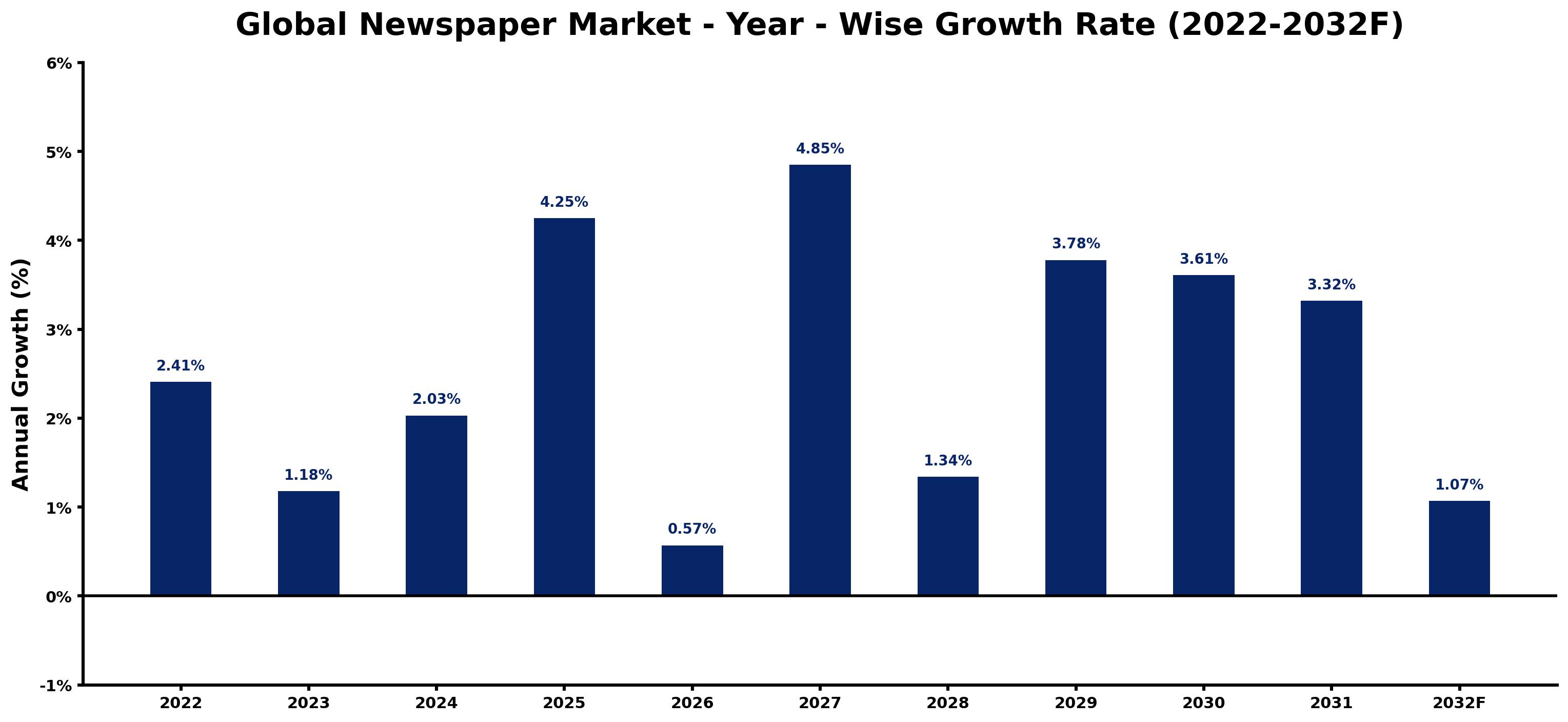
The table below presents the year‑wise growth rates along with the key drivers influencing the market
| Year | Growth Rate (%) | Major Drivers |
| 2022 | 2.41 | A surge in digital subscriptions reflects changing preferences among newspaper audiences. |
| 2023 | 1.18 | Increased access to online platforms drives consumers to engage with newspapers more. |
| 2024 | 2.03 | A shift toward multimedia skills within the workforce improves newspaper content production. |
| 2025 | 4.25 | Expanding eco-friendly printing methods enables newspapers to appeal to sustainability-minded readers. |
| 2026 | 0.57 | Advertisers within local newspapers adapt to new regulations affecting ad-supported revenue models. |
| 2027 | 4.85 | In North America, supply chain efficiencies enhance the timely distribution of newspapers. |
| 2028 | 1.34 | Independent newspapers strengthen their presence in urban areas, capturing regional readership growth. |
| 2029 | 3.78 | While digital streaming services gain traction, traditional newspapers innovate to maintain relevance. |
| 2030 | 3.61 | Major publishers pursue mergers to consolidate their positions in the competitive newspaper sector. |
| 2031 | 3.32 | Rising paper costs challenge newspapers to adjust pricing strategies and optimize budgets. |
| 2032 | 1.07 | Artificial intelligence tools enhance newspaper production, improving efficiency and content quality. |
Note - Market size estimations and growth projections presented in this report are based on 6Wresearch's proprietary research methodology, combining internal industry data, secondary research, and primary validation, updated periodically to reflect current market conditions. As markets evolve rapidly, figures for certain industries may vary slightly and are intended as informed estimates rather than absolute figures. For the most current market sizing, we recommend validating figures with a 6Wresearch analyst.
Global Newspaper Market Key Takeaways
Below are some of the specific key takeaways from the market, including:
- Digital formats are expected to account for approximately 60% of market revenue by 2025.
- The number of paid digital subscriptions has surpassed 40 million in the U.S. as of 2023, showcasing a successful pivot by many publications towards subscription revenue.
- The Asia-Pacific region is projected to have a CAGR of around 4.5% from 2026 to 2032, driven by increasing internet penetration and mobile consumption.
- In 2024, the European Union announced regulations focused on preventing misinformation, which may shape content standards for online news platforms.
- The New York Times Company reported a 21% increase in digital-only subscriptions in Q4 2022, highlighting successful revenue strategies.
Evaluation of Restraints in Global Newspaper Market
A major restraint affecting the Global Newspaper Market is the advertising revenue decline, which dropped by 30% across print publications in 2022, a troubling trend for many traditional publishers reliant on this income stream. Compounding this issue, the shift to digital formats imposes additional costs for content management systems and online infrastructure, often requiring significant upfront investments. For example, many legacy print publishers must allocate budgets exceeding $1 million to integrate new digital platforms effectively, hindering their ability to compete. Furthermore, the rising prevalence of misinformation online poses reputational risks that can further alienate advertisers.
Global Newspaper Market Trends
The Global Newspaper Market is experiencing several transformative trends, reflecting the shift toward digitization and consumer engagement. First, newspapers are increasingly adopting digital subscriptions as a primary revenue model, with companies like News Corp reporting that nearly 50% of their revenue now derives from digital products as of 2023. Second, artificial intelligence and data analytics are being leveraged to personalize reader experiences, with publishers implementing tailored content recommendations that enhance user engagement. For example, The Washington Post’s AI-driven recommendation engine has seen a 30% increase in article views because it curates content based on reader preferences. This multifaceted approach highlights how newspapers are navigating the dual challenge of evolving readership and digital disruption.
Global Newspaper Market Opportunities
Numerous compelling opportunities are emerging within the Global Newspaper Market as organizations adapt their strategies. One promising area is the expanded use of multimedia storytelling, where newspapers pivot towards video and interactive content. This initiative creates avenues for higher ad rates and audience retention. For instance, Gannett Co. plans to invest USD 150 million in multimedia initiatives over the next three years, aiming to enhance viewer engagement. Additionally, partnerships with tech companies for podcasting and affiliate marketing can diversify revenue streams; The New York Times, for example, reported a 25% revenue increase from its podcast division in 2022. These avenues underscore the potential for growth if traditional newspapers adapt to the changing consumption habits of younger audiences.
Global Newspaper Market by Platform
The leading segment of the Global Newspaper Market is Digital, commanding a significant portion of revenue as it accounts for approximately 60% share in 2025. In contrast, Print is the fastest-growing segment, expected to grow at a CAGR of 4.0% from 2026 to 2032 as certain regional markets still maintain a robust demand for physical formats, particularly in developing areas where digital access is limited. The increased investment in niche print publications illustrates this resilience; many publishers focusing on local content continue to attract loyal readership due, in part, to the community connection that print offers.
Global Newspaper Market by Business Model
In terms of business models, Subscription leads with an estimated 55% market share in 2025, indicative of the industry's shift toward setting up paywalls for quality content. However, Advertising is the fastest-growing model, projected to see a CAGR of 4.5% from 2026 to 2032, fueled by increasing digital ad spending as businesses recognize the value of targeted campaigns. The advertising model's growth indicates a strategic pivot among publishers towards diversifying revenue sources, capitalizing on their digital platforms to attract advertisers seeking specific demographics.
Global Newspaper Market by Region
North America is the largest region in the Global Newspaper Market, holding approximately 45% share in 2025, bolstered by a long-standing tradition of print publications and a strong digital subscription base. Simultaneously, Asia is witnessing rapid growth and is projected to achieve a CAGR of 4.5% from 2026 to 2032, driven by the increasing internet penetration and mobile device usage across emerging economies. This acceleration indicates a significant transformation in content consumption habits, particularly among younger demographics who prefer news through digital channels.
Government Initiatives in the Global Newspaper Market
The regulatory environment surrounding the Global Newspaper Market is shaped by a variety of government initiatives aimed at promoting responsible journalism and supporting media diversity. Policymakers are increasingly focused on ensuring that traditional media can compete effectively against digital platforms while also addressing misinformation issues.
- Federal Communications Commission (FCC), Local Journalism Sustainability Act, 2021. This act provides tax incentives and funding opportunities for local newspapers to enhance their sustainability, aiming to preserve the diversity of news sources.
- Department of Justice, Antitrust Guidelines for Collaborations Among Competitors, 2020. This policy outlines frameworks that enable newspapers to collaborate on digital advertising strategies, mitigating competition while securing revenue.
- European Commission, Digital Services Act, Proposed in 2020. This forthcoming regulation seeks to establish a safer digital space, impacting how newspapers operate online and ensuring compliance with standards against misinformation.
- United Nations Educational, Scientific and Cultural Organization (UNESCO), Global Media and Information Literacy Week, Annually. This initiative promotes media literacy and informs citizens about responsible news consumption, benefitting newspaper reach and credibility.
Future Insights of the Global Newspaper Market
The Global Newspaper Market is expected to undergo significant structural changes as traditional business models evolve to meet digital demands. By leveraging advancements in artificial intelligence, key players like News Corp are enhancing reader engagement through personalized content. As consumer preferences shift towards multimedia formats, an invested focus on video content is anticipated to bolster advertising revenues further. Additionally, digital subscription models will likely mature, with the percentage of revenue from these streams approaching or surpassing 60% by 2032.
Global Newspaper Market Latest Developments
Recent strategic moves by industry leaders highlight their efforts to adapt to new consumer behaviors and technological advancements.
- In early 2023, The New York Times Company launched an interactive storytelling platform, aiming to enhance reader engagement and leverage multimedia content.
- As of late 2022, Gannett Co. Inc. began partnerships with local businesses to create exclusive content, emphasizing community ties and boosting regional subscriber numbers.
- In mid-2023, Fairfax Media introduced a loyalty program for subscribers that rewards engagement with personalized content, enhancing user retention.
- By late 2022, Washington Post expanded its investment in artificial intelligence, resulting in a 30% increase in personalized content consumption among readers.
Global Newspaper Market Key Players and Industry Positioning
The Global Newspaper Market is characterized by a mix of consolidated and fragmented structures, with several large companies commanding a significant share while many regional players maintain local relevance. The competitive landscape is shaped by a blend of legacy firms transitioning into digital-first strategies and new entrants focusing on niche audiences.
| Leading Company | Core Strength | Strategic Focus |
|---|---|---|
| The New York Times Company | High-quality journalism and strong digital platform | Innovative digital subscription models, multimedia engagement |
| News Corp | Extensive global reach across media platforms | Diversification into digital and regional markets |
| Gannett Co., Inc. | Strong local media footprint | Community-focused strategies and content partnerships |
| Washington Post | Innovative use of technology for content delivery | AI-driven personalized content and digital growth |
| Fairfax Media | Robust regional connections and advertising base | Focus on digital transformation and local engagement |
As the industry adapts to the realities of digital consumption, these key players are strategically positioned to capitalize on emerging opportunities while navigating the challenges that lie ahead.
Key Attractiveness of the Report
- 10 Years of Market Numbers
- Historical Data Starting from 2022 to 2025
- Base Year: 2025
- Forecast Data until 2032
- Key Performance Indicators Impacting the Market
- Major Upcoming Developments and Projects
Key Highlights of the Report:
- Global Newspaper Market Outlook
- Market Size of Global Newspaper Market, 2025
- Forecast of Global Newspaper Market, 2032
- Historical Data and Forecast of Global Newspaper Revenues & Volume for the Period 2022-2032
- Global Newspaper Market Trend Evolution
- Global Newspaper Market Drivers and Challenges
- Global Newspaper Price Trends
- Global Newspaper Porter's Five Forces
- Global Newspaper Industry Life Cycle
- Historical Data and Forecast of Global Newspaper Market Revenues & Volume
- Historical Data and Forecast of Global Newspaper Market Revenues & Volume By Platform for the Period 2022-2032
- Historical Data and Forecast of Global Newspaper Market Revenues & Volume By Print for the Period 2022-2032
- Historical Data and Forecast of Global Newspaper Market Revenues & Volume By Digital for the Period 2022-2032
- Historical Data and Forecast of Global Newspaper Market Revenues & Volume By Business Model for the Period 2022-2032
- Historical Data and Forecast of Global Newspaper Market Revenues & Volume By Subscription for the Period 2022-2032
- Historical Data and Forecast of Global Newspaper Market Revenues & Volume By Advertising for the Period 2022-2032
- Historical Data and Forecast of North America Newspaper Market Revenues & Volume By Platform for the Period 2022-2032
- Historical Data and Forecast of North America Newspaper Market Revenues & Volume By Print for the Period 2022-2032
- Historical Data and Forecast of North America Newspaper Market Revenues & Volume By Digital for the Period 2022-2032
- Historical Data and Forecast of North America Newspaper Market Revenues & Volume By Business Model for the Period 2022-2032
- Historical Data and Forecast of North America Newspaper Market Revenues & Volume By Subscription for the Period 2022-2032
- Historical Data and Forecast of North America Newspaper Market Revenues & Volume By Advertising for the Period 2022-2032
- Historical Data and Forecast of United States of America Newspaper Market Revenues & Volume for the Period 2022-2032
- Historical Data and Forecast of Canada Newspaper Market Revenues & Volume for the Period 2022-2032
- Historical Data and Forecast of Rest of North America Newspaper Market Revenues & Volume for the Period 2022-2032
- Historical Data and Forecast of Latin America (LATAM) Newspaper Market Revenues & Volume By Platform for the Period 2022-2032
- Historical Data and Forecast of Latin America (LATAM) Newspaper Market Revenues & Volume By Print for the Period 2022-2032
- Historical Data and Forecast of Latin America (LATAM) Newspaper Market Revenues & Volume By Digital for the Period 2022-2032
- Historical Data and Forecast of Latin America (LATAM) Newspaper Market Revenues & Volume By Business Model for the Period 2022-2032
- Historical Data and Forecast of Latin America (LATAM) Newspaper Market Revenues & Volume By Subscription for the Period 2022-2032
- Historical Data and Forecast of Latin America (LATAM) Newspaper Market Revenues & Volume By Advertising for the Period 2022-2032
- Historical Data and Forecast of Brazil Newspaper Market Revenues & Volume for the Period 2022-2032
- Historical Data and Forecast of Mexico Newspaper Market Revenues & Volume for the Period 2022-2032
- Historical Data and Forecast of Argentina Newspaper Market Revenues & Volume for the Period 2022-2032
- Historical Data and Forecast of Rest of LATAM Newspaper Market Revenues & Volume for the Period 2022-2032
- Historical Data and Forecast of Asia Newspaper Market Revenues & Volume By Platform for the Period 2022-2032
- Historical Data and Forecast of Asia Newspaper Market Revenues & Volume By Print for the Period 2022-2032
- Historical Data and Forecast of Asia Newspaper Market Revenues & Volume By Digital for the Period 2022-2032
- Historical Data and Forecast of Asia Newspaper Market Revenues & Volume By Business Model for the Period 2022-2032
- Historical Data and Forecast of Asia Newspaper Market Revenues & Volume By Subscription for the Period 2022-2032
- Historical Data and Forecast of Asia Newspaper Market Revenues & Volume By Advertising for the Period 2022-2032
- Historical Data and Forecast of China Newspaper Market Revenues & Volume for the Period 2022-2032
- Historical Data and Forecast of India Newspaper Market Revenues & Volume for the Period 2022-2032
- Historical Data and Forecast of Japan Newspaper Market Revenues & Volume for the Period 2022-2032
- Historical Data and Forecast of Rest of Asia Newspaper Market Revenues & Volume for the Period 2022-2032
- Historical Data and Forecast of Africa Newspaper Market Revenues & Volume By Platform for the Period 2022-2032
- Historical Data and Forecast of Africa Newspaper Market Revenues & Volume By Print for the Period 2022-2032
- Historical Data and Forecast of Africa Newspaper Market Revenues & Volume By Digital for the Period 2022-2032
- Historical Data and Forecast of Africa Newspaper Market Revenues & Volume By Business Model for the Period 2022-2032
- Historical Data and Forecast of Africa Newspaper Market Revenues & Volume By Subscription for the Period 2022-2032
- Historical Data and Forecast of Africa Newspaper Market Revenues & Volume By Advertising for the Period 2022-2032
- Historical Data and Forecast of South Africa Newspaper Market Revenues & Volume for the Period 2022-2032
- Historical Data and Forecast of Nigeria Newspaper Market Revenues & Volume for the Period 2022-2032
- Historical Data and Forecast of Egypt Newspaper Market Revenues & Volume for the Period 2022-2032
- Historical Data and Forecast of Rest of Africa Newspaper Market Revenues & Volume for the Period 2022-2032
- Historical Data and Forecast of Europe Newspaper Market Revenues & Volume By Platform for the Period 2022-2032
- Historical Data and Forecast of Europe Newspaper Market Revenues & Volume By Print for the Period 2022-2032
- Historical Data and Forecast of Europe Newspaper Market Revenues & Volume By Digital for the Period 2022-2032
- Historical Data and Forecast of Europe Newspaper Market Revenues & Volume By Business Model for the Period 2022-2032
- Historical Data and Forecast of Europe Newspaper Market Revenues & Volume By Subscription for the Period 2022-2032
- Historical Data and Forecast of Europe Newspaper Market Revenues & Volume By Advertising for the Period 2022-2032
- Historical Data and Forecast of United Kingdom Newspaper Market Revenues & Volume for the Period 2022-2032
- Historical Data and Forecast of France Newspaper Market Revenues & Volume for the Period 2022-2032
- Historical Data and Forecast of Germany Newspaper Market Revenues & Volume for the Period 2022-2032
- Historical Data and Forecast of Rest of Europe Newspaper Market Revenues & Volume for the Period 2022-2032
- Historical Data and Forecast of Middle East Newspaper Market Revenues & Volume By Platform for the Period 2022-2032
- Historical Data and Forecast of Middle East Newspaper Market Revenues & Volume By Print for the Period 2022-2032
- Historical Data and Forecast of Middle East Newspaper Market Revenues & Volume By Digital for the Period 2022-2032
- Historical Data and Forecast of Middle East Newspaper Market Revenues & Volume By Business Model for the Period 2022-2032
- Historical Data and Forecast of Middle East Newspaper Market Revenues & Volume By Subscription for the Period 2022-2032
- Historical Data and Forecast of Middle East Newspaper Market Revenues & Volume By Advertising for the Period 2022-2032
- Historical Data and Forecast of Saudi Arabia Newspaper Market Revenues & Volume for the Period 2022-2032
- Historical Data and Forecast of UAE Newspaper Market Revenues & Volume for the Period 2022-2032
- Historical Data and Forecast of Turkey Newspaper Market Revenues & Volume for the Period 2022-2032
- Historical Data and Forecast of Rest of Middle East Newspaper Market Revenues & Volume for the Period 2022-2032
- Global Newspaper Market - Key Performance Indicators
- Global Newspaper Market - Import Export Trade Statistics
- Global Newspaper Market - Opportunity Assessment By Countries
- Global Newspaper Market - Opportunity Assessment By Platform
- Global Newspaper Market - Opportunity Assessment By Business Model
- Global Newspaper Market - Top Companies Market Share
- Global Newspaper Market - Top Companies Profiles
- Global Newspaper Market - Comparison of Players in Technical and Operating Parameters
- Global Newspaper Market - Strategic Recommendations
Markets Covered
The Global Newspaper Market report provides a detailed analysis of the following market segments:
By Regions and Countries:
- North America
- Europe
- LATAM
- Middle East
- Asia
- Africa
By Platform:
- Digital
By Business Model:
- Subscription
- Advertising






































