Global Packaged water Market Highlights
| Market Size (2025) | USD 390 Billion |
| Forecast Size (2032) | USD 545 Billion |
| CAGR | 11.10% |
| Base Year | 2025 |
| Forecast Period | 2026-2032 |
| Largest Region | North America |
| Fastest Growing Region | Asia |
| Largest Segment | Still Water |
| Fastest Growing Segment | Functional Water |
| Leading Companies | Coca-Cola, Nestlé, PepsiCo, Danone, Fiji Water |
Global Packaged water Market Size & Growth Rate (2026-2032)
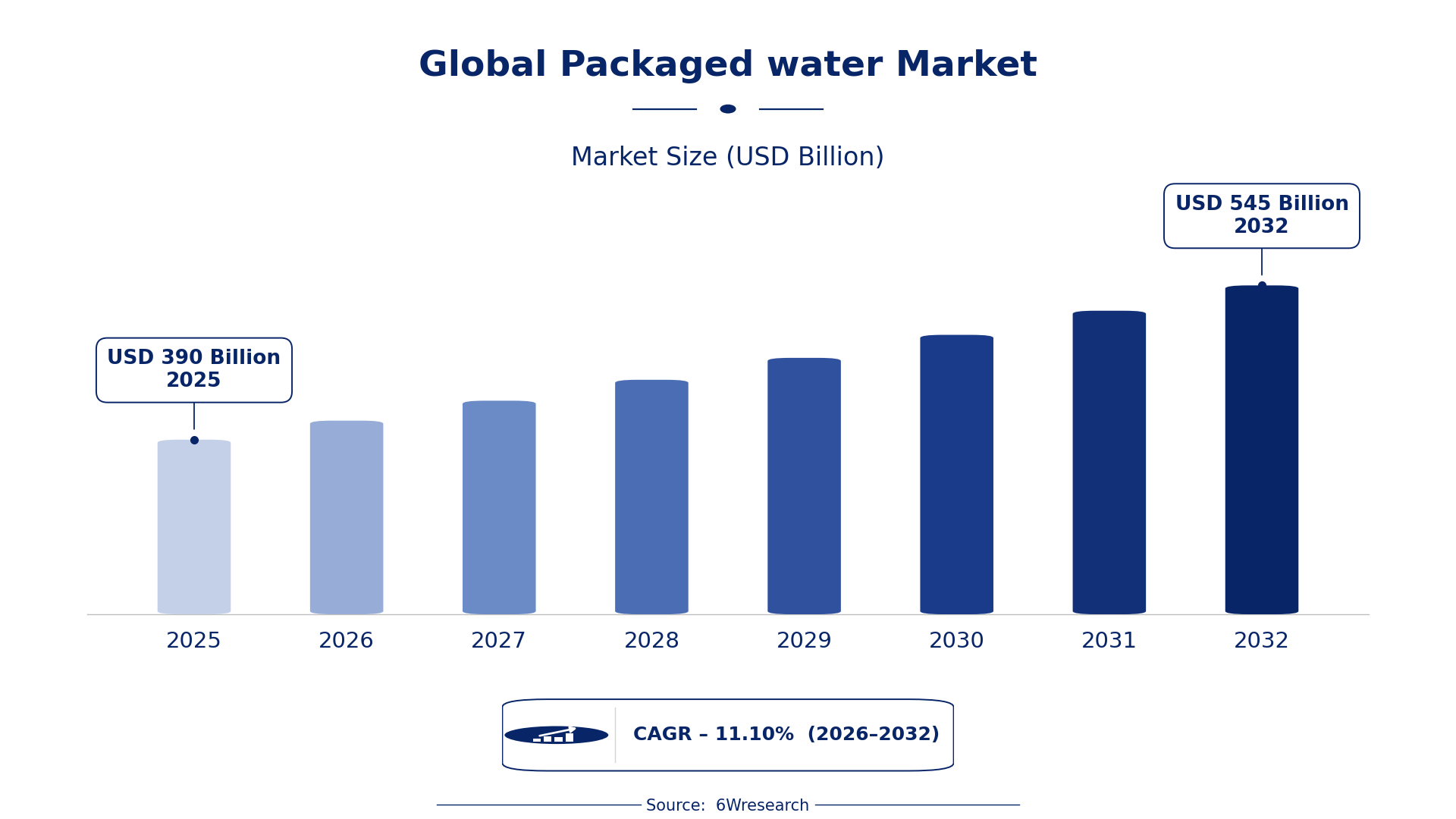
The Global Packaged water Market was estimated at USD 390 Billion in 2025 and is projected to reach USD 545 Billion by 2032, growing at a CAGR of 11.10% from 2026 to 2032.
Global Packaged water Market Synopsis
The Global Packaged water Market is evolving, largely influenced by changing consumer preferences towards healthier hydration options and sustainability concerns. This transformation is underscoring the need for companies to innovate their offerings and packaging solutions, ultimately leading to heightened competition among established and emerging brands.
As urban populations increase and lifestyles shift, the demand for convenient packaged water is escalating. Major trends include the rising popularity of functional water products, which cater to health-conscious consumers seeking added benefits. This sector's dynamics illustrate a uniquely differentiated market landscape, distinct from traditional beverage categories.
Global Packaged water Market Year-wise Growth Rate and Key Drivers
This graph illustrates the annual growth rates of the Global Packaged water Market from 2022 to 2032, highlighting a steady upward trajectory and projected expansion over the forecast period.
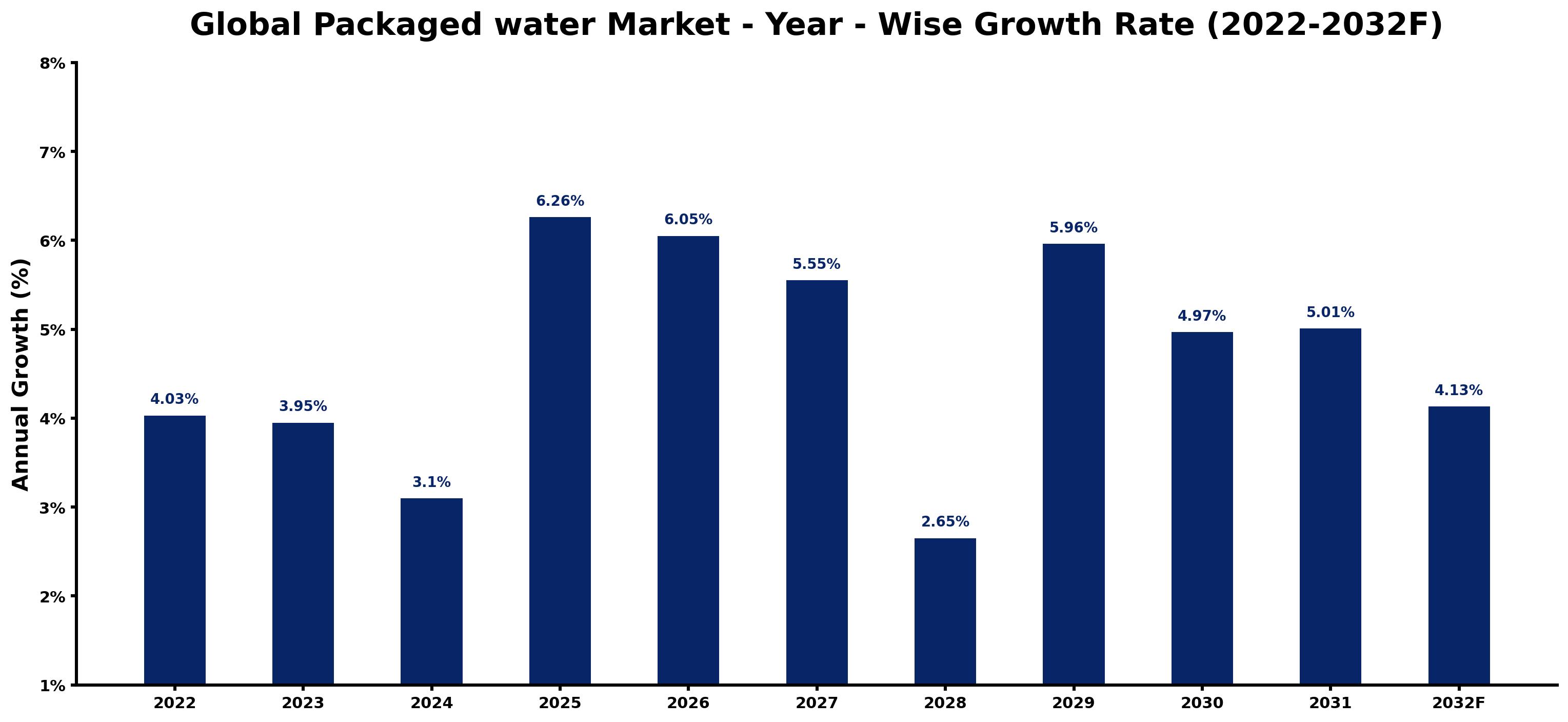
The table below presents the year‑wise growth rates along with the key drivers influencing the market
| Year | Growth Rate (%) | Major Drivers |
| 2022 | 4.03 | Technological advancements in packaging solutions enhance consumer engagement with packaged water. |
| 2023 | 3.95 | As talent retention strategies improve, skilled labor supports packaged water production efficiency. |
| 2024 | 3.1 | A shift toward strategic M&A activities transforms competitive positioning in packaged water brands. |
| 2025 | 6.26 | Consumers increasingly prioritize premium bottled water options as health-conscious choices expand. |
| 2026 | 6.05 | In urban regions, the e-commerce channel shift drives packaged water sales growth significantly. |
| 2027 | 5.55 | Manufacturers prioritize sustainable practices to align with rising consumer interest in eco-friendly packaged water. |
| 2028 | 2.65 | Rising input costs for materials challenge pricing strategies within the packaged water sector. |
| 2029 | 5.96 | The growth of private-label packaged water options intensifies competition among established brands. |
| 2030 | 4.97 | Advanced logistics and distribution technologies streamline the supply chain for packaged water retailers. |
| 2031 | 5.01 | Regulatory updates concerning bottled water labeling prompt adjustments across packaging and marketing strategies. |
| 2032 | 4.13 | Expanding international markets enables wider availability of diverse packaged water brands and options. |
Note - Market size estimations and growth projections presented in this report are based on 6Wresearch's proprietary research methodology, combining internal industry data, secondary research, and primary validation, updated periodically to reflect current market conditions. As markets evolve rapidly, figures for certain industries may vary slightly and are intended as informed estimates rather than absolute figures. For the most current market sizing, we recommend validating figures with a 6Wresearch analyst.
Global Packaged water Market Key Takeaways
Below are some of the specific key takeaways from the market, including:
- In 2025, the North American region is anticipated to command an approximate 40% share of the total market.
- Functional water is on track to grow at a remarkable CAGR of 15% from 2026 to 2032, indicating a robust consumer shift towards enhanced health benefits.
- Coca-Cola launched its Smartwater brand aimed at a health-conscious demographic in 2023, reflecting strategic positioning in the functional segment.
- The e-commerce channel for bottled water sales is expected to see a CAGR of 20% during the forecast period, highlighting changing distribution preferences.
- In 2025, flavored water is estimated to hold a market share of nearly 10%, indicating a niche yet growing consumer class.
Evaluation of Restraints in Global Packaged water Market
The Global Packaged water Market faces significant challenges, notably from environmental regulations aimed at reducing plastic waste. For instance, the European Union's directive mandates that single-use plastic bottles be reduced by 50% by 2025. Compliance with such stringent policies can drive up operational costs for manufacturers who may need to invest in more sustainable packaging alternatives. These regulatory hurdles create an uneven playing field, with smaller players lacking the resources to adapt, thereby constraining market growth potential.
Global Packaged water Market Trends
Consumers are gravitating towards plant-based bottled water variants, a direct response to preferences for natural and sustainable products. Companies like Nestlé are integrating plant-based materials into their packaging solutions, improving their ecological footprint. Furthermore, integrations of technology such as smart labeling allow consumers to trace the source and purity of their water, enhancing transparency in the market. For example, by 2024, approximately 30% of bottled water brands are expected to adopt such technology, reshaping consumer expectations around product accountability.
Global Packaged water Market Opportunities
Opportunities in the Global Packaged water Market are expanding, particularly in health-focused product lines. Brands are beginning to capitalize on the functional water trend, which integrates vitamins and minerals into their offerings. For instance, PepsiCo's launch of 'LIFEWTR' aims to rejuvenate not just thirst but also well-being, capturing the attention of health-conscious consumers. Moreover, the demand for eco-conscious packaging alternatives is increasing, prompting a shift towards biodegradable materials. The adoption of such innovations can create a market entry point worth an estimated $10 billion by 2032, aimed at eco-friendly consumers.
Global Packaged water Market by Product
In the Global Packaged water Market, Still Water stands as the largest segment, commanding a market share of approximately 55% in 2025. Meanwhile, Functional Water is expected to witness the fastest growth, achieving a CAGR of 15% from 2026 to 2032. This segment's appeal can be attributed to consumers' increasing preference for added health benefits, positioning functional water as a preferred alternative to traditional hydration options.
Global Packaged water Market by Region
North America dominates the Global Packaged water Market with a significant share of around 40% in 2025, driven by strong consumer demand and established distribution networks. However, Asia is emerging as the fastest-growing region, projected to grow at a CAGR of 14% from 2026 to 2032, influenced by urbanization and a growing middle class seeking convenient hydration solutions. This growth is underscored by increasing retail developments and evolving consumer preferences in countries like India and China.
Government Initiatives in the Global Packaged water Market
The regulatory environment surrounding the Global Packaged water Market is increasingly shaped by governmental initiatives aimed at promoting sustainability and ensuring consumer safety. Various countries are implementing policies to support eco-friendly practices within the industry, fostering a more competitive landscape. These initiatives not only respond to environmental concerns but also aim at optimizing the consumer experience.
- U.S. Environmental Protection Agency, "National Strategy to Reduce Single-Use Plastics," 2021: This initiative aims to minimize plastic usage, directly impacting bottled water manufacturers.
- European Commission, "Circular Economy Action Plan," March 2020: Focuses on reducing plastic waste and fostering recycling, providing guidelines for manufacturers to innovate in packaging.
- Ministry of Environment, Japan, "Plastic Waste Reduction Strategy," launched in 2023: Encourages companies to invest in sustainable packaging, supported by government grants.
- Indian Government, "Swachh Bharat Mission," ongoing since 2014: A sanitation initiative promoting the use of safe and packaged drinking water, benefitting bottled water brands.
- Water Resources Ministry, Brazil, "National Water Security Plan," 2022: A framework aimed at ensuring clean water availability, which incentivizes investments in packaged water.
Future Insights of the Global Packaged water Market
The Global Packaged water Market is expected to undergo significant shifts by 2032, driven by advancements in sustainable packaging technology. Innovations such as plant-based plastics and refillable systems will likely become mainstream, reflecting growing consumer demands for eco-friendly alternatives. Companies like Nestlé are already exploring biodegradable materials, positioning themselves for competitive advantage as regulatory frameworks become more stringent. The focus on health-oriented products will push brands to integrate functional ingredients further, aligning their offerings with consumer wellness trends.
Global Packaged water Market Latest Developments
Recent activities in the Global Packaged water Market illustrate a dynamic environment of innovation and adaptive strategies among leading players. The following developments are noteworthy:
- Coca-Cola launched a new flavor variant of Smartwater aimed at the health-conscious segment in early 2023, targeting an increase in market share within the functional water category.
- PepsiCo is expanding its LIFEWTR brand distribution through e-commerce channels, with plans set for increased presence by late 2023, enhancing accessibility in urban markets.
- Danone announced a strategic partnership with a biotechnology firm in mid-2023 to develop sustainable packaging solutions, optimizing its product lifecycle by 2025.
- Fiji Water is rolling out a new recycling initiative in 2024, encouraging customers to return used bottles, thereby reinforcing its sustainability efforts.
Global Packaged water Market Key Players and Industry Positioning
The competitive structure of the Global Packaged water Market is fragmented, with both large multinationals and niche players vying for market share. Major companies dominate through established brand loyalty and extensive distribution networks, while smaller entrants carve out specialized segments such as flavored or functional waters.
| Leading Company | Core Strength | Strategic Focus |
|---|---|---|
| Coca-Cola | Extensive distribution network | Diversifying with functional water brands |
| Nestlé | Strong brand recognition | Investing in sustainable packaging |
| PepsiCo | Robust product portfolio | Enhancing e-commerce presence |
| Danone | Focus on health-oriented products | Collaborations for sustainability |
| Fiji Water | Premium product positioning | Emphasizing eco-friendly initiatives |
A diverse range of strategies among these companies indicates a complex landscape where innovation, sustainability, and consumer engagement will play critical roles in determining future market leaders.
Key Attractiveness of the Report
- 10 Years of Market Numbers
- Historical Data Starting from 2022 to 2025
- Base Year: 2025
- Forecast Data until 2032
- Key Performance Indicators Impacting the Market
- Major Upcoming Developments and Projects
Key Highlights of the Report:
- Global Packaged water Market Outlook
- Market Size of Global Packaged water Market, 2025
- Forecast of Global Packaged water Market, 2032
- Historical Data and Forecast of Global Packaged water Revenues & Volume for the Period 2022-2032
- Global Packaged water Market Trend Evolution
- Global Packaged water Market Drivers and Challenges
- Global Packaged water Price Trends
- Global Packaged water Porter's Five Forces
- Global Packaged water Industry Life Cycle
- Historical Data and Forecast of Global Packaged water Market Revenues & Volume
- Historical Data and Forecast of Global Packaged water Market Revenues & Volume By Product for the Period 2022-2032
- Historical Data and Forecast of Global Packaged water Market Revenues & Volume By Still for the Period 2022-2032
- Historical Data and Forecast of Global Packaged water Market Revenues & Volume By Carbonated for the Period 2022-2032
- Historical Data and Forecast of Global Packaged water Market Revenues & Volume By Flavored for the Period 2022-2032
- Historical Data and Forecast of Global Packaged water Market Revenues & Volume By Functional for the Period 2022-2032
- Historical Data and Forecast of North America Packaged water Market Revenues & Volume By Product for the Period 2022-2032
- Historical Data and Forecast of North America Packaged water Market Revenues & Volume By Still for the Period 2022-2032
- Historical Data and Forecast of North America Packaged water Market Revenues & Volume By Carbonated for the Period 2022-2032
- Historical Data and Forecast of North America Packaged water Market Revenues & Volume By Flavored for the Period 2022-2032
- Historical Data and Forecast of North America Packaged water Market Revenues & Volume By Functional for the Period 2022-2032
- Historical Data and Forecast of United States of America Packaged water Market Revenues & Volume for the Period 2022-2032
- Historical Data and Forecast of Canada Packaged water Market Revenues & Volume for the Period 2022-2032
- Historical Data and Forecast of Rest of North America Packaged water Market Revenues & Volume for the Period 2022-2032
- Historical Data and Forecast of Latin America (LATAM) Packaged water Market Revenues & Volume By Product for the Period 2022-2032
- Historical Data and Forecast of Latin America (LATAM) Packaged water Market Revenues & Volume By Still for the Period 2022-2032
- Historical Data and Forecast of Latin America (LATAM) Packaged water Market Revenues & Volume By Carbonated for the Period 2022-2032
- Historical Data and Forecast of Latin America (LATAM) Packaged water Market Revenues & Volume By Flavored for the Period 2022-2032
- Historical Data and Forecast of Latin America (LATAM) Packaged water Market Revenues & Volume By Functional for the Period 2022-2032
- Historical Data and Forecast of Brazil Packaged water Market Revenues & Volume for the Period 2022-2032
- Historical Data and Forecast of Mexico Packaged water Market Revenues & Volume for the Period 2022-2032
- Historical Data and Forecast of Argentina Packaged water Market Revenues & Volume for the Period 2022-2032
- Historical Data and Forecast of Rest of LATAM Packaged water Market Revenues & Volume for the Period 2022-2032
- Historical Data and Forecast of Asia Packaged water Market Revenues & Volume By Product for the Period 2022-2032
- Historical Data and Forecast of Asia Packaged water Market Revenues & Volume By Still for the Period 2022-2032
- Historical Data and Forecast of Asia Packaged water Market Revenues & Volume By Carbonated for the Period 2022-2032
- Historical Data and Forecast of Asia Packaged water Market Revenues & Volume By Flavored for the Period 2022-2032
- Historical Data and Forecast of Asia Packaged water Market Revenues & Volume By Functional for the Period 2022-2032
- Historical Data and Forecast of China Packaged water Market Revenues & Volume for the Period 2022-2032
- Historical Data and Forecast of India Packaged water Market Revenues & Volume for the Period 2022-2032
- Historical Data and Forecast of Japan Packaged water Market Revenues & Volume for the Period 2022-2032
- Historical Data and Forecast of Rest of Asia Packaged water Market Revenues & Volume for the Period 2022-2032
- Historical Data and Forecast of Africa Packaged water Market Revenues & Volume By Product for the Period 2022-2032
- Historical Data and Forecast of Africa Packaged water Market Revenues & Volume By Still for the Period 2022-2032
- Historical Data and Forecast of Africa Packaged water Market Revenues & Volume By Carbonated for the Period 2022-2032
- Historical Data and Forecast of Africa Packaged water Market Revenues & Volume By Flavored for the Period 2022-2032
- Historical Data and Forecast of Africa Packaged water Market Revenues & Volume By Functional for the Period 2022-2032
- Historical Data and Forecast of South Africa Packaged water Market Revenues & Volume for the Period 2022-2032
- Historical Data and Forecast of Nigeria Packaged water Market Revenues & Volume for the Period 2022-2032
- Historical Data and Forecast of Egypt Packaged water Market Revenues & Volume for the Period 2022-2032
- Historical Data and Forecast of Rest of Africa Packaged water Market Revenues & Volume for the Period 2022-2032
- Historical Data and Forecast of Europe Packaged water Market Revenues & Volume By Product for the Period 2022-2032
- Historical Data and Forecast of Europe Packaged water Market Revenues & Volume By Still for the Period 2022-2032
- Historical Data and Forecast of Europe Packaged water Market Revenues & Volume By Carbonated for the Period 2022-2032
- Historical Data and Forecast of Europe Packaged water Market Revenues & Volume By Flavored for the Period 2022-2032
- Historical Data and Forecast of Europe Packaged water Market Revenues & Volume By Functional for the Period 2022-2032
- Historical Data and Forecast of United Kingdom Packaged water Market Revenues & Volume for the Period 2022-2032
- Historical Data and Forecast of France Packaged water Market Revenues & Volume for the Period 2022-2032
- Historical Data and Forecast of Germany Packaged water Market Revenues & Volume for the Period 2022-2032
- Historical Data and Forecast of Rest of Europe Packaged water Market Revenues & Volume for the Period 2022-2032
- Historical Data and Forecast of Middle East Packaged water Market Revenues & Volume By Product for the Period 2022-2032
- Historical Data and Forecast of Middle East Packaged water Market Revenues & Volume By Still for the Period 2022-2032
- Historical Data and Forecast of Middle East Packaged water Market Revenues & Volume By Carbonated for the Period 2022-2032
- Historical Data and Forecast of Middle East Packaged water Market Revenues & Volume By Flavored for the Period 2022-2032
- Historical Data and Forecast of Middle East Packaged water Market Revenues & Volume By Functional for the Period 2022-2032
- Historical Data and Forecast of Saudi Arabia Packaged water Market Revenues & Volume for the Period 2022-2032
- Historical Data and Forecast of UAE Packaged water Market Revenues & Volume for the Period 2022-2032
- Historical Data and Forecast of Turkey Packaged water Market Revenues & Volume for the Period 2022-2032
- Historical Data and Forecast of Rest of Middle East Packaged water Market Revenues & Volume for the Period 2022-2032
- Global Packaged water Market - Key Performance Indicators
- Global Packaged water Market - Import Export Trade Statistics
- Global Packaged water Market - Opportunity Assessment By Countries
- Global Packaged water Market - Opportunity Assessment By Product
- 0
- Global Packaged water Market - Top Companies Market Share
- Global Packaged water Market - Top Companies Profiles
- Global Packaged water Market - Comparison of Players in Technical and Operating Parameters
- Global Packaged water Market - Strategic Recommendations
Markets Covered
The Global Packaged water Market report provides a detailed analysis of the following market segments:
By Regions and Countries:
- North America
- Europe
- LATAM
- Middle East
- Asia
- Africa
By Product:
- Still
- Carbonated
- Flavored
- Functional






































