Global Perfume Market Highlights
| Market Size (2025) | USD 56.3 Billion |
| Forecast Size (2032) | USD 87.5 Billion |
| CAGR | 6.50% |
| Base Year | 2025 |
| Forecast Period | 2026-2032 |
| Largest Region | Asia-Pacific |
| Fastest Growing Region | Latin America |
| Largest Segment | Premium Perfume Products |
| Fastest Growing Segment | Mass Perfume Products |
| Leading Companies | L'Oreal, Estée Lauder, Coty, Procter & Gamble, Avon |
Global Perfume Market Size & Growth Rate (2026-2032)
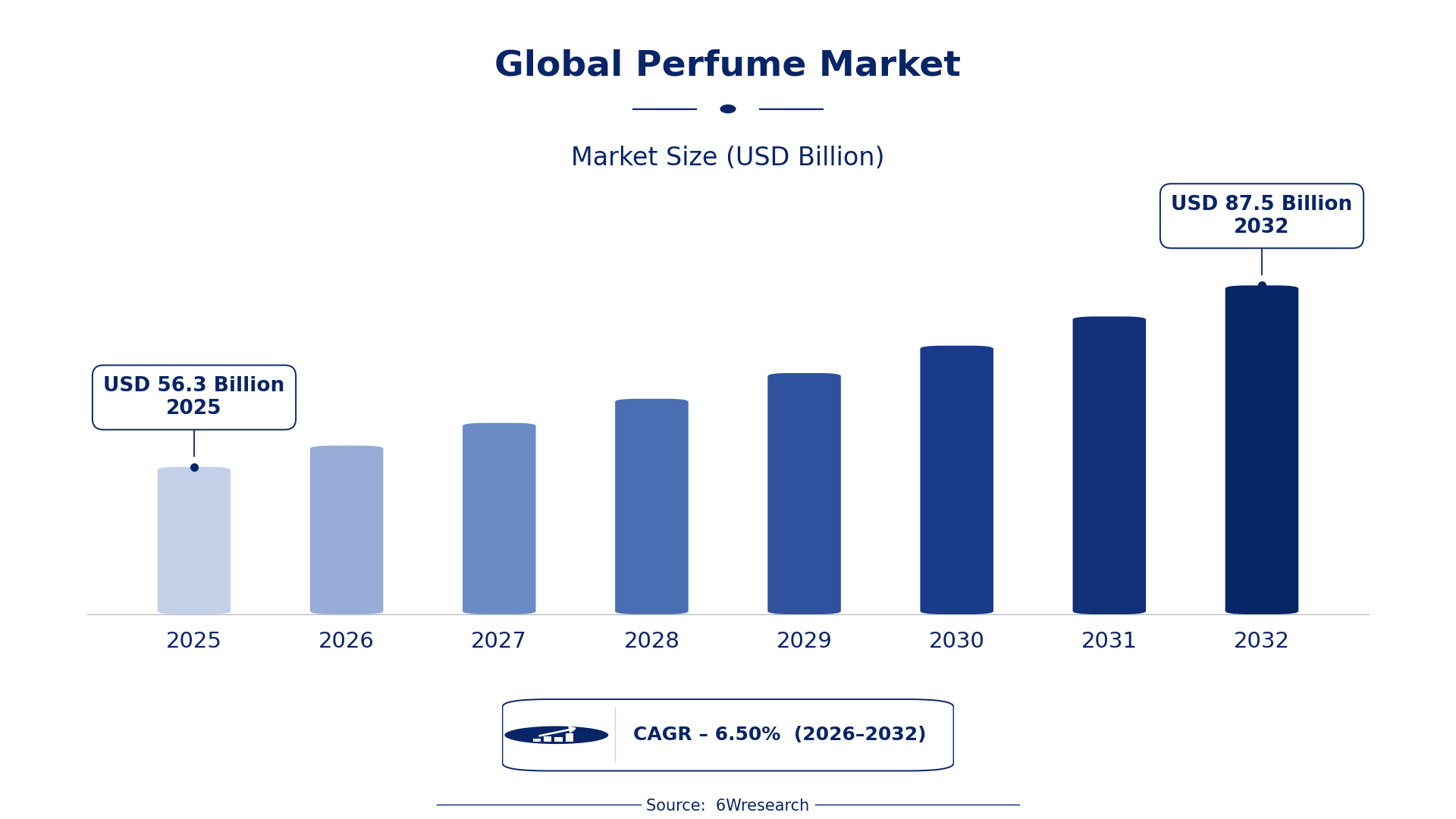
The Global Perfume Market was estimated at USD 56.3 Billion in 2025 and is projected to reach USD 87.5 Billion by 2032, growing at a CAGR of 6.50% from 2026 to 2032.
Global Perfume Market Synopsis
The current trajectory of the Global Perfume Market underscores a thrilling evolution, characterized by a mounting preference for both luxury and niche fragrances. Consumers are increasingly seeking unique olfactory experiences, driving brands to innovate their offerings significantly. This shift is not merely aesthetic; it represents deeper cultural changes, as fragrances become a means for personal expression and storytelling.
Market dynamics are also being shaped by new retail strategies, especially online platforms that enhance accessibility and broaden consumer reach. The demographic shifts, particularly among millennials and Gen Z, are prompting brands to revise marketing approaches and product formulations. Understanding these factors will be crucial for players aiming to capitalize on the evolving landscape.
Global Perfume Market Year-wise Growth Rate and Key Drivers
This graph illustrates the annual growth rates of the Global Perfume Market from 2022 to 2032, highlighting a steady upward trajectory and projected expansion over the forecast period.
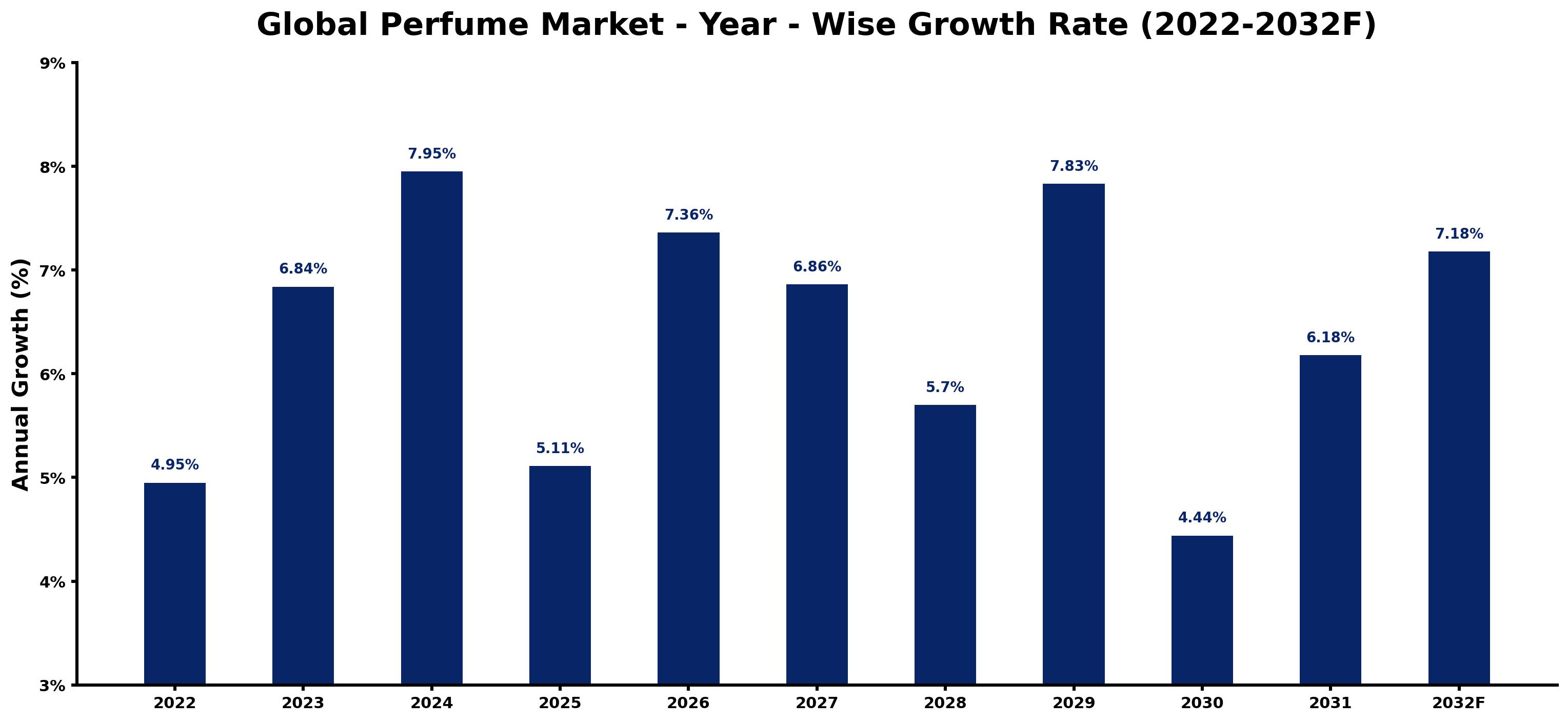
The table below presents the year‑wise growth rates along with the key drivers influencing the market
| Year | Growth Rate (%) | Major Drivers |
| 2022 | 4.95 | Consumers are increasingly focusing on fragrance personalizations that enhance their identity. |
| 2023 | 6.84 | As brands expand their presence in emerging markets, awareness of perfume varieties grows. |
| 2024 | 7.95 | Sustainable packaging solutions are increasingly becoming a priority for environmentally conscious consumers. |
| 2025 | 5.11 | In the premium segment, competitive differentiation among perfume brands intensifies significantly. |
| 2026 | 7.36 | Supply chain disruptions prompt brands to source raw materials locally for perfume production. |
| 2027 | 6.86 | A shift toward more expensive natural ingredients impacts the pricing strategies of perfumes. |
| 2028 | 5.7 | Private-label brands are increasingly investing in perfume lines to capture market share effectively. |
| 2029 | 7.83 | Manufacturers are adopting advanced fragrance formulation technologies to meet evolving consumer preferences. |
| 2030 | 4.44 | Regulating fragrance ingredients promotes transparency and fosters consumer trust in perfume brands. |
| 2031 | 6.18 | E-commerce platforms are enhancing the accessibility of perfume selections to tech-savvy shoppers. |
| 2032 | 7.18 | Innovative clean-label formulations are redefining consumer expectations in the global perfume market. |
Note - Market size estimations and growth projections presented in this report are based on 6Wresearch's proprietary research methodology, combining internal industry data, secondary research, and primary validation, updated periodically to reflect current market conditions. As markets evolve rapidly, figures for certain industries may vary slightly and are intended as informed estimates rather than absolute figures. For the most current market sizing, we recommend validating figures with a 6Wresearch analyst.
Global Perfume Market Key Takeaways
Below are some of the specific key takeaways from the market, including:
- The Asia-Pacific region represented approximately 38% of the market share in 2025, highlighting its dominance due to rising disposable incomes.
- Coty has made significant strides with its sustainable packaging initiative, aiming for 100% recyclable materials by 2025.
- Mass Perfume Products are projected to grow at a CAGR of 7.2% from 2026 to 2032, fueled by expansive distribution strategies.
- The demand for unisex fragrances is increasingly appealing to younger consumers, leading to a surge in product launches.
Evaluation of Restraints in Global Perfume Market
The Global Perfume Market is currently facing notable restraints including stringent regulatory frameworks concerning ingredient safety and labeling standards, which can increase production costs. For instance, compliance with the European Union’s REACH regulations mandates exhaustive testing of chemicals used in perfumes, often requiring investment exceeding $1 million per product for compliance. Moreover, the prevalence of counterfeiting poses an ongoing threat, as it not only dilutes brand value but potentially exposes consumers to harmful substances, thereby necessitating continuous investment in security and authenticity measures.
Global Perfume Market Trends
The landscape of the Global Perfume Market is undergoing transformations driven by clear operational trends. One such trend is the increasing focus on sustainability; many brands like Estée Lauder are transitioning to environmentally friendly practices, such as sourcing natural ingredients from certified suppliers. By 2025, they aim to have 75% of their fragrance lines derived from known sustainable origins. Another pivotal trend is the rise of digital platforms where brands engage with consumers through social media, allowing personalized connection and real-time feedback. For example, L'Oreal has successfully launched campaigns leveraging TikTok, engaging millions of users and propelling fragrance launches. Additionally, the demand for customization is pronounced; companies are beginning to offer bespoke perfumes, allowing consumers to tailor formulations to individual preferences, thereby enhancing customer loyalty.
Global Perfume Market Opportunities
Emerging markets represent a significant growth opportunity for the Global Perfume Market, particularly in regions like Latin America where income levels are projected to rise by approximately 4.5% annually through 2030. Companies like Avon are capitalizing on this shift by expanding their product lines tailored to local preferences. Furthermore, technological integration through AI is set to reshape consumer interactions; brands are exploring AI-driven scent development processes that personalize recommendations based on users' preferences. For instance, companies are targeting to deploy these technologies by 2026, enhancing retail experiences and potentially boosting sales. Additionally, as consumers increasingly demand products that align with their values, the move towards clean and vegan fragrances opens new avenues for revenue growth.
Global Perfume Market by Perfume Type
In the Global Perfume Market, the Premium Perfume Products segment stands as the largest segment, capturing approximately 55% share in 2025. This dominance is attributed to their established consumer bases and perceived value advantages. Conversely, the Mass Perfume Products segment is expected to be the fastest-growing, with a CAGR of 7.2% from 2026 to 2032, driven by their affordability and widespread availability in retail channels, making them highly accessible for diverse consumer demographics.
Global Perfume Market by Category
Among the categories within the Global Perfume Market, Female Fragrances lead with an estimated share of approximately 60% in 2025. This strong performance is largely due to the established brand loyalty among female consumers. In conjunction, Male Fragrances are predicted to grow at a CAGR of 8.0% from 2026 to 2032, buoyed by increased marketing activities and product diversification aimed at male consumers, thereby addressing previously under-targeted segments in the market.
Global Perfume Market by Region
The Asia-Pacific region is currently the largest in the Global Perfume Market, contributing approximately 38% of the overall market share in 2025. This is largely driven by increasing urbanization, a burgeoning middle class, and rising consumer spending on luxury goods. Meanwhile, Latin America is set to emerge as the fastest-growing region, with an expected CAGR of 7.5% from 2026 to 2032, stimulated by greater affordability and a growing appetite for premium products among younger demographics.
Government Initiatives in the Global Perfume Market
Government regulations and initiatives play a pivotal role in shaping the operational landscape of the Global Perfume Market. From sustainability mandates to consumer protection schemes, these policies directly influence market dynamics, affecting production practices, export capabilities, and overall competitiveness.
- European Commission, REACH Regulation, implemented in 2007 - this regulation ensures the safe registration and authorization of chemical substances in perfumes, impacting formulation practices significantly.
- U.S. Environmental Protection Agency, Volatile Organic Compounds regulation, introduced in 2020 - aimed at reducing emissions from fragrance products, compelling manufacturers to innovate in reducing emissions.
- Government of France, Sustainable Fragrance Initiative, launched in 2021 - encourages brands to adopt eco-friendly sourcing practices, supporting local farmers and reducing overall carbon footprints.
- Indian Ministry of Environment, proposed Fragrance Industry Regulatory Framework, planned for 2024 - aims to standardize quality and sustainability benchmarks specifically for the Indian market, fostering compliance and enhancing global trade relationships.
Future Insights of the Global Perfume Market
As the Global Perfume Market evolves, a shift toward more personalized and sustainable offerings is anticipated. With companies like Estée Lauder aiming for 75% of their fragrance lines to be sustainably sourced by 2025, the focus will increasingly be on eco-friendly ingredients and packaging. Technological advancements such as AI-driven scent personalization are expected to reshape consumer interactions, making it vital for brands to innovate continually and align with shifting consumer values. This trajectory will not only impact product development but also optimize supply chain efficiencies and enhance market competitiveness.
Global Perfume Market Latest Developments
Recent initiatives from leading companies showcase significant strides in sustainability and market engagement strategies.
- Recently completed: Coty launched a new line of vegan fragrances in early 2023, catering to the increasing consumer preference for cruelty-free products and underscoring their sustainability commitment.
- Upcoming: Procter & Gamble is set to introduce an augmented reality (AR) app by late 2023 to enhance the consumer shopping experience, allowing virtual try-ons of fragrances.
- Ongoing: Avon is expanding its distribution channels in Latin America throughout 2023, capitalizing on regional growth opportunities by introducing more affordable mass fragrance products.
- Recently completed: L'Oreal invested in renewable technology in 2023 for its manufacturing plants, aiming to reduce carbon emissions and elevate its sustainability credentials across product lines.
Global Perfume Market Key Players and Industry Positioning
The competitive structure of the Global Perfume Market remains fragmented with a mix of established giants and emerging brands. Leading players like L'Oreal and Estée Lauder leverage brand equity and research to maintain market presence, while newer entrants focus on niche segments. This diverse environment fosters innovation and enables players to cater to varying consumer preferences.
| Leading Company | Core Strength | Strategic Focus |
|---|---|---|
| L'Oreal | Strong brand portfolio and extensive distribution networks | Focus on digital engagement and sustainability |
| Estée Lauder | Continuous innovation in premium fragrances | Emphasis on luxury and personalized experiences |
| Coty | Expertise in mass-market fragrances and celebrity endorsements | Development of sustainable packaging solutions |
| Procter & Gamble | Wide product range with strong marketing strategies | Enhancing consumer technology through digital innovations |
| Avon | Robust direct selling model and strong female customer base | Expanding presence in emerging markets |
With a dynamic competitive landscape, companies must seize opportunities for collaboration and technological integration to thrive in the changing environment of the Global Perfume Market.
Key Attractiveness of the Report
- 10 Years of Market Numbers
- Historical Data Starting from 2022 to 2025
- Base Year: 2025
- Forecast Data until 2032
- Key Performance Indicators Impacting the Market
- Major Upcoming Developments and Projects
Key Highlights of the Report:
- Global Perfume Market Outlook
- Market Size of Global Perfume Market, 2025
- Forecast of Global Perfume Market, 2032
- Historical Data and Forecast of Global Perfume Revenues & Volume for the Period 2022-2032
- Global Perfume Market Trend Evolution
- Global Perfume Market Drivers and Challenges
- Global Perfume Price Trends
- Global Perfume Porter's Five Forces
- Global Perfume Industry Life Cycle
- Historical Data and Forecast of Global Perfume Market Revenues & Volume
- Historical Data and Forecast of Global Perfume Market Revenues & Volume By Perfume Type for the Period 2022-2032
- Historical Data and Forecast of Global Perfume Market Revenues & Volume By Premium Perfume Products for the Period 2022-2032
- Historical Data and Forecast of Global Perfume Market Revenues & Volume By Mass Perfume Products for the Period 2022-2032
- Historical Data and Forecast of Global Perfume Market Revenues & Volume By Category for the Period 2022-2032
- Historical Data and Forecast of Global Perfume Market Revenues & Volume By Female Fragrances for the Period 2022-2032
- Historical Data and Forecast of Global Perfume Market Revenues & Volume By Male Fragrances for the Period 2022-2032
- Historical Data and Forecast of Global Perfume Market Revenues & Volume By Unisex Fragrances for the Period 2022-2032
- Historical Data and Forecast of North America Perfume Market Revenues & Volume By Perfume Type for the Period 2022-2032
- Historical Data and Forecast of North America Perfume Market Revenues & Volume By Premium Perfume Products for the Period 2022-2032
- Historical Data and Forecast of North America Perfume Market Revenues & Volume By Mass Perfume Products for the Period 2022-2032
- Historical Data and Forecast of North America Perfume Market Revenues & Volume By Category for the Period 2022-2032
- Historical Data and Forecast of North America Perfume Market Revenues & Volume By Female Fragrances for the Period 2022-2032
- Historical Data and Forecast of North America Perfume Market Revenues & Volume By Male Fragrances for the Period 2022-2032
- Historical Data and Forecast of North America Perfume Market Revenues & Volume By Unisex Fragrances for the Period 2022-2032
- Historical Data and Forecast of United States of America Perfume Market Revenues & Volume for the Period 2022-2032
- Historical Data and Forecast of Canada Perfume Market Revenues & Volume for the Period 2022-2032
- Historical Data and Forecast of Rest of North America Perfume Market Revenues & Volume for the Period 2022-2032
- Historical Data and Forecast of Latin America (LATAM) Perfume Market Revenues & Volume By Perfume Type for the Period 2022-2032
- Historical Data and Forecast of Latin America (LATAM) Perfume Market Revenues & Volume By Premium Perfume Products for the Period 2022-2032
- Historical Data and Forecast of Latin America (LATAM) Perfume Market Revenues & Volume By Mass Perfume Products for the Period 2022-2032
- Historical Data and Forecast of Latin America (LATAM) Perfume Market Revenues & Volume By Category for the Period 2022-2032
- Historical Data and Forecast of Latin America (LATAM) Perfume Market Revenues & Volume By Female Fragrances for the Period 2022-2032
- Historical Data and Forecast of Latin America (LATAM) Perfume Market Revenues & Volume By Male Fragrances for the Period 2022-2032
- Historical Data and Forecast of Latin America (LATAM) Perfume Market Revenues & Volume By Unisex Fragrances for the Period 2022-2032
- Historical Data and Forecast of Brazil Perfume Market Revenues & Volume for the Period 2022-2032
- Historical Data and Forecast of Mexico Perfume Market Revenues & Volume for the Period 2022-2032
- Historical Data and Forecast of Argentina Perfume Market Revenues & Volume for the Period 2022-2032
- Historical Data and Forecast of Rest of LATAM Perfume Market Revenues & Volume for the Period 2022-2032
- Historical Data and Forecast of Asia Perfume Market Revenues & Volume By Perfume Type for the Period 2022-2032
- Historical Data and Forecast of Asia Perfume Market Revenues & Volume By Premium Perfume Products for the Period 2022-2032
- Historical Data and Forecast of Asia Perfume Market Revenues & Volume By Mass Perfume Products for the Period 2022-2032
- Historical Data and Forecast of Asia Perfume Market Revenues & Volume By Category for the Period 2022-2032
- Historical Data and Forecast of Asia Perfume Market Revenues & Volume By Female Fragrances for the Period 2022-2032
- Historical Data and Forecast of Asia Perfume Market Revenues & Volume By Male Fragrances for the Period 2022-2032
- Historical Data and Forecast of Asia Perfume Market Revenues & Volume By Unisex Fragrances for the Period 2022-2032
- Historical Data and Forecast of China Perfume Market Revenues & Volume for the Period 2022-2032
- Historical Data and Forecast of India Perfume Market Revenues & Volume for the Period 2022-2032
- Historical Data and Forecast of Japan Perfume Market Revenues & Volume for the Period 2022-2032
- Historical Data and Forecast of Rest of Asia Perfume Market Revenues & Volume for the Period 2022-2032
- Historical Data and Forecast of Africa Perfume Market Revenues & Volume By Perfume Type for the Period 2022-2032
- Historical Data and Forecast of Africa Perfume Market Revenues & Volume By Premium Perfume Products for the Period 2022-2032
- Historical Data and Forecast of Africa Perfume Market Revenues & Volume By Mass Perfume Products for the Period 2022-2032
- Historical Data and Forecast of Africa Perfume Market Revenues & Volume By Category for the Period 2022-2032
- Historical Data and Forecast of Africa Perfume Market Revenues & Volume By Female Fragrances for the Period 2022-2032
- Historical Data and Forecast of Africa Perfume Market Revenues & Volume By Male Fragrances for the Period 2022-2032
- Historical Data and Forecast of Africa Perfume Market Revenues & Volume By Unisex Fragrances for the Period 2022-2032
- Historical Data and Forecast of South Africa Perfume Market Revenues & Volume for the Period 2022-2032
- Historical Data and Forecast of Nigeria Perfume Market Revenues & Volume for the Period 2022-2032
- Historical Data and Forecast of Egypt Perfume Market Revenues & Volume for the Period 2022-2032
- Historical Data and Forecast of Rest of Africa Perfume Market Revenues & Volume for the Period 2022-2032
- Historical Data and Forecast of Europe Perfume Market Revenues & Volume By Perfume Type for the Period 2022-2032
- Historical Data and Forecast of Europe Perfume Market Revenues & Volume By Premium Perfume Products for the Period 2022-2032
- Historical Data and Forecast of Europe Perfume Market Revenues & Volume By Mass Perfume Products for the Period 2022-2032
- Historical Data and Forecast of Europe Perfume Market Revenues & Volume By Category for the Period 2022-2032
- Historical Data and Forecast of Europe Perfume Market Revenues & Volume By Female Fragrances for the Period 2022-2032
- Historical Data and Forecast of Europe Perfume Market Revenues & Volume By Male Fragrances for the Period 2022-2032
- Historical Data and Forecast of Europe Perfume Market Revenues & Volume By Unisex Fragrances for the Period 2022-2032
- Historical Data and Forecast of United Kingdom Perfume Market Revenues & Volume for the Period 2022-2032
- Historical Data and Forecast of France Perfume Market Revenues & Volume for the Period 2022-2032
- Historical Data and Forecast of Germany Perfume Market Revenues & Volume for the Period 2022-2032
- Historical Data and Forecast of Rest of Europe Perfume Market Revenues & Volume for the Period 2022-2032
- Historical Data and Forecast of Middle East Perfume Market Revenues & Volume By Perfume Type for the Period 2022-2032
- Historical Data and Forecast of Middle East Perfume Market Revenues & Volume By Premium Perfume Products for the Period 2022-2032
- Historical Data and Forecast of Middle East Perfume Market Revenues & Volume By Mass Perfume Products for the Period 2022-2032
- Historical Data and Forecast of Middle East Perfume Market Revenues & Volume By Category for the Period 2022-2032
- Historical Data and Forecast of Middle East Perfume Market Revenues & Volume By Female Fragrances for the Period 2022-2032
- Historical Data and Forecast of Middle East Perfume Market Revenues & Volume By Male Fragrances for the Period 2022-2032
- Historical Data and Forecast of Middle East Perfume Market Revenues & Volume By Unisex Fragrances for the Period 2022-2032
- Historical Data and Forecast of Saudi Arabia Perfume Market Revenues & Volume for the Period 2022-2032
- Historical Data and Forecast of UAE Perfume Market Revenues & Volume for the Period 2022-2032
- Historical Data and Forecast of Turkey Perfume Market Revenues & Volume for the Period 2022-2032
- Historical Data and Forecast of Rest of Middle East Perfume Market Revenues & Volume for the Period 2022-2032
- Global Perfume Market - Key Performance Indicators
- Global Perfume Market - Import Export Trade Statistics
- Global Perfume Market - Opportunity Assessment By Countries
- Global Perfume Market - Opportunity Assessment By Perfume Type
- Global Perfume Market - Opportunity Assessment By Category
- Global Perfume Market - Top Companies Market Share
- Global Perfume Market - Top Companies Profiles
- Global Perfume Market - Comparison of Players in Technical and Operating Parameters
- Global Perfume Market - Strategic Recommendations
Markets Covered
The Global Perfume Market report provides a detailed analysis of the following market segments:
By Regions and Countries:
- North America
- Europe
- LATAM
- Middle East
- Asia
- Africa
By Perfume Type:
- Premium Perfume Products
- Mass Perfume Products
By Category:
- Female Fragrances
- Male Fragrances
- Unisex Fragrances






































