Global Premium Cosmetics Market Highlights
| Market Size (2025) | USD 100 Billion |
| Forecast Size (2032) | USD 145 Billion |
| CAGR | 5.80% |
| Base Year | 2025 |
| Forecast Period | 2026-2032 |
| Largest Region | North America |
| Fastest Growing Region | Asia |
| Largest Segment | Skincare |
| Fastest Growing Segment | Makeup |
| Leading Companies | L'Oréal, Estée Lauder, Procter & Gamble, Shiseido, Coty |
Global Premium Cosmetics Market Size & Growth Rate (2026-2032)
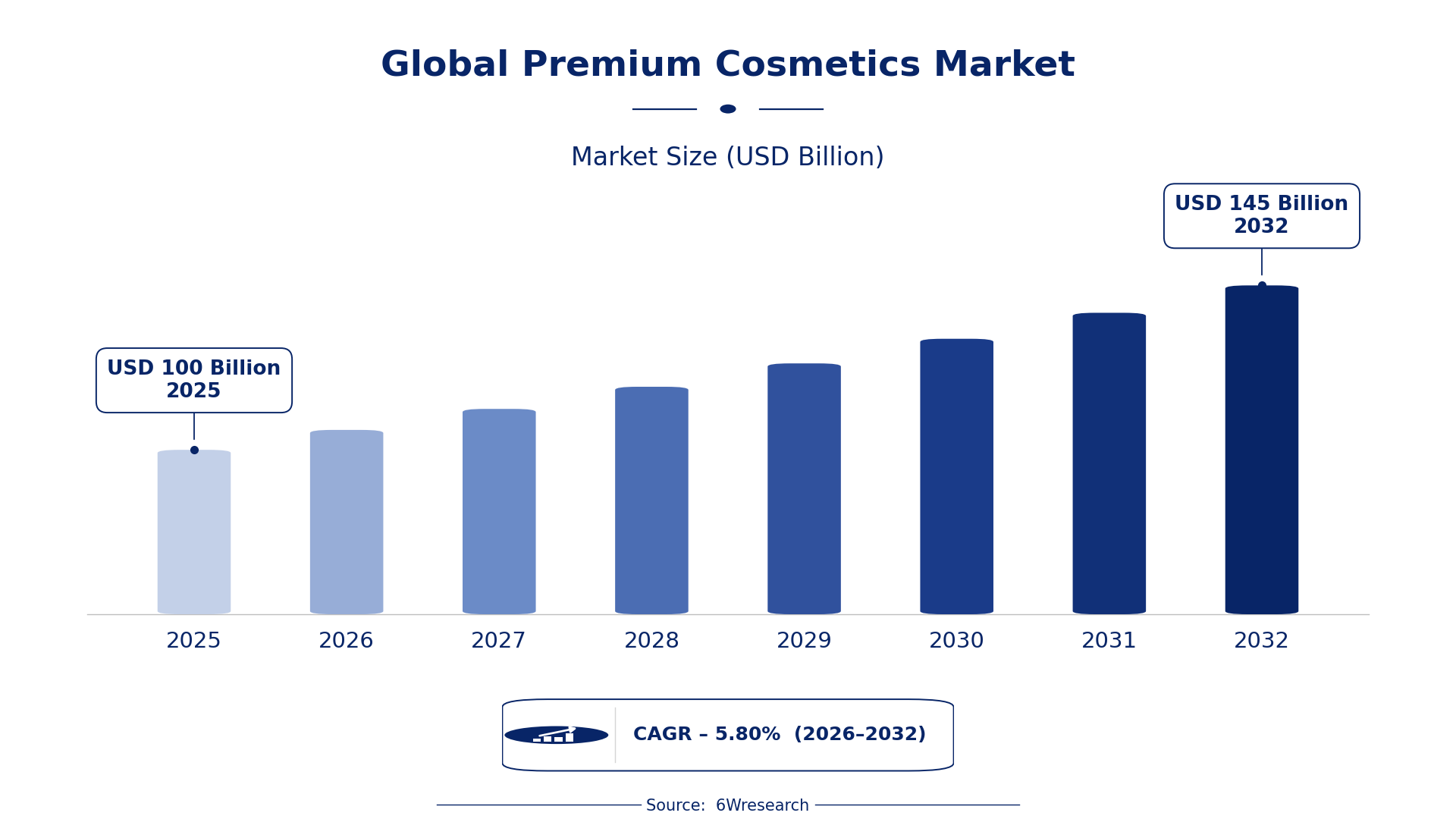
The Global Premium Cosmetics Market was estimated at USD 100 Billion in 2025 and is projected to reach USD 145 Billion by 2032, growing at a CAGR of 5.80% from 2026 to 2032.
Global Premium Cosmetics Market Synopsis
The Global Premium Cosmetics Market is at a pivotal moment, characterized by significant shifts in consumer preferences towards high-quality, luxury beauty products. A strong affinity for brands that emphasize personalization and sustainable practices is reshaping the competitive landscape, compelling companies to invest in innovative solutions. The intersection of technology and beauty is also creating avenues for enhanced customer engagement, aligning products closely with consumer expectations.
A surge in disposable incomes, particularly in emerging markets, is fueling aspirations for premium cosmetics, elevating the category's status beyond mere aesthetics to symbolize a lifestyle. As companies pivot towards natural and eco-friendly ingredients, they are not only catering to the evolving consumer mindset but also setting industry benchmarks. This evolution not only broadens the market appeal but also attracts diverse demographic segments.
Global Premium Cosmetics Market Year-wise Growth Rate and Key Drivers
This graph illustrates the annual growth rates of the Global Premium Cosmetics Market from 2022 to 2032, highlighting a steady upward trajectory and projected expansion over the forecast period.
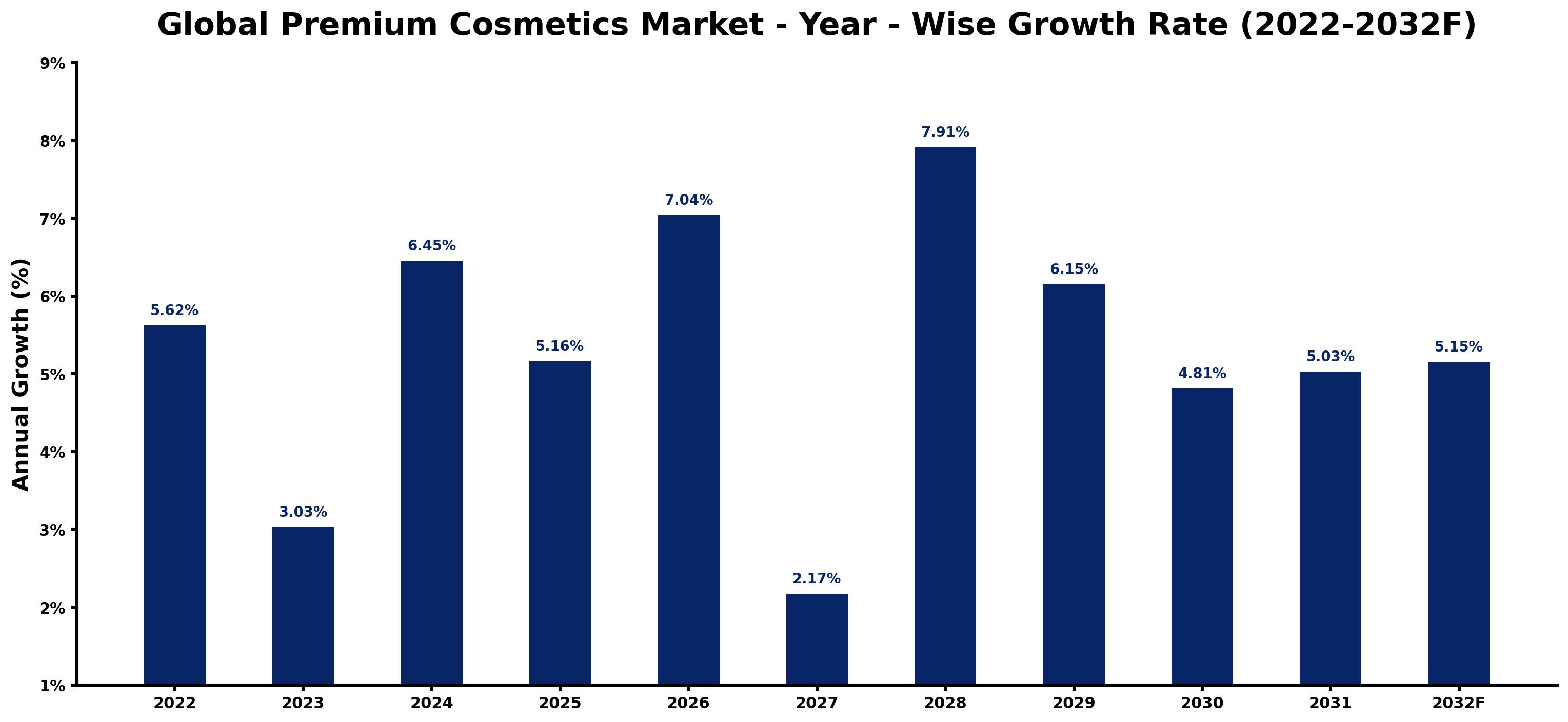
The table below presents the year‑wise growth rates along with the key drivers influencing the market
| Year | Growth Rate (%) | Major Drivers |
| 2022 | 5.62 | Consumers increasingly favor premium cosmetics due to stricter regulatory formulations. |
| 2023 | 3.03 | Innovating clean-label formulations drives interest in premium cosmetics among buyers. |
| 2024 | 6.45 | Manufacturers respond to rising raw material costs by adjusting premium cosmetics pricing. |
| 2025 | 5.16 | Expanding interest in premium cosmetics aligns with changing grooming habits among consumers. |
| 2026 | 7.04 | A shift toward regional expansion enhances accessibility of premium cosmetics globally. |
| 2027 | 2.17 | Sustainable packaging innovations resonate with consumers, increasing premium cosmetics adoption. |
| 2028 | 7.91 | Retail channels increasingly prioritize skilled sales teams to promote premium cosmetics. |
| 2029 | 6.15 | Increased consumer awareness of ingredient quality shapes demand for premium cosmetics. |
| 2030 | 4.81 | Intense competition among brands accelerates market consolidation in premium cosmetics. |
| 2031 | 5.03 | As supply chain improvements streamline logistics, premium cosmetics reach consumers faster. |
| 2032 | 5.15 | In North America, investment in premium cosmetics firms drives market growth to $145 billion. |
Note - Market size estimations and growth projections presented in this report are based on 6Wresearch's proprietary research methodology, combining internal industry data, secondary research, and primary validation, updated periodically to reflect current market conditions. As markets evolve rapidly, figures for certain industries may vary slightly and are intended as informed estimates rather than absolute figures. For the most current market sizing, we recommend validating figures with a 6Wresearch analyst.
Global Premium Cosmetics Market Key Takeaways
Below are some of the specific key takeaways from the market, including:
- Skincare commands the largest share in the premium cosmetics market, accounting for approximately 45% in 2025, reflecting growing consumer awareness around skin health.
- The Asia-Pacific region is expected to see a significant CAGR of 8.5% from 2026 to 2032, driven by increasing purchasing power and urbanization.
- Major players like L'Oréal invested over USD 1 billion in R&D in 2022 to develop sustainable product lines that resonate with eco-conscious consumers.
- Makeup is noted as the fastest-growing segment, with a CAGR of 7.2% from 2026 to 2032, as social media trends drive demand for innovative cosmetic solutions.
- The online distribution channel is witnessing a considerable upswing, with sales projected to increase by 35% over the forecast period.
Evaluation of Restraints in Global Premium Cosmetics Market
The Global Premium Cosmetics Market faces various restraints that could hinder its momentum. Heightened competition from indie brands has intensified market fragmentation, making it difficult for established brands to maintain market dominance. Economic pressure is also a concern; for example, rising raw material costs have increased production expenses by approximately 15%, forcing companies to consider price adjustments that could alienate budget-conscious consumers. Furthermore, regulatory scrutiny surrounding certain ingredients, particularly those deemed harmful or unsustainable, adds an additional layer of complexity to product formulation. Compliance with evolving regulations not only strains R&D resources but also creates obstacles for market entry, particularly for new entrants.
Global Premium Cosmetics Market Trends
Several distinct trends are shaping the Global Premium Cosmetics Market as brands navigate consumer expectations and regulatory landscapes. One notable trend is the rise of clean beauty, exemplified by brands like ILIA Beauty, which has made a name for itself by committing to non-toxic ingredients and transparency. Additionally, personalization is becoming a focal point, with technologies like AI being integrated to offer customized solutions to consumers. For instance, the launch of Sephora's “Color IQ” system allows consumers to find tailored shade recommendations, aligning with their unique skin tones.
The influence of social media cannot be overlooked, as platforms such as TikTok continue to shape consumer interests and trends. Brands are leveraging this trend by investing heavily in influencer partnerships, further amplifying their reach. The estimated investment in influencer marketing in beauty alone is projected to exceed USD 1 billion in 2023, underscoring its critical role in product promotion and brand loyalty. Lastly, sustainability initiatives have taken center stage, prompting brands to innovate packaging material, with companies like Estée Lauder committing to 100% recyclable packaging by 2025.
Global Premium Cosmetics Market Opportunities
As the Global Premium Cosmetics Market evolves, several lucrative opportunities are emerging. One major area is the expansion into the Asian market, particularly in countries like India and China, where rising middle-class consumers are increasingly inclined to spend on luxury beauty products. Companies such as Shiseido are already tailoring product lines to meet regional preferences and tastes, anticipating a market entry that can reach USD 5 billion by 2030.
The integration of advanced technologies also presents significant revenue opportunities, particularly in the realm of augmented reality (AR). For example, L'Oréal has begun implementing AR try-on solutions in their apps, reshaping how consumers interact with products prior to purchase, which can enhance customer satisfaction and reduce return rates. Furthermore, as the market shifts towards e-commerce, brands that effectively optimize their online presence are well-positioned to capture additional value, particularly through improved digital marketing strategies, driving projected growth of 15% in this distribution channel by 2032.
Global Premium Cosmetics Market by Product
Within the Global Premium Cosmetics Market, the Skincare segment commands the largest share, accounting for approximately 45% in 2025. This leading position is attributed to an increasing consumer focus on dermatological benefits and anti-aging solutions. In contrast, Makeup is identified as the fastest-growing segment, with an expected CAGR of 7.2% from 2026 to 2032. This growth is propelled by trends in social media and the rising popularity of bold cosmetic applications, as consumers seek products that allow for self-expression and creativity.
Global Premium Cosmetics Market by Distribution Channel
The distribution landscape of the Global Premium Cosmetics Market reveals that Online channels are leading, holding a market share of approximately 35% in 2025. This preference is driven by the convenience and expanded product access that online retail offers. Meanwhile, Offline channels remain significant but are projected to experience a CAGR of just 3.5% from 2026 to 2032 as traditional retail struggles against the growing dominance of e-commerce. The increasing integration of virtual shopping experiences suggests a transformative shift in consumer purchasing behaviors, reinforcing the trend towards digital transactions.
Global Premium Cosmetics Market by Region
North America currently stands as the largest region in the Global Premium Cosmetics Market, accounting for about 40% in 2025. This dominance is driven by a well-developed distribution network and high consumer spending on premium beauty products. Asia, however, is projected to be the fastest-growing region, with an estimated CAGR of 8.5% from 2026 to 2032. This rapid growth can be attributed to factors such as increasing urbanization, evolving beauty standards, and a surge in disposable income, particularly among the millennial demographic, who are driving demand for premium beauty solutions.
Government Initiatives in the Global Premium Cosmetics Market
The regulatory landscape for the Global Premium Cosmetics Market is evolving to address safety, sustainability, and ethical practices. Policies aimed at enhancing product standards and promoting eco-friendly practices are increasingly emphasized, reflecting both consumer demand and environmental considerations.
- European Commission, Regulation (EC) No 1223/2009, effective from July 2013, mandates comprehensive safety assessments for cosmetic products, ensuring consumer safety across the EU.
- U.S. Food and Drug Administration (FDA), Cosmetic Labeling Guide, updated in 2021, enforces clearer labeling practices aimed at preventing misleading information, benefiting consumers and established brands alike.
- Government of India, Draft Cosmetics Bill, 2021, proposes more stringent regulations regarding the safety and efficacy of cosmetic products, expected to be implemented by 2023.
- Ministry of Health and Family Welfare, India, launched the National Action Plan for Chemical Safety in 2022, promoting guidelines for the safe use of chemical ingredients in cosmetics, which will impact formulation practices significantly.
Future Insights of the Global Premium Cosmetics Market
The Global Premium Cosmetics Market is expected to undergo substantial transformations by 2032, driven by advancements in technology and shifting consumer preferences. Companies like L'Oréal are investing heavily in artificial intelligence to refine product personalization, creating tailored experiences that resonate deeply with consumers. Emerging trends in clean beauty and sustainability will prompt brands to innovate their ingredient sourcing and packaging solutions, often leading to partnerships with green tech companies. Furthermore, the rise of omnichannel retailing will create an integrated shopping experience, altering traditional distribution strategies significantly.
Global Premium Cosmetics Market Latest Developments
Recent activities among leading firms underscore their commitment to adapting to market demands and consumer expectations. The following developments highlight significant strides companies are making:
- Recently completed, Procter & Gamble launched a new eco-friendly skincare line that utilizes fully recyclable packaging, aligning with global sustainability trends.
- In early 2023, Estée Lauder began expanding its presence in Asia by opening new distribution centers, enhancing its logistics capabilities in response to market growth.
- Upcoming in Q2 2024, Shiseido plans to introduce a virtual reality makeup experience in flagship stores, reshaping customer engagement through immersive technology.
- Ongoing, Coty is collaborating with tech firms to refine its AI-based color matching software, aiming to personalize makeup product suggestions for users.
Global Premium Cosmetics Market Key Players and Industry Positioning
The competitive landscape of the Global Premium Cosmetics Market is fragmented yet characterized by several dominant players that maintain significant market shares. These companies are leveraging unique strategies to differentiate themselves through product innovation, regional focus, and technological advancements, influencing overall market dynamics.
| Leading Company | Core Strength | Strategic Focus |
|---|---|---|
| L'Oréal | Strong R&D capabilities driven by sustainability initiatives | Expanding product lines focused on eco-friendly ingredients |
| Estée Lauder | Robust brand portfolio with diverse market appeal | Investing in Asia-Pacific for regional growth |
| Procter & Gamble | Extensive distribution network and logistical prowess | Strengthening e-commerce presence to meet consumer demands |
| Shiseido | Expertise in traditional Japanese beauty concepts | Innovating with tech integration in consumer experiences |
| Coty | Strong influencer partnerships for brand amplification | Focusing on digital marketing and e-commerce amplifications |
These companies are strategically positioning themselves to capitalize on evolving consumer preferences, emphasizing a blend of technological integration and sustainable practices.
Key Attractiveness of the Report
- 10 Years of Market Numbers
- Historical Data Starting from 2022 to 2025
- Base Year: 2025
- Forecast Data until 2032
- Key Performance Indicators Impacting the Market
- Major Upcoming Developments and Projects
Key Highlights of the Report:
- Global Premium Cosmetics Market Outlook
- Market Size of Global Premium Cosmetics Market, 2025
- Forecast of Global Premium Cosmetics Market, 2032
- Historical Data and Forecast of Global Premium Cosmetics Revenues & Volume for the Period 2022-2032
- Global Premium Cosmetics Market Trend Evolution
- Global Premium Cosmetics Market Drivers and Challenges
- Global Premium Cosmetics Price Trends
- Global Premium Cosmetics Porter's Five Forces
- Global Premium Cosmetics Industry Life Cycle
- Historical Data and Forecast of Global Premium Cosmetics Market Revenues & Volume
- Historical Data and Forecast of Global Premium Cosmetics Market Revenues & Volume By Product for the Period 2022-2032
- Historical Data and Forecast of Global Premium Cosmetics Market Revenues & Volume By Skincare for the Period 2022-2032
- Historical Data and Forecast of Global Premium Cosmetics Market Revenues & Volume By Haircare for the Period 2022-2032
- Historical Data and Forecast of Global Premium Cosmetics Market Revenues & Volume By Makeup for the Period 2022-2032
- Historical Data and Forecast of Global Premium Cosmetics Market Revenues & Volume By Fragrance for the Period 2022-2032
- Historical Data and Forecast of Global Premium Cosmetics Market Revenues & Volume By Distribution Channel for the Period 2022-2032
- Historical Data and Forecast of Global Premium Cosmetics Market Revenues & Volume By Online for the Period 2022-2032
- Historical Data and Forecast of Global Premium Cosmetics Market Revenues & Volume By Offline for the Period 2022-2032
- Historical Data and Forecast of North America Premium Cosmetics Market Revenues & Volume By Product for the Period 2022-2032
- Historical Data and Forecast of North America Premium Cosmetics Market Revenues & Volume By Skincare for the Period 2022-2032
- Historical Data and Forecast of North America Premium Cosmetics Market Revenues & Volume By Haircare for the Period 2022-2032
- Historical Data and Forecast of North America Premium Cosmetics Market Revenues & Volume By Makeup for the Period 2022-2032
- Historical Data and Forecast of North America Premium Cosmetics Market Revenues & Volume By Fragrance for the Period 2022-2032
- Historical Data and Forecast of North America Premium Cosmetics Market Revenues & Volume By Distribution Channel for the Period 2022-2032
- Historical Data and Forecast of North America Premium Cosmetics Market Revenues & Volume By Online for the Period 2022-2032
- Historical Data and Forecast of North America Premium Cosmetics Market Revenues & Volume By Offline for the Period 2022-2032
- Historical Data and Forecast of United States of America Premium Cosmetics Market Revenues & Volume for the Period 2022-2032
- Historical Data and Forecast of Canada Premium Cosmetics Market Revenues & Volume for the Period 2022-2032
- Historical Data and Forecast of Rest of North America Premium Cosmetics Market Revenues & Volume for the Period 2022-2032
- Historical Data and Forecast of Latin America (LATAM) Premium Cosmetics Market Revenues & Volume By Product for the Period 2022-2032
- Historical Data and Forecast of Latin America (LATAM) Premium Cosmetics Market Revenues & Volume By Skincare for the Period 2022-2032
- Historical Data and Forecast of Latin America (LATAM) Premium Cosmetics Market Revenues & Volume By Haircare for the Period 2022-2032
- Historical Data and Forecast of Latin America (LATAM) Premium Cosmetics Market Revenues & Volume By Makeup for the Period 2022-2032
- Historical Data and Forecast of Latin America (LATAM) Premium Cosmetics Market Revenues & Volume By Fragrance for the Period 2022-2032
- Historical Data and Forecast of Latin America (LATAM) Premium Cosmetics Market Revenues & Volume By Distribution Channel for the Period 2022-2032
- Historical Data and Forecast of Latin America (LATAM) Premium Cosmetics Market Revenues & Volume By Online for the Period 2022-2032
- Historical Data and Forecast of Latin America (LATAM) Premium Cosmetics Market Revenues & Volume By Offline for the Period 2022-2032
- Historical Data and Forecast of Brazil Premium Cosmetics Market Revenues & Volume for the Period 2022-2032
- Historical Data and Forecast of Mexico Premium Cosmetics Market Revenues & Volume for the Period 2022-2032
- Historical Data and Forecast of Argentina Premium Cosmetics Market Revenues & Volume for the Period 2022-2032
- Historical Data and Forecast of Rest of LATAM Premium Cosmetics Market Revenues & Volume for the Period 2022-2032
- Historical Data and Forecast of Asia Premium Cosmetics Market Revenues & Volume By Product for the Period 2022-2032
- Historical Data and Forecast of Asia Premium Cosmetics Market Revenues & Volume By Skincare for the Period 2022-2032
- Historical Data and Forecast of Asia Premium Cosmetics Market Revenues & Volume By Haircare for the Period 2022-2032
- Historical Data and Forecast of Asia Premium Cosmetics Market Revenues & Volume By Makeup for the Period 2022-2032
- Historical Data and Forecast of Asia Premium Cosmetics Market Revenues & Volume By Fragrance for the Period 2022-2032
- Historical Data and Forecast of Asia Premium Cosmetics Market Revenues & Volume By Distribution Channel for the Period 2022-2032
- Historical Data and Forecast of Asia Premium Cosmetics Market Revenues & Volume By Online for the Period 2022-2032
- Historical Data and Forecast of Asia Premium Cosmetics Market Revenues & Volume By Offline for the Period 2022-2032
- Historical Data and Forecast of China Premium Cosmetics Market Revenues & Volume for the Period 2022-2032
- Historical Data and Forecast of India Premium Cosmetics Market Revenues & Volume for the Period 2022-2032
- Historical Data and Forecast of Japan Premium Cosmetics Market Revenues & Volume for the Period 2022-2032
- Historical Data and Forecast of Rest of Asia Premium Cosmetics Market Revenues & Volume for the Period 2022-2032
- Historical Data and Forecast of Africa Premium Cosmetics Market Revenues & Volume By Product for the Period 2022-2032
- Historical Data and Forecast of Africa Premium Cosmetics Market Revenues & Volume By Skincare for the Period 2022-2032
- Historical Data and Forecast of Africa Premium Cosmetics Market Revenues & Volume By Haircare for the Period 2022-2032
- Historical Data and Forecast of Africa Premium Cosmetics Market Revenues & Volume By Makeup for the Period 2022-2032
- Historical Data and Forecast of Africa Premium Cosmetics Market Revenues & Volume By Fragrance for the Period 2022-2032
- Historical Data and Forecast of Africa Premium Cosmetics Market Revenues & Volume By Distribution Channel for the Period 2022-2032
- Historical Data and Forecast of Africa Premium Cosmetics Market Revenues & Volume By Online for the Period 2022-2032
- Historical Data and Forecast of Africa Premium Cosmetics Market Revenues & Volume By Offline for the Period 2022-2032
- Historical Data and Forecast of South Africa Premium Cosmetics Market Revenues & Volume for the Period 2022-2032
- Historical Data and Forecast of Nigeria Premium Cosmetics Market Revenues & Volume for the Period 2022-2032
- Historical Data and Forecast of Egypt Premium Cosmetics Market Revenues & Volume for the Period 2022-2032
- Historical Data and Forecast of Rest of Africa Premium Cosmetics Market Revenues & Volume for the Period 2022-2032
- Historical Data and Forecast of Europe Premium Cosmetics Market Revenues & Volume By Product for the Period 2022-2032
- Historical Data and Forecast of Europe Premium Cosmetics Market Revenues & Volume By Skincare for the Period 2022-2032
- Historical Data and Forecast of Europe Premium Cosmetics Market Revenues & Volume By Haircare for the Period 2022-2032
- Historical Data and Forecast of Europe Premium Cosmetics Market Revenues & Volume By Makeup for the Period 2022-2032
- Historical Data and Forecast of Europe Premium Cosmetics Market Revenues & Volume By Fragrance for the Period 2022-2032
- Historical Data and Forecast of Europe Premium Cosmetics Market Revenues & Volume By Distribution Channel for the Period 2022-2032
- Historical Data and Forecast of Europe Premium Cosmetics Market Revenues & Volume By Online for the Period 2022-2032
- Historical Data and Forecast of Europe Premium Cosmetics Market Revenues & Volume By Offline for the Period 2022-2032
- Historical Data and Forecast of United Kingdom Premium Cosmetics Market Revenues & Volume for the Period 2022-2032
- Historical Data and Forecast of France Premium Cosmetics Market Revenues & Volume for the Period 2022-2032
- Historical Data and Forecast of Germany Premium Cosmetics Market Revenues & Volume for the Period 2022-2032
- Historical Data and Forecast of Rest of Europe Premium Cosmetics Market Revenues & Volume for the Period 2022-2032
- Historical Data and Forecast of Middle East Premium Cosmetics Market Revenues & Volume By Product for the Period 2022-2032
- Historical Data and Forecast of Middle East Premium Cosmetics Market Revenues & Volume By Skincare for the Period 2022-2032
- Historical Data and Forecast of Middle East Premium Cosmetics Market Revenues & Volume By Haircare for the Period 2022-2032
- Historical Data and Forecast of Middle East Premium Cosmetics Market Revenues & Volume By Makeup for the Period 2022-2032
- Historical Data and Forecast of Middle East Premium Cosmetics Market Revenues & Volume By Fragrance for the Period 2022-2032
- Historical Data and Forecast of Middle East Premium Cosmetics Market Revenues & Volume By Distribution Channel for the Period 2022-2032
- Historical Data and Forecast of Middle East Premium Cosmetics Market Revenues & Volume By Online for the Period 2022-2032
- Historical Data and Forecast of Middle East Premium Cosmetics Market Revenues & Volume By Offline for the Period 2022-2032
- Historical Data and Forecast of Saudi Arabia Premium Cosmetics Market Revenues & Volume for the Period 2022-2032
- Historical Data and Forecast of UAE Premium Cosmetics Market Revenues & Volume for the Period 2022-2032
- Historical Data and Forecast of Turkey Premium Cosmetics Market Revenues & Volume for the Period 2022-2032
- Historical Data and Forecast of Rest of Middle East Premium Cosmetics Market Revenues & Volume for the Period 2022-2032
- Global Premium Cosmetics Market - Key Performance Indicators
- Global Premium Cosmetics Market - Import Export Trade Statistics
- Global Premium Cosmetics Market - Opportunity Assessment By Countries
- Global Premium Cosmetics Market - Opportunity Assessment By Product
- Global Premium Cosmetics Market - Opportunity Assessment By Distribution Channel
- Global Premium Cosmetics Market - Top Companies Market Share
- Global Premium Cosmetics Market - Top Companies Profiles
- Global Premium Cosmetics Market - Comparison of Players in Technical and Operating Parameters
- Global Premium Cosmetics Market - Strategic Recommendations
Markets Covered
The Global Premium Cosmetics Market report provides a detailed analysis of the following market segments:
By Regions and Countries:
- North America
- Europe
- LATAM
- Middle East
- Asia
- Africa
By Product:
- Skincare
- Haircare
- Makeup
- Fragrance
By Distribution Channel:
- Online
- Offline






































