Global Protein Market Highlights
| Market Size (2025) | USD 78 Billion |
| Forecast Size (2032) | USD 112 Billion |
| CAGR | 8.20% |
| Base Year | 2025 |
| Forecast Period | 2026-2032 |
| Largest Region | North America |
| Fastest Growing Region | Asia |
| Largest Segment | Animal-based Proteins |
| Fastest Growing Segment | Plant-based Proteins |
| Leading Companies | Nestlé, Cargill, DuPont, Unilever, Tyson Foods |
Global Protein Market Size & Growth Rate (2026-2032)
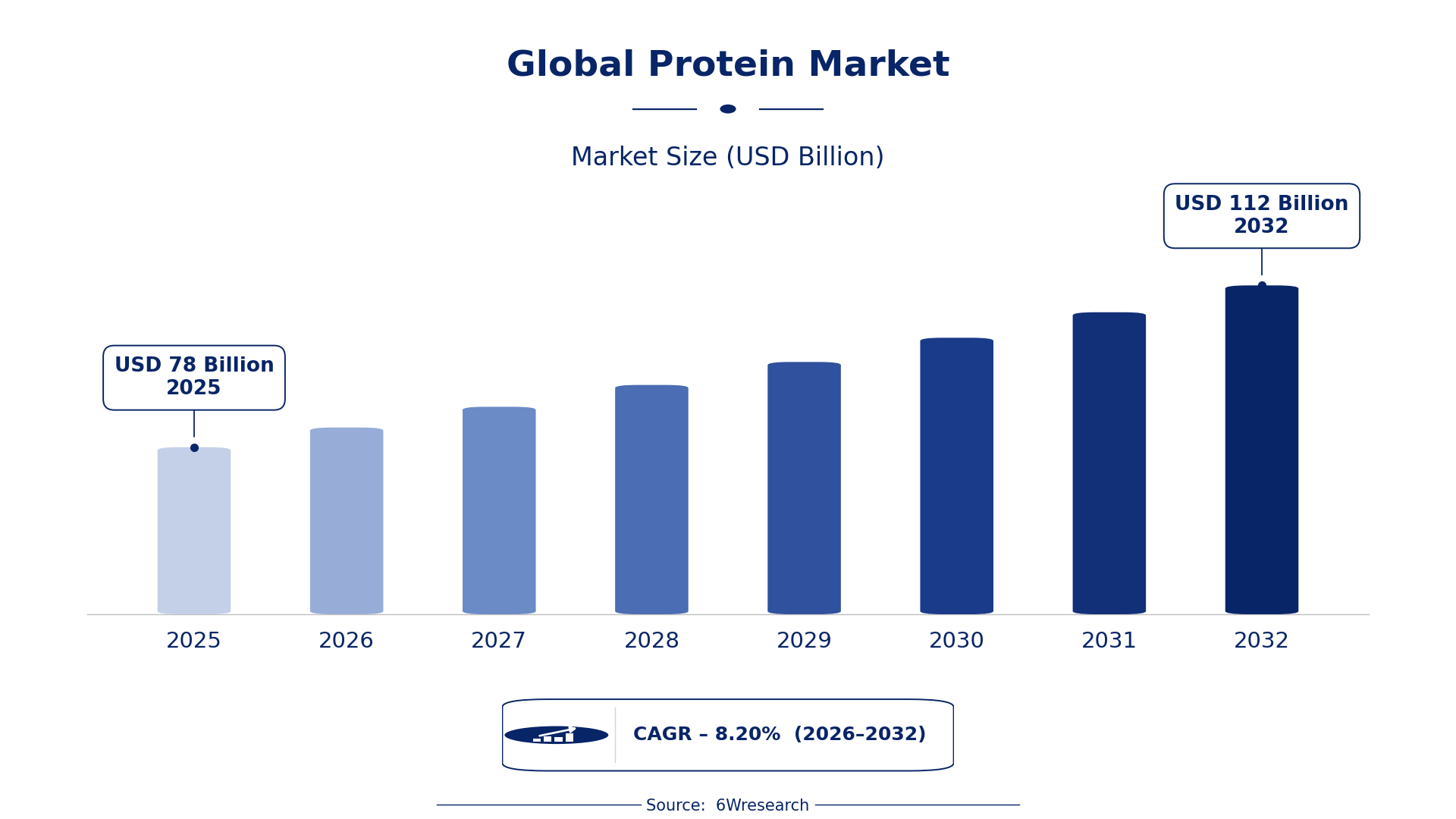
The Global Protein Market was estimated at USD 78 Billion in 2025 and is projected to reach USD 112 Billion by 2032, growing at a CAGR of 8.20% from 2026 to 2032.
Global Protein Market Synopsis
The Global Protein Market is witnessing transformative dynamics fueled by increasing consumer health consciousness and a shift towards protein-rich diets. Plant-based proteins are rapidly capturing market share due to their sustainability profile, ethical considerations, and innovations in alternative protein sources. The market is diverse, addressing needs across sectors like food and beverage, sports nutrition, and dietary supplements, which are all evolving to incorporate enhanced protein offerings.
As regulations evolve in favor of sustainability, companies are accelerating their R&D efforts in both traditional and alternative protein sources. This competitive landscape is characterized by growing collaborations among companies and investment in technological innovations, particularly within processing and ingredient development, which allow for greater customization and efficiency in protein production.
Global Protein Market Year-wise Growth Rate and Key Drivers
This graph illustrates the annual growth rates of the Global Protein Market from 2022 to 2032, highlighting a steady upward trajectory and projected expansion over the forecast period.
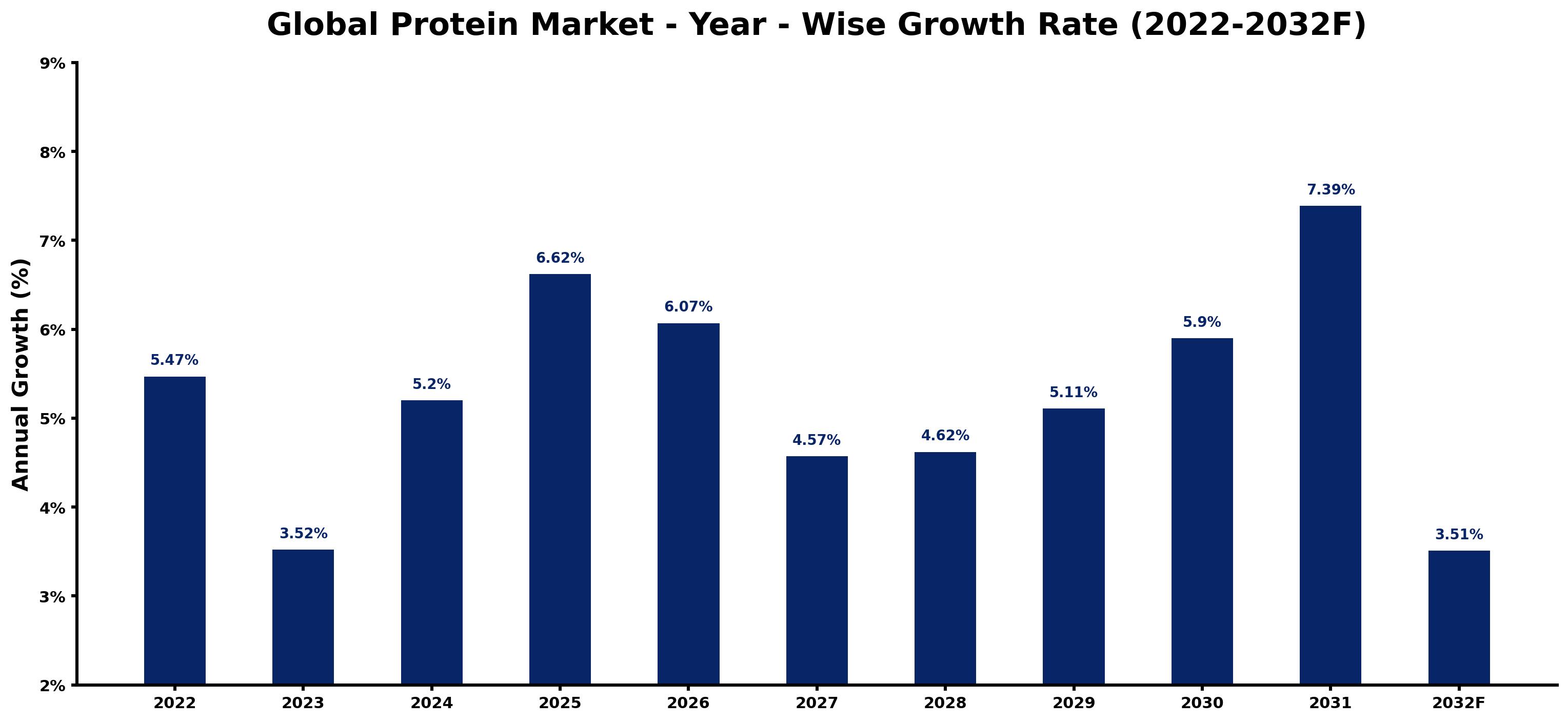
The table below presents the year‑wise growth rates along with the key drivers influencing the market
| Year | Growth Rate (%) | Major Drivers |
| 2022 | 5.47 | Supply chain complexities hinder timely distribution of protein products to consumers. |
| 2023 | 3.52 | A shift toward healthier lifestyles emphasizes the need for protein-rich offerings. |
| 2024 | 5.2 | Expanding retail networks allows protein brands to reach diverse consumer demographics. |
| 2025 | 6.62 | Novel clean-label formulations enhance consumer interest in protein supplements and snacks. |
| 2026 | 6.07 | A skilled workforce enhances the production capabilities of protein products. |
| 2027 | 4.57 | While raw material prices fluctuate, manufacturers adapt to maintain protein product affordability. |
| 2028 | 4.62 | Increased venture capital investment drives innovations in plant-based protein technologies. |
| 2029 | 5.11 | Protein-enriched snacks gain popularity as consumers seek healthier snacking alternatives. |
| 2030 | 5.9 | Manufacturers face intensifying competition, leading to innovation in protein offerings. |
| 2031 | 7.39 | Health-conscious consumers demand sustainable packaging for their preferred protein products. |
| 2032 | 3.51 | Retail channels implement stricter policies affecting the distribution of protein goods. |
Note - Market size estimations and growth projections presented in this report are based on 6Wresearch's proprietary research methodology, combining internal industry data, secondary research, and primary validation, updated periodically to reflect current market conditions. As markets evolve rapidly, figures for certain industries may vary slightly and are intended as informed estimates rather than absolute figures. For the most current market sizing, we recommend validating figures with a 6Wresearch analyst.
Global Protein Market Key Takeaways
Below are some of the specific key takeaways from the market, including:
- Nestlé has committed to investing $1.5 billion in plant-based protein innovations by 2026, aiming to expand its offerings in response to consumer demand.
- The plant-based protein segment is expected to grow at a substantial CAGR of 10.5% from 2026 to 2032, outperforming other segments in the market.
- In 2023, animal-based proteins will still command an estimated 60% share of the total protein market, showcasing their sustained consumer base.
- Regulatory shifts towards organic and non-GMO proteins are anticipated to influence about 20% of market growth by 2030.
- Cargill's launch of its new pea protein isolate, expected in early 2024, aims to capture the growing demand for allergen-free protein alternatives.
Evaluation of Restraints in Global Protein Market
The Global Protein Market faces significant challenges tied to fluctuating raw material prices and sustainability concerns. For instance, animal feed prices have seen volatility, with major feed components like soybean meal experiencing price increases of over 30% in the last two years. This fluctuation impacts production costs and profitability. Moreover, regulatory pressures related to emissions and resource utilization are compelling companies to adapt swiftly, thus raising compliance costs. For example, recent proposals by the EU could enforce greenhouse gas reduction targets which may elevate operational expenditures for producers across the board.
Global Protein Market Trends
Several trends are currently redefining the operational landscape of the Global Protein Market. Firstly, the shift towards automation in production processes is gaining traction to enhance efficiency and lower operating costs; companies like Tyson Foods are leveraging AI-driven analytics to optimize their supply chains. Additionally, there is a marked rise in consumer interest towards functional foods enriched with protein, driven by health-consciousness. For example, a 2023 report indicated a 15% increase in the sales of protein-fortified beverages aimed at athletes and fitness enthusiasts.
Another significant trend is the integration of lab-grown proteins, which are expected to diversify market offerings. Companies, including Eat Just, are pioneering lab-grown meat solutions, targeting mainstream consumers with products slated for release in late 2024. This innovation coupled with sustainability narratives aims to capture market interest while addressing ethical concerns around animal protein consumption.
Global Protein Market Opportunities
The Global Protein Market presents substantial future revenue opportunities, particularly in innovative product applications. The rise of the vegan and vegetarian demographic is spurring investments in alternative protein technologies, such as MycoTechnology's mushroom-based protein projects, which have demonstrated potential for commercial scalability, opening avenues for mainstream consumer acceptance. Additionally, the burgeoning health and wellness trend has created an opening for high-protein snack products; for example, protein bars that emphasize organic and low-sugar formulations are projected to see a market growth of around 25% by 2028.
Moreover, advancements in personalized nutrition are encouraging companies to invest in tailored protein solutions. Brands like Huel are exploring blends that cater directly to individual dietary needs, predicting a significant opportunity for customization in protein supplement offerings.
Global Protein Market by Source
In the Global Protein Market, animal-based proteins currently lead with an estimated ~60% share in 2025. This dominance can be attributed to longstanding consumer preferences and established supply chains. Conversely, plant-based proteins are poised to emerge as the fastest-growing segment, expected to exhibit a CAGR of 10.5% from 2026 to 2032. This growth is driven by increasing consumer demand for sustainable and ethically sourced protein options, reflecting a shift in dietary patterns as more individuals embrace vegetarian and vegan lifestyles.
Global Protein Market by End User
Within the Global Protein Market, the Food and Beverages segment commands the largest market share, with an estimated ~55% in 2025. This prominence is largely due to the extensive applications of protein in products ranging from dairy to meal replacements. Meanwhile, the Supplements segment is projected to grow at a notable CAGR of 9.2% from 2026 to 2032, fueled by increasing consumer interest in dietary supplements for fitness and health benefits, appealing particularly to the fitness-conscious demographic.
Global Protein Market by Region
North America holds the largest share of the Global Protein Market, estimated at ~48% in 2025, driven by the strong consumer base for both animal and plant-based protein products. In contrast, Asia is anticipated to be the fastest-growing region, with a projected CAGR of 9.5% from 2026 to 2032. This rapid growth can be attributed to a rising middle class and increasing health awareness, particularly in countries like India and China, where protein consumption is on the rise.
Government Initiatives in the Global Protein Market
The regulatory environment surrounding the Global Protein Market is evolving, with various initiatives aimed at promoting sustainable protein sources and innovative production methods. Governments are increasingly recognizing the importance of protein supply management, leading to policies that encourage advancements and compliance within the sector.
- U.S. Department of Agriculture (USDA), "Protein Innovation Grant Program," August 2023. This initiative supports startups focusing on sustainable protein technologies, enhancing research and development efforts.
- European Commission, "Farm to Fork Strategy," May 2021. Aimed at reducing the environmental impact of food production, this strategy promotes protein diversification and sustainable agriculture across EU member states.
- Food and Drug Administration (FDA), "Guidelines for Lab-Grown Meat," proposed in February 2024. These regulations are designed to establish safety standards for lab-grown proteins, facilitating their entry into mainstream markets.
- Australian Department of Agriculture, "Food Innovation Roadmap," January 2023. This roadmap outlines investment in research for alternative proteins, focusing on boosting local industries and enhancing export capabilities.
Future Insights of the Global Protein Market
The Global Protein Market is set to undergo transformative structural changes as consumer preferences shift toward sustainable and ethical protein sources. An emerging focus on lab-grown proteins, exemplified by companies like Eat Just and their anticipated developments in 2024, will likely redefine market dynamics. Enhanced regulatory support for plant-based alternatives is expected to catalyze further adoption. By 2032, greater emphasis on personalized nutrition solutions is anticipated, with businesses investing significantly in tailored products to meet diverse dietary needs.
Global Protein Market Latest Developments
Recent activities within the Global Protein Market highlight the competitive advancements and strategic shifts occurring among key players. The following are notable developments:
- Nestlé recently announced plans to introduce a new line of plant-based protein products by late 2024, aiming to strengthen its presence in the growing vegan segment.
- Cargill is ongoing with its global expansion of pea protein facilities, with completion expected by mid-2024, to enhance production capabilities for allergen-free protein sources.
- Tyson Foods launched a digital platform in January 2023 that connects consumers to sustainable protein products, positioning the company as a leader in customer engagement for eco-friendly proteins.
- DuPont is set to unveil a new fermentation-based protein by late 2023, which promises to improve yield and efficiency, thus enhancing its technology leadership.
Global Protein Market Key Players and Industry Positioning
The competitive structure of the Global Protein Market is moderately consolidated, with several major players holding significant market shares while also fostering innovation through research and development. The landscape is characterized by competition in product offerings, technological advancements, and sustainability initiatives.
| Leading Company | Core Strength | Strategic Focus |
|---|---|---|
| Nestlé | Diverse product portfolio with strong brand recognition. | Investment in plant-based innovations and health-focused products. |
| Cargill | Leading supplier in agribusiness with extensive supply chain experience. | Focus on sustainable protein production and expansion in alternative proteins. |
| DuPont | Expertise in fermentation technology for protein production. | Innovation in processing technologies and plant-based protein applications. |
| Unilever | Strong global reach with recognized consumer brands. | Commitment to sustainable sourcing and diversification towards plant-based products. |
| Tyson Foods | Established infrastructure in meat production with significant market share. | Strategic initiatives towards integrating plant-based offerings. |
Collaboration and innovation are likely to define competitive strategies moving forward, as these companies adapt to changing consumer preferences and regulatory landscapes.
Key Attractiveness of the Report
- 10 Years of Market Numbers
- Historical Data Starting from 2022 to 2025
- Base Year: 2025
- Forecast Data until 2032
- Key Performance Indicators Impacting the Market
- Major Upcoming Developments and Projects
Key Highlights of the Report:
- Global Protein Market Outlook
- Market Size of Global Protein Market, 2025
- Forecast of Global Protein Market, 2032
- Historical Data and Forecast of Global Protein Revenues & Volume for the Period 2022-2032
- Global Protein Market Trend Evolution
- Global Protein Market Drivers and Challenges
- Global Protein Price Trends
- Global Protein Porter's Five Forces
- Global Protein Industry Life Cycle
- Historical Data and Forecast of Global Protein Market Revenues & Volume
- Historical Data and Forecast of Global Protein Market Revenues & Volume By Source for the Period 2022-2032
- Historical Data and Forecast of Global Protein Market Revenues & Volume By Animal for the Period 2022-2032
- Historical Data and Forecast of Global Protein Market Revenues & Volume By Microbial for the Period 2022-2032
- Historical Data and Forecast of Global Protein Market Revenues & Volume By End User for the Period 2022-2032
- Historical Data and Forecast of Global Protein Market Revenues & Volume By Animal Feed for the Period 2022-2032
- Historical Data and Forecast of Global Protein Market Revenues & Volume By Food and Beverages for the Period 2022-2032
- Historical Data and Forecast of Global Protein Market Revenues & Volume By Personal Care and Cosmetics for the Period 2022-2032
- Historical Data and Forecast of Global Protein Market Revenues & Volume By Supplements for the Period 2022-2032
- Historical Data and Forecast of North America Protein Market Revenues & Volume By Source for the Period 2022-2032
- Historical Data and Forecast of North America Protein Market Revenues & Volume By Animal for the Period 2022-2032
- Historical Data and Forecast of North America Protein Market Revenues & Volume By Microbial for the Period 2022-2032
- Historical Data and Forecast of North America Protein Market Revenues & Volume By End User for the Period 2022-2032
- Historical Data and Forecast of North America Protein Market Revenues & Volume By Animal Feed for the Period 2022-2032
- Historical Data and Forecast of North America Protein Market Revenues & Volume By Food and Beverages for the Period 2022-2032
- Historical Data and Forecast of North America Protein Market Revenues & Volume By Personal Care and Cosmetics for the Period 2022-2032
- Historical Data and Forecast of North America Protein Market Revenues & Volume By Supplements for the Period 2022-2032
- Historical Data and Forecast of United States of America Protein Market Revenues & Volume for the Period 2022-2032
- Historical Data and Forecast of Canada Protein Market Revenues & Volume for the Period 2022-2032
- Historical Data and Forecast of Rest of North America Protein Market Revenues & Volume for the Period 2022-2032
- Historical Data and Forecast of Latin America (LATAM) Protein Market Revenues & Volume By Source for the Period 2022-2032
- Historical Data and Forecast of Latin America (LATAM) Protein Market Revenues & Volume By Animal for the Period 2022-2032
- Historical Data and Forecast of Latin America (LATAM) Protein Market Revenues & Volume By Microbial for the Period 2022-2032
- Historical Data and Forecast of Latin America (LATAM) Protein Market Revenues & Volume By End User for the Period 2022-2032
- Historical Data and Forecast of Latin America (LATAM) Protein Market Revenues & Volume By Animal Feed for the Period 2022-2032
- Historical Data and Forecast of Latin America (LATAM) Protein Market Revenues & Volume By Food and Beverages for the Period 2022-2032
- Historical Data and Forecast of Latin America (LATAM) Protein Market Revenues & Volume By Personal Care and Cosmetics for the Period 2022-2032
- Historical Data and Forecast of Latin America (LATAM) Protein Market Revenues & Volume By Supplements for the Period 2022-2032
- Historical Data and Forecast of Brazil Protein Market Revenues & Volume for the Period 2022-2032
- Historical Data and Forecast of Mexico Protein Market Revenues & Volume for the Period 2022-2032
- Historical Data and Forecast of Argentina Protein Market Revenues & Volume for the Period 2022-2032
- Historical Data and Forecast of Rest of LATAM Protein Market Revenues & Volume for the Period 2022-2032
- Historical Data and Forecast of Asia Protein Market Revenues & Volume By Source for the Period 2022-2032
- Historical Data and Forecast of Asia Protein Market Revenues & Volume By Animal for the Period 2022-2032
- Historical Data and Forecast of Asia Protein Market Revenues & Volume By Microbial for the Period 2022-2032
- Historical Data and Forecast of Asia Protein Market Revenues & Volume By End User for the Period 2022-2032
- Historical Data and Forecast of Asia Protein Market Revenues & Volume By Animal Feed for the Period 2022-2032
- Historical Data and Forecast of Asia Protein Market Revenues & Volume By Food and Beverages for the Period 2022-2032
- Historical Data and Forecast of Asia Protein Market Revenues & Volume By Personal Care and Cosmetics for the Period 2022-2032
- Historical Data and Forecast of Asia Protein Market Revenues & Volume By Supplements for the Period 2022-2032
- Historical Data and Forecast of China Protein Market Revenues & Volume for the Period 2022-2032
- Historical Data and Forecast of India Protein Market Revenues & Volume for the Period 2022-2032
- Historical Data and Forecast of Japan Protein Market Revenues & Volume for the Period 2022-2032
- Historical Data and Forecast of Rest of Asia Protein Market Revenues & Volume for the Period 2022-2032
- Historical Data and Forecast of Africa Protein Market Revenues & Volume By Source for the Period 2022-2032
- Historical Data and Forecast of Africa Protein Market Revenues & Volume By Animal for the Period 2022-2032
- Historical Data and Forecast of Africa Protein Market Revenues & Volume By Microbial for the Period 2022-2032
- Historical Data and Forecast of Africa Protein Market Revenues & Volume By End User for the Period 2022-2032
- Historical Data and Forecast of Africa Protein Market Revenues & Volume By Animal Feed for the Period 2022-2032
- Historical Data and Forecast of Africa Protein Market Revenues & Volume By Food and Beverages for the Period 2022-2032
- Historical Data and Forecast of Africa Protein Market Revenues & Volume By Personal Care and Cosmetics for the Period 2022-2032
- Historical Data and Forecast of Africa Protein Market Revenues & Volume By Supplements for the Period 2022-2032
- Historical Data and Forecast of South Africa Protein Market Revenues & Volume for the Period 2022-2032
- Historical Data and Forecast of Nigeria Protein Market Revenues & Volume for the Period 2022-2032
- Historical Data and Forecast of Egypt Protein Market Revenues & Volume for the Period 2022-2032
- Historical Data and Forecast of Rest of Africa Protein Market Revenues & Volume for the Period 2022-2032
- Historical Data and Forecast of Europe Protein Market Revenues & Volume By Source for the Period 2022-2032
- Historical Data and Forecast of Europe Protein Market Revenues & Volume By Animal for the Period 2022-2032
- Historical Data and Forecast of Europe Protein Market Revenues & Volume By Microbial for the Period 2022-2032
- Historical Data and Forecast of Europe Protein Market Revenues & Volume By End User for the Period 2022-2032
- Historical Data and Forecast of Europe Protein Market Revenues & Volume By Animal Feed for the Period 2022-2032
- Historical Data and Forecast of Europe Protein Market Revenues & Volume By Food and Beverages for the Period 2022-2032
- Historical Data and Forecast of Europe Protein Market Revenues & Volume By Personal Care and Cosmetics for the Period 2022-2032
- Historical Data and Forecast of Europe Protein Market Revenues & Volume By Supplements for the Period 2022-2032
- Historical Data and Forecast of United Kingdom Protein Market Revenues & Volume for the Period 2022-2032
- Historical Data and Forecast of France Protein Market Revenues & Volume for the Period 2022-2032
- Historical Data and Forecast of Germany Protein Market Revenues & Volume for the Period 2022-2032
- Historical Data and Forecast of Rest of Europe Protein Market Revenues & Volume for the Period 2022-2032
- Historical Data and Forecast of Middle East Protein Market Revenues & Volume By Source for the Period 2022-2032
- Historical Data and Forecast of Middle East Protein Market Revenues & Volume By Animal for the Period 2022-2032
- Historical Data and Forecast of Middle East Protein Market Revenues & Volume By Microbial for the Period 2022-2032
- Historical Data and Forecast of Middle East Protein Market Revenues & Volume By End User for the Period 2022-2032
- Historical Data and Forecast of Middle East Protein Market Revenues & Volume By Animal Feed for the Period 2022-2032
- Historical Data and Forecast of Middle East Protein Market Revenues & Volume By Food and Beverages for the Period 2022-2032
- Historical Data and Forecast of Middle East Protein Market Revenues & Volume By Personal Care and Cosmetics for the Period 2022-2032
- Historical Data and Forecast of Middle East Protein Market Revenues & Volume By Supplements for the Period 2022-2032
- Historical Data and Forecast of Saudi Arabia Protein Market Revenues & Volume for the Period 2022-2032
- Historical Data and Forecast of UAE Protein Market Revenues & Volume for the Period 2022-2032
- Historical Data and Forecast of Turkey Protein Market Revenues & Volume for the Period 2022-2032
- Historical Data and Forecast of Rest of Middle East Protein Market Revenues & Volume for the Period 2022-2032
- Global Protein Market - Key Performance Indicators
- Global Protein Market - Import Export Trade Statistics
- Global Protein Market - Opportunity Assessment By Countries
- Global Protein Market - Opportunity Assessment By Source
- Global Protein Market - Opportunity Assessment By End User
- Global Protein Market - Top Companies Market Share
- Global Protein Market - Top Companies Profiles
- Global Protein Market - Comparison of Players in Technical and Operating Parameters
- Global Protein Market - Strategic Recommendations
Markets Covered
The Global Protein Market report provides a detailed analysis of the following market segments:
By Regions and Countries:
- North America
- Europe
- LATAM
- Middle East
- Asia
- Africa
By Source:
- Animal
- Microbial
By End User:
- Animal Feed
- Food
- Beverages
- Personal Care
- Cosmetics
- Supplements






































