Global Reptile Leather Market Highlights
| Market Size (2025) | USD 130 Billion |
| Forecast Size (2032) | USD 220 Billion |
| CAGR | 7.10% |
| Base Year | 2025 |
| Forecast Period | 2026-2032 |
| Largest Region | Asia Pacific |
| Fastest Growing Region | Latin America |
| Largest Segment | Crocodile Leather |
| Fastest Growing Segment | Lizard Leather |
| Leading Companies | Hermès International, LVMH, Kering, LVHM Moët Hennessy Louis Vuitton, Guccio Gucci S.P.A. |
Global Reptile Leather Market Size & Growth Rate (2026-2032)
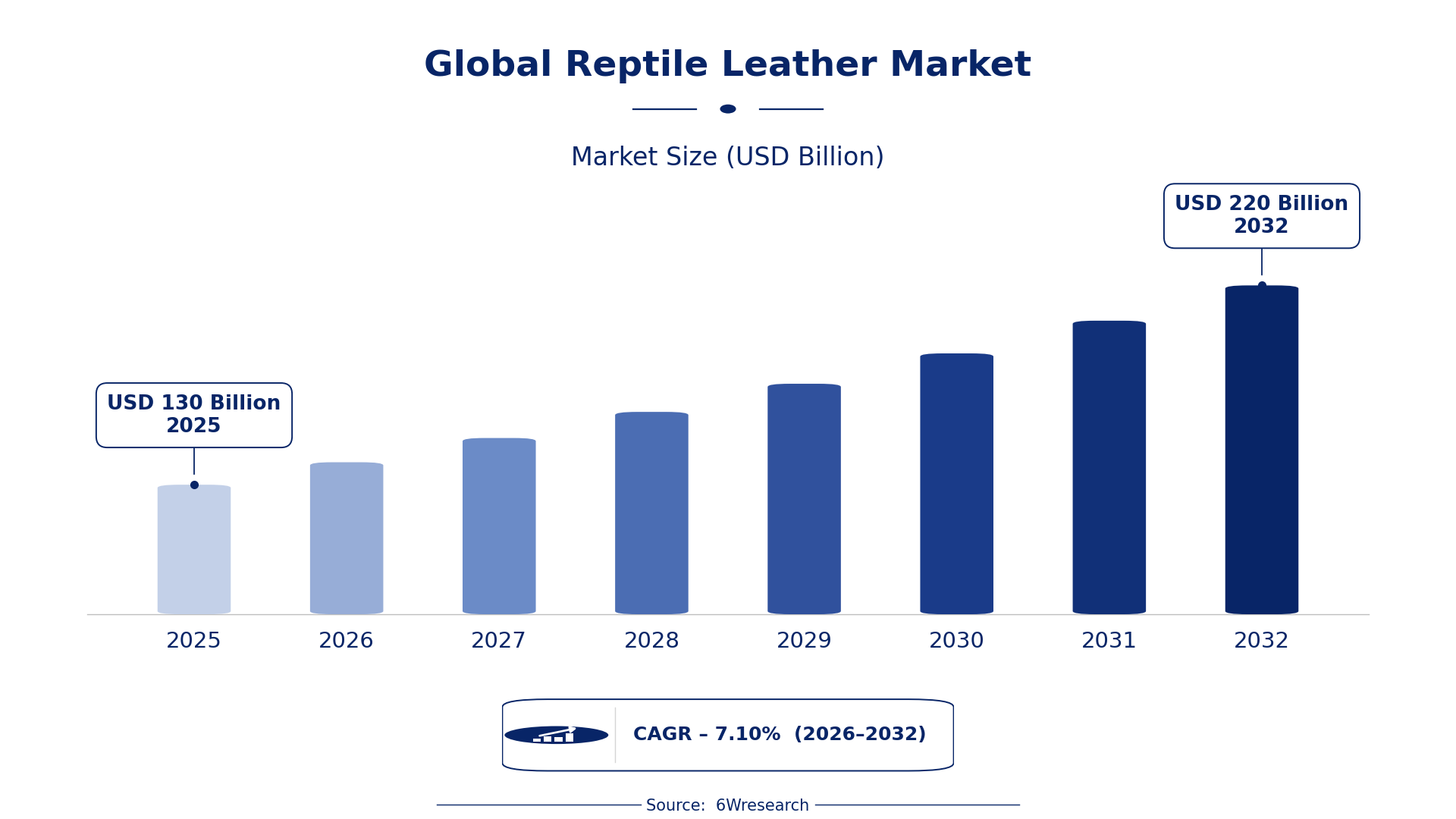
The Global Reptile Leather Market was estimated at USD 130 Billion in 2025 and is projected to reach USD 220 Billion by 2032, growing at a CAGR of 7.10% from 2026 to 2032.
Global Reptile Leather Market Synopsis
The Global Reptile Leather Market is currently witnessing a transformative phase, fueled by the luxury fashion industry's appetite for exotic materials. This drive for uniqueness is particularly intense within high-end markets. Reptile leathers, sourced primarily from crocodiles, snakes, and lizards, are now increasingly set against the backdrop of sustainability and ethical sourcing, reshaping consumer purchasing preferences.
Manufacturers are compelled to innovate, either through advanced processing techniques or by tapping into ethical alternatives, redefining product offerings to meet consumer demands for transparency. The significant concentration of production facilities in Asia Pacific also underlines this region's critical role in shaping the future of the global reptile leather market.
Global Reptile Leather Market Year-wise Growth Rate and Key Drivers
This graph illustrates the annual growth rates of the Global Reptile Leather Market from 2022 to 2032, highlighting a steady upward trajectory and projected expansion over the forecast period.
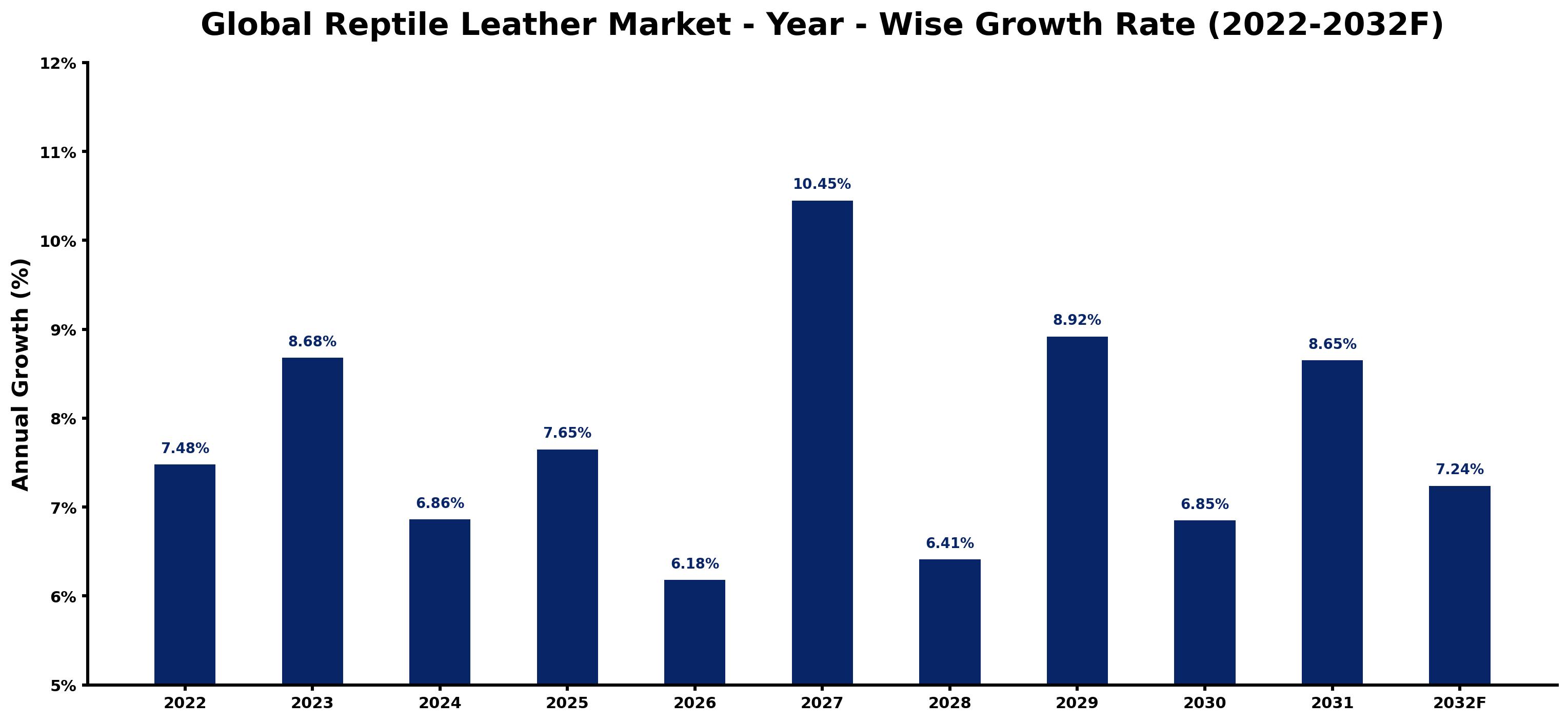
The table below presents the year‑wise growth rates along with the key drivers influencing the market
| Year | Growth Rate (%) | Major Drivers |
| 2022 | 7.48 | Increased regulatory scrutiny on reptile leather harvesting supports market establishment efforts. |
| 2023 | 8.68 | Attracting investment from fashion brands accelerates innovation in reptile leather products. |
| 2024 | 6.86 | Leather companies adopting sustainable practices enhance market appeal and consumer trust. |
| 2025 | 7.65 | Luxury brands recognizing the value of reptile leather drive adoption among high-end consumers. |
| 2026 | 6.18 | Manufacturers adjusting strategies to emphasize unique reptile leather offerings stimulate competition. |
| 2027 | 10.45 | Extensive trade agreements facilitate geographic expansion for reptile leather exports globally. |
| 2028 | 6.41 | As raw material costs fluctuate, reptile leather prices experience varying consumer interest. |
| 2029 | 8.92 | Emerging supply chain efficiencies allow for lower pricing and increased reptile leather accessibility. |
| 2030 | 6.85 | In North America, product innovations in reptile leather enhance its appeal to consumers. |
| 2031 | 8.65 | A shift toward eco-conscious fashion influences demand for sustainably sourced reptile leather. |
| 2032 | 7.24 | Python leather's popularity among luxury brands reshapes consumer buying patterns in accessories. |
Note - Market size estimations and growth projections presented in this report are based on 6Wresearch's proprietary research methodology, combining internal industry data, secondary research, and primary validation, updated periodically to reflect current market conditions. As markets evolve rapidly, figures for certain industries may vary slightly and are intended as informed estimates rather than absolute figures. For the most current market sizing, we recommend validating figures with a 6Wresearch analyst.
Global Reptile Leather Market Key Takeaways
Below are some of the specific key takeaways from the market, including:
- As of 2025, the crocodile leather segment accounts for over 45% of the total reptile leather market due to its high value in luxury goods.
- Innovative companies are implementing cruelty-free leather alternatives to capture the growing eco-conscious consumer base.
- Latin America is expected to witness a CAGR of 9.5% from 2026 to 2032, emerging as a significant player in the reptile leather market.
- Recent surveys suggest 70% of luxury consumers prioritize sustainable practices when purchasing reptile leather items.
- Companies are investing heavily in upcycling processes to meet regulatory compliance and ethical standards, enhancing brand loyalty.
Evaluation of Restraints in Global Reptile Leather Market
While the Global Reptile Leather Market shows promise, it faces significant challenges. Regulatory barriers, such as the Convention on International Trade in Endangered Species (CITES), impose strict guidelines on the trade of certain reptile species, thereby limiting sourcing capabilities. For example, compliance costs related to sustainable practices are estimated to range from $50,000 to $200,000 annually for major manufacturers. Additionally, growing consumer scrutiny surrounding ethical sourcing raises the stakes for companies in this sector to enhance transparency and accountability.
Global Reptile Leather Market Trends
Several notable trends are reshaping the Global Reptile Leather Market. One significant trend is the increasing investment in sustainable sourcing practices that align with consumer ethical demands. For instance, Hermès has committed to sourcing all its reptile leather exclusively from certified farms, thereby enhancing its brand credibility. Additionally, advancements in manufacturing techniques are allowing for higher quality and more durable products. As of 2026, eco-friendly treatments are expected to replace more than 40% of traditional processing methods in this market. Another emerging trend involves the development of synthetic alternatives; in 2023, Kering announced partnerships with biotech firms to create lab-grown leather, which is anticipated to meet rising consumer eco-consciousness more effectively.
Global Reptile Leather Market Opportunities
The Global Reptile Leather Market presents multiple avenues for future growth. The rising popularity of luxury reptiles in sectors like automotive and high-end accessories stands out significantly. For instance, a notable luxury automotive brand has begun integrating lizard leather into its interiors, projected to boost their annual sales segment by 15% over the next five years. Additionally, untapped markets in Asia Pacific are opening as consumer bases shift toward luxury reptile products, estimated to contribute an additional $5 billion by 2030. Lastly, as feedback from trade shows indicates an inclination towards ethical standards, businesses focusing on upcycling and sustainable leather processing are likely to see a surge in partnerships and investments.
Global Reptile Leather Market by Distribution Channels
Retail stores lead the distribution channels in the Global Reptile Leather Market, commanding approximately 62% of market share in 2025. In contrast, online stores are identified as the fastest-growing segment, with an estimated CAGR of 11.2% from 2026 to 2032. This growth is driven by increased consumer accessibility and a preference for luxury shopping experiences via digital platforms. Retail stores remain prominent due to their traditional customer engagement and tactile product experience, essential for high-value leather purchases.
Global Reptile Leather Market by Region
Asia Pacific dominates the Global Reptile Leather Market, accounting for nearly 50% of the share as of 2025. The region benefits from a concentration of manufacturing facilities and a strong consumer base for luxury leather goods. Conversely, Latin America is emerging as the fastest-growing region, with a CAGR of 9.8% from 2026 to 2032. This growth is largely attributed to expanding production capabilities and increasing export activities, particularly in countries like Brazil and Argentina, which also have rich biodiversity and resources that cater to the reptile leather market.
Government Initiatives in the Global Reptile Leather Market
The regulatory environment surrounding the Global Reptile Leather Market is increasingly influenced by sustainability and ethical sourcing mandates. Various government initiatives have been implemented to ensure responsible practices, balancing the interests of the industry with environmental considerations.
- U.S. Fish and Wildlife Service, "Endangered Species Act (ESA)", 1973 - This act regulates the conservation of threatened and endangered species, impacting the sourcing practices of reptile leather.
- European Commission, "EU Regulation 2016/2031", 2016 - Aimed at sustainable trade practices, it demands transparency in the sourcing of reptile skins.
- Ministry of Environment, Government of Brazil, "National Policy on Biodiversity", 2015 - This policy promotes preservation of species while permitting sustainable use of resources, directly affecting reptile sourcing practices.
- Australian Government Department of Agriculture, "Wildlife Protection Act", 2013 - This act restricts the export of certain reptile materials, thereby impacting international trade dynamics.
- International Trade Commission, "Reptile Leather Trade Guidelines", 2020 - These guidelines offer a framework for ethical trade and ensure that market participants comply with international standards.
Future Insights of the Global Reptile Leather Market
The Global Reptile Leather Market is expected to undergo transformative changes driven by technological advancements in sustainable practices and increased consumer awareness. Companies like Hermès are already setting standards by exclusively sourcing from certified farms, a strategy likely to influence competitive dynamics. This shift not only aligns with environmental demands but also enhances brand reputation, marking a shift towards transparency in production. With a compound annual growth rate (CAGR) of 7.10% projected from 2026 to 2032, the emphasis will increasingly be on ethical sourcing of materials and innovative manufacturing methods.
Global Reptile Leather Market Latest Developments
Recent changes within the Global Reptile Leather Market reflect significant strategic moves by leading companies, enhancing their competitive positioning and market potential.
- In April 2023, Kering launched a new line of sustainable handbags crafted with a cruelty-free leather alternative, addressing the increasing consumer demand for ethical products.
- Hermès recently completed the expansion of its production facility in Singapore, designed to increase crocodile leather sourcing capabilities by mid-2024, thereby strengthening their supply chain.
- In June 2023, LVMH announced a partnership with a biotech company to develop lab-grown reptile leather, aiming for commercial viability by 2025.
- Guccio Gucci S.P.A. is set to introduce an exclusive line of lizard leather accessories in late 2023, targeting the luxury market segment to expand its product portfolio.
Global Reptile Leather Market Key Players and Industry Positioning
The competitive structure of the Global Reptile Leather Market is characterized by a mix of consolidated and fragmented elements. While key players dominate with established brand loyalty and large-scale operations, numerous smaller producers focus on niche markets, especially sustainable and ethically sourced materials, creating a dynamic environment.
| Leading Company | Core Strength | Strategic Focus |
|---|---|---|
| Hermès International | Renowned for premium craftsmanship | Sustainable sourcing from certified farms |
| LVMH | Strong brand portfolio and market presence | Investment in innovative alternatives like lab-grown leather |
| Kering | Leadership in ethical fashion initiatives | Development of cruelty-free and sustainable products |
| LVHM Moët Hennessy Louis Vuitton | Global supply chain robustness | Expansion in high-end markets |
| Guccio Gucci S.P.A. | Strong focus on luxury and heritage | Diversification into exotic materials for accessories |
As the market evolves, these key players will increasingly prioritize sustainability and ethical sourcing, necessitating vigilance in maintaining their competitive edge while meeting the rising consumer demand for transparency.
Key Attractiveness of the Report
- 10 Years of Market Numbers
- Historical Data Starting from 2022 to 2025
- Base Year: 2025
- Forecast Data until 2032
- Key Performance Indicators Impacting the Market
- Major Upcoming Developments and Projects
Key Highlights of the Report:
- Global Reptile Leather Market Outlook
- Market Size of Global Reptile Leather Market, 2025
- Forecast of Global Reptile Leather Market, 2032
- Historical Data and Forecast of Global Reptile Leather Revenues & Volume for the Period 2022-2032
- Global Reptile Leather Market Trend Evolution
- Global Reptile Leather Market Drivers and Challenges
- Global Reptile Leather Price Trends
- Global Reptile Leather Porter's Five Forces
- Global Reptile Leather Industry Life Cycle
- Historical Data and Forecast of Global Reptile Leather Market Revenues & Volume
- Historical Data and Forecast of Global Reptile Leather Market Revenues & Volume By Distribution Channels for the Period 2022-2032
- Historical Data and Forecast of Global Reptile Leather Market Revenues & Volume By Online stores for the Period 2022-2032
- Historical Data and Forecast of Global Reptile Leather Market Revenues & Volume By Retail stores for the Period 2022-2032
- Historical Data and Forecast of North America Reptile Leather Market Revenues & Volume By Distribution Channels for the Period 2022-2032
- Historical Data and Forecast of North America Reptile Leather Market Revenues & Volume By Online stores for the Period 2022-2032
- Historical Data and Forecast of North America Reptile Leather Market Revenues & Volume By Retail stores for the Period 2022-2032
- Historical Data and Forecast of United States of America Reptile Leather Market Revenues & Volume for the Period 2022-2032
- Historical Data and Forecast of Canada Reptile Leather Market Revenues & Volume for the Period 2022-2032
- Historical Data and Forecast of Rest of North America Reptile Leather Market Revenues & Volume for the Period 2022-2032
- Historical Data and Forecast of Latin America (LATAM) Reptile Leather Market Revenues & Volume By Distribution Channels for the Period 2022-2032
- Historical Data and Forecast of Latin America (LATAM) Reptile Leather Market Revenues & Volume By Online stores for the Period 2022-2032
- Historical Data and Forecast of Latin America (LATAM) Reptile Leather Market Revenues & Volume By Retail stores for the Period 2022-2032
- Historical Data and Forecast of Brazil Reptile Leather Market Revenues & Volume for the Period 2022-2032
- Historical Data and Forecast of Mexico Reptile Leather Market Revenues & Volume for the Period 2022-2032
- Historical Data and Forecast of Argentina Reptile Leather Market Revenues & Volume for the Period 2022-2032
- Historical Data and Forecast of Rest of LATAM Reptile Leather Market Revenues & Volume for the Period 2022-2032
- Historical Data and Forecast of Asia Reptile Leather Market Revenues & Volume By Distribution Channels for the Period 2022-2032
- Historical Data and Forecast of Asia Reptile Leather Market Revenues & Volume By Online stores for the Period 2022-2032
- Historical Data and Forecast of Asia Reptile Leather Market Revenues & Volume By Retail stores for the Period 2022-2032
- Historical Data and Forecast of China Reptile Leather Market Revenues & Volume for the Period 2022-2032
- Historical Data and Forecast of India Reptile Leather Market Revenues & Volume for the Period 2022-2032
- Historical Data and Forecast of Japan Reptile Leather Market Revenues & Volume for the Period 2022-2032
- Historical Data and Forecast of Rest of Asia Reptile Leather Market Revenues & Volume for the Period 2022-2032
- Historical Data and Forecast of Africa Reptile Leather Market Revenues & Volume By Distribution Channels for the Period 2022-2032
- Historical Data and Forecast of Africa Reptile Leather Market Revenues & Volume By Online stores for the Period 2022-2032
- Historical Data and Forecast of Africa Reptile Leather Market Revenues & Volume By Retail stores for the Period 2022-2032
- Historical Data and Forecast of South Africa Reptile Leather Market Revenues & Volume for the Period 2022-2032
- Historical Data and Forecast of Nigeria Reptile Leather Market Revenues & Volume for the Period 2022-2032
- Historical Data and Forecast of Egypt Reptile Leather Market Revenues & Volume for the Period 2022-2032
- Historical Data and Forecast of Rest of Africa Reptile Leather Market Revenues & Volume for the Period 2022-2032
- Historical Data and Forecast of Europe Reptile Leather Market Revenues & Volume By Distribution Channels for the Period 2022-2032
- Historical Data and Forecast of Europe Reptile Leather Market Revenues & Volume By Online stores for the Period 2022-2032
- Historical Data and Forecast of Europe Reptile Leather Market Revenues & Volume By Retail stores for the Period 2022-2032
- Historical Data and Forecast of United Kingdom Reptile Leather Market Revenues & Volume for the Period 2022-2032
- Historical Data and Forecast of France Reptile Leather Market Revenues & Volume for the Period 2022-2032
- Historical Data and Forecast of Germany Reptile Leather Market Revenues & Volume for the Period 2022-2032
- Historical Data and Forecast of Rest of Europe Reptile Leather Market Revenues & Volume for the Period 2022-2032
- Historical Data and Forecast of Middle East Reptile Leather Market Revenues & Volume By Distribution Channels for the Period 2022-2032
- Historical Data and Forecast of Middle East Reptile Leather Market Revenues & Volume By Online stores for the Period 2022-2032
- Historical Data and Forecast of Middle East Reptile Leather Market Revenues & Volume By Retail stores for the Period 2022-2032
- Historical Data and Forecast of Saudi Arabia Reptile Leather Market Revenues & Volume for the Period 2022-2032
- Historical Data and Forecast of UAE Reptile Leather Market Revenues & Volume for the Period 2022-2032
- Historical Data and Forecast of Turkey Reptile Leather Market Revenues & Volume for the Period 2022-2032
- Historical Data and Forecast of Rest of Middle East Reptile Leather Market Revenues & Volume for the Period 2022-2032
- Global Reptile Leather Market - Key Performance Indicators
- Global Reptile Leather Market - Import Export Trade Statistics
- Global Reptile Leather Market - Opportunity Assessment By Countries
- Global Reptile Leather Market - Opportunity Assessment By Distribution Channels
- 0
- Global Reptile Leather Market - Top Companies Market Share
- Global Reptile Leather Market - Top Companies Profiles
- Global Reptile Leather Market - Comparison of Players in Technical and Operating Parameters
- Global Reptile Leather Market - Strategic Recommendations
Markets Covered
The Global Reptile Leather Market report provides a detailed analysis of the following market segments:
By Regions and Countries:
- North America
- Europe
- LATAM
- Middle East
- Asia
- Africa
By Distribution Channels:
- Online stores
- Retail stores






































