Global Small Satellite Market Highlights
| Market Size (2025) | USD 7 Billion |
| Forecast Size (2032) | USD 22.71 Billion |
| CAGR | 5.20% |
| Base Year | 2025 |
| Forecast Period | 2026-2032 |
| Largest Region | North America |
| Fastest Growing Region | Asia |
| Largest Segment | Nanosatellite |
| Fastest Growing Segment | Microsatellite |
| Leading Companies | Planet Labs, Spire Global, Raytheon Technologies, Maxar Technologies, Blue Canyon Technologies |
Global Small Satellite Market Size & Growth Rate (2026-2032)
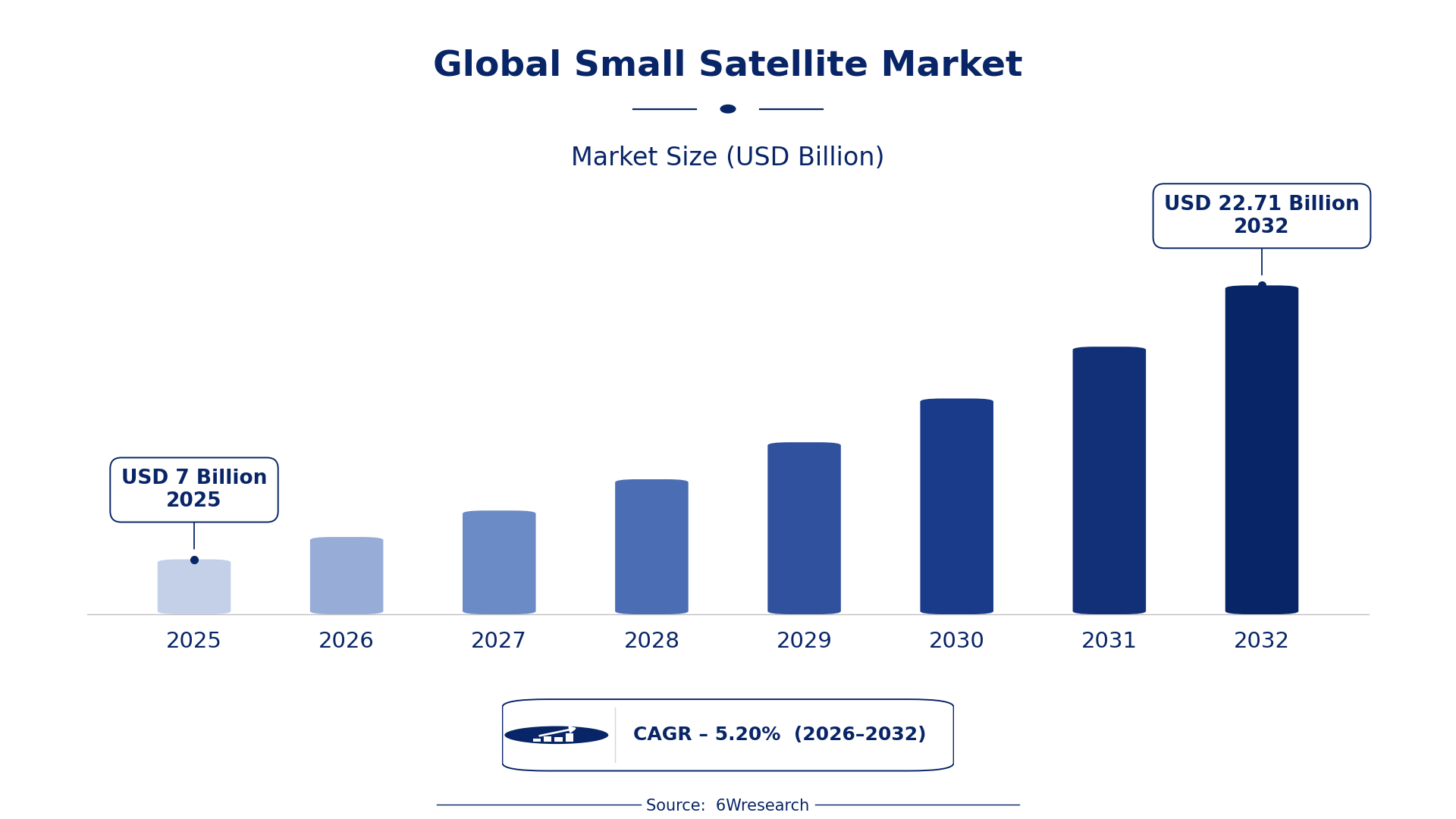
The Global Small Satellite Market was estimated at USD 7 Billion in 2025 and is projected to reach USD 22.71 Billion by 2032, growing at a CAGR of 5.20% from 2026 to 2032.
Global Small Satellite Market Synopsis
The Global Small Satellite Market is witnessing pivotal changes driven by the increasing deployment of satellite constellations for communication and Earth observation. Advances in miniaturization technologies enable these satellites to deliver high-quality data at reduced costs, enhancing their appeal across various applications.
A noteworthy transformation is the collaboration between private companies and government entities to deploy small satellites for national security and disaster management. This collaboration supports significant investments and indicates a shift in how both sectors leverage satellite technology for practical applications, distinguishing the market from traditional satellite offerings.
Global Small Satellite Market Year-wise Growth Rate and Key Drivers
This graph illustrates the annual growth rates of the Global Small Satellite Market from 2022 to 2032, highlighting a steady upward trajectory and projected expansion over the forecast period.
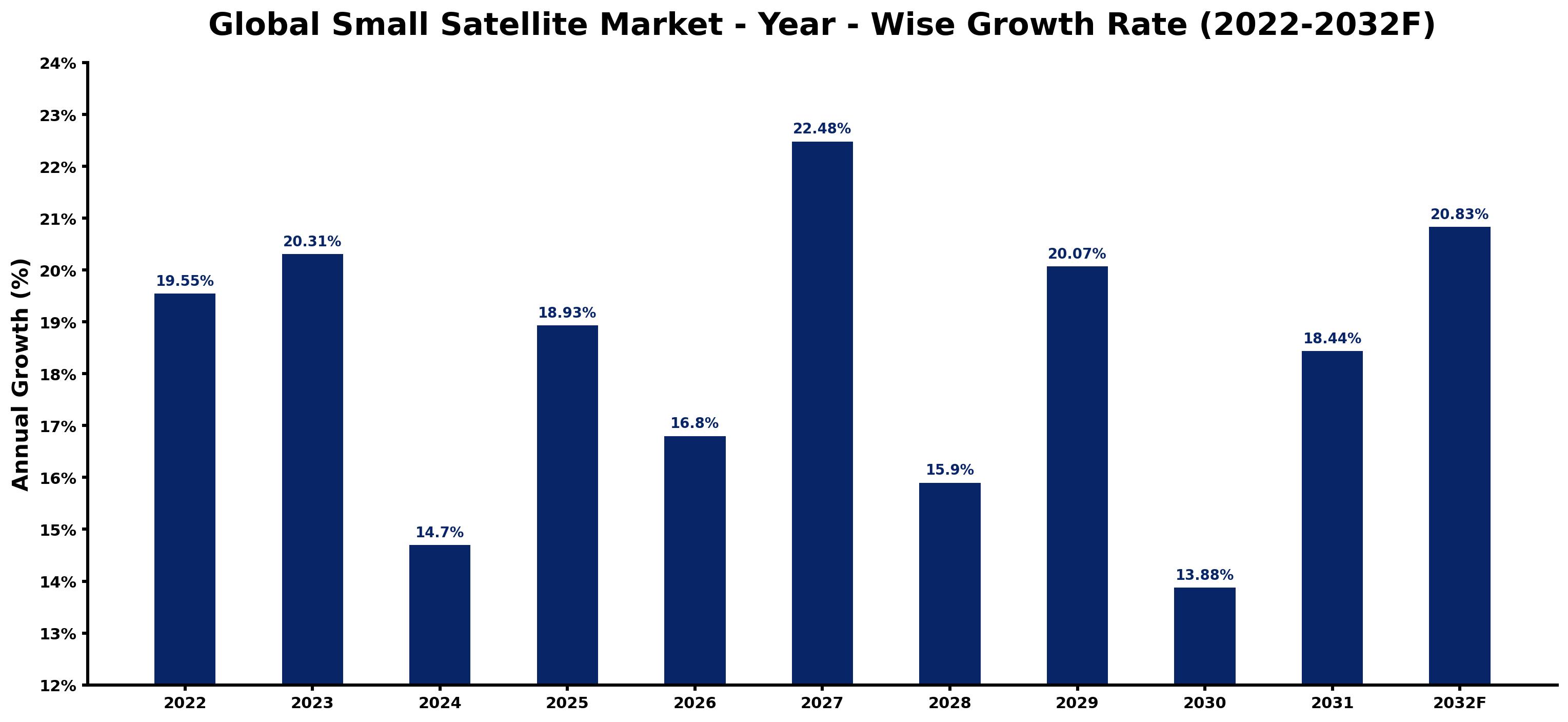
The table below presents the year‑wise growth rates along with the key drivers influencing the market
| Year | Growth Rate (%) | Major Drivers |
| 2022 | 19.55 | Government contractors are adapting to a shift in small satellite production dynamics. |
| 2023 | 20.31 | Emerging small satellite propulsion systems promote sustainability in space applications. |
| 2024 | 14.7 | Satellite operators increasingly prioritize low-cost small satellites for diverse missions. |
| 2025 | 18.93 | Expanding export control regulations facilitate a broader small satellite market access. |
| 2026 | 16.8 | Manufacturers are exploring international markets, increasing small satellite deployment opportunities. |
| 2027 | 22.48 | Growing interest in satellite constellations enhances small satellite utilization among end-users. |
| 2028 | 15.9 | Acquisitions within the aerospace sector accelerate innovation in small satellite technologies. |
| 2029 | 20.07 | Supply shortages for composite materials impact the pricing dynamics of small satellites. |
| 2030 | 13.88 | In the Asia-Pacific region, small satellite projects are reshaping aerospace supply chains. |
| 2031 | 18.44 | As advancements in avionics emerge, small satellite capabilities become increasingly viable. |
| 2032 | 20.83 | A shift toward specialized training programs elevates skills in small satellite development. |
Note - Market size estimations and growth projections presented in this report are based on 6Wresearch's proprietary research methodology, combining internal industry data, secondary research, and primary validation, updated periodically to reflect current market conditions. As markets evolve rapidly, figures for certain industries may vary slightly and are intended as informed estimates rather than absolute figures. For the most current market sizing, we recommend validating figures with a 6Wresearch analyst.
Global Small Satellite Market Key Takeaways
Below are some of the specific key takeaways from the market, including:
- As of 2025, North America is expected to hold a market share of ~45%, reflecting its leading position in technological advancements and satellite launches.
- The Nanosatellite segment commands approximately 50% of the market share in 2025, attributed to its cost-effectiveness and increasing applications in various sectors.
- Microsatellites are anticipated to grow at a CAGR of 7% from 2026 to 2032, driven by their use in scientific exploration and remote sensing.
- Planet Labs has launched over 300 small satellites as of 2023, emphasizing the focus on Earth observation and rapid data acquisition.
Evaluation of Restraints in Global Small Satellite Market
Despite the positive outlook, the Global Small Satellite Market faces several restraints. Notably, the cost of launching small satellites can be high due to expenses related to rocket launches, which can reach around $10 million for a single launch. Moreover, regulatory hurdles can impact the speed of satellite deployment. For example, many countries require detailed licensing processes, which can delay projects by several months, affecting market entry timings for new players.
Global Small Satellite Market Trends
One prominent trend is the increasing integration of artificial intelligence (AI) in small satellites. Companies like Spire Global are utilizing AI algorithms to enhance data processing capabilities, making it easier to analyze satellite imagery efficiently. Alongside this, the shift towards more agile manufacturing processes is transforming supply chains, allowing for quicker deployments and adjustments of satellite functionalities.
Moreover, satellite constellations are gaining traction in connecting rural areas. For instance, OneWeb aims to provide internet access to underserved regions, demonstrating a real-world application driven by increased connectivity needs. These operational changes reflect a broader transformation in how small satellites are conceptualized and used across different sectors.
Global Small Satellite Market Opportunities
The future revenue landscape for the Global Small Satellite Market is rich with opportunities. One promising area is the rise of Earth observation satellites for agriculture, with companies like Planet Labs targeting precision farming solutions as part of their offering. The increasing emphasis on data-driven decision-making in agriculture is projected to increase the segment's share significantly.
Another opportunity lies within the defense sector, where investments are up, aiming at enhanced surveillance capabilities using small satellites. The U.S. Department of Defense's recent budget allocations include approximately $1.5 billion for small satellite technology enhancements through 2025, igniting interest in military-grade small satellites. This growing focus highlights both the strategic value and potential revenue streams in this market.
Global Small Satellite Market by Type
In the Global Small Satellite Market, the Nanosatellite segment leads with a market share of approximately 50% in 2025, driven by its versatility in applications ranging from Earth observation to communications. Contrastingly, the Microsatellite segment is forecasted to experience the fastest growth, with an anticipated CAGR of 7% from 2026 to 2032. This growth is largely attributed to their enhanced payload capacity and operational flexibility, making them increasingly popular for scientific and exploration missions.
Global Small Satellite Market by Application
Earth Observation & Remote Sensing dominates the Global Small Satellite Market, holding a share of about 40% in 2025. This strong presence reflects the increasing demand for real-time data across environmental monitoring and urban planning. Following this, the Science & Exploration segment is projected to grow at a robust CAGR of 6.5% from 2026 to 2032, fueled by international space exploration initiatives that necessitate advanced satellite capabilities.
Global Small Satellite Market by End User
The Commercial end-user segment leads the Global Small Satellite Market with an approximate share of 50% in 2025, primarily driven by demand from telecommunications and earth observation services. Meanwhile, the Government & Military segment is set to grow at a CAGR of 6% from 2026 to 2032. This growth indicates heightened investment in satellite technologies aimed at enhancing national security and defense capabilities.
Global Small Satellite Market by Region
North America commands the largest share of approximately 45% in 2025, largely due to its well-established satellite launch infrastructure and strong government support for space exploration initiatives. Alternatively, the Asia region is forecasted to be the fastest-growing market with a CAGR of 7.5% from 2026 to 2032, influenced by increasing investments in satellite technology and emerging private sector players keen on expanding their capabilities in communications and Earth observation.
Government Initiatives in the Global Small Satellite Market
The regulatory environment surrounding the Global Small Satellite Market is evolving rapidly, influenced by increasing demand from both government and commercial sectors. Policymakers are implementing new programs and policies to support innovation and minimize licensing delays, driving developments within the sector.
- National Oceanic and Atmospheric Administration (NOAA) - Commercial Space Operations Office, "Satellite Data Policy", May 2023: This policy encourages private sector investment in satellite technology for environmental monitoring.
- European Space Agency (ESA), "Small Satellite Market Development Initiative", July 2022: This ongoing initiative aims to provide funding and support for small satellite development, enhancing manufacturing capabilities and promoting collaboration.
- Federal Communications Commission (FCC), "Spectrum Access Plan for Small Satellites", January 2022: A regulatory update that streamlines the licensing process for small satellite operators, thereby reducing approval times.
- Indian Space Research Organisation (ISRO), "Start-up Space Policy", April 2024: An upcoming policy aimed at fostering private investment in satellite launches, set to boost India's position in the small satellite sector.
Future Insights of the Global Small Satellite Market
The trajectory of the Global Small Satellite Market is heading toward enhanced capabilities in satellite functionalities and more robust applications. As seen with Planet Labs’ extensive deployment of over 300 satellites focused on Earth observation, there is a shift toward leveraging advanced imaging and data analytics aiming for significant impacts in agricultural and urban planning sectors. The convergence of AI technology and satellite operations will likely lead to smarter, real-time data acquisition systems, optimizing how these resources are utilized in various industries through 2032.
Global Small Satellite Market Latest Developments
Recent developments in the Global Small Satellite Market underscore a trend toward innovation and strategic partnerships that bolster technological advancements and market reach. Key activities include:
- Planet Labs announced plans in March 2023 to expand its Earth observation capabilities through the launch of additional nanosatellites, aiming to enhance real-time data collection for agriculture.
- Spire Global is ramping up its microsatellite launches as of July 2023 to enrich its data analytics services, positioning itself strongly in the maritime and aviation sectors.
- Raytheon Technologies finalized an alliance in January 2024 with a major telecommunications provider to increase the application of small satellites in secure communications for defense.
- Maxar Technologies expanded its manufacturing facilities in July 2023 to enhance production efficiency, with a focus on small satellite systems designed for scientific and commercial use.
Global Small Satellite Market Key Players and Industry Positioning
The Global Small Satellite Market features a fragmented competitive landscape characterized by distinct specialization among key players. Companies are increasingly focusing on niche markets such as Earth observation, communication, and defense applications, allowing for differentiated strategies and positioning in the market.
| Leading Company | Core Strength | Strategic Focus |
|---|---|---|
| Planet Labs | Advanced Earth observation technology | Data analytics for precision agriculture |
| Spire Global | Unique satellite applications in maritime and weather | Expansion of real-time data services |
| Raytheon Technologies | Defense-oriented satellite systems | Secure communication technologies |
| Maxar Technologies | High-resolution imaging capabilities | Scientific missions and analytics software |
| Blue Canyon Technologies | Innovative microsatellite platforms | Customizable solutions for diverse missions |
The competitive dynamics of the market are evolving, with companies focusing on technological partnerships and product diversification to meet the rising demand across multiple sectors.
Key Attractiveness of the Report
- 10 Years of Market Numbers
- Historical Data Starting from 2022 to 2025
- Base Year: 2025
- Forecast Data until 2032
- Key Performance Indicators Impacting the Market
- Major Upcoming Developments and Projects
Key Highlights of the Report:
- Small Satellite Market Overview
- Small Satellite Market Outlook
- Small Satellite Market Forecast
- Historical Data of Small Satellite Market Revenues for the Period 2022-2032
- Small Satellite Market Size and Small Satellite Market Forecast of Revenues, Until 2032
- Historical Data of Small Satellite Market Revenues, by Satellite Type, for the Period 2022-2032
- Market Size & Forecast of Small Satellite Market Revenues, by Satellite Type, until 2032
- Historical Data of Small Satellite Market Revenues, by End Users, for the Period 2022-2032
- Market Size & Forecast of Small Satellite Market Revenues, by End Users, until 2032
- Historical Data of Small Satellite Market Revenues, By Regions, for the Period 2022-2032.
- Market Size & Forecast of Small Satellite Market Revenues, By Regions, until 2032
- Historical Data of North America Small Satellite Market Revenues, for the Period 2022-2032.
- Market Size & Forecast of North America Small Satellite Market Revenues, until 2032.
- Historical Data of Europe Small Satellite Market Revenues, for the Period 2022-2032.
- Market Size & Forecast of Europe Small Satellite Market Revenues, until 2032.
- Historical Data of Asia Pacific Small Satellite Market Revenues, for the Period 2022-2032.
- Market Size & Forecast of Asia Pacific Small Satellite Market Revenues, until 2032.
- Historical Data of MEA Small Satellite Market Revenues, for the Period 2022-2032.
- Market Size & Forecast of MEA Small Satellite Market Revenues, until 2032
- Historical Data of Rest of the World Small Satellite Market Revenues, for the Period 2022-2032.
- Market Size & Forecast of Rest of the World Small Satellite Market Revenues, until 2032.
- Market Drivers and Restraints
- Small Satellite Market Trends and Industry Life Cycle
- Porter’s Five Force Analysis
- Market Opportunity Assessment
- Small Satellite Market Share, By Regions
- Small Satellite Market Share, By Players
- Small Satellite Market Overview on Competitive Benchmarking
- Company Profiles
- Key Strategic Recommendations
Markets Covered
The Global Small Satellite Market report provides a detailed analysis of the following market segments:
By Regions and Countries:
- North America
- Europe
- LATAM
- Middle East
- Asia
- Africa
By Type:
- Minisatellite
- Microsatellite
- Nanosatellite
- Others
By Application:
- Earth Observation & Remote Sensing
- Satellite Communication
- Science & Exploration
- Mapping & Navigation
- Space Observation
- Others
By End User:
- Commercial
- Academic
- Government & Military
- Others






































