Global Supplement Market Highlights
| Market Size (2025) | USD 156 Billion |
| Forecast Size (2032) | USD 232 Billion |
| CAGR | 5.50% |
| Base Year | 2025 |
| Forecast Period | 2026-2032 |
| Largest Region | North America |
| Fastest Growing Region | Asia |
| Largest Segment | Vegan |
| Fastest Growing Segment | Plant-Based |
| Leading Companies | Amway, Herbalife, Nestle, GNC, Nature's Bounty |
Global Supplement Market Size & Growth Rate (2026-2032)
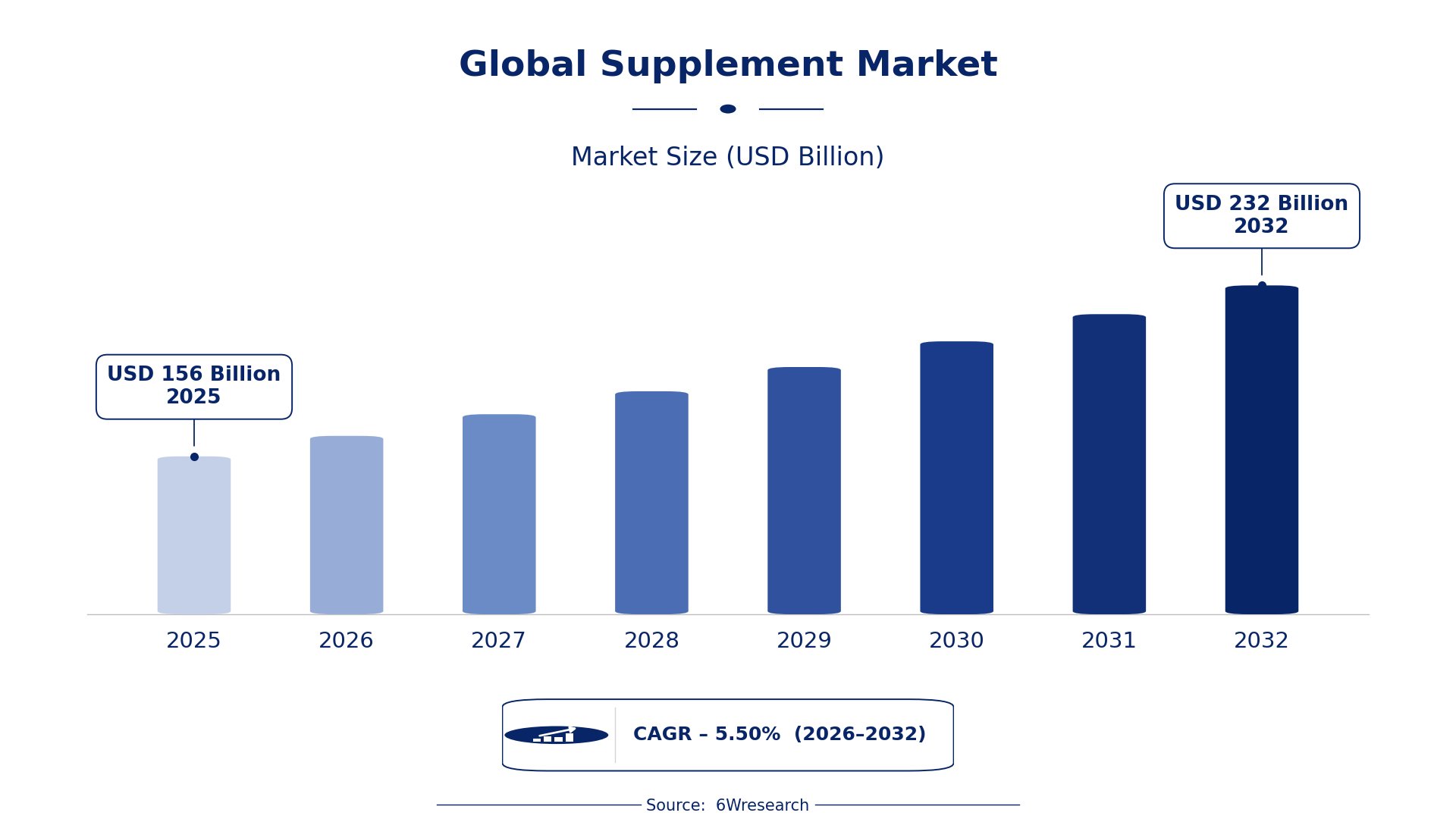
The Global Supplement Market was estimated at USD 156 Billion in 2025 and is projected to reach USD 232 Billion by 2032, growing at a CAGR of 5.50% from 2026 to 2032.
Global Supplement Market Synopsis
Currently, the Global Supplement Market is experiencing a transformation driven by evolving consumer preferences and stricter regulatory landscapes. The emphasis on preventive healthcare is leading to a surge in demand for supplements tailored to specific health and wellness needs. As an illustration, the pandemic's aftermath has significantly influenced consumer behavior, pushing them toward immunity-enhancing products.
Additionally, the market is witnessing innovative product developments focusing on natural and organic ingredients, which are aligning with consumer sustainability demands. This trajectory is attracting investment and fostering a competitive landscape, characterized by both established players and new entrants attempting to capture market share through differentiation.
Global Supplement Market Year-wise Growth Rate and Key Drivers
This graph illustrates the annual growth rates of the Global Supplement Market from 2022 to 2032, highlighting a steady upward trajectory and projected expansion over the forecast period.
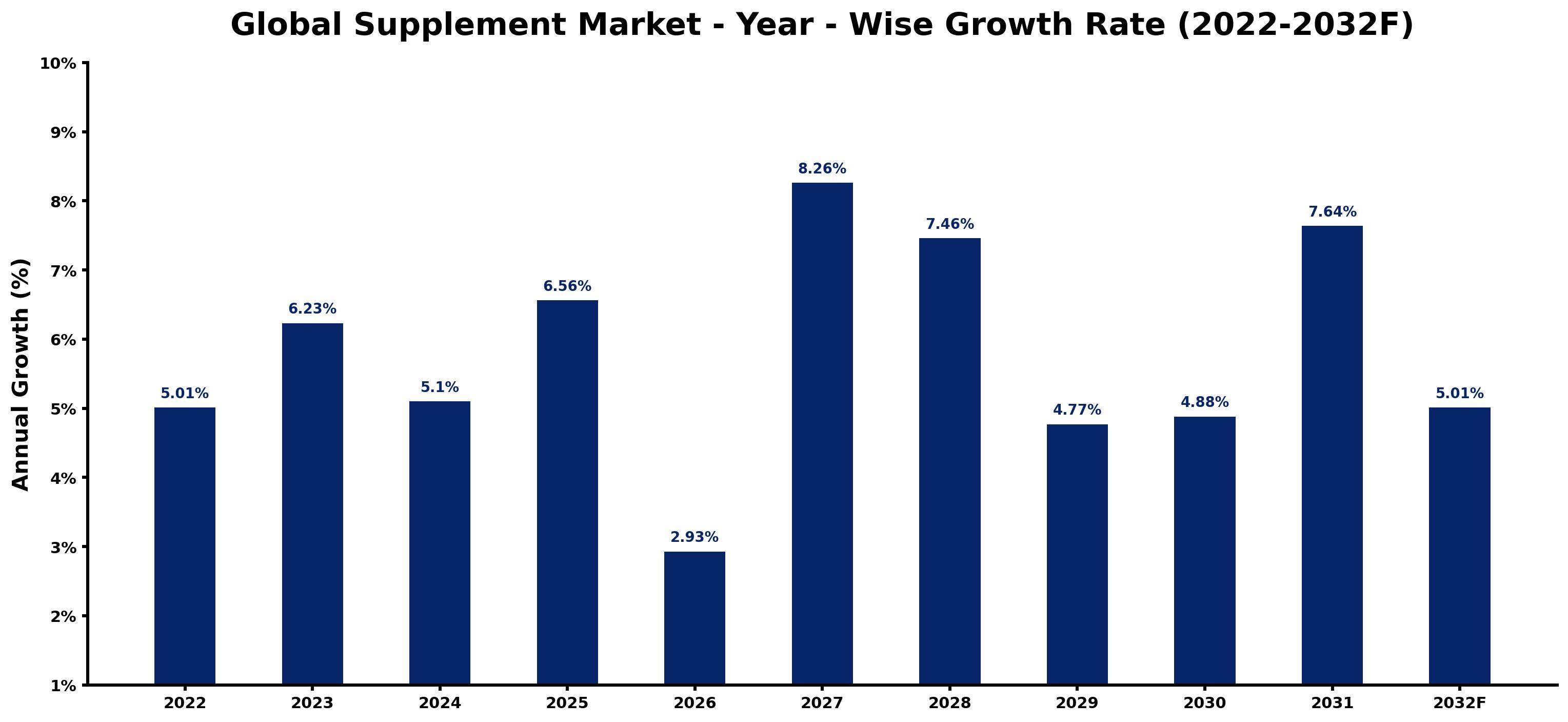
The table below presents the year‑wise growth rates along with the key drivers influencing the market
| Year | Growth Rate (%) | Major Drivers |
| 2022 | 5.01 | Hospital infrastructure investments increasingly prioritize sustainability in supplement sourcing strategies. |
| 2023 | 6.23 | Technological advancements enhance the efficacy and accessibility of dietary supplements. |
| 2024 | 5.1 | Consumers are shifting towards natural supplements as health-conscious lifestyle choices evolve. |
| 2025 | 6.56 | Efficient supply chain logistics enable timely distribution of supplements to meet rising needs. |
| 2026 | 2.93 | Biosensor technology drives innovative applications in monitoring supplement effectiveness for patients. |
| 2027 | 8.26 | As raw material prices rise, supplement manufacturers adapt strategies to maintain profitability. |
| 2028 | 7.46 | Health insurers are expanding reimbursement policies for clinically approved supplement therapies. |
| 2029 | 4.77 | A shift toward personalized supplements changes the competitive strategies of leading companies. |
| 2030 | 4.88 | Increasing user familiarity with digital therapeutics enhances supplement integration into healthcare plans. |
| 2031 | 7.64 | In North America, regional expansion leads to increased distribution of specialized supplements. |
| 2032 | 5.01 | Ramping up investment in supplement R&D is expected to stimulate market consolidation. |
Note - Market size estimations and growth projections presented in this report are based on 6Wresearch's proprietary research methodology, combining internal industry data, secondary research, and primary validation, updated periodically to reflect current market conditions. As markets evolve rapidly, figures for certain industries may vary slightly and are intended as informed estimates rather than absolute figures. For the most current market sizing, we recommend validating figures with a 6Wresearch analyst.
Global Supplement Market Key Takeaways
Below are some of the specific key takeaways from the market, including:
- The vegan supplement segment is expected to make up around 38% of the market share in 2025, driven by increasing health consciousness.
- Asia is emerging as a fast-growing region, projected to exhibit a CAGR of 8.7% from 2026 to 2032, primarily due to rising disposable incomes and health awareness.
- Amway reported a 10% growth in their dietary supplement division in 2022, showcasing robust performance against competitors.
- The demand for plant-based supplements surged by approximately 15% in 2023 compared to the previous year, reflecting changing consumer preferences.
Evaluation of Restraints in Global Supplement Market
Several restraints affect the Global Supplement Market, notably regulatory challenges that could result in significant compliance costs. For instance, the FDA's stringent guidelines on dietary supplements mandate extensive safety and efficacy documentation, which can exceed costs of $1 million for some businesses. For example, smaller enterprises often face barriers in meeting established quality standards, limiting their market entry. Additionally, growing consumer skepticism about supplement efficacy further complicates market dynamics.
Global Supplement Market Trends
The Global Supplement Market is characterized by several key trends that signify operational shifts. First, the integration of digital platforms for customer engagement is transforming how brands connect with consumers. For instance, companies like Herbalife have turned to personalized nutritional assessments through online interfaces, increasing engagement and tailored offerings. Furthermore, there’s a noted increase in the adoption of augmented reality (AR) technologies to enhance consumer education about supplement ingredients and benefits.
Additionally, a significant focus on clean labels is emerging. Brands that transparently showcase ingredient sourcing and manufacturing processes are better positioned to capture discerning consumers. For example, Nature's Bounty reports that supplements marketed with clean labels see a 25% higher purchase rate compared to regular offerings, reflecting evolving consumer expectations toward transparency and quality.
Global Supplement Market Opportunities
The Global Supplement Market presents numerous future revenue opportunities. One of the burgeoning segments is plant-based supplements, with a projected growth rate anticipated to exceed 10% by 2032. Companies like Garden of Life are at the forefront of this shift, investing heavily in organic sourcing to meet emerging demand. For example, they launched their new line of plant-based protein powders in 2023, aiming to attract health-conscious consumers.
Additionally, the increasing popularity of supplements targeting mental health and wellness holds promise. Research indicates that approximately 30% of consumers are now considering supplements for cognitive enhancement. Projects aimed at developing products enriched with adaptogens and nootropics are gaining traction. For instance, the market for adaptogenic supplements is expected to reach $5 billion by 2026, driven by a growing interest in natural stress relief solutions.
Global Supplement Market by Type
In the Global Supplement Market, the vegan segment leads the market, accounting for approximately 38% share in 2025. This dominance is fueled by a rising consumer shift toward plant-based diets and increased awareness of health benefits associated with vegan products. Additionally, the plant-based segment is anticipated to be the fastest-growing, with a CAGR of 8.3% from 2026 to 2032 due to heightened interest in sustainable sourcing and transparent labeling.
Global Supplement Market by Application
The largest application segment within the Global Supplement Market is targeting the elderly, which is projected to hold around 40% share in 2025. This demand is largely driven by the aging population's specific nutritional requirements and health concerns. Conversely, the fastest-growing segment is focused on infants and children, expected to see a CAGR of 9.2% from 2026 to 2032, primarily due to increasing parental awareness of early nutrition and preventative health.
Global Supplement Market by Region
North America is currently the largest region in the Global Supplement Market, boasting around 45% share in 2025. The robust production ecosystem, coupled with strong consumer demand for health-related products, underpins this dominant position. In contrast, Asia is anticipated to be the fastest-growing region, with a CAGR of 8.7% from 2026 to 2032, influenced by rapid urbanization, rising incomes, and heightened health awareness among consumers.
Government Initiatives in the Global Supplement Market
The regulatory landscape for the Global Supplement Market is shaped by various government initiatives designed to promote product safety and quality standards. These initiatives are essential for fostering consumer trust and enabling fair competition among market players.
- U.S. Food and Drug Administration (FDA) – Dietary Supplement Health and Education Act (DSHEA), 1994: This act set forth regulations for dietary supplements, establishing a framework for product labeling and claims, thereby affecting compliance costs for manufacturers.
- European Food Safety Authority (EFSA) – Regulation (EU) No 1169/2011, December 2011: This regulation mandates clear labeling of nutritional information, directly impacting the marketing strategies of supplement companies operating in Europe.
- Health Canada – Natural Health Products Regulations, effective 2004: These regulations require a license for natural health products sold in Canada, enhancing product safety and efficacy oversight in the Canadian market.
- Food Safety and Standards Authority of India (FSSAI) – Food Safety and Standards (Health Supplements, Nutraceuticals and Functional Foods) Regulations, 2023: This recent initiative aims to standardize health supplement quality in India, enhancing consumer protection and market integrity.
Future Insights of the Global Supplement Market
As the Global Supplement Market moves towards 2032, an emphasis on personalized nutrition will become increasingly prevalent. Companies like GNC are investing in data-driven approaches to tailor supplements based on individual health profiles, fueling consumer engagement. The rise of e-commerce platforms will also augment accessibility, enabling consumers to easily obtain targeted products. Furthermore, the shift towards preventative health measures is likely to accelerate the development of supplements focused on immunity and overall wellness, meeting heightened consumer expectations for efficacy and transparency.
Global Supplement Market Latest Developments
Several noteworthy initiatives are shaping the Global Supplement Market, impacting competitive dynamics and paving the way for future growth.
- In late 2023, Herbalife introduced a new range of vegan protein powders, enhancing their portfolio to cater to the rising demand for plant-based nutrition, thus strengthening their market position.
- Recently completed in early 2024, Amway expanded its product line with a focus on clean-label supplements, responding to consumer preferences for transparency and natural ingredients.
- Upcoming in 2025, Nature's Bounty plans to launch a series of products integrating adaptogens aimed at mental health and cognitive functions, tapping into a growing segment of health-conscious consumers.
- In 2024, GNC announced a strategic partnership with a tech company to develop a personalized supplement subscription service, aiming at enhancing customer loyalty and tailored solutions.
Global Supplement Market Key Players and Industry Positioning
The Global Supplement Market exhibits a mixed competitive structure, featuring both established giants and emerging players. Major companies are leveraging proprietary innovations and strategic partnerships to fortify market presence. This competitive environment allows for a diverse array of products that cater to various consumer needs and preferences.
| Leading Company | Core Strength | Strategic Focus |
|---|---|---|
| Amway | Broad product portfolio with a focus on quality | Expansion of clean-label and organic products |
| Herbalife | Strong brand loyalty with personalized offerings | Targeting health and fitness with vegan options |
| Nestle | Global distribution network and significant R&D | Investing in health-focused nutritional supplements |
| GNC | Established retail presence with diverse product lines | Adopting technology for personalized nutrition |
| Nature's Bounty | Commitment to transparency and clean-label initiatives | Focus on adaptogens and wellness-driven products |
The competitive landscape highlights distinct strategic focuses that allow each company to carve out a niche within the market, continuously evolving to meet consumer expectations.
Key Attractiveness of the Report
- 10 Years of Market Numbers
- Historical Data Starting from 2022 to 2025
- Base Year: 2025
- Forecast Data until 2032
- Key Performance Indicators Impacting the Market
- Major Upcoming Developments and Projects
Key Highlights of the Report:
- Global Supplement Market Outlook
- Market Size of Global Supplement Market, 2025
- Forecast of Global Supplement Market, 2032
- Historical Data and Forecast of Global Supplement Revenues & Volume for the Period 2022-2032
- Global Supplement Market Trend Evolution
- Global Supplement Market Drivers and Challenges
- Global Supplement Price Trends
- Global Supplement Porter's Five Forces
- Global Supplement Industry Life Cycle
- Historical Data and Forecast of Global Supplement Market Revenues & Volume
- Historical Data and Forecast of Global Supplement Market Revenues & Volume By Type for the Period 2022-2032
- Historical Data and Forecast of Global Supplement Market Revenues & Volume By Vegan for the Period 2022-2032
- Historical Data and Forecast of Global Supplement Market Revenues & Volume By Non-Vegan for the Period 2022-2032
- Historical Data and Forecast of Global Supplement Market Revenues & Volume By Application for the Period 2022-2032
- Historical Data and Forecast of Global Supplement Market Revenues & Volume By Elderly for the Period 2022-2032
- Historical Data and Forecast of Global Supplement Market Revenues & Volume By Pregnant Female for the Period 2022-2032
- Historical Data and Forecast of Global Supplement Market Revenues & Volume By Infants and Children for the Period 2022-2032
- Historical Data and Forecast of Global Supplement Market Revenues & Volume By Others for the Period 2022-2032
- Historical Data and Forecast of North America Supplement Market Revenues & Volume By Type for the Period 2022-2032
- Historical Data and Forecast of North America Supplement Market Revenues & Volume By Vegan for the Period 2022-2032
- Historical Data and Forecast of North America Supplement Market Revenues & Volume By Non-Vegan for the Period 2022-2032
- Historical Data and Forecast of North America Supplement Market Revenues & Volume By Application for the Period 2022-2032
- Historical Data and Forecast of North America Supplement Market Revenues & Volume By Elderly for the Period 2022-2032
- Historical Data and Forecast of North America Supplement Market Revenues & Volume By Pregnant Female for the Period 2022-2032
- Historical Data and Forecast of North America Supplement Market Revenues & Volume By Infants and Children for the Period 2022-2032
- Historical Data and Forecast of North America Supplement Market Revenues & Volume By Others for the Period 2022-2032
- Historical Data and Forecast of United States of America Supplement Market Revenues & Volume for the Period 2022-2032
- Historical Data and Forecast of Canada Supplement Market Revenues & Volume for the Period 2022-2032
- Historical Data and Forecast of Rest of North America Supplement Market Revenues & Volume for the Period 2022-2032
- Historical Data and Forecast of Latin America (LATAM) Supplement Market Revenues & Volume By Type for the Period 2022-2032
- Historical Data and Forecast of Latin America (LATAM) Supplement Market Revenues & Volume By Vegan for the Period 2022-2032
- Historical Data and Forecast of Latin America (LATAM) Supplement Market Revenues & Volume By Non-Vegan for the Period 2022-2032
- Historical Data and Forecast of Latin America (LATAM) Supplement Market Revenues & Volume By Application for the Period 2022-2032
- Historical Data and Forecast of Latin America (LATAM) Supplement Market Revenues & Volume By Elderly for the Period 2022-2032
- Historical Data and Forecast of Latin America (LATAM) Supplement Market Revenues & Volume By Pregnant Female for the Period 2022-2032
- Historical Data and Forecast of Latin America (LATAM) Supplement Market Revenues & Volume By Infants and Children for the Period 2022-2032
- Historical Data and Forecast of Latin America (LATAM) Supplement Market Revenues & Volume By Others for the Period 2022-2032
- Historical Data and Forecast of Brazil Supplement Market Revenues & Volume for the Period 2022-2032
- Historical Data and Forecast of Mexico Supplement Market Revenues & Volume for the Period 2022-2032
- Historical Data and Forecast of Argentina Supplement Market Revenues & Volume for the Period 2022-2032
- Historical Data and Forecast of Rest of LATAM Supplement Market Revenues & Volume for the Period 2022-2032
- Historical Data and Forecast of Asia Supplement Market Revenues & Volume By Type for the Period 2022-2032
- Historical Data and Forecast of Asia Supplement Market Revenues & Volume By Vegan for the Period 2022-2032
- Historical Data and Forecast of Asia Supplement Market Revenues & Volume By Non-Vegan for the Period 2022-2032
- Historical Data and Forecast of Asia Supplement Market Revenues & Volume By Application for the Period 2022-2032
- Historical Data and Forecast of Asia Supplement Market Revenues & Volume By Elderly for the Period 2022-2032
- Historical Data and Forecast of Asia Supplement Market Revenues & Volume By Pregnant Female for the Period 2022-2032
- Historical Data and Forecast of Asia Supplement Market Revenues & Volume By Infants and Children for the Period 2022-2032
- Historical Data and Forecast of Asia Supplement Market Revenues & Volume By Others for the Period 2022-2032
- Historical Data and Forecast of China Supplement Market Revenues & Volume for the Period 2022-2032
- Historical Data and Forecast of India Supplement Market Revenues & Volume for the Period 2022-2032
- Historical Data and Forecast of Japan Supplement Market Revenues & Volume for the Period 2022-2032
- Historical Data and Forecast of Rest of Asia Supplement Market Revenues & Volume for the Period 2022-2032
- Historical Data and Forecast of Africa Supplement Market Revenues & Volume By Type for the Period 2022-2032
- Historical Data and Forecast of Africa Supplement Market Revenues & Volume By Vegan for the Period 2022-2032
- Historical Data and Forecast of Africa Supplement Market Revenues & Volume By Non-Vegan for the Period 2022-2032
- Historical Data and Forecast of Africa Supplement Market Revenues & Volume By Application for the Period 2022-2032
- Historical Data and Forecast of Africa Supplement Market Revenues & Volume By Elderly for the Period 2022-2032
- Historical Data and Forecast of Africa Supplement Market Revenues & Volume By Pregnant Female for the Period 2022-2032
- Historical Data and Forecast of Africa Supplement Market Revenues & Volume By Infants and Children for the Period 2022-2032
- Historical Data and Forecast of Africa Supplement Market Revenues & Volume By Others for the Period 2022-2032
- Historical Data and Forecast of South Africa Supplement Market Revenues & Volume for the Period 2022-2032
- Historical Data and Forecast of Nigeria Supplement Market Revenues & Volume for the Period 2022-2032
- Historical Data and Forecast of Egypt Supplement Market Revenues & Volume for the Period 2022-2032
- Historical Data and Forecast of Rest of Africa Supplement Market Revenues & Volume for the Period 2022-2032
- Historical Data and Forecast of Europe Supplement Market Revenues & Volume By Type for the Period 2022-2032
- Historical Data and Forecast of Europe Supplement Market Revenues & Volume By Vegan for the Period 2022-2032
- Historical Data and Forecast of Europe Supplement Market Revenues & Volume By Non-Vegan for the Period 2022-2032
- Historical Data and Forecast of Europe Supplement Market Revenues & Volume By Application for the Period 2022-2032
- Historical Data and Forecast of Europe Supplement Market Revenues & Volume By Elderly for the Period 2022-2032
- Historical Data and Forecast of Europe Supplement Market Revenues & Volume By Pregnant Female for the Period 2022-2032
- Historical Data and Forecast of Europe Supplement Market Revenues & Volume By Infants and Children for the Period 2022-2032
- Historical Data and Forecast of Europe Supplement Market Revenues & Volume By Others for the Period 2022-2032
- Historical Data and Forecast of United Kingdom Supplement Market Revenues & Volume for the Period 2022-2032
- Historical Data and Forecast of France Supplement Market Revenues & Volume for the Period 2022-2032
- Historical Data and Forecast of Germany Supplement Market Revenues & Volume for the Period 2022-2032
- Historical Data and Forecast of Rest of Europe Supplement Market Revenues & Volume for the Period 2022-2032
- Historical Data and Forecast of Middle East Supplement Market Revenues & Volume By Type for the Period 2022-2032
- Historical Data and Forecast of Middle East Supplement Market Revenues & Volume By Vegan for the Period 2022-2032
- Historical Data and Forecast of Middle East Supplement Market Revenues & Volume By Non-Vegan for the Period 2022-2032
- Historical Data and Forecast of Middle East Supplement Market Revenues & Volume By Application for the Period 2022-2032
- Historical Data and Forecast of Middle East Supplement Market Revenues & Volume By Elderly for the Period 2022-2032
- Historical Data and Forecast of Middle East Supplement Market Revenues & Volume By Pregnant Female for the Period 2022-2032
- Historical Data and Forecast of Middle East Supplement Market Revenues & Volume By Infants and Children for the Period 2022-2032
- Historical Data and Forecast of Middle East Supplement Market Revenues & Volume By Others for the Period 2022-2032
- Historical Data and Forecast of Saudi Arabia Supplement Market Revenues & Volume for the Period 2022-2032
- Historical Data and Forecast of UAE Supplement Market Revenues & Volume for the Period 2022-2032
- Historical Data and Forecast of Turkey Supplement Market Revenues & Volume for the Period 2022-2032
- Historical Data and Forecast of Rest of Middle East Supplement Market Revenues & Volume for the Period 2022-2032
- Global Supplement Market - Key Performance Indicators
- Global Supplement Market - Import Export Trade Statistics
- Global Supplement Market - Opportunity Assessment By Countries
- Global Supplement Market - Opportunity Assessment By Type
- Global Supplement Market - Opportunity Assessment By Application
- Global Supplement Market - Top Companies Market Share
- Global Supplement Market - Top Companies Profiles
- Global Supplement Market - Comparison of Players in Technical and Operating Parameters
- Global Supplement Market - Strategic Recommendations
Markets Covered
The Global Supplement Market report provides a detailed analysis of the following market segments:
By Regions and Countries:
- North America
- Europe
- LATAM
- Middle East
- Asia
- Africa
By Type:
- Vegan
- Non-Vegan
By Application:
- Elderly
- Pregnant Female
- Infants
- Children
- Others






































