Global Vans Market Highlights
| Market Size (2025) | USD 108.4 Billion |
| Forecast Size (2032) | USD 138.7 Billion |
| CAGR | 8.31% |
| Base Year | 2025 |
| Forecast Period | 2026-2032 |
| Largest Region | North America |
| Fastest Growing Region | Asia-Pacific |
| Largest Segment | 6 People |
| Fastest Growing Segment | 9 People or More |
| Leading Companies | Ford, Mercedes-Benz, Toyota, Volkswagen, Nissan |
Global Vans Market Size & Growth Rate (2026-2032)
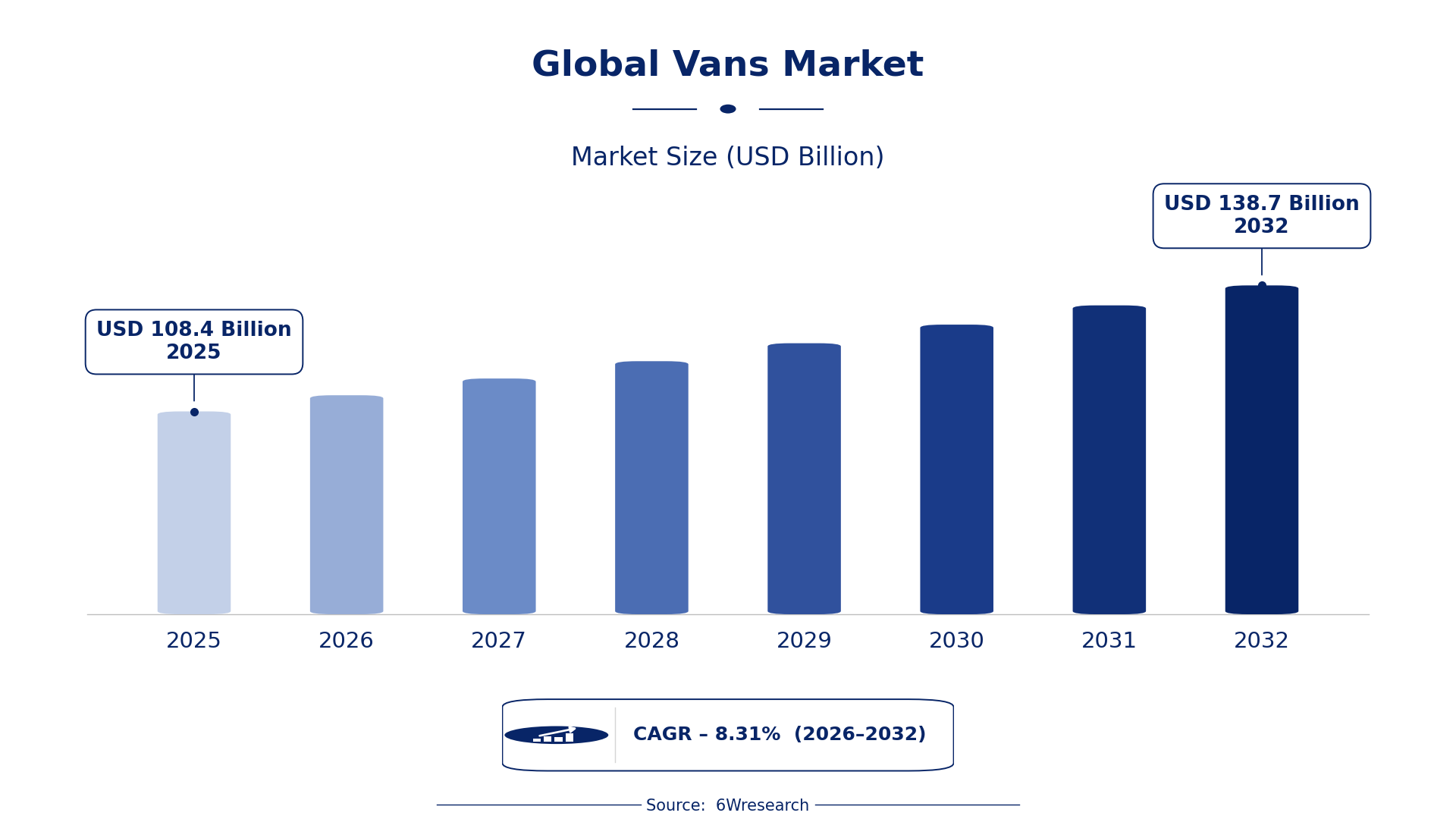
The Global Vans Market was estimated at USD 108.4 Billion in 2025 and is projected to reach USD 138.7 Billion by 2032, growing at a CAGR of 8.31% from 2026 to 2032.
Global Vans Market Synopsis
The Global Vans Market is witnessing transformative changes, driven by evolving consumer behaviors and increasing requirements for multifunctional transportation. The shift towards urbanization, alongside a growing preference for efficient logistics solutions, has rendered vans indispensable in sectors such as e-commerce and passenger transport.
The market’s landscape is distinct from other automotive sectors due to its specialization in cargo, passenger, and recreational vehicles. Technological advancements, like the emergence of electric vans, signal a drive towards sustainability, further differentiating this market from adjacent sectors focused primarily on passenger cars.
Global Vans Market Year-wise Growth Rate and Key Drivers
This graph illustrates the annual growth rates of the Global Vans Market from 2022 to 2032, highlighting a steady upward trajectory and projected expansion over the forecast period.
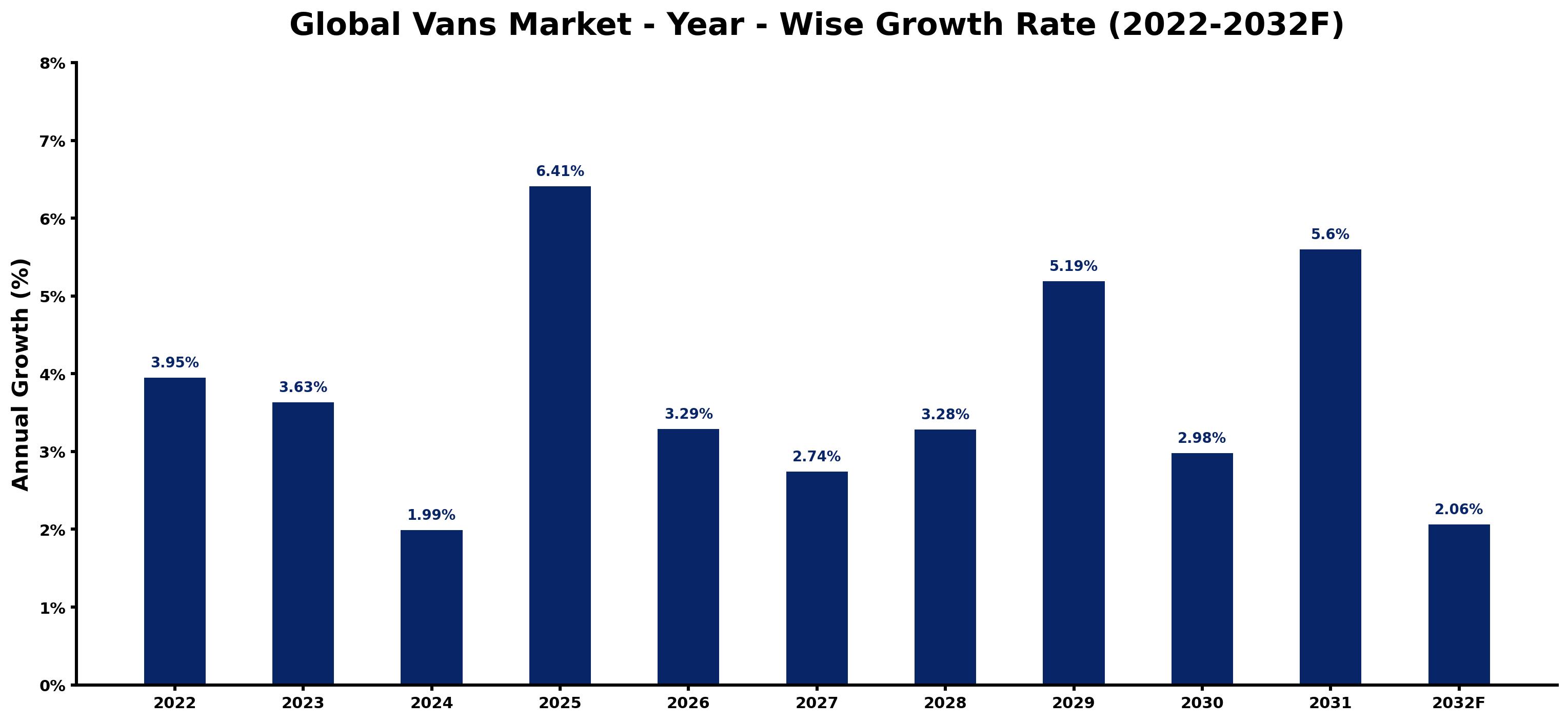
The table below presents the year‑wise growth rates along with the key drivers influencing the market
| Year | Growth Rate (%) | Major Drivers |
| 2022 | 3.95 | A shift toward stricter emissions regulations changes the compliance landscape for vans. |
| 2023 | 3.63 | Electric vehicle battery technology enhances the skills required in the vans workforce. |
| 2024 | 1.99 | Manufacturers prioritizing sustainability in production aims for eco-friendly vans. |
| 2025 | 6.41 | Supply chain constraints in OEM production cycles impact the availability of vans. |
| 2026 | 3.29 | Investing in charging infrastructure increases consumer confidence in electric vans. |
| 2027 | 2.74 | Rising raw material costs are challenging the profitability of van manufacturers. |
| 2028 | 3.28 | While competition intensifies, manufacturers are innovating next-generation vans for urban mobility. |
| 2029 | 5.19 | Advancements in autonomous driving software enhance the functionality of commercial vans. |
| 2030 | 2.98 | Fleet operators are increasingly demanding electric vans to lower operational costs. |
| 2031 | 5.6 | In North America, the shift toward electric vans is gaining significant traction. |
| 2032 | 2.06 | Automakers expanding their electric vehicle offerings are integrating innovative vans into their portfolios. |
Note - Market size estimations and growth projections presented in this report are based on 6Wresearch's proprietary research methodology, combining internal industry data, secondary research, and primary validation, updated periodically to reflect current market conditions. As markets evolve rapidly, figures for certain industries may vary slightly and are intended as informed estimates rather than absolute figures. For the most current market sizing, we recommend validating figures with a 6Wresearch analyst.
Global Vans Market Key Takeaways
Below are some of the specific key takeaways from the market, including:
- By 2025, North America is expected to capture approximately 40% of the Global Vans Market.
- The segment for 6 People is anticipated to constitute around 32% of the total market share in 2025.
- Asia-Pacific is projected to exhibit a robust CAGR of 10.2% during the forecast period, indicative of increasing demand.
- Leading companies such as Ford are expanding their production capacities, with an investment of $1.5 billion in electric van manufacturing planned for 2023.
- Sustainability practices are becoming vital, with over 25% of the major manufacturers now focusing on low-emission vehicle technologies.
Evaluation of Restraints in Global Vans Market
The Global Vans Market faces unique challenges that could hinder its progress. Fluctuating raw material prices, particularly for critical components like aluminum and steel, can lead to significant production cost increases. For instance, a recent surge in aluminum prices resulted in an estimated cost increase of about $2,000 per van, directly impacting manufacturers’ margins. Additionally, increasingly stringent environmental regulations are imposing compliance costs, pressuring companies to invest heavily in technology to meet emissions standards.
Global Vans Market Trends
The Global Vans Market is undergoing notable trends driven by technological and operational shifts. Firstly, the integration of electric vehicle (EV) technology is reshaping the market dynamics. Companies like Mercedes-Benz plan to release their EQV electric van series in 2023, targeting eco-conscious consumers. Secondly, the rise of e-commerce is pushing brands towards development in last-mile delivery solutions, leading to innovations in design and functionality. For example, the introduction of automated vans by Waymo aims to enhance delivery efficiency without the need for drivers, further realigning operational strategies.
Global Vans Market Opportunities
The future of the Global Vans Market holds promising revenue opportunities stemming from multiple sectors. One evident area is the electrification of vans, with companies like Rivian targeting the commercial sector with their electric delivery vehicles projected to exceed 100,000 sales by 2025. Additionally, as the demand for urban logistics solutions grows, investing in smart, automated vans for logistics applications presents substantial growth avenues, as they can significantly reduce delivery times and costs. Furthermore, there is potential in diversifying into emerging markets, as increasing disposable incomes in regions like South Asia drive the demand for personal and recreational vans.
Global Vans Market by Type
Among the various configurations in the Global Vans Market, the segment for 6 People leads with a 32% share in 2025. In contrast, the 9 People or More segment is poised to be the fastest-growing segment, with an anticipated CAGR of 9.5% from 2026 to 2032. The growing preference for larger family vans and the concurrent rise in travel and tourism highlight the increasing consumer demand for spacious vehicles, making this shift critical for market players.
Global Vans Market by Application
Commercial application leads the Global Vans Market, capturing approximately 64% of the market share in 2025. Conversely, personal use is on a growth trajectory, with an impressive CAGR of 9.0% anticipated from 2026 to 2032. The surge in small business establishments necessitating practical transportation for goods and services solidifies the commercial segment's leadership, while recreational trends are driving personal applications upward, underscoring evolving consumer preferences.
Global Vans Market by Region
North America stands out as the largest region in the Global Vans Market, accounting for about 40% of the market share in 2025. Meanwhile, Asia-Pacific is expected to showcase the fastest growth, with an estimated CAGR of 10.2% from 2026 to 2032. The region's burgeoning infrastructure coupled with an increasing urban population drives strong demand for versatile transportation solutions, positioning it favorably within the global landscape.
Government Initiatives in the Global Vans Market
The regulatory landscape surrounding the Global Vans Market is undergoing significant changes, as various governments enact policies aimed at promoting sustainability and innovation. These initiatives are primarily focused on enhancing manufacturing efficiencies and reducing environmental impacts, shaping the operational framework for industry players.
- U.S. Department of Energy: Clean Cities Program, 2022 - This initiative aims to promote the adoption of green technologies in the transportation sector, enabling a shift toward cleaner van production processes.
- European Commission: Green Deal, 2023 - This comprehensive policy seeks to regulate emissions and promote the electrification of commercial fleets, thereby benefiting manufacturers focusing on electric vans.
- Indian Ministry of Road Transport and Highways: National Electric Mobility Mission Plan (NEMMP), 2021 - This program outlines plans for incentives and subsidies for electric vans to promote cleaner transportation solutions.
- Chinese Ministry of Industry and Information Technology: New Energy Vehicle (NEV) Policy, 2020 - Aims to boost EV production capacity through subsidies, increasing competitiveness in the van market.
Future Insights of the Global Vans Market
As the Global Vans Market evolves, the integration of advanced technologies such as artificial intelligence and autonomous driving solutions is anticipated to reshape operational models. For instance, major players like Ford are investing in AI-driven logistics systems to enhance delivery efficiency. By 2032, this could lead to a significant transformation in supply chains, allowing for enhanced tracking, reduced operational costs, and improved customer satisfaction, thereby solidifying market positions through innovation and efficiency.
Global Vans Market Latest Developments
Several recent developments have marked strategic moves by companies in the Global Vans Market. These enhancements reflect shifts in technology and market focus.
- Ford announced an upcoming launch of its electric Transit van series in early 2024, aiming to capture commercial clients focused on sustainability.
- Mercedes-Benz is currently expanding its manufacturing capabilities in Europe to produce its next-gen electric vans, set for completion in mid-2023, enhancing its market reach.
- Volkswagen is rolling out its new software platform designed for smart vehicle connectivity, expected to be operational by late 2023, facilitating better integration of fleet management systems.
- Toyota is investing in battery technology improvements, with a pilot program scheduled for late 2024 focused on enhancing energy efficiency in its van designs.
Global Vans Market Key Players and Industry Positioning
The Global Vans Market features a fragmented competitive structure, where both established and emerging players vie for market share. Each company's unique strengths and strategic initiatives paint a diverse picture of competition, addressing different consumer needs and technological advancements.
| Leading Company | Core Strength | Strategic Focus |
|---|---|---|
| Ford | Strong in commercial vehicle manufacturing | Shift towards electric vehicle lineup |
| Mercedes-Benz | Premium market positioning | Emphasis on electric and connected vans |
| Toyota | Expertise in hybrid and fuel-efficient technologies | Innovating battery technology for vans |
| Volkswagen | Robust software development capabilities | Integration of smart technology in vehicle design |
| Nissan | Reputation for reliable commercial electric vans | Expansion of charging infrastructure partnerships |
A diversified approach among key players is shaping the Global Vans Market, with emphasis on both technological innovation and sustainable practices that cater to evolving consumer preferences.
Key Attractiveness of the Report
- 10 Years of Market Numbers
- Historical Data Starting from 2022 to 2025
- Base Year: 2025
- Forecast Data until 2032
- Key Performance Indicators Impacting the Market
- Major Upcoming Developments and Projects
Key Highlights of the Report:
- Global Vans Market Outlook
- Market Size of Global Vans Market, 2025
- Forecast of Global Vans Market, 2032
- Historical Data and Forecast of Global Vans Revenues & Volume for the Period 2022-2032
- Global Vans Market Trend Evolution
- Global Vans Market Drivers and Challenges
- Global Vans Price Trends
- Global Vans Porter's Five Forces
- Global Vans Industry Life Cycle
- Historical Data and Forecast of Global Vans Market Revenues & Volume
- Historical Data and Forecast of Global Vans Market Revenues & Volume By Type for the Period 2022-2032
- Historical Data and Forecast of Global Vans Market Revenues & Volume By 2 People or Fewer for the Period 2022-2032
- Historical Data and Forecast of Global Vans Market Revenues & Volume By 5 People for the Period 2022-2032
- Historical Data and Forecast of Global Vans Market Revenues & Volume By 6 People for the Period 2022-2032
- Historical Data and Forecast of Global Vans Market Revenues & Volume By 7 to 8 People for the Period 2022-2032
- Historical Data and Forecast of Global Vans Market Revenues & Volume By 9 People or More for the Period 2022-2032
- Historical Data and Forecast of Global Vans Market Revenues & Volume By Application for the Period 2022-2032
- Historical Data and Forecast of Global Vans Market Revenues & Volume By Commercial for the Period 2022-2032
- Historical Data and Forecast of Global Vans Market Revenues & Volume By Personal for the Period 2022-2032
- Historical Data and Forecast of North America Vans Market Revenues & Volume By Type for the Period 2022-2032
- Historical Data and Forecast of North America Vans Market Revenues & Volume By 2 People or Fewer for the Period 2022-2032
- Historical Data and Forecast of North America Vans Market Revenues & Volume By 5 People for the Period 2022-2032
- Historical Data and Forecast of North America Vans Market Revenues & Volume By 6 People for the Period 2022-2032
- Historical Data and Forecast of North America Vans Market Revenues & Volume By 7 to 8 People for the Period 2022-2032
- Historical Data and Forecast of North America Vans Market Revenues & Volume By 9 People or More for the Period 2022-2032
- Historical Data and Forecast of North America Vans Market Revenues & Volume By Application for the Period 2022-2032
- Historical Data and Forecast of North America Vans Market Revenues & Volume By Commercial for the Period 2022-2032
- Historical Data and Forecast of North America Vans Market Revenues & Volume By Personal for the Period 2022-2032
- Historical Data and Forecast of United States of America Vans Market Revenues & Volume for the Period 2022-2032
- Historical Data and Forecast of Canada Vans Market Revenues & Volume for the Period 2022-2032
- Historical Data and Forecast of Rest of North America Vans Market Revenues & Volume for the Period 2022-2032
- Historical Data and Forecast of Latin America (LATAM) Vans Market Revenues & Volume By Type for the Period 2022-2032
- Historical Data and Forecast of Latin America (LATAM) Vans Market Revenues & Volume By 2 People or Fewer for the Period 2022-2032
- Historical Data and Forecast of Latin America (LATAM) Vans Market Revenues & Volume By 5 People for the Period 2022-2032
- Historical Data and Forecast of Latin America (LATAM) Vans Market Revenues & Volume By 6 People for the Period 2022-2032
- Historical Data and Forecast of Latin America (LATAM) Vans Market Revenues & Volume By 7 to 8 People for the Period 2022-2032
- Historical Data and Forecast of Latin America (LATAM) Vans Market Revenues & Volume By 9 People or More for the Period 2022-2032
- Historical Data and Forecast of Latin America (LATAM) Vans Market Revenues & Volume By Application for the Period 2022-2032
- Historical Data and Forecast of Latin America (LATAM) Vans Market Revenues & Volume By Commercial for the Period 2022-2032
- Historical Data and Forecast of Latin America (LATAM) Vans Market Revenues & Volume By Personal for the Period 2022-2032
- Historical Data and Forecast of Brazil Vans Market Revenues & Volume for the Period 2022-2032
- Historical Data and Forecast of Mexico Vans Market Revenues & Volume for the Period 2022-2032
- Historical Data and Forecast of Argentina Vans Market Revenues & Volume for the Period 2022-2032
- Historical Data and Forecast of Rest of LATAM Vans Market Revenues & Volume for the Period 2022-2032
- Historical Data and Forecast of Asia Vans Market Revenues & Volume By Type for the Period 2022-2032
- Historical Data and Forecast of Asia Vans Market Revenues & Volume By 2 People or Fewer for the Period 2022-2032
- Historical Data and Forecast of Asia Vans Market Revenues & Volume By 5 People for the Period 2022-2032
- Historical Data and Forecast of Asia Vans Market Revenues & Volume By 6 People for the Period 2022-2032
- Historical Data and Forecast of Asia Vans Market Revenues & Volume By 7 to 8 People for the Period 2022-2032
- Historical Data and Forecast of Asia Vans Market Revenues & Volume By 9 People or More for the Period 2022-2032
- Historical Data and Forecast of Asia Vans Market Revenues & Volume By Application for the Period 2022-2032
- Historical Data and Forecast of Asia Vans Market Revenues & Volume By Commercial for the Period 2022-2032
- Historical Data and Forecast of Asia Vans Market Revenues & Volume By Personal for the Period 2022-2032
- Historical Data and Forecast of China Vans Market Revenues & Volume for the Period 2022-2032
- Historical Data and Forecast of India Vans Market Revenues & Volume for the Period 2022-2032
- Historical Data and Forecast of Japan Vans Market Revenues & Volume for the Period 2022-2032
- Historical Data and Forecast of Rest of Asia Vans Market Revenues & Volume for the Period 2022-2032
- Historical Data and Forecast of Africa Vans Market Revenues & Volume By Type for the Period 2022-2032
- Historical Data and Forecast of Africa Vans Market Revenues & Volume By 2 People or Fewer for the Period 2022-2032
- Historical Data and Forecast of Africa Vans Market Revenues & Volume By 5 People for the Period 2022-2032
- Historical Data and Forecast of Africa Vans Market Revenues & Volume By 6 People for the Period 2022-2032
- Historical Data and Forecast of Africa Vans Market Revenues & Volume By 7 to 8 People for the Period 2022-2032
- Historical Data and Forecast of Africa Vans Market Revenues & Volume By 9 People or More for the Period 2022-2032
- Historical Data and Forecast of Africa Vans Market Revenues & Volume By Application for the Period 2022-2032
- Historical Data and Forecast of Africa Vans Market Revenues & Volume By Commercial for the Period 2022-2032
- Historical Data and Forecast of Africa Vans Market Revenues & Volume By Personal for the Period 2022-2032
- Historical Data and Forecast of South Africa Vans Market Revenues & Volume for the Period 2022-2032
- Historical Data and Forecast of Nigeria Vans Market Revenues & Volume for the Period 2022-2032
- Historical Data and Forecast of Egypt Vans Market Revenues & Volume for the Period 2022-2032
- Historical Data and Forecast of Rest of Africa Vans Market Revenues & Volume for the Period 2022-2032
- Historical Data and Forecast of Europe Vans Market Revenues & Volume By Type for the Period 2022-2032
- Historical Data and Forecast of Europe Vans Market Revenues & Volume By 2 People or Fewer for the Period 2022-2032
- Historical Data and Forecast of Europe Vans Market Revenues & Volume By 5 People for the Period 2022-2032
- Historical Data and Forecast of Europe Vans Market Revenues & Volume By 6 People for the Period 2022-2032
- Historical Data and Forecast of Europe Vans Market Revenues & Volume By 7 to 8 People for the Period 2022-2032
- Historical Data and Forecast of Europe Vans Market Revenues & Volume By 9 People or More for the Period 2022-2032
- Historical Data and Forecast of Europe Vans Market Revenues & Volume By Application for the Period 2022-2032
- Historical Data and Forecast of Europe Vans Market Revenues & Volume By Commercial for the Period 2022-2032
- Historical Data and Forecast of Europe Vans Market Revenues & Volume By Personal for the Period 2022-2032
- Historical Data and Forecast of United Kingdom Vans Market Revenues & Volume for the Period 2022-2032
- Historical Data and Forecast of France Vans Market Revenues & Volume for the Period 2022-2032
- Historical Data and Forecast of Germany Vans Market Revenues & Volume for the Period 2022-2032
- Historical Data and Forecast of Rest of Europe Vans Market Revenues & Volume for the Period 2022-2032
- Historical Data and Forecast of Middle East Vans Market Revenues & Volume By Type for the Period 2022-2032
- Historical Data and Forecast of Middle East Vans Market Revenues & Volume By 2 People or Fewer for the Period 2022-2032
- Historical Data and Forecast of Middle East Vans Market Revenues & Volume By 5 People for the Period 2022-2032
- Historical Data and Forecast of Middle East Vans Market Revenues & Volume By 6 People for the Period 2022-2032
- Historical Data and Forecast of Middle East Vans Market Revenues & Volume By 7 to 8 People for the Period 2022-2032
- Historical Data and Forecast of Middle East Vans Market Revenues & Volume By 9 People or More for the Period 2022-2032
- Historical Data and Forecast of Middle East Vans Market Revenues & Volume By Application for the Period 2022-2032
- Historical Data and Forecast of Middle East Vans Market Revenues & Volume By Commercial for the Period 2022-2032
- Historical Data and Forecast of Middle East Vans Market Revenues & Volume By Personal for the Period 2022-2032
- Historical Data and Forecast of Saudi Arabia Vans Market Revenues & Volume for the Period 2022-2032
- Historical Data and Forecast of UAE Vans Market Revenues & Volume for the Period 2022-2032
- Historical Data and Forecast of Turkey Vans Market Revenues & Volume for the Period 2022-2032
- Historical Data and Forecast of Rest of Middle East Vans Market Revenues & Volume for the Period 2022-2032
- Global Vans Market - Key Performance Indicators
- Global Vans Market - Import Export Trade Statistics
- Global Vans Market - Opportunity Assessment By Countries
- Global Vans Market - Opportunity Assessment By Type
- Global Vans Market - Opportunity Assessment By Application
- Global Vans Market - Top Companies Market Share
- Global Vans Market - Top Companies Profiles
- Global Vans Market - Comparison of Players in Technical and Operating Parameters
- Global Vans Market - Strategic Recommendations
Markets Covered
The Global Vans Market report provides a detailed analysis of the following market segments:
By Regions and Countries:
- North America
- Europe
- LATAM
- Middle East
- Asia
- Africa
By Type:
- 2 People or Fewer
- 5 People
- 6 People
- 7 to 8 People
- 9 People or More
By Application:
- Commercial
- Personal






































