Hong Kong Canned Tuna Market Top 5 Importing Countries and Market Competition (HHI) Analysis
In 2024, Hong Kong continued to rely on Thailand, Japan, Vietnam, Philippines, and China as the top exporters of canned tuna. Despite a modest compound annual growth rate (CAGR) of 2.31% from 2020 to 2024, the market experienced a decline in growth rate from 2023 to 2024 at -6.44%. The high Herfindahl-Hirschman Index (HHI) indicates a concentrated market for canned tuna imports in Hong Kong. Monitoring these trends and understanding the dynamics of key exporting countries will be crucial for stakeholders in the industry.
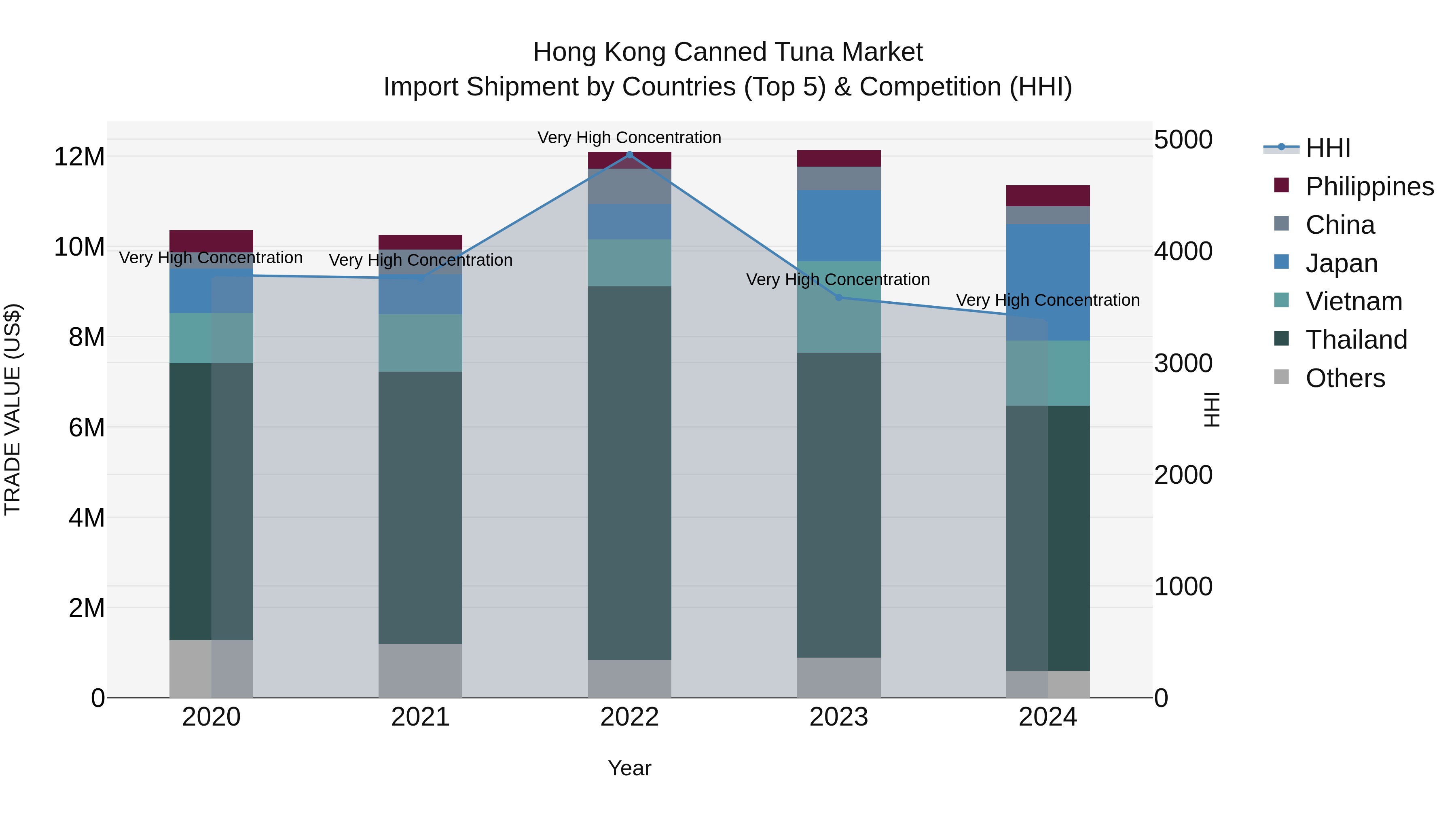
Hong Kong Canned Tuna Market Synopsis
The canned tuna market in Hong Kong is driven by a rising demand for convenient, high-protein food products. Consumers increasingly prefer ready-to-eat items due to busy lifestyles, and canned tuna fits this trend perfectly. Import dynamics and consumer preferences for specific tuna varieties are key factors shaping the market.
Drivers of the market
The canned tuna market in Hong Kong is influenced by the increasing consumer preference for healthy and convenient protein sources. As awareness of the health benefits of fish consumption grows, the demand for canned tuna is rising. The trend towards sustainable sourcing and responsible fishing practices further enhances market potential.
Challenges of the market
Sustainability concerns related to tuna fishing practices and competition from alternative protein sources are significant hurdles in the canned tuna market. Price volatility in the raw materials market adds further complications.
Government Policy of the market
In the Canned Tuna market, the Hong Kong government plays a critical role in regulating food safety standards and promoting sustainable fishing practices. The government enforces guidelines for the production and labeling of canned tuna products to ensure compliance with health regulations. Policies support responsible sourcing and environmental sustainability in the tuna fishing industry. Additionally, the government promotes consumer education about the nutritional benefits and safety of canned tuna.
Key Highlights of the Report:
- Hong Kong Canned Tuna Market Outlook
- Market Size of Hong Kong Canned Tuna Market, 2024
- Forecast of Hong Kong Canned Tuna Market, 2031
- Historical Data and Forecast of Hong Kong Canned Tuna Revenues & Volume for the Period 2021-2031
- Hong Kong Canned Tuna Market Trend Evolution
- Hong Kong Canned Tuna Market Drivers and Challenges
- Hong Kong Canned Tuna Price Trends
- Hong Kong Canned Tuna Porter`s Five Forces
- Hong Kong Canned Tuna Industry Life Cycle
- Historical Data and Forecast of Hong Kong Canned Tuna Market Revenues & Volume By Product for the Period 2021-2031
- Historical Data and Forecast of Hong Kong Canned Tuna Market Revenues & Volume By Skipjack for the Period 2021-2031
- Historical Data and Forecast of Hong Kong Canned Tuna Market Revenues & Volume By Yellowfin for the Period 2021-2031
- Historical Data and Forecast of Hong Kong Canned Tuna Market Revenues & Volume By Others for the Period 2021-2031
- Historical Data and Forecast of Hong Kong Canned Tuna Market Revenues & Volume By Distribution Channel for the Period 2021-2031
- Historical Data and Forecast of Hong Kong Canned Tuna Market Revenues & Volume By Hypermarket & Supermarket for the Period 2021-2031
- Historical Data and Forecast of Hong Kong Canned Tuna Market Revenues & Volume By Specialty Stores for the Period 2021-2031
- Historical Data and Forecast of Hong Kong Canned Tuna Market Revenues & Volume By Online for the Period 2021-2031
- Hong Kong Canned Tuna Import Export Trade Statistics
- Market Opportunity Assessment By Product
- Market Opportunity Assessment By Distribution Channel
- Hong Kong Canned Tuna Top Companies Market Share
- Hong Kong Canned Tuna Competitive Benchmarking By Technical and Operational Parameters
- Hong Kong Canned Tuna Company Profiles
- Hong Kong Canned Tuna Key Strategic Recommendations






































