Hong Kong Cyclohexane Market Top 5 Importing Countries and Market Competition (HHI) Analysis
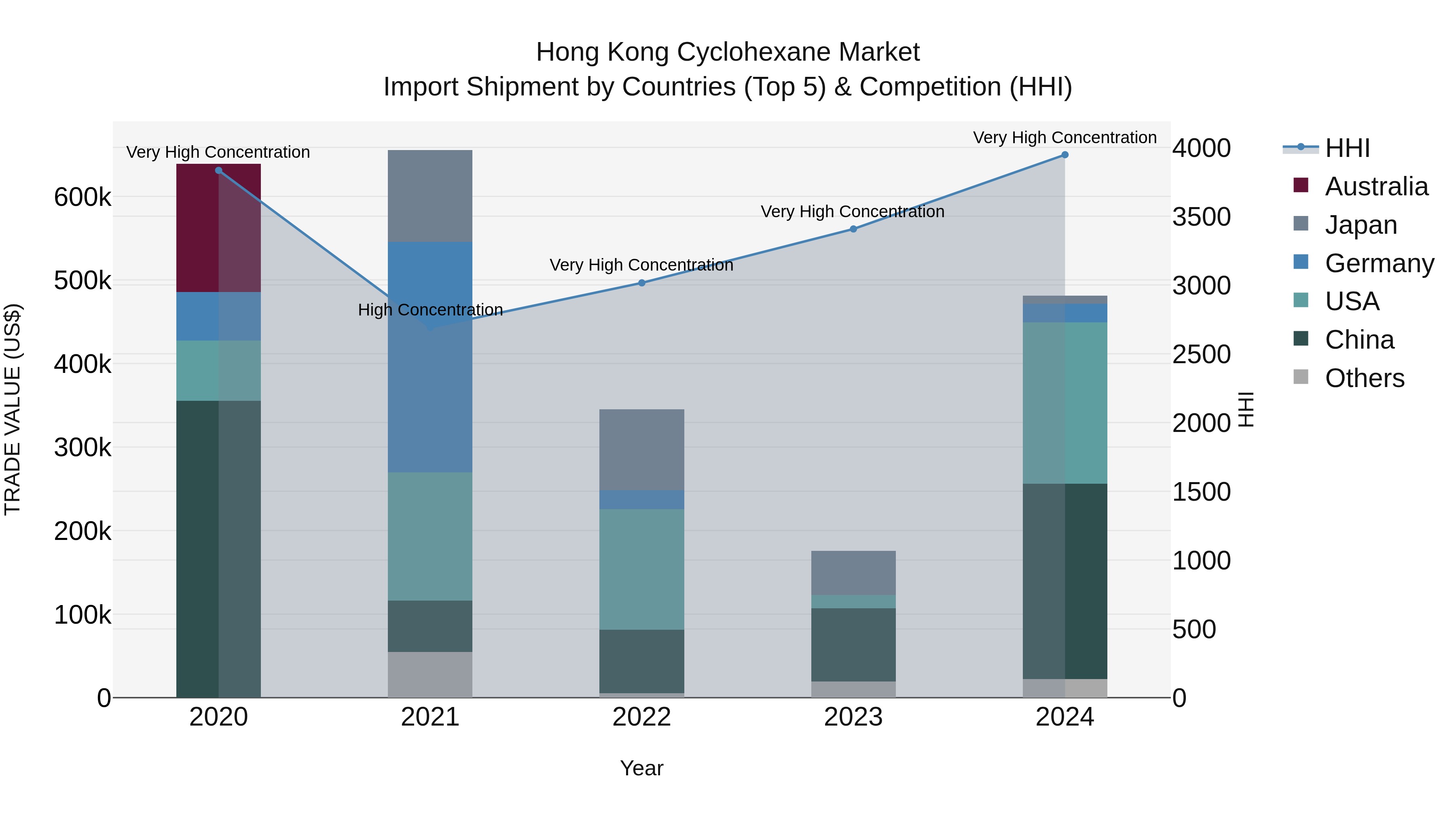
In 2024, Hong Kong continued to rely heavily on cyclohexane imports, with significant contributions from China, USA, Germany, Spain, and Japan. The market remained highly concentrated, as indicated by the high Herfindahl-Hirschman Index (HHI). Despite a negative compound annual growth rate (CAGR) from 2020 to 2024, the impressive growth rate in 2024 highlights a potential resurgence in demand for cyclohexane in Hong Kong. This dynamic market scenario suggests evolving trends and opportunities for stakeholders to monitor and capitalize on in the coming years.
Hong Kong Cyclohexane Market Synopsis
The cyclohexane market in Hong Kong is influenced by its applications in the production of chemicals and solvents. Cyclohexane is primarily used as a precursor in the synthesis of nylon, and its demand is closely tied to the textile and plastics industries. The market is characterized by fluctuations in raw material availability and pricing, impacting production costs. Manufacturers are focusing on optimizing production processes to enhance efficiency and meet the evolving needs of their customers.
Drivers of the market
The cyclohexane market in Hong Kong is driven by its widespread applications in the production of chemicals, solvents, and polymers. As industries such as textiles, automotive, and pharmaceuticals expand, the demand for cyclohexane continues to grow. The increasing focus on sustainability and the development of greener alternatives also influence market dynamics.
Challenges of the market
The cyclohexane market in Hong Kong encounters challenges related to supply chain disruptions and environmental regulations. As global demand for cyclohexane fluctuates, securing reliable suppliers and maintaining consistent production levels can be complex. Additionally, increasing environmental concerns surrounding chemical production necessitate adherence to stringent regulations, compelling manufacturers to adopt sustainable practices. Companies must prioritize supply chain resilience and sustainability initiatives to effectively address these challenges in the competitive market.
Government Policy of the market
The Cyclohexane market is shaped by government regulations that prioritize safety and environmental protection. The government establishes guidelines for the production and use of cyclohexane to minimize health and environmental risks. Research initiatives are supported to develop safer alternatives and improve production processes in the chemical industry.
Key Highlights of the Report:
- Hong Kong Cyclohexane Market Outlook
- Market Size of Hong Kong Cyclohexane Market, 2024
- Forecast of Hong Kong Cyclohexane Market, 2031
- Historical Data and Forecast of Hong Kong Cyclohexane Revenues & Volume for the Period 2021-2031
- Hong Kong Cyclohexane Market Trend Evolution
- Hong Kong Cyclohexane Market Drivers and Challenges
- Hong Kong Cyclohexane Price Trends
- Hong Kong Cyclohexane Porter`s Five Forces
- Hong Kong Cyclohexane Industry Life Cycle
- Historical Data and Forecast of Hong Kong Cyclohexane Market Revenues & Volume By Application for the Period 2021-2031
- Historical Data and Forecast of Hong Kong Cyclohexane Market Revenues & Volume By Adipic acid for the Period 2021-2031
- Historical Data and Forecast of Hong Kong Cyclohexane Market Revenues & Volume By Caprolactam for the Period 2021-2031
- Historical Data and Forecast of Hong Kong Cyclohexane Market Revenues & Volume By Others for the Period 2021-2031
- Historical Data and Forecast of Hong Kong Cyclohexane Market Revenues & Volume By End-use for the Period 2021-2031
- Historical Data and Forecast of Hong Kong Cyclohexane Market Revenues & Volume By Nylon 6 for the Period 2021-2031
- Historical Data and Forecast of Hong Kong Cyclohexane Market Revenues & Volume By Nylon 66 for the Period 2021-2031
- Historical Data and Forecast of Hong Kong Cyclohexane Market Revenues & Volume By Others for the Period 2021-2031
- Hong Kong Cyclohexane Import Export Trade Statistics
- Market Opportunity Assessment By Application
- Market Opportunity Assessment By End-use
- Hong Kong Cyclohexane Top Companies Market Share
- Hong Kong Cyclohexane Competitive Benchmarking By Technical and Operational Parameters
- Hong Kong Cyclohexane Company Profiles
- Hong Kong Cyclohexane Key Strategic Recommendations






































