Hong Kong Electric Mobility Market Top 5 Importing Countries and Market Competition (HHI) Analysis
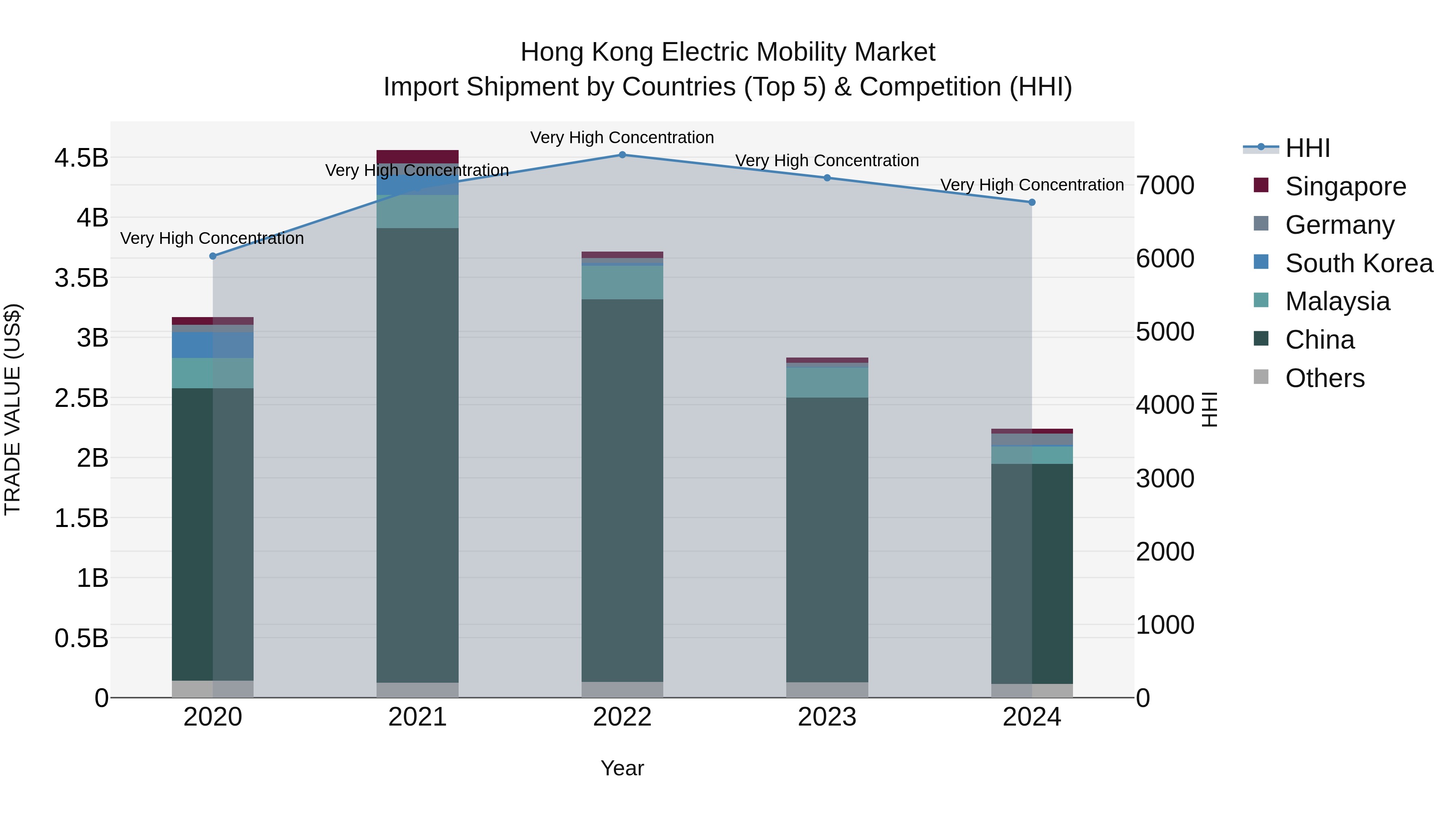
Despite the high concentration of imports from top countries like China, Malaysia, Germany, Singapore, and Japan, Hong Kong`s electric mobility import market experienced a significant decline in 2024. The negative compound annual growth rate (CAGR) of -8.3% from 2020 to 2024 and a steep decline in growth rate of -20.93% from 2023 to 2024 indicate challenges in the market. It will be crucial for stakeholders to closely monitor market dynamics and adapt strategies to navigate these challenging conditions in the electric mobility sector in Hong Kong.
Hong Kong Electric Mobility Market Overview
The Hong Kong Electric Mobility Market is experiencing significant growth driven by government initiatives to reduce air pollution and promote sustainable transportation solutions. The city`s dense urban environment and limited space for traditional vehicles have fueled the adoption of electric vehicles (EVs) and electric scooters. The market is characterized by a diverse range of EVs, including cars, buses, and motorcycles, as well as a growing network of charging infrastructure. Key players in the market include Tesla, Nissan, and BYD, with increasing competition from new entrants and startups. The government offers incentives such as tax breaks and subsidies to encourage EV adoption, while also investing in charging infrastructure development. Overall, the Hong Kong Electric Mobility Market presents opportunities for continued growth and innovation in the transportation sector.
Hong Kong Electric Mobility Market Trends and Opportunities
The Hong Kong Electric Mobility Market is experiencing significant growth due to the increasing demand for sustainable transportation solutions. The government`s push for reducing carbon emissions and improving air quality has led to incentives for electric vehicle adoption. Key trends in the market include the expansion of charging infrastructure, the introduction of more electric vehicle models by automakers, and the rise of innovative mobility services such as electric bike-sharing programs. Opportunities in the market lie in developing smart charging solutions, enhancing battery technology, and promoting electric vehicles for commercial use such as in delivery services and public transportation. Collaborations between government, industry stakeholders, and technology providers are crucial to drive further growth and adoption of electric mobility in Hong Kong.
Hong Kong Electric Mobility Market Challenges
The Hong Kong Electric Mobility Market faces several challenges, including limited charging infrastructure, high vehicle costs, and lack of government incentives. The availability of charging stations remains a key obstacle, leading to range anxiety among consumers and hindering the widespread adoption of electric vehicles. Additionally, the higher upfront costs of electric vehicles compared to traditional gasoline vehicles deter many potential buyers. Despite efforts to promote electric mobility, such as tax incentives and rebates, the lack of comprehensive government support and policies tailored to the unique needs of the market present further challenges. Overcoming these obstacles will require significant investment in charging infrastructure, financial incentives to make electric vehicles more affordable, and robust policy frameworks to encourage their adoption in Hong Kong.
Hong Kong Electric Mobility Market Drivers
The Hong Kong Electric Mobility Market is primarily driven by government initiatives and policies promoting the adoption of electric vehicles (EVs) to reduce air pollution and carbon emissions. The Hong Kong government offers various incentives such as tax breaks, subsidies for EV purchases, and charging infrastructure development to encourage the transition to cleaner transportation options. Additionally, the rising awareness of environmental issues among consumers, coupled with advancements in EV technology leading to improved performance and cost-effectiveness, further propel the growth of the electric mobility market in Hong Kong. Furthermore, the increasing availability of EV models from both local and international manufacturers and the expanding charging network contribute to the overall positive outlook for the electric vehicle sector in Hong Kong.
Hong Kong Electric Mobility Market Government Policy
The Hong Kong government has implemented several policies to promote the growth of the electric mobility market in the region. These include incentives such as waiving the first registration tax for electric vehicles, providing subsidies for the installation of electric vehicle charging facilities, and offering financial incentives for the purchase of electric vehicles. Additionally, the government has set a target of achieving 30% of private cars as electric vehicles by 2030 to reduce emissions and combat air pollution. To support these initiatives, the government has also been investing in expanding the charging infrastructure across the city to encourage the adoption of electric vehicles among residents and businesses.
Hong Kong Electric Mobility Market Future Outlook
The future outlook for the Hong Kong Electric Mobility Market is promising, driven by government initiatives to reduce carbon emissions and improve air quality. Hong Kong`s goal to phase out internal combustion engine vehicles by 2035 will further boost the adoption of electric vehicles (EVs). The availability of charging infrastructure is expected to improve, encouraging more consumers to switch to EVs. Additionally, advancements in battery technology will lead to increased driving range and faster charging times, addressing common concerns about EVs. With a growing emphasis on sustainability and environmental consciousness, the electric mobility market in Hong Kong is poised for significant growth in the coming years, presenting opportunities for both manufacturers and consumers alike.
Key Highlights of the Report:
- Hong Kong Electric Mobility Market Outlook
- Market Size of Hong Kong Electric Mobility Market, 2024
- Forecast of Hong Kong Electric Mobility Market, 2031
- Historical Data and Forecast of Hong Kong Electric Mobility Revenues & Volume for the Period 2021- 2031
- Hong Kong Electric Mobility Market Trend Evolution
- Hong Kong Electric Mobility Market Drivers and Challenges
- Hong Kong Electric Mobility Price Trends
- Hong Kong Electric Mobility Porter's Five Forces
- Hong Kong Electric Mobility Industry Life Cycle
- Historical Data and Forecast of Hong Kong Electric Mobility Market Revenues & Volume By Product for the Period 2021- 2031
- Historical Data and Forecast of Hong Kong Electric Mobility Market Revenues & Volume By Electric Bikes for the Period 2021- 2031
- Historical Data and Forecast of Hong Kong Electric Mobility Market Revenues & Volume By Electric Scooters for the Period 2021- 2031
- Historical Data and Forecast of Hong Kong Electric Mobility Market Revenues & Volume By Electric Motorized Scooters for the Period 2021- 2031
- Historical Data and Forecast of Hong Kong Electric Mobility Market Revenues & Volume By Electric Motorcycles for the Period 2021- 2031
- Historical Data and Forecast of Hong Kong Electric Mobility Market Revenues & Volume By Drive for the Period 2021- 2031
- Historical Data and Forecast of Hong Kong Electric Mobility Market Revenues & Volume By Belt Drive for the Period 2021- 2031
- Historical Data and Forecast of Hong Kong Electric Mobility Market Revenues & Volume By Chain Drive for the Period 2021- 2031
- Historical Data and Forecast of Hong Kong Electric Mobility Market Revenues & Volume By Hub Drive for the Period 2021- 2031
- Historical Data and Forecast of Hong Kong Electric Mobility Market Revenues & Volume By Battery for the Period 2021- 2031
- Historical Data and Forecast of Hong Kong Electric Mobility Market Revenues & Volume By Lead Acid Battery for the Period 2021- 2031
- Historical Data and Forecast of Hong Kong Electric Mobility Market Revenues & Volume By Li-Ion Battery for the Period 2021- 2031
- Historical Data and Forecast of Hong Kong Electric Mobility Market Revenues & Volume By End-use for the Period 2021- 2031
- Historical Data and Forecast of Hong Kong Electric Mobility Market Revenues & Volume By Personal for the Period 2021- 2031
- Historical Data and Forecast of Hong Kong Electric Mobility Market Revenues & Volume By Commercial for the Period 2021- 2031
- Hong Kong Electric Mobility Import Export Trade Statistics
- Market Opportunity Assessment By Product
- Market Opportunity Assessment By Drive
- Market Opportunity Assessment By Battery
- Market Opportunity Assessment By End-use
- Hong Kong Electric Mobility Top Companies Market Share
- Hong Kong Electric Mobility Competitive Benchmarking By Technical and Operational Parameters
- Hong Kong Electric Mobility Company Profiles
- Hong Kong Electric Mobility Key Strategic Recommendations






































