Hong Kong Fruit Pulp Market Top 5 Importing Countries and Market Competition (HHI) Analysis
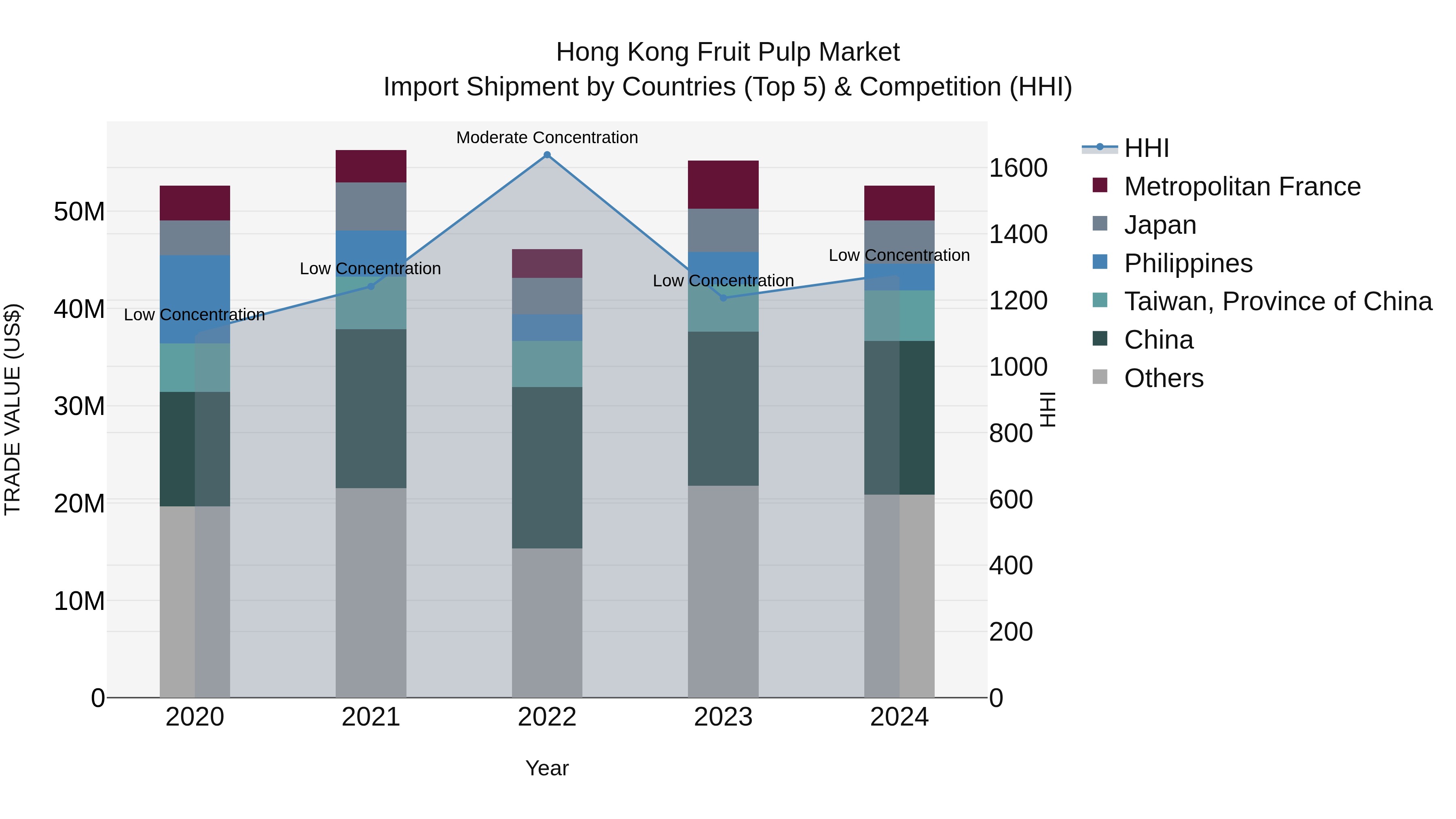
Despite a slight decline in growth rate in 2024, Hong Kong`s fruit pulp import market continues to be diversified with key suppliers including China, Taiwan, Japan, Metropolitan France, and the USA. The low Herfindahl-Hirschman Index (HHI) indicates a lack of concentration among exporters, providing opportunities for a variety of players in the market. With a stagnant compound annual growth rate (CAGR) from 2020 to 2024, it will be interesting to see how market dynamics and consumer preferences shape the future of fruit pulp imports in Hong Kong.
Hong Kong Fruit Pulp Market Synopsis
The fruit pulp market in Hong Kong is flourishing as consumers increasingly gravitate towards natural and healthy food options. This market supplies fruit pulp for various applications, including beverages, desserts, and sauces, and is characterized by a wide range of flavors and textures. The demand for organic and minimally processed ingredients is driving innovation, with manufacturers focusing on sourcing high-quality fruit and utilizing advanced processing techniques to preserve nutritional value. The growing trend of incorporating fruit pulp into everyday diets is further propelling the market`s expansion.
Drivers of the market
The Hong Kong fruit pulp market is influenced by the growing consumer preference for natural and healthy food products. As more people adopt healthier lifestyles, the demand for fruit-based products such as smoothies, juices, and desserts has risen. This trend drives manufacturers to source high-quality fruit pulps to meet consumer expectations. Additionally, the rising popularity of vegan and plant-based diets is contributing to the increased demand for fruit pulp ingredients in various food applications.
Challenges of the market
In the fruit pulp market, producers face challenges related to supply chain disruptions caused by climate change and fluctuating agricultural yields. This unpredictability can lead to inconsistent product quality and availability. Moreover, intense competition from alternative fruit-based products and the need for innovative marketing strategies to capture consumer interest add pressure to businesses in this sector.
Government Policy of the market
In the Fruit Pulp Market, the Hong Kong government actively supports local producers through initiatives that promote food safety and quality control. Regulatory measures are in place to ensure that fruit pulp products meet health standards, and the CFS regularly conducts inspections. Moreover, the government encourages the export of fruit pulp by providing resources and information on international market trends, thereby enhancing the competitiveness of local producers.
Key Highlights of the Report:
- Hong Kong Fruit Pulp Market Outlook
- Market Size of Hong Kong Fruit Pulp Market, 2024
- Forecast of Hong Kong Fruit Pulp Market, 2031
- Historical Data and Forecast of Hong Kong Fruit Pulp Revenues & Volume for the Period 2021-2031
- Hong Kong Fruit Pulp Market Trend Evolution
- Hong Kong Fruit Pulp Market Drivers and Challenges
- Hong Kong Fruit Pulp Price Trends
- Hong Kong Fruit Pulp Porter`s Five Forces
- Hong Kong Fruit Pulp Industry Life Cycle
- Historical Data and Forecast of Hong Kong Fruit Pulp Market Revenues & Volume By Fruit Type for the Period 2021-2031
- Historical Data and Forecast of Hong Kong Fruit Pulp Market Revenues & Volume By Mango for the Period 2021-2031
- Historical Data and Forecast of Hong Kong Fruit Pulp Market Revenues & Volume By Strawberry for the Period 2021-2031
- Historical Data and Forecast of Hong Kong Fruit Pulp Market Revenues & Volume By Apple for the Period 2021-2031
- Historical Data and Forecast of Hong Kong Fruit Pulp Market Revenues & Volume By Guava for the Period 2021-2031
- Historical Data and Forecast of Hong Kong Fruit Pulp Market Revenues & Volume By Berries for the Period 2021-2031
- Historical Data and Forecast of Hong Kong Fruit Pulp Market Revenues & Volume By Citrus Fruits for the Period 2021-2031
- Historical Data and Forecast of Hong Kong Fruit Pulp Market Revenues & Volume By Others for the Period 2021-2031
- Historical Data and Forecast of Hong Kong Fruit Pulp Market Revenues & Volume By Form for the Period 2021-2031
- Historical Data and Forecast of Hong Kong Fruit Pulp Market Revenues & Volume By Liquid for the Period 2021-2031
- Historical Data and Forecast of Hong Kong Fruit Pulp Market Revenues & Volume By Powder for the Period 2021-2031
- Historical Data and Forecast of Hong Kong Fruit Pulp Market Revenues & Volume By Application for the Period 2021-2031
- Historical Data and Forecast of Hong Kong Fruit Pulp Market Revenues & Volume By Food and Beverages for the Period 2021-2031
- Historical Data and Forecast of Hong Kong Fruit Pulp Market Revenues & Volume By Distribution for the Period 2021-2031
- Historical Data and Forecast of Hong Kong Fruit Pulp Market Revenues & Volume By E-Commerce for the Period 2021-2031
- Historical Data and Forecast of Hong Kong Fruit Pulp Market Revenues & Volume By Convenience Stores for the Period 2021-2031
- Historical Data and Forecast of Hong Kong Fruit Pulp Market Revenues & Volume By Supermarkets/Hypermarkets for the Period 2021-2031
- Historical Data and Forecast of Hong Kong Fruit Pulp Market Revenues & Volume By Specialty Stores for the Period 2021-2031
- Historical Data and Forecast of Hong Kong Fruit Pulp Market Revenues & Volume By Others for the Period 2021-2031
- Hong Kong Fruit Pulp Import Export Trade Statistics
- Market Opportunity Assessment By Fruit Type
- Market Opportunity Assessment By Form
- Market Opportunity Assessment By Application
- Market Opportunity Assessment By Distribution
- Hong Kong Fruit Pulp Top Companies Market Share
- Hong Kong Fruit Pulp Competitive Benchmarking By Technical and Operational Parameters
- Hong Kong Fruit Pulp Company Profiles
- Hong Kong Fruit Pulp Key Strategic Recommendations






































