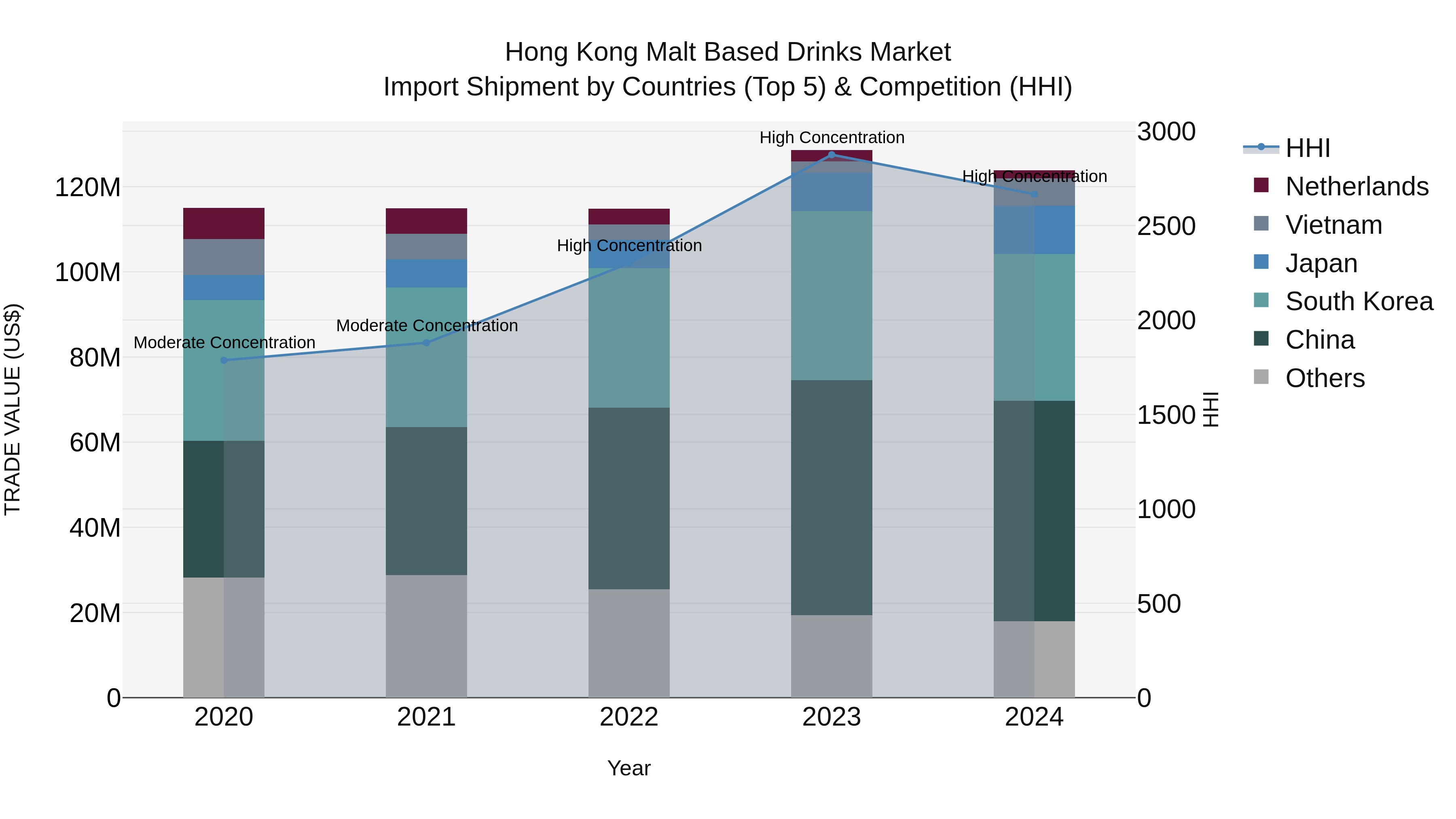
Hong Kong Malt Based Drinks Market Top 5 Importing Countries and Market Competition (HHI) Analysis
Despite a slight decline in growth rate from 2023 to 2024, the Hong Kong malt based drinks import market continues to show steady growth with a cumulative annual growth rate of 1.86% from 2020 to 2024. The top exporting countries to Hong Kong in 2024, including China, South Korea, Japan, Vietnam, and the UK, indicate a diverse range of sources. However, the high concentration level, as reflected by the HHI, suggests that market competition may still be limited. Monitoring market dynamics and exploring strategies to enhance market diversification could be key for sustained growth in this sector.
Hong Kong Malt Based Drinks Market Growth Rate
According to 6Wresearch internal database and industry insights, the Hong Kong Malt Based Drinks Market is projected to grow at a compound annual growth rate (CAGR) of 6% during the forecast period from 2026 to 2032.
Topics Covered in the Hong Kong Malt Based Drinks Market Report
The Hong Kong Malt Based Drinks Market report thoroughly covers the market by type, application, and distribution channel, providing an unbiased and detailed analysis of ongoing market trends, opportunities, challenges, and market drivers, helping stakeholders align their strategies with current and future market dynamics.
Hong Kong Malt Based Drinks Market Highlights
| Report Name | Hong Kong Malt Based Drinks Market |
| Forecast period | 2026–2032 |
| CAGR | 6% |
| Growing Sector | Malt Based Drinks |
Hong Kong Malt Based Drinks Market Synopsis
Hong Kong Malt Based Drinks Market maintains its expansion as more people choose functional beverages which provide convenience. The rising knowledge about nutritional advantages combined with the growing need for flavoured beverages drives product acceptance. However, the popularity of malt beverages extends to both alcoholic and non-alcoholic options which different consumer groups now find attractive. The market expansion of Hong Kong Malt Based Drinks Market Growth receives support from strong retail networks and expanding online distribution channels.
Evaluation of Growth Drivers in the Hong Kong Malt Based Drinks Market
Below mentioned are some prominent drivers and their impact on the market dynamics:
| Drivers | Primary Segments Affected | Why It Matters (Evidence) |
| Increasing Health Awareness | Non-Alcoholic, Flavored Beverages | Consumers prefer malt drinks enriched with vitamins and nutrients. |
| Rising Demand for Convenience | Online, Ready-to-Drink Products | Busy urban lifestyles drive demand for quick consumption beverages. |
| Product Innovation and Flavors | Flavored Beverages | Innovative flavors are attracting youth and high-end customers. |
| Expanding Retail Network | Offline, Online Channels | Various flavours and innovations attract younger demographics and premium users. |
| Growth in Premiumization | Alcoholic Segment | Premium malt beverages are gaining popularity among affluent consumers. |
The Hong Kong Malt Based Drinks Market Size is projected to grow at a CAGR of 6% from 2026 to 2032. The Malt Based Drinks Market in Hong Kong experiences ongoing growth as consumers demand healthy drinks, companies introduce new flavors and create more accessible products. The combination of rising disposable income and better living conditions leads consumers to try out both premium and functional drink products. Furthermore, the market demand for products grows as more consumers choose healthier drinks that contain additional health benefits. The market continues to grow since both retail networks and online distribution channels experience rapid expansion.
Evaluation of Restraints in the Hong Kong Malt Based Drinks Market
Below mentioned are some major restraints and their influence on the market dynamics:
| Restraints | Primary Segments Affected | What This Means (Evidence) |
| High Product Pricing | Premium and Alcoholic Beverages | Limits affordability among price-sensitive consumers. |
| Competition from Alternatives | Non-Alcoholic Beverages | Soft drinks and energy drinks compete strongly. |
| Sugar Content Concerns | Flavored Beverages | Sugar-aware buyers may steer clear of sweetened drinks. |
| Regulatory Restrictions | Alcoholic Segment | Licensing and compliance requirements increase operational challenges. |
| Limited Awareness in Some Segments | Unflavored Beverages | Lower consumer awareness reduces demand. |
Hong Kong Malt Based Drinks Market Challenges
The Hong Kong Malt Based Drinks Industry experiences obstacles since consumers choose alternative beverages and they become more worried about sugar consumption. The market faces both premium pricing and alcohol regulation requirements which create barriers to its expansion and consumer access. Furthermore, the shift in consumer taste from regular beverages to low-calorie functional drinks creates difficulties for producers who must adapt their products. Companies need to focus on creating low-sugar products while developing new items, building their brand and educating customers about malt-based drinks to maintain market demand.
Hong Kong Malt Based Drinks Market Trends
Here are some major trends changing the Hong Kong Malt Based Drinks Market Growth dynamics:
- Rising Demand for Functional Beverages – Consumers are increasingly opting for malt-based drinks fortified with vitamins and minerals to support health and wellness.
- Growth of Flavored Malt Drinks – Unique flavors are drawing more young consumers while strengthening competitive differentiation.
- Expansion of E-Commerce Platforms – Online retail channels are enabling easy product access and wider consumer reach.
Investment Opportunities in the Hong Kong Malt Based Drinks Market
The Hong Kong Malt Based Drinks Market presents several investment opportunities, including:
- Development of Health-Focused Products – Health-conscious customers will be attracted to products which contain low-sugar and fortified beverages as they make their purchase decisions.
- Expansion of Online Distribution Channels – Developing a stronger online presence through e-commerce will help the business to enter new markets.
- Innovation in Flavor Variants – The creation of distinctive flavors will help the business to win over different customer groups.
Top 5 Leading Players in the Hong Kong Malt Based Drinks Market
Below is the list of prominent companies leading the Hong Kong Malt Based Drinks Market Share:
1. Budweiser Brewing Company APAC
| Company Name | Budweiser Brewing Company APAC |
| Established | 1366 (Global) / 2019 (APAC entity) |
| Headquarters | Hong Kong (Regional HQ) / Leuven, Belgium (Global) |
| Website | Click Here |
Budweiser APAC is a dominant force in Hong Kong, managing a vast portfolio of premium malt-based alcoholic beverages. Its key brands, including Budweiser, Stella Artois, and Corona, lead the premium and super-premium segments across the city's extensive on-trade and off-trade channels.
2. San Miguel Brewery Hong Kong Ltd.
| Company Name | San Miguel Brewery Hong Kong Ltd. |
| Established | 1948 (in Hong Kong) |
| Headquarters | Sha Tin, Hong Kong |
| Website | Click Here |
One of the most historically significant players in the region, San Miguel operates the only large-scale brewery in Hong Kong. It provides a wide range of malt-based lagers and specialty beers, maintaining a strong grip on the mass-market and local distribution networks.
3. Carlsberg Hong Kong Ltd.
| Company Name | Carlsberg Hong Kong Ltd. |
| Established | 1847 |
| Headquarters | Copenhagen, Denmark |
| Website | Click Here |
Carlsberg is a leading competitor in both the alcoholic and non-alcoholic malt categories. Beyond its flagship lager, the company has successfully expanded its "Somersby" cider and non-alcoholic malt portfolios, catering to the growing trend of health-conscious consumption in urban Hong Kong.
4. Nestlé
| Company Name | Nestlé |
| Established | 1866 |
| Headquarters | Vevey, Switzerland |
| Website | Click Here |
Nestlé dominates the non-alcoholic malt-based "malted food drink" category in Hong Kong, primarily through its Milo brand. It is a staple in the FMCG sector, found in virtually every supermarket and traditional "cha chaan teng" (Hong Kong-style cafes) as a popular nutritional beverage.
5. Tsingtao Brewery Co., Ltd.
| Company Name | Tsingtao Brewery Co., Ltd. |
| Established | 1903 |
| Headquarters | Qingdao, China |
| Website | - |
Leveraging its proximity and strong trade links, Tsingtao is the leading mainland Chinese malt beverage player in Hong Kong. It is highly favored in the dining sector, particularly in traditional Chinese restaurants, and has recently pushed into the craft and "pure malt" segments to attract younger consumers.
Government Regulations in the Hong Kong Malt Based Drinks Market
According to HongKongers government data, the Centre for Food Safety (CFS) establishes beverage safety standards which all products must meet through their labeling, hygiene and nutritional specifications. The system achieves transparency and protects consumers through its enforcement of mandatory sugar labeling and alcohol licensing regulations. Furthermore, public health campaigns which promote reduced sugar consumption create pressure on beverage manufacturers to change their product formulas and meet new quality standards which reflect current consumer health expectations.
Future Insights of the Hong Kong Malt Based Drinks Market
The outlook for Hong Kong Malt Based Drinks Market remains positive, driven by increasing consumer awareness of health and wellness, along with continuous product innovation. The rising demand for functional, low-sugar, and premium beverages is expected to shape future consumption patterns. Moreover, the rapid growth of e-commerce and digital retail platforms will improve accessibility and distribution efficiency, while changing lifestyles support long-term market growth and new opportunities.
Market Segmentation Analysis
The report offers a comprehensive study of the following market segments and their leading categories:
By Type – Flavored Beverages to Dominate the Market
According to Ritika Kalra, Senior Research Analyst, 6Wresearch, flavored beverages will lead the Hong Kong Malt Based Drinks Market as they attract young consumers who prefer their multiple taste options. The beverages provide better sensory experiences as they combine enjoyable elements with extra nutritional content.
By Application – Non-Alcoholic Segment to Dominate the Market
The non-alcoholic segment is projected to dominate the market owing to increasing health consciousness and demand for nutritious beverages among all age groups. These drinks are widely consumed as daily nutritional supplements and energy boosters, particularly among children and working professionals.
By Distribution Channel – Offline Channel to Dominate the Market
Offline distribution channels will maintain their market leadership as retailers operate multiple store types which include supermarkets, convenience stores and specialty retail outlets. Consumers prefer purchasing beverages physically since they want to access products right away and they need to see all available options.
Key Attractiveness of the Report
- 10 Years of Market Numbers.
- Historical Data Starting from 2022 to 2025.
- Base Year: 2025.
- Forecast Data until 2032.
- Key Performance Indicators Impacting the Market.
- Major Upcoming Developments and Projects.
Key Highlights of the Report:
- Hong Kong Malt Based Drinks Market Outlook
- Market Size of Hong Kong Malt Based Drinks Market, 2025
- Forecast of Hong Kong Malt Based Drinks Market, 2032
- Historical Data and Forecast of Hong Kong Malt Based Drinks Revenues & Volume for the Period 2022 - 2032
- Hong Kong Malt Based Drinks Market Trend Evolution
- Hong Kong Malt Based Drinks Market Drivers and Challenges
- Hong Kong Malt Based Drinks Price Trends
- Hong Kong Malt Based Drinks Porter's Five Forces
- Hong Kong Malt Based Drinks Industry Life Cycle
- Historical Data and Forecast of Hong Kong Malt Based Drinks Market Revenues & Volume By Type for the Period 2022 - 2032
- Historical Data and Forecast of Hong Kong Malt Based Drinks Market Revenues & Volume By Flavored beverages for the Period 2022 - 2032
- Historical Data and Forecast of Hong Kong Malt Based Drinks Market Revenues & Volume By Unflavored beverages for the Period 2022 - 2032
- Historical Data and Forecast of Hong Kong Malt Based Drinks Market Revenues & Volume By Application for the Period 2022 - 2032
- Historical Data and Forecast of Hong Kong Malt Based Drinks Market Revenues & Volume By Alcoholic for the Period 2022 - 2032
- Historical Data and Forecast of Hong Kong Malt Based Drinks Market Revenues & Volume By Non-Alcoholic for the Period 2022 - 2032
- Historical Data and Forecast of Hong Kong Malt Based Drinks Market Revenues & Volume By Distribution Channel for the Period 2022 - 2032
- Historical Data and Forecast of Hong Kong Malt Based Drinks Market Revenues & Volume By Offline for the Period 2022 - 2032
- Historical Data and Forecast of Hong Kong Malt Based Drinks Market Revenues & Volume By Online for the Period 2022 - 2032
- Hong Kong Malt Based Drinks Import Export Trade Statistics
- Market Opportunity Assessment By Type
- Market Opportunity Assessment By Application
- Market Opportunity Assessment By Distribution Channel
- Hong Kong Malt Based Drinks Top Companies Market Share
- Hong Kong Malt Based Drinks Competitive Benchmarking By Technical and Operational Parameters
- Hong Kong Malt Based Drinks Company Profiles
- Hong Kong Malt Based Drinks Key Strategic Recommendations






































