Hungary Business Intelligence Market Size & Growth Rate (2026-2032)
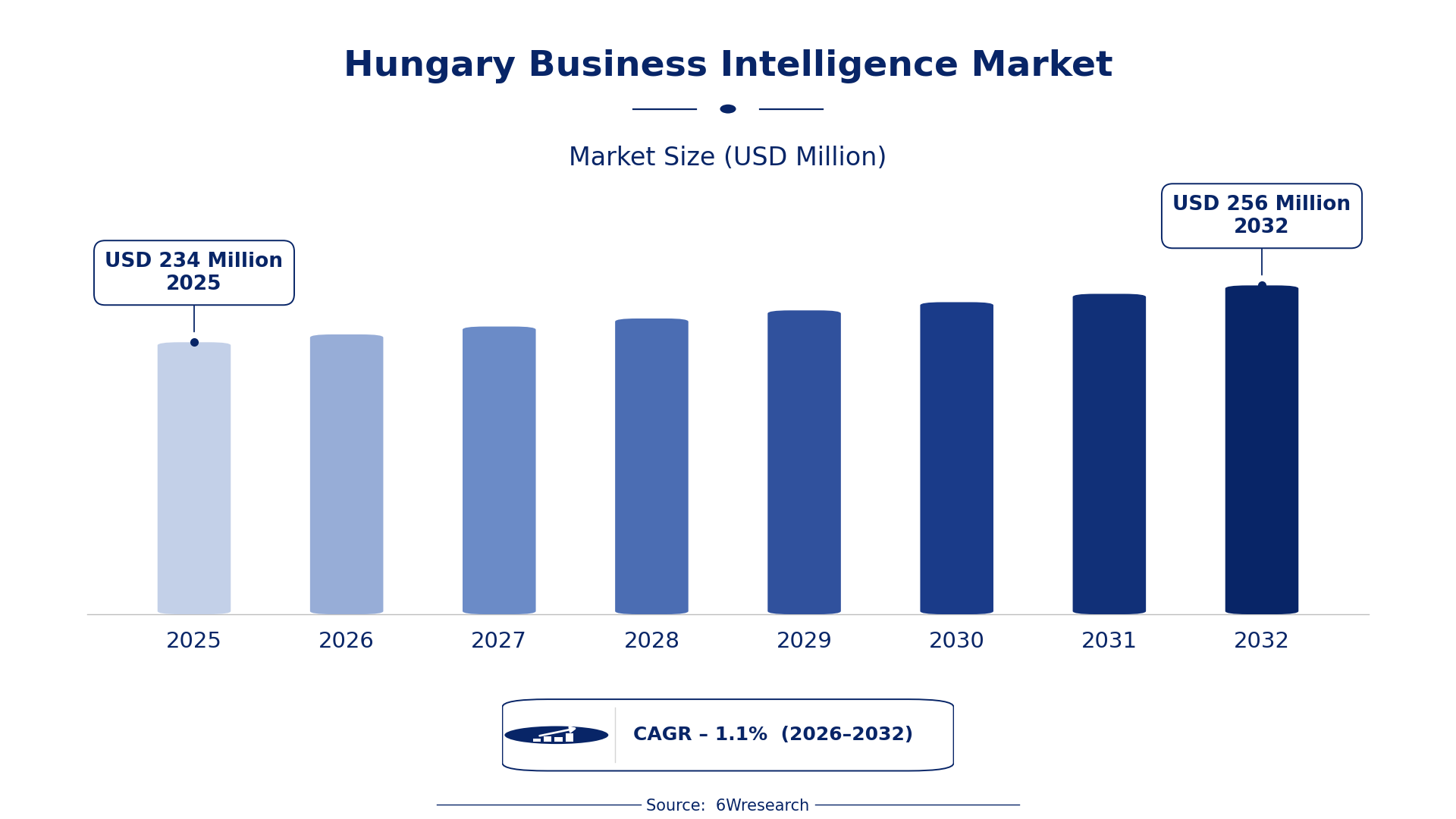
The Hungary Business Intelligence Market was estimated at USD 234 Million in 2025 and is projected to reach USD 256 Million by 2032, growing at a CAGR of 1.1% from 2026 to 2032.
Hungary Business Intelligence Market Synopsis
As the Hungary Business Intelligence market continues to gain momentum, it stands at a critical juncture of transformation. Increasingly, businesses across sectors recognize the imperative of data-driven strategies, which is reshaping the BI landscape in Hungary.
The market is not just about tools and technologies; it’s about enabling organizations to make informed decisions. With government support and a growing understanding of the benefits of BI, the future looks promising for vendors willing to innovate and adapt.
Hungary Business Intelligence Market Year-wise Growth Rate and Key Drivers
This graph illustrates the annual growth rates of the Hungary Business Intelligence Market from 2021 to 2032, highlighting a steady upward trajectory and projected expansion over the forecast period.
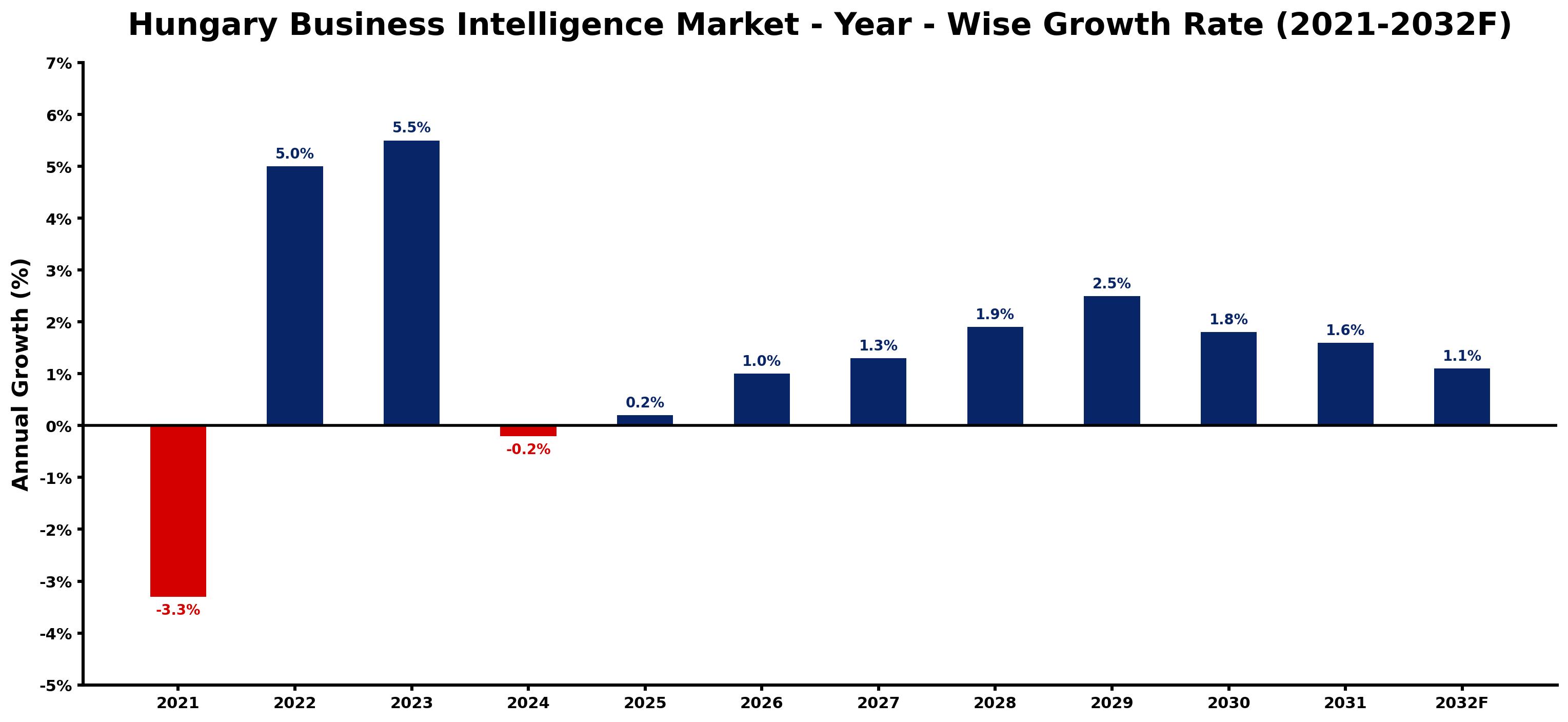
The table below presents the year‑wise growth rates along with the key drivers influencing the market
| Year | Growth Rate | Major Drivers |
| 2021 | -3.3% | Rising data privacy regulations by Hungarian authorities |
| 2022 | 5.0% | Increased government funding for digital transformation projects |
| 2023 | 5.5% | Rising awareness of data-driven decision-making among enterprises |
| 2024 | -0.2% | Decline in local investments affecting technology adoption |
| 2025 | 0.2% | Implementation of new data protection regulations enhancing compliance |
| 2026 | 1.0% | Adoption of AI tools for improved business insights |
| 2027 | 1.3% | Growth in IoT devices generating more data analytics needs |
| 2028 | 1.9% | Development of Budapest as a tech innovation hub |
| 2029 | 2.5% | Emergence of local startups focusing on BI solutions |
| 2030 | 1.8% | Increased export opportunities for Hungarian tech companies |
| 2031 | 1.6% | Collaboration between universities and businesses for data research |
| 2032 | 1.1% | Strengthened partnerships among regional BI technology providers |
Note: Market size estimations and growth projections presented in this report are based on 6Wresearch's proprietary forecasting methodology, utilizing the latest available industry data, government publications, and primary research inputs.
Hungary Business Intelligence Market Key Takeaways
Below are some of the specific key takeaways from the market, including:
- Growing adoption of cloud-based BI solutions among Hungarian businesses.
- Increased demand for advanced analytics and machine learning capabilities.
- Government initiatives driving digital transformation across industries.
- Focus on data privacy and compliance shaping BI investments.
- Rising competition between global and local BI vendors catering to specific market needs.
Evaluation of Restraints in Hungary Business Intelligence Market
Despite its potential, the Hungary Business Intelligence market faces notable constraints that hinder broader adoption. Many smaller companies remain unaware of the advantages that BI tools can offer, leading to slower integration into their operational frameworks. on top of that, the stringent data privacy regulations, notably GDPR, create hurdles for businesses seeking to implement comprehensive data analytics solutions.
The shortage of skilled professionals proficient in BI technologies compounds these issues, making it challenging for organizations to fully leverage available tools. Additionally, the market's relatively modest size compared to larger economies limits the availability of advanced BI solutions, which can drive up costs for businesses looking to adopt innovative technologies.
Hungary Business Intelligence Market Trends
A noticeable trend in the Hungary Business Intelligence market is the shift towards advanced analytics and machine learning. Businesses are increasingly seeking solutions that can provide deeper insights and predictive capabilities, moving beyond traditional reporting tools. The surge in cloud-based BI solutions also reflects a growing desire for scalability and cost-effectiveness.
on top of that, the integration of BI with emerging technologies like IoT and Big Data analytics is becoming vital for businesses looking to stay competitive. Real-time data analysis is no longer a luxury but a necessity, compelling organizations to invest in innovative BI frameworks that offer agility and responsiveness.
Hungary Business Intelligence Market Opportunities
The Hungary Business Intelligence market presents significant opportunities for growth, particularly in sectors such as finance, healthcare, and retail. Companies that invest in tailored BI solutions, focusing on industry-specific needs, are likely to find fertile ground for expansion.
The ongoing emphasis on data privacy and compliance also opens avenues for vendors offering secure BI solutions. As organizations strive to balance analytical capabilities with regulatory requirements, the demand for BI tools that prioritize security features is set to increase.
Government Initiatives in the Hungary Business Intelligence Market
Government policy is playing a crucial role in shaping the Hungary Business Intelligence market. By promoting digital transformation through various initiatives, the government aims to enhance the overall economic landscape and encourage businesses to adopt data-driven strategies. The focus on regulatory compliance and data protection also underscores the importance of fostering a secure environment for BI investments.
- A national digital infrastructure upgrade programme launched in early 2025 to improve connectivity and data accessibility.
- Currently ongoing initiatives aimed at providing financial incentives for businesses adopting BI solutions, enhancing their operational capabilities.
- A recent policy introduced in 2024 promoting collaboration between industry stakeholders and research institutions to drive innovation.
- Upcoming plans for a regulatory framework to streamline data governance processes expected to roll out by late 2026.
- Ongoing efforts to improve public awareness of BI benefits through workshops and educational programs targeted at smaller businesses.
Future Insights of the Hungary Business Intelligence Market
Looking ahead to 2026-2032, the Hungary Business Intelligence market is set for steady growth, driven by an increasing recognition of the value of data analytics. As businesses continue to embrace digital transformation, the demand for sophisticated BI tools will rise, particularly those integrating advanced technologies like AI and machine learning.
With a focus on improving operational efficiency and achieving competitive advantages, organizations will prioritize investments in real-time data visualization and predictive analytics solutions. This trajectory indicates a promising future for both domestic and international BI vendors willing to innovate and respond to market demands.
Hungary Business Intelligence Market Latest Developments
Recent developments in the Hungary Business Intelligence market reflect a dynamic shift towards more integrated and advanced solutions. Over the past year, several initiatives have emerged that underline the growing importance of BI in various sectors.
- A major technology vendor launched a new BI platform in Q1 2025, incorporating AI-driven analytics for improved data insights.
- A partnership between local businesses and academic institutions established in early 2025 aims to foster innovation in BI technologies, currently underway.
- An initiative focusing on the development of industry-specific BI solutions was announced in mid-2025, targeting the healthcare sector.
- Plans for an upcoming BI conference set to take place in late 2026 to facilitate knowledge sharing and networking among industry players.
- A new training program aimed at upskilling professionals in BI technologies was rolled out in early 2025, addressing the talent gap in the market.
Hungary Business Intelligence Market - Key Attractiveness of the Report
- 10 Years of Market Numbers
- Historical Data Starting from 2022 to 2025
- Base Year: 2025
- Forecast Data until 2032
- Key Performance Indicators Impacting the Market
- Major Upcoming Developments and Projects
Key Highlights of the Report:
- Hungary Business Intelligence Market Outlook
- Market Size of Hungary Business Intelligence Market, 2025
- Forecast of Hungary Business Intelligence Market, 2032
- Historical Data and Forecast of Hungary Business Intelligence Revenues & Volume for the Period 2022-2032F
- Hungary Business Intelligence Market Trend Evolution
- Hungary Business Intelligence Market Drivers and Challenges
- Hungary Business Intelligence Price Trends
- Hungary Business Intelligence Porter's Five Forces
- Hungary Business Intelligence Industry Life Cycle
- Historical Data and Forecast of Hungary Business Intelligence Market Revenues & Volume By Component for the Period 2022-2032F
- Historical Data and Forecast of Hungary Business Intelligence Market Revenues & Volume By Solutions for the Period 2022-2032F
- Historical Data and Forecast of Hungary Business Intelligence Market Revenues & Volume By Services for the Period 2022-2032F
- Historical Data and Forecast of Hungary Business Intelligence Market Revenues & Volume By Business Function for the Period 2022-2032F
- Historical Data and Forecast of Hungary Business Intelligence Market Revenues & Volume By Human Resource for the Period 2022-2032F
- Historical Data and Forecast of Hungary Business Intelligence Market Revenues & Volume By Finance for the Period 2022-2032F
- Historical Data and Forecast of Hungary Business Intelligence Market Revenues & Volume By Operations for the Period 2022-2032F
- Historical Data and Forecast of Hungary Business Intelligence Market Revenues & Volume By Sales and Marketing for the Period 2022-2032F
- Historical Data and Forecast of Hungary Business Intelligence Market Revenues & Volume By Deployment Mode for the Period 2022-2032F
- Historical Data and Forecast of Hungary Business Intelligence Market Revenues & Volume By On-premises for the Period 2022-2032F
- Historical Data and Forecast of Hungary Business Intelligence Market Revenues & Volume By Cloud for the Period 2022-2032F
- Historical Data and Forecast of Hungary Business Intelligence Market Revenues & Volume By Organization Size for the Period 2022-2032F
- Historical Data and Forecast of Hungary Business Intelligence Market Revenues & Volume By SMEs for the Period 2022-2032F
- Historical Data and Forecast of Hungary Business Intelligence Market Revenues & Volume By Large Enterprises for the Period 2022-2032F
- Historical Data and Forecast of Hungary Business Intelligence Market Revenues & Volume By Vertical for the Period 2022-2032F
- Historical Data and Forecast of Hungary Business Intelligence Market Revenues & Volume By Retail for the Period 2022-2032F
- Historical Data and Forecast of Hungary Business Intelligence Market Revenues & Volume By Manufacturing for the Period 2022-2032F
- Historical Data and Forecast of Hungary Business Intelligence Market Revenues & Volume By Government and Public Services for the Period 2022-2032F
- Historical Data and Forecast of Hungary Business Intelligence Market Revenues & Volume By Media and Entertainment for the Period 2022-2032F
- Historical Data and Forecast of Hungary Business Intelligence Market Revenues & Volume By Transportation and Logistics for the Period 2022-2032F
- Historical Data and Forecast of Hungary Business Intelligence Market Revenues & Volume By BFSI for the Period 2022-2032F
- Historical Data and Forecast of Hungary Business Intelligence Market Revenues & Volume By Telecom and IT for the Period 2022-2032F
- Historical Data and Forecast of Hungary Business Intelligence Market Revenues & Volume By Healthcare and Life Sciences for the Period 2022-2032F
- Hungary Business Intelligence Import Export Trade Statistics
- Market Opportunity Assessment By Component
- Market Opportunity Assessment By Business Function
- Market Opportunity Assessment By Deployment Mode
- Market Opportunity Assessment By Organization Size
- Market Opportunity Assessment By Vertical
- Hungary Business Intelligence Top Companies Market Share
- Hungary Business Intelligence Competitive Benchmarking By Technical and Operational Parameters
- Hungary Business Intelligence Company Profiles
- Hungary Business Intelligence Key Strategic Recommendations






































