Hungary Computer Peripherals Market: Import Trend Analysis
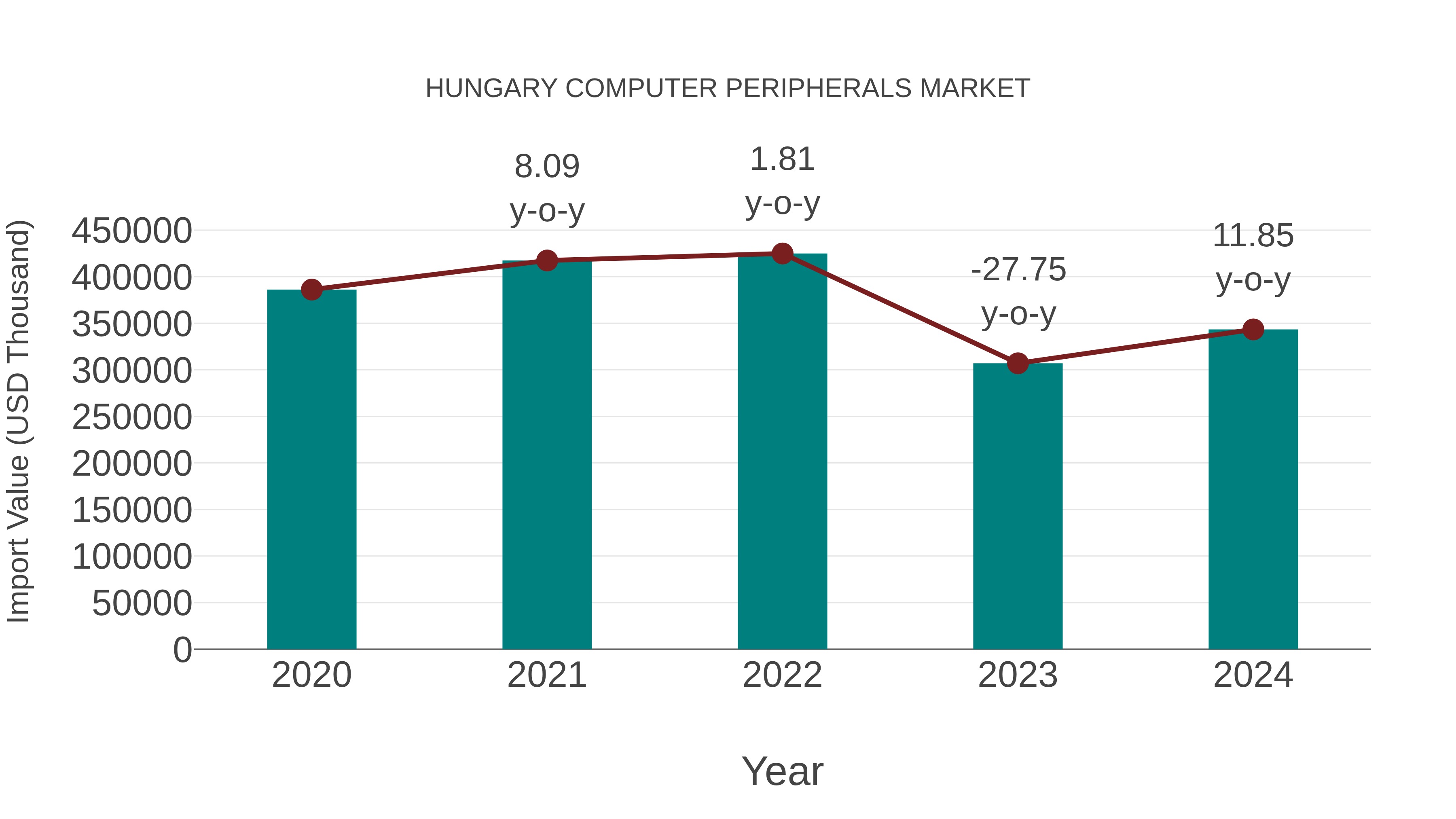
In 2024, Hungary`s import trend for computer peripherals experienced a growth rate of 11.85%, contrasting with a -2.89% compound annual growth rate (CAGR) from 2020 to 2023. This shift could be attributed to evolving consumer preferences or increased demand for tech products in the region, potentially indicating a market recovery.
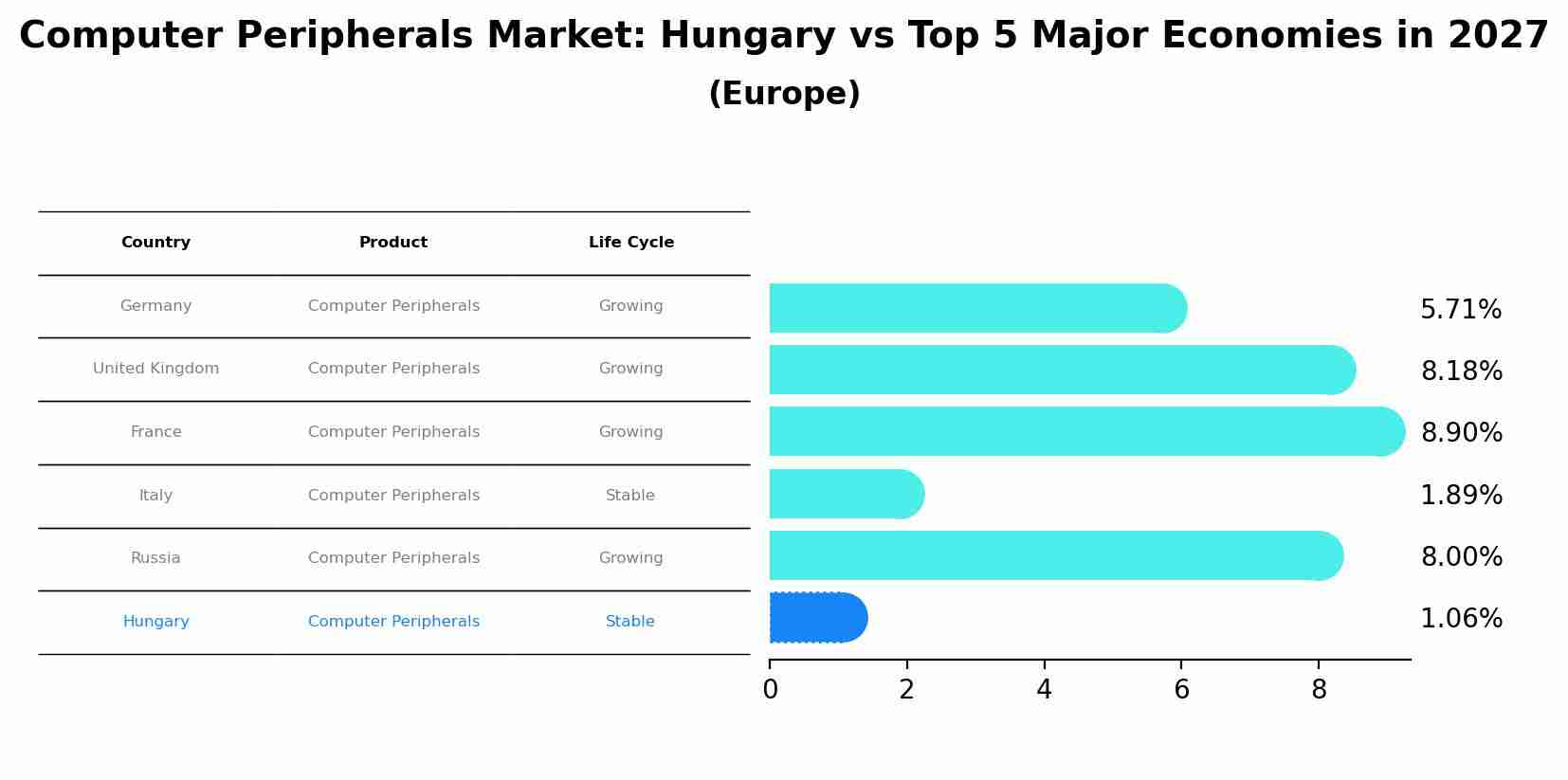
Computer Peripherals Market: Hungary vs Top 5 Major Economies in 2027 (Europe)
By 2027, Hungary's Computer Peripherals market is forecasted to achieve a stable growth rate of 1.06%, with Germany leading the Europe region, followed by United Kingdom, France, Italy and Russia.
Hungary Computer Peripherals Market Overview
The computer peripherals market in Hungary encompasses a wide range of devices such as printers, scanners, keyboards, and mice. As the adoption of digital technologies increases across various sectors, the demand for computer peripherals is also on the rise. Companies are investing in research and development to introduce advanced peripherals with enhanced features and compatibility.
Drivers of the market
The computer peripherals market in Hungary is experiencing growth driven by several factors. Firstly, the increasing adoption of computers and laptops across various sectors such as education, healthcare, and finance is boosting the demand for peripherals like keyboards, mice, and monitors. Additionally, the rise of remote work and online gaming is driving the sales of gaming peripherals and accessories. Moreover, technological advancements such as wireless connectivity and ergonomic designs are further propelling the growth of the peripherals market as consumers seek convenience and comfort in their computing experiences.
Challenges of the market
One of the primary challenges in the computer peripherals market in Hungary is the saturation of certain product categories. With a limited consumer base and a preference for established brands, newer or niche peripherals may struggle to gain traction. Additionally, the rise of wireless and Bluetooth technology poses challenges for traditional wired peripherals manufacturers to adapt and innovate.
Government Policy of the market
The computer peripherals market in Hungary has seen notable expansion, buoyed by rising consumer preferences for advanced peripherals such as gaming keyboards, mice, and monitors. Government policies aimed at fostering innovation and competitiveness in the electronics industry have contributed to this growth, alongside efforts to enhance connectivity and digital literacy among the population.
Key Highlights of the Report:
- Hungary Computer Peripherals Market Outlook
- Market Size of Hungary Computer Peripherals Market, 2019
- Forecast of Hungary Computer Peripherals Market, 2026
- Historical Data and Forecast of Hungary Computer Peripherals Revenues & Volume for the Period 2016 - 2026
- Hungary Computer Peripherals Market Trend Evolution
- Hungary Computer Peripherals Market Drivers and Challenges
- Hungary Computer Peripherals Price Trends
- Hungary Computer Peripherals Porter's Five Forces
- Hungary Computer Peripherals Industry Life Cycle
- Historical Data and Forecast of Hungary Computer Peripherals Market Revenues & Volume By Connectivity for the Period 2016 - 2026
- Historical Data and Forecast of Hungary Computer Peripherals Market Revenues & Volume By Wired devices for the Period 2016 - 2026
- Historical Data and Forecast of Hungary Computer Peripherals Market Revenues & Volume By Wireless devices for the Period 2016 - 2026
- Historical Data and Forecast of Hungary Computer Peripherals Market Revenues & Volume By Product for the Period 2016 - 2026
- Historical Data and Forecast of Hungary Computer Peripherals Market Revenues & Volume By Input Devices for the Period 2016 - 2026
- Historical Data and Forecast of Hungary Computer Peripherals Market Revenues & Volume By Keyboard for the Period 2016 - 2026
- Historical Data and Forecast of Hungary Computer Peripherals Market Revenues & Volume By Image Scanner for the Period 2016 - 2026
- Historical Data and Forecast of Hungary Computer Peripherals Market Revenues & Volume By Pointing Devices for the Period 2016 - 2026
- Historical Data and Forecast of Hungary Computer Peripherals Market Revenues & Volume By Webcam for the Period 2016 - 2026
- Historical Data and Forecast of Hungary Computer Peripherals Market Revenues & Volume By Output Devices for the Period 2016 - 2026
- Historical Data and Forecast of Hungary Computer Peripherals Market Revenues & Volume By Printer for the Period 2016 - 2026
- Historical Data and Forecast of Hungary Computer Peripherals Market Revenues & Volume By Others for the Period 2016 - 2026
- Hungary Computer Peripherals Import Export Trade Statistics
- Market Opportunity Assessment By Connectivity
- Market Opportunity Assessment By Product
- Hungary Computer Peripherals Top Companies Market Share
- Hungary Computer Peripherals Competitive Benchmarking By Technical and Operational Parameters
- Hungary Computer Peripherals Company Profiles
- Hungary Computer Peripherals Key Strategic Recommendations






































