Hungary Customer Experience Management Market Size & Growth Rate (2026-2032)
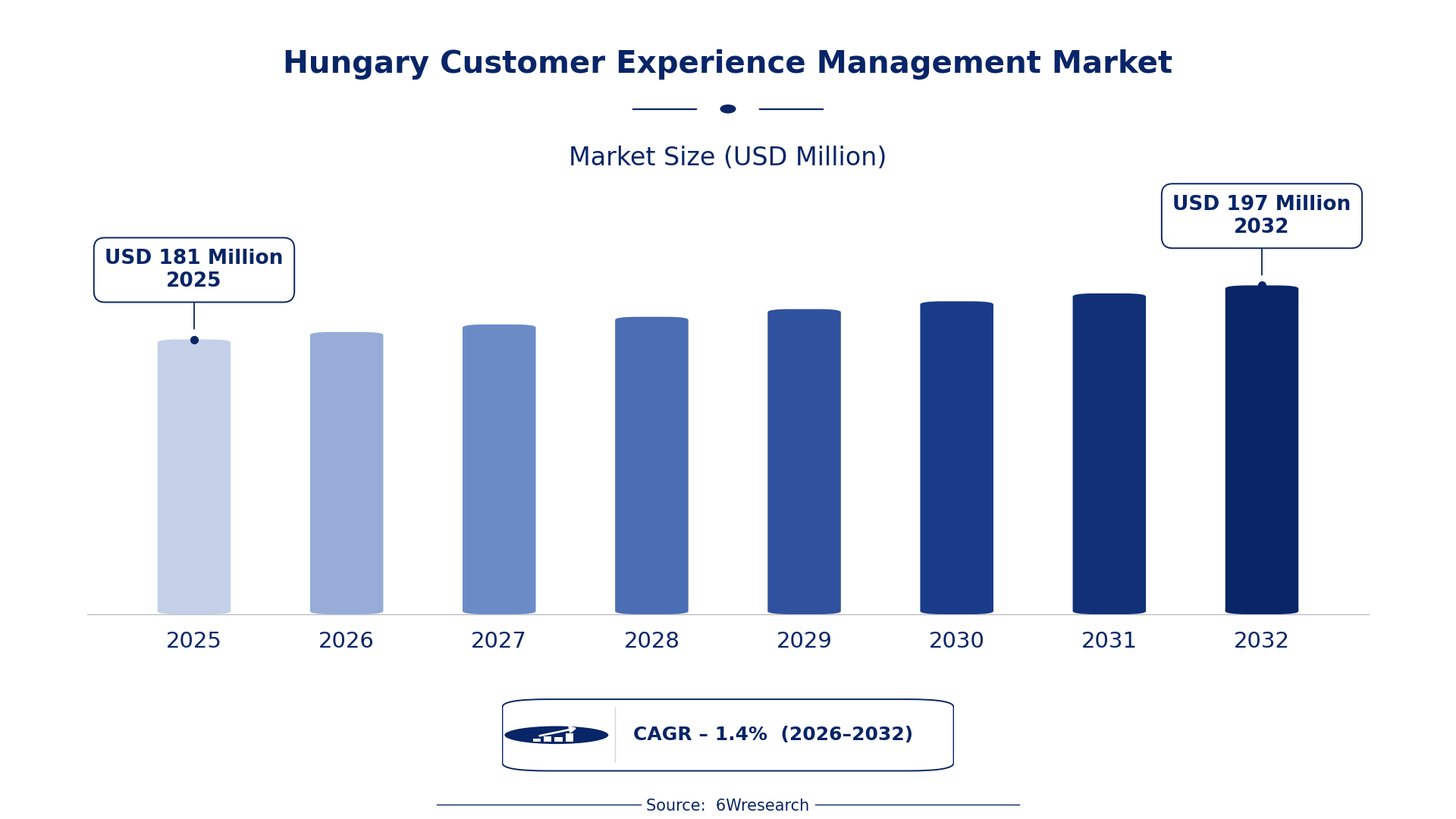
The Hungary Customer Experience Management Market was estimated at USD 181 Million in 2025 and is projected to reach USD 197 Million by 2032, growing at a CAGR of 1.4% from 2026 to 2032.
Hungary Customer Experience Management Market Synopsis
In Hungary, the customer experience management (CXM) market is gaining momentum as businesses increasingly recognize the critical role of customer satisfaction in driving loyalty and revenue. Companies are integrating advanced CXM solutions to gather feedback and enhance interactions across various customer touchpoints. This investment reflects a broader commitment to understanding consumer needs and delivering tailored experiences.
As organizations seek a competitive advantage, the focus on optimizing every aspect of the customer journey becomes paramount. From leveraging sentiment analysis to addressing pain points, businesses are actively pursuing strategies that will elevate their customer experience. The commitment to CXM is transforming the market dynamics, making it a focal point for strategic investment.
Hungary Customer Experience Management Market Year-wise Growth Rate and Key Drivers
This graph illustrates the annual growth rates of the Hungary Customer Experience Management Market from 2021 to 2032, highlighting a steady upward trajectory and projected expansion over the forecast period.
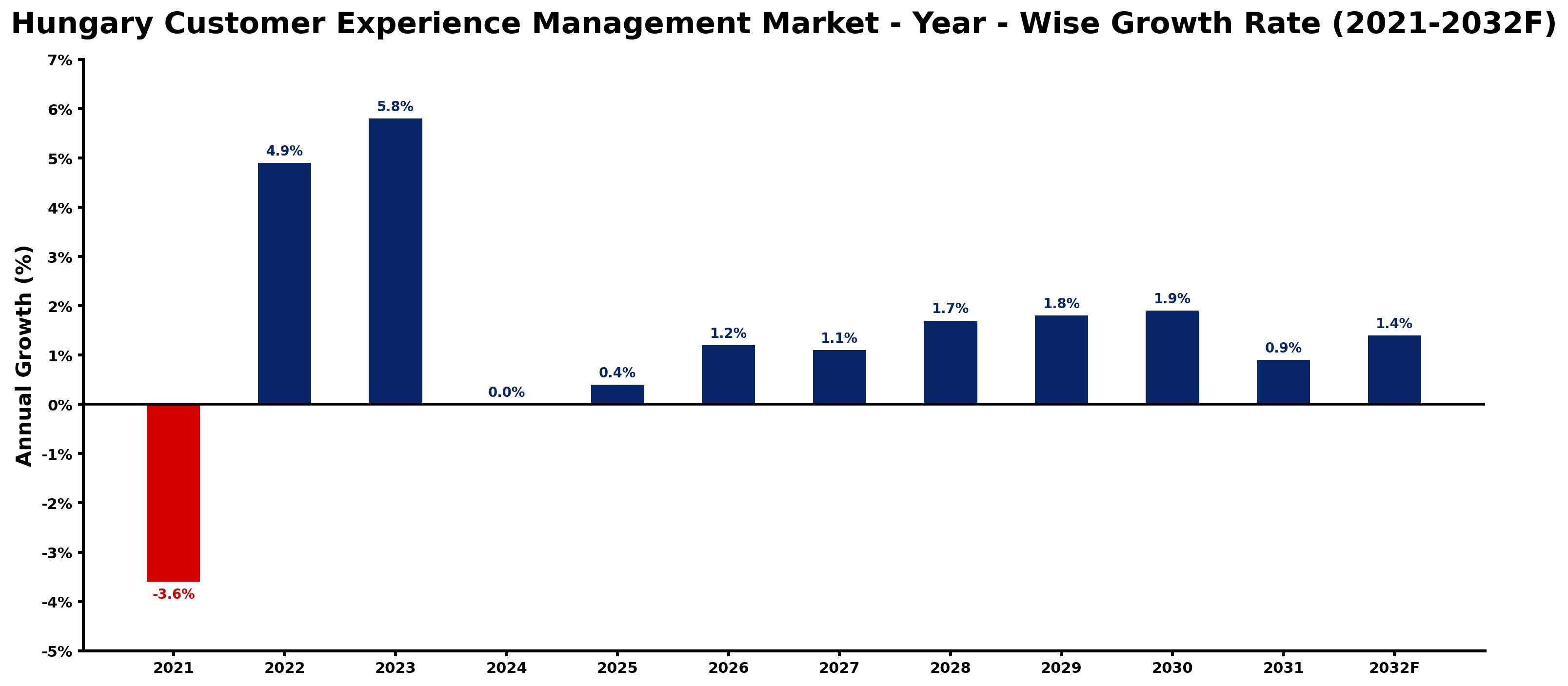
The table below presents the year‑wise growth rates along with the key drivers influencing the market
| Year | Growth Rate | Major Drivers |
| 2021 | -3.6% | COVID-19 restrictions limited customer engagement activities. |
| 2022 | 4.9% | Increased focus on digital transformation by SMEs |
| 2023 | 5.8% | Hungarian government initiatives supporting tech start-ups proliferation |
| 2024 | 0.0% | Increasing adoption of advanced technologies |
| 2025 | 0.4% | Rise of remote work influencing customer service solutions |
| 2026 | 1.2% | More companies adopting omnichannel communication strategies |
| 2027 | 1.1% | Regulatory frameworks enhancing consumer data protection awareness |
| 2028 | 1.7% | Growing e-commerce sector heightening need for customer insights |
| 2029 | 1.8% | Increased investment in customer feedback platforms by businesses |
| 2030 | 1.9% | Focus on customer journey mapping in service industries |
| 2031 | 0.9% | Surge in mobile app usage driving feedback mechanisms |
| 2032 | 1.4% | Demand for localized customer support services and insights |
Note: Market size estimations and growth projections presented in this report are based on 6Wresearch's proprietary forecasting methodology, utilizing the latest available industry data, government publications, and primary research inputs.
Hungary Customer Experience Management Market Key Takeaways
Below are some of the specific key takeaways from the market, including:
- The market is projected to grow steadily, with a CAGR of 1.4% from 2026 to 2032.
- Businesses are increasingly adopting CXM solutions to enhance customer satisfaction and loyalty.
- There is a notable emphasis on collecting and analyzing customer feedback across multiple channels.
- Government initiatives are promoting a customer-centric culture among businesses.
- Challenges include effectively synthesizing diverse customer feedback data into actionable insights.
Evaluation of Restraints in Hungary Customer Experience Management Market
The Hungary Customer Experience Management Market faces several constraints that could impede its growth. A primary challenge is the ability of organizations to effectively capture and analyze customer feedback across various channels. Many businesses struggle with collecting data from surveys, social media, and online reviews, which complicates the synthesis of insights. This lack of cohesive data integration hinders companies from making informed decisions about improving customer experiences. Additionally, the market's growth is sometimes limited by insufficient understanding of advanced analytics capabilities, which can restrict the implementation of effective CXM strategies.
Hungary Customer Experience Management Market Trends
Several trends are shaping the Hungary Customer Experience Management Market. Firstly, there is a shift toward utilizing artificial intelligence and machine learning to analyze customer data more effectively. Companies are increasingly turning to predictive analytics to anticipate customer needs and tailor experiences accordingly. Secondly, the rise of omnichannel strategies is compelling businesses to create cohesive experiences across various platforms, ensuring that customer interactions are seamless and integrated. Lastly, the focus on personalized customer journeys is becoming more pronounced, with companies seeking to leverage insights to deliver targeted communications and offers that resonate with individual preferences.
Hungary Customer Experience Management Market Opportunities
The potential for growth in the Hungary Customer Experience Management Market is promising. Companies can capitalize on the opportunity to invest in advanced analytics platforms that provide deeper insights into customer behavior. on top of that, as digital transformation accelerates, there is a chance for businesses to enhance their CXM capabilities by integrating new technologies, such as chatbots and CRM systems, into their operations. Additionally, fostering partnerships with technology vendors can drive innovation and improve service delivery, ultimately leading to enhanced customer experiences and loyalty.
Government Initiatives in the Hungary Customer Experience Management Market
The Hungarian government is actively shaping the customer experience management sector through various initiatives aimed at fostering a customer-centric culture. By introducing policies that encourage investment in CXM tools and strategies, the government aims to elevate the overall standard of customer service across industries. This commitment to improving customer satisfaction is crucial for businesses looking to thrive in a competitive market.
- A recently completed initiative focused on developing a national customer service framework to enhance standards across sectors.
- A current program is underway that incentivizes businesses to adopt advanced CXM technologies, aiming to improve customer interaction quality.
- Plans for a public-private partnership are expected to launch in 2026, aimed at boosting digital infrastructure in customer service sectors.
- Ongoing regulatory reviews are looking to implement new guidelines for customer feedback collection and analysis.
- A proposed policy in 2027 seeks to mandate transparency in customer service metrics to enhance accountability among service providers.
Future Insights of the Hungary Customer Experience Management Market
Looking ahead to 2026-2032, the Hungary Customer Experience Management Market is set to evolve significantly. With businesses increasingly prioritizing customer insights, the demand for sophisticated CXM solutions will continue to rise. As technology advances, expect to see greater integration of AI-driven analytics that will empower organizations to refine their customer engagement strategies. The focus will likely shift toward not just meeting but exceeding customer expectations, creating a landscape where personalization becomes the norm rather than the exception.
Hungary Customer Experience Management Market Latest Developments
In the past year, the Hungary Customer Experience Management Market has experienced several noteworthy developments. Organizations are increasingly adopting innovative solutions to enhance their customer engagement strategies, reflecting a shift in focus toward the customer journey. This momentum highlights the need for businesses to remain agile and responsive to evolving customer expectations.
- A major technology vendor launched a new CXM platform in early 2025, designed to streamline customer feedback collection and analysis.
- An initiative that began in mid-2025 aims to integrate AI-driven chatbots into customer service operations across various industries.
- By late 2025, a leading regional operator is expected to complete its rollout of a comprehensive customer satisfaction survey initiative.
- A planned upgrade to digital customer service infrastructure is set to begin in Q3 2026, aimed at improving responsiveness and efficiency.
- Current partnerships between companies and analytics firms are underway, focusing on enhancing sentiment analysis capabilities for better customer insights.
Hungary Customer Experience Management Market - Key Attractiveness of the Report
- 10 Years of Market Numbers
- Historical Data Starting from 2022 to 2025
- Base Year: 2025
- Forecast Data until 2032
- Key Performance Indicators Impacting the Market
- Major Upcoming Developments and Projects
Key Highlights of the Report:
- Hungary Customer Experience Management Market Outlook
- Market Size of Hungary Customer Experience Management Market, 2025
- Forecast of Hungary Customer Experience Management Market, 2032
- Historical Data and Forecast of Hungary Customer Experience Management Revenues & Volume for the Period 2022-2032F
- Hungary Customer Experience Management Market Trend Evolution
- Hungary Customer Experience Management Market Drivers and Challenges
- Hungary Customer Experience Management Price Trends
- Hungary Customer Experience Management Porter's Five Forces
- Hungary Customer Experience Management Industry Life Cycle
- Historical Data and Forecast of Hungary Customer Experience Management Market Revenues & Volume By Component for the Period 2022-2032F
- Historical Data and Forecast of Hungary Customer Experience Management Market Revenues & Volume By Solutions for the Period 2022-2032F
- Historical Data and Forecast of Hungary Customer Experience Management Market Revenues & Volume By Services for the Period 2022-2032F
- Historical Data and Forecast of Hungary Customer Experience Management Market Revenues & Volume By Vertical for the Period 2022-2032F
- Historical Data and Forecast of Hungary Customer Experience Management Market Revenues & Volume By IT and Telecom for the Period 2022-2032F
- Historical Data and Forecast of Hungary Customer Experience Management Market Revenues & Volume By BFSI for the Period 2022-2032F
- Historical Data and Forecast of Hungary Customer Experience Management Market Revenues & Volume By Retail for the Period 2022-2032F
- Historical Data and Forecast of Hungary Customer Experience Management Market Revenues & Volume By Healthcare for the Period 2022-2032F
- Historical Data and Forecast of Hungary Customer Experience Management Market Revenues & Volume By Automotive for the Period 2022-2032F
- Historical Data and Forecast of Hungary Customer Experience Management Market Revenues & Volume By Travel and hospitality for the Period 2022-2032F
- Historical Data and Forecast of Hungary Customer Experience Management Market Revenues & Volume By Media and entertainment for the Period 2022-2032F
- Historical Data and Forecast of Hungary Customer Experience Management Market Revenues & Volume By Public sector for the Period 2022-2032F
- Historical Data and Forecast of Hungary Customer Experience Management Market Revenues & Volume By Touchpoint for the Period 2022-2032F
- Historical Data and Forecast of Hungary Customer Experience Management Market Revenues & Volume By Websites for the Period 2022-2032F
- Historical Data and Forecast of Hungary Customer Experience Management Market Revenues & Volume By Stores for the Period 2022-2032F
- Historical Data and Forecast of Hungary Customer Experience Management Market Revenues & Volume By Call centers for the Period 2022-2032F
- Historical Data and Forecast of Hungary Customer Experience Management Market Revenues & Volume By Mobile apps for the Period 2022-2032F
- Historical Data and Forecast of Hungary Customer Experience Management Market Revenues & Volume By Social media for the Period 2022-2032F
- Historical Data and Forecast of Hungary Customer Experience Management Market Revenues & Volume By Emails for the Period 2022-2032F
- Historical Data and Forecast of Hungary Customer Experience Management Market Revenues & Volume By Virtual assistants for the Period 2022-2032F
- Historical Data and Forecast of Hungary Customer Experience Management Market Revenues & Volume By Other touchpoints (loyalty programs, surveys, sales representatives, seminars, trade shows, public speaking, and training) for the Period 2022-2032F
- Historical Data and Forecast of Hungary Customer Experience Management Market Revenues & Volume By Deployment Type for the Period 2022-2032F
- Historical Data and Forecast of Hungary Customer Experience Management Market Revenues & Volume By On-Premises for the Period 2022-2032F
- Historical Data and Forecast of Hungary Customer Experience Management Market Revenues & Volume By Cloud for the Period 2022-2032F
- Historical Data and Forecast of Hungary Customer Experience Management Market Revenues & Volume By Organization Size for the Period 2022-2032F
- Historical Data and Forecast of Hungary Customer Experience Management Market Revenues & Volume By Small and Medium Enterprises (SMEs) for the Period 2022-2032F
- Historical Data and Forecast of Hungary Customer Experience Management Market Revenues & Volume By Large Enterprises for the Period 2022-2032F
- Hungary Customer Experience Management Import Export Trade Statistics
- Market Opportunity Assessment By Component
- Market Opportunity Assessment By Vertical
- Market Opportunity Assessment By Touchpoint
- Market Opportunity Assessment By Deployment Type
- Market Opportunity Assessment By Organization Size
- Hungary Customer Experience Management Top Companies Market Share
- Hungary Customer Experience Management Competitive Benchmarking By Technical and Operational Parameters
- Hungary Customer Experience Management Company Profiles
- Hungary Customer Experience Management Key Strategic Recommendations






































