Hungary Diesel Engine Market Size (2020-2030)
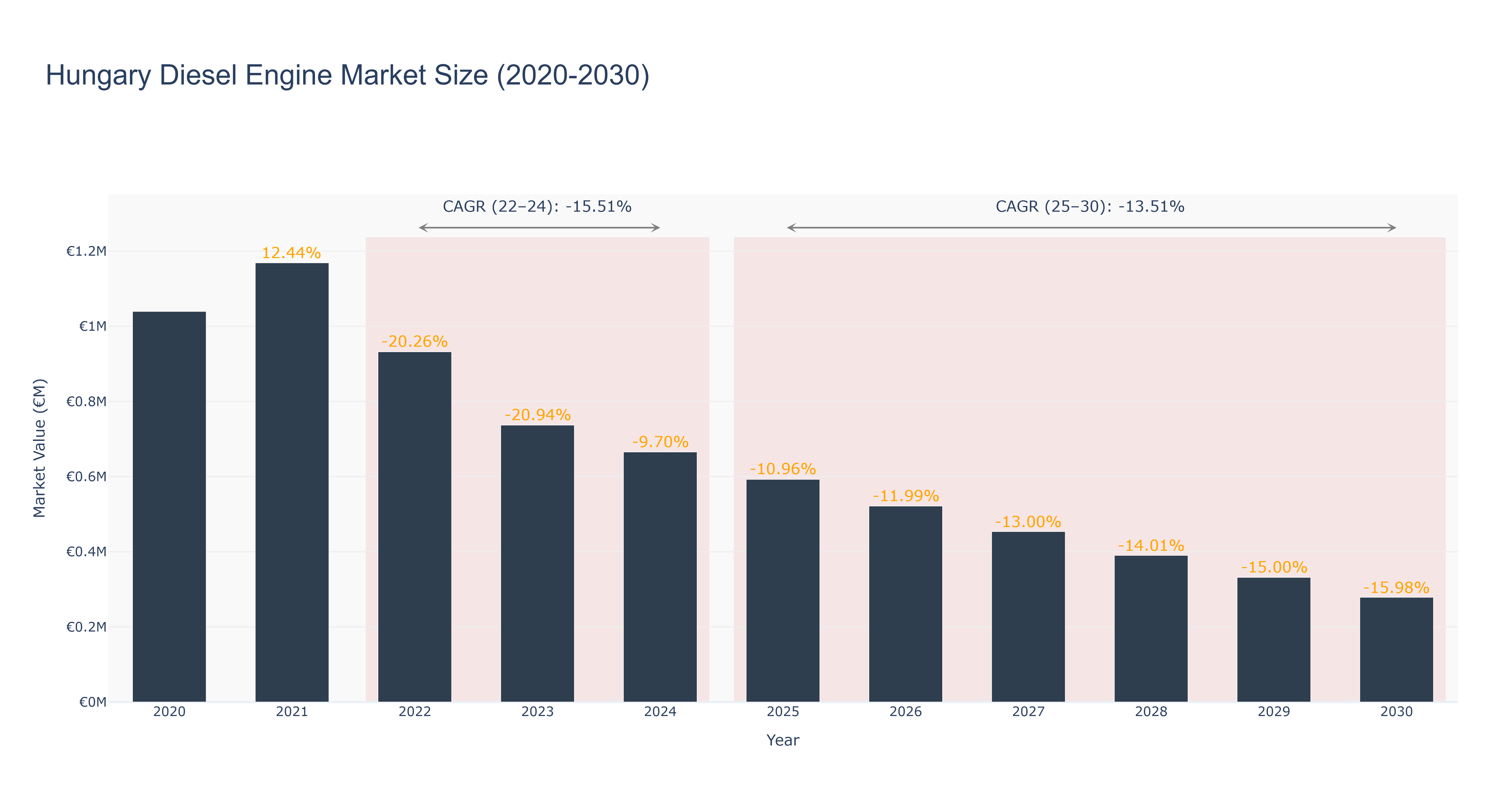
The Hungary Diesel Engine Market reached its peak in 2021 with a market size of €1.17 million, before experiencing a significant decline, dropping to €665.48 thousand by 2024, representing a compound annual growth rate (CAGR) of -15.51% from 2022 to 2024. This downturn is attributable to increasing regulatory pressures favoring cleaner energy sources and a shift in consumer preference towards more sustainable alternatives. Looking ahead, the forecasted period from 2025 to 2030 suggests continued challenges, with projected market sizes declining from €592.56 thousand to €278.66 thousand, yielding a CAGR of -13.51%. Key factors influencing this trajectory include stricter emissions regulations and advancements in electric vehicle technology. While specific upcoming projects have not been highlighted, the overarching trend indicates a sustained push towards decarbonization, which will likely further inhibit growth in the diesel engine segment.
Hungary Diesel Engine Market: Production & Trade Performance (2019-2025)
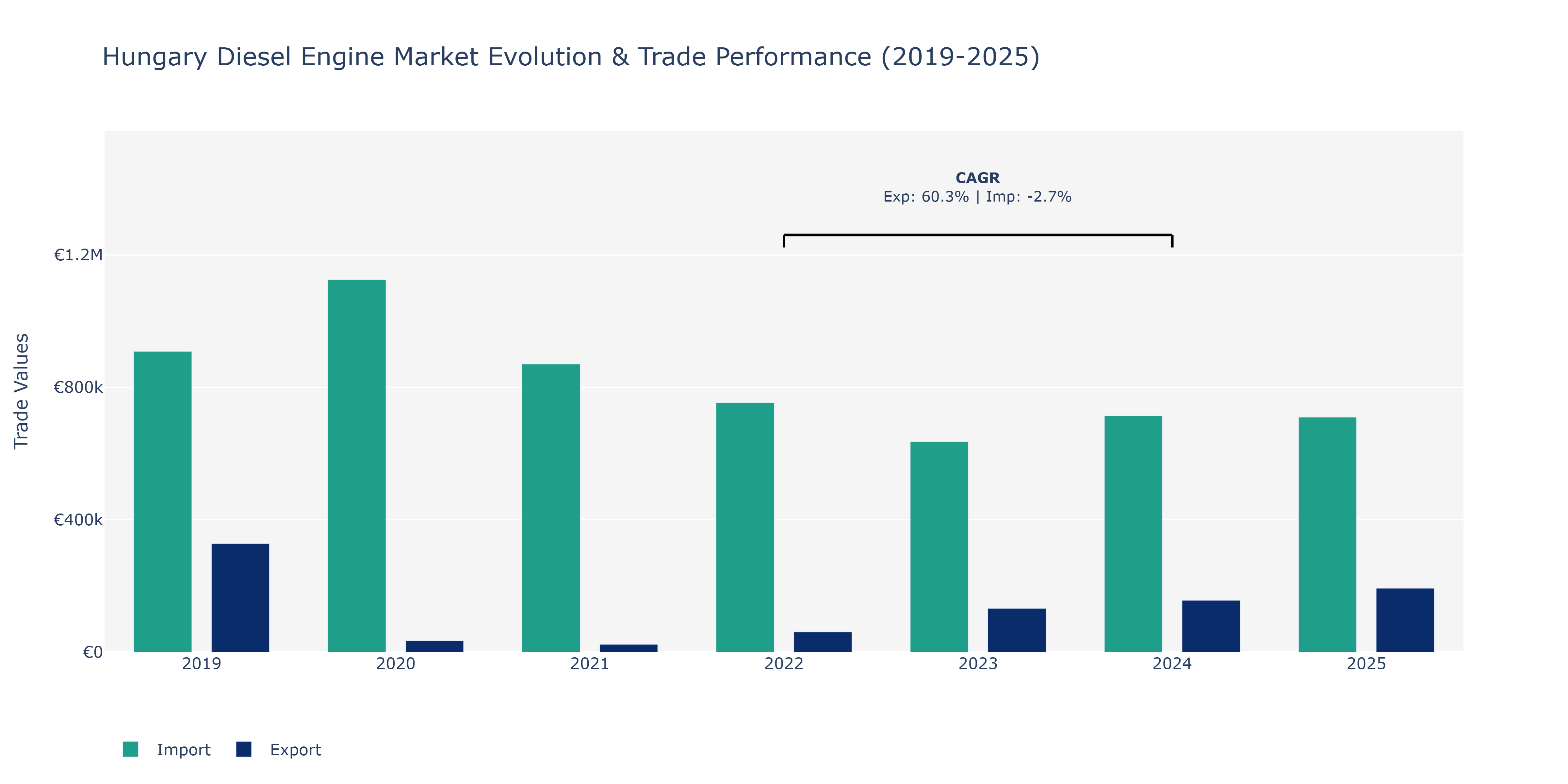
Between 2019 and 2025, Hungary's Diesel Engine Market saw noteworthy fluctuations in both Exports and Imports. Exports peaked in 2025 at approximately €193.08 thousand, showing a clear upward trend throughout the period. Conversely, Imports peaked in 2020 at around €1.13 million and experienced a noticeable decline in the following years. The sharp decrease in 2021 for both Exports and Imports can be attributed to the global economic impact of the COVID-19 pandemic, disrupting trade flows and reducing demand for diesel engines across borders. However, the subsequent recovery in exports reflects Hungary's resilience in regaining market stability. The decrease in imports post-2020 could be due to shifts in domestic production capabilities or changes in foreign trade policies. These trends align with the global automotive industry's transition towards more sustainable technologies, impacting the demand for diesel engines in Hungary.
Hungary Diesel Engine Market Overview
The diesel engine market in Hungary is witnessing steady demand driven by the widespread use of diesel-powered vehicles, machinery, and equipment in transportation, construction, agriculture, and industrial sectors. Diesel engines offer high efficiency, durability, and torque output, making them suitable for heavy-duty applications requiring reliable power generation and propulsion capabilities.
Drivers of the market
The Hungary diesel engine market is driven by various factors such as industrial growth, infrastructure development, and increasing demand for commercial vehicles. Diesel engines are widely used in transportation, construction, and power generation sectors, thus making them indispensable for economic activities. Additionally, technological advancements aimed at improving fuel efficiency and reducing emissions further stimulate market growth.
Challenges of the market
Balancing performance with emissions regulations poses challenges for diesel engine manufacturers. Additionally, addressing the transition towards alternative fuels and electrification adds complexity to the market.
Government Policy of the market
Government regulations concerning vehicle emissions, fuel efficiency, and transportation infrastructure influence the diesel engine market in Hungary. Policies related to emission standards and vehicle testing, standards for engine performance and durability, as well as guidelines for fuel quality and taxation, impact market dynamics. Government initiatives aimed at reducing air pollution and promoting alternative fuels may also shape demand for diesel engine technologies.
Key Highlights of the Report:
- Hungary Diesel Engine Market Outlook
- Market Size of Hungary Diesel Engine Market, 2021
- Forecast of Hungary Diesel Engine Market, 2028
- Historical Data and Forecast of Hungary Diesel Engine Revenues & Volume for the Period 2018 - 2028
- Hungary Diesel Engine Market Trend Evolution
- Hungary Diesel Engine Market Drivers and Challenges
- Hungary Diesel Engine Price Trends
- Hungary Diesel Engine Porter's Five Forces
- Hungary Diesel Engine Industry Life Cycle
- Historical Data and Forecast of Hungary Diesel Engine Market Revenues & Volume By Power Rating for the Period 2018 - 2028
- Historical Data and Forecast of Hungary Diesel Engine Market Revenues & Volume By 0.5 MW 1 MW for the Period 2018 - 2028
- Historical Data and Forecast of Hungary Diesel Engine Market Revenues & Volume By Up to 0.5 MW for the Period 2018 - 2028
- Historical Data and Forecast of Hungary Diesel Engine Market Revenues & Volume By 2 MW 5 MW for the Period 2018 - 2028
- Historical Data and Forecast of Hungary Diesel Engine Market Revenues & Volume By 1 MW 2 MW for the Period 2018 - 2028
- Historical Data and Forecast of Hungary Diesel Engine Market Revenues & Volume By Above 5 MW for the Period 2018 - 2028
- Historical Data and Forecast of Hungary Diesel Engine Market Revenues & Volume By for the Period 2018 - 2028
- Historical Data and Forecast of Hungary Diesel Engine Market Revenues & Volume By End User for the Period 2018 - 2028
- Historical Data and Forecast of Hungary Diesel Engine Market Revenues & Volume By Automotive for the Period 2018 - 2028
- Historical Data and Forecast of Hungary Diesel Engine Market Revenues & Volume By Non-Automotive for the Period 2018 - 2028
- Hungary Diesel Engine Import Export Trade Statistics
- Market Opportunity Assessment By Power Rating
- Market Opportunity Assessment By End User
- Hungary Diesel Engine Top Companies Market Share
- Hungary Diesel Engine Competitive Benchmarking By Technical and Operational Parameters
- Hungary Diesel Engine Company Profiles
- Hungary Diesel Engine Key Strategic Recommendations






































