Hungary Kosher Food Market Size, Share & Growth Rate
The Hungary Kosher Food Market was estimated at USD 1331 Million in 2025 and is projected to reach USD 1926 Million by 2032, growing at a CAGR of 5.4% from 2026 to 2032. This growth trajectory is fueled by an increasing demand from both the local Jewish community and a broader consumer base interested in dietary restrictions that align with kosher principles. The globalization of food production and the subsequent rise in international kosher certification bodies have enhanced product availability, enabling retailers to offer a wider variety of kosher-certified options.
Hungary Kosher Food Market Year-wise Growth Rate and Key Drivers
This graph highlights how the Hungary Kosher Food Market has steadily grown over the years, supported by major growth factors.
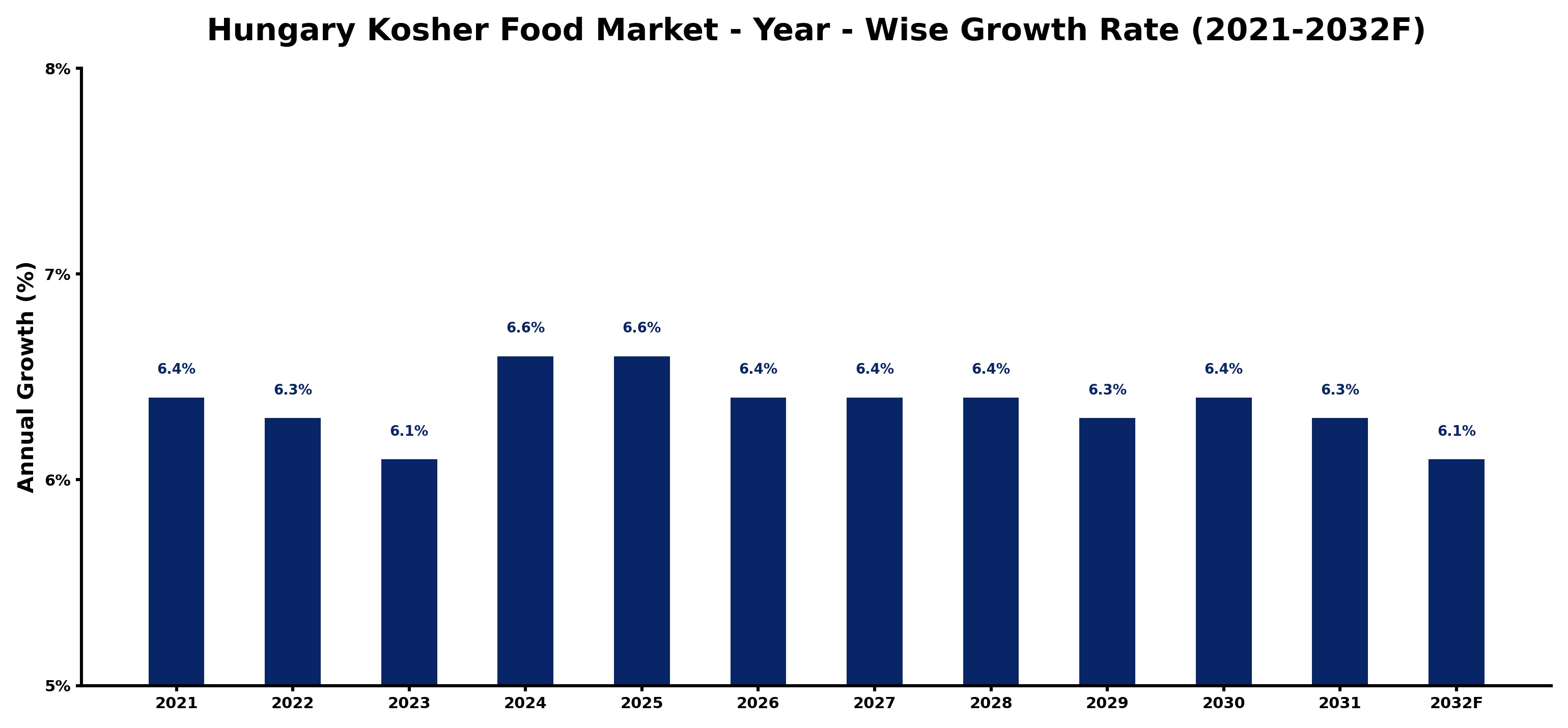
The table below presents the year‑wise growth rates along with the key drivers influencing the market
| Year | Growth Rate | Major Drivers |
| 2021 | 6.4% | New kosher certification processes boost domestic food manufacturing capacity |
| 2022 | 6.3% | Export driven demand for Kosher certification boosts local food production |
| 2023 | 6.1% | Kosher certification process improvements boosted meat processing efficiency |
| 2024 | 6.6% | Manufacturing investments in processing facilities boost kosher product availability |
| 2025 | 6.6% | Export driven digital traceability systems enhanced kosher certification processes |
| 2026 | 6.4% | Domestic kosher food processing upgrades enhance production efficiency |
| 2027 | 6.4% | Smart packaging solutions enhance efficiency in kosher food distribution |
| 2028 | 6.4% | Improved packaging technology streamlined kosher food processing operations |
| 2029 | 6.3% | Increased investment in kosher food processing technology drives productivity |
| 2030 | 6.4% | New kosher certification regulations boost local food processing capabilities |
| 2031 | 6.3% | Kosher certification process streamlining boosted local food production capacity |
| 2032 | 6.1% | Export demand for traditional kosher foods boosts local manufacturing output |
Note - Market size estimations and growth projections presented in this report are based on 6Wresearch's advanced forecasting approach, validated with industry datasets as of June 2026.
Hungary Kosher Food Market Synopsis
In Hungary, the kosher food segment is driven by a unique blend of tradition and modern dietary preferences. The appeal of kosher food transcends religious observance, attracting health-conscious consumers who value the quality and ethical considerations associated with these products.
Retailers are increasingly recognizing the potential of kosher offerings, leading to an expansion of product lines that cater to diverse dietary needs. As more consumers seek kosher options for various reasons, from personal ethics to health benefits, the market is positioned for significant growth in the coming years.
Hungary Kosher Food Market Key Takeaways
- Growing consumer base for kosher products driven by health, ethical, and cultural factors.
- Expansion of international kosher certification agencies enhancing product diversity.
- Rising perception of kosher food as premium quality boosts consumer interest.
- Collaboration among producers, retailers, and certification bodies is crucial for market growth.
- Government support for kosher food production fosters a favorable business environment.
Evaluation of Restraints in Hungary Kosher Food Market
The growth of the kosher food market in Hungary faces certain restraints primarily related to product availability and supply chain complexities. Many consumers still associate kosher products with niche markets, which can limit broader consumer acceptance. Additionally, sourcing kosher-certified ingredients poses challenges, as not all suppliers can meet the necessary standards. This discrepancy requires ongoing collaboration between food producers, certification agencies, and retailers to address these limitations effectively, ensuring that a wider range of consumers can access quality kosher products.
Hungary Kosher Food Market Trends
Several current trends are shaping the Hungary kosher food landscape. There is an increasing focus on sustainability, with many kosher brands highlighting ethical sourcing and production practices that resonate with environmentally-conscious consumers. Additionally, the rise in e-commerce has made kosher products more accessible, allowing for wider distribution beyond traditional markets. The demand for innovative kosher offerings, such as plant-based and gluten-free options, is also on the rise, reflecting broader dietary trends in Hungary.
Hungary Kosher Food Market Opportunities
The Hungary kosher food market presents numerous growth opportunities, particularly in the realm of product innovation. There is significant potential for expanding the range of kosher-certified foods available in mainstream grocery stores and specialty retailers. Moreover, tapping into the burgeoning health and wellness trend offers avenues for developing functional kosher foods that cater to specific dietary needs. As consumer awareness continues to evolve, opportunities for partnerships between local producers and international kosher brands are ripe for exploration, fostering a diverse market landscape.
Government Initiatives in the Hungary Kosher Food Market
The Hungarian government actively supports the production and certification of kosher food, recognizing its significance for religious and cultural communities. Regulations governing kosher certification agencies are in place to ensure compliance with Jewish dietary laws, promoting transparency and consumer trust. Public initiatives aimed at enhancing the capabilities of kosher food production facilities further demonstrate the government's commitment to meeting the dietary needs of its citizens. Such support creates a conducive environment for the kosher food market to flourish.
Future Insights of the Hungary Kosher Food Market
Looking ahead, the Hungary kosher food market is expected to evolve significantly between 2026 and 2032. The increasing incorporation of kosher products into mainstream culinary offerings will likely expand consumer access and appreciation. Innovations driven by health trends and sustainability concerns will also play a pivotal role in shaping product development. As the market adapts to changing consumer preferences and embraces broader demographics, it is positioned for sustained growth, ensuring that kosher foods are an integral part of Hungary's diverse food landscape.
Hungary Kosher Food Market Latest Developments (May 2025 - June 2026)
Recent developments in the Hungary kosher food market indicate a shift towards more inclusive product offerings. Retailers are beginning to expand their kosher sections, incorporating a variety of international kosher brands alongside local products. Additionally, the push for sustainable practices is becoming more pronounced, with companies actively promoting their environmental efforts as part of their kosher credentials. The overall direction reflects a growing acceptance of kosher food among a broader consumer base, signaling an exciting phase for market expansion.
Hungary Kosher Food Market - Key Attractiveness of the Report
- 10 Years of Market Numbers
- Historical Data Starting from 2022 to 2025
- Base Year: 2025
- Forecast Data until 2032
- Key Performance Indicators Impacting the Market
- Major Upcoming Developments and Projects
Key Highlights of the Report:
- Hungary Kosher Food Market Outlook
- Market Size of Hungary Kosher Food Market, 2025
- Forecast of Hungary Kosher Food Market, 2032
- Historical Data and Forecast of Hungary Kosher Food Revenues & Volume for the Period 2022-2032F
- Hungary Kosher Food Market Trend Evolution
- Hungary Kosher Food Market Drivers and Challenges
- Hungary Kosher Food Price Trends
- Hungary Kosher Food Porter's Five Forces
- Hungary Kosher Food Industry Life Cycle
- Historical Data and Forecast of Hungary Kosher Food Market Revenues & Volume By Type for the Period 2022-2032F
- Historical Data and Forecast of Hungary Kosher Food Market Revenues & Volume By Meat for the Period 2022-2032F
- Historical Data and Forecast of Hungary Kosher Food Market Revenues & Volume By Dairy for the Period 2022-2032F
- Historical Data and Forecast of Hungary Kosher Food Market Revenues & Volume By Pareve for the Period 2022-2032F
- Historical Data and Forecast of Hungary Kosher Food Market Revenues & Volume By Application for the Period 2022-2032F
- Historical Data and Forecast of Hungary Kosher Food Market Revenues & Volume By Seafood for the Period 2022-2032F
- Historical Data and Forecast of Hungary Kosher Food Market Revenues & Volume By Processed Meat and Poultry for the Period 2022-2032F
- Historical Data and Forecast of Hungary Kosher Food Market Revenues & Volume By Beverages for the Period 2022-2032F
- Historical Data and Forecast of Hungary Kosher Food Market Revenues & Volume By Staples for the Period 2022-2032F
- Historical Data and Forecast of Hungary Kosher Food Market Revenues & Volume By Snacks & Savoury for the Period 2022-2032F
- Historical Data and Forecast of Hungary Kosher Food Market Revenues & Volume By Bakery and Confectionery for the Period 2022-2032F
- Historical Data and Forecast of Hungary Kosher Food Market Revenues & Volume By Others for the Period 2022-2032F
- Historical Data and Forecast of Hungary Kosher Food Market Revenues & Volume By Distribution Channel for the Period 2022-2032F
- Historical Data and Forecast of Hungary Kosher Food Market Revenues & Volume By Supermarkets and Hypermarkets for the Period 2022-2032F
- Historical Data and Forecast of Hungary Kosher Food Market Revenues & Volume By Grocery Stores for the Period 2022-2032F
- Historical Data and Forecast of Hungary Kosher Food Market Revenues & Volume By Online Stores for the Period 2022-2032F
- Hungary Kosher Food Import Export Trade Statistics
- Market Opportunity Assessment By Type
- Market Opportunity Assessment By Application
- Market Opportunity Assessment By Distribution Channel
- Hungary Kosher Food Top Companies Market Share
- Hungary Kosher Food Competitive Benchmarking By Technical and Operational Parameters
- Hungary Kosher Food Company Profiles
- Hungary Kosher Food Key Strategic Recommendations






































