Hungary Loudspeaker Market Size (2020-2030)
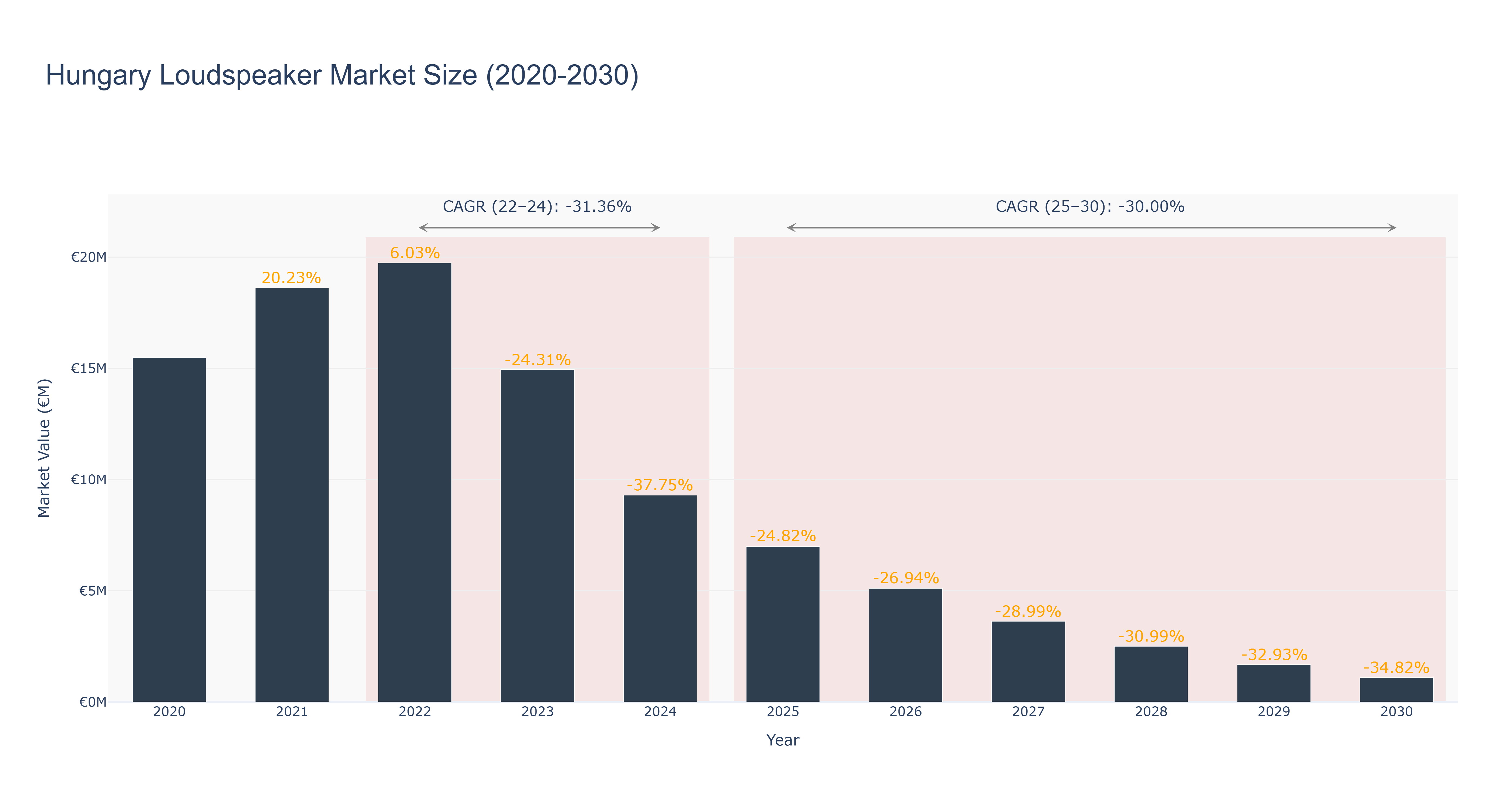
Hungary Loudspeaker Market has seen a significant decline in market size over the years. The peak market size of €19.75 million was recorded in 2022, followed by a sharp decrease to €9.30 million in 2024. The market is forecasted to continue shrinking, with an expected size of €1.09 million by 2030. The CAGR for the period 2022-24 was -31.36%, while for 2025-30, it is projected at -30.0%. The downward trend can be attributed to changing consumer preferences towards more compact audio solutions and the rise of wireless technology. Despite the challenging market conditions, Hungary is set to launch a national initiative promoting local audio technology startups, aiming to revitalize the industry and foster innovation. This initiative aligns with the industry drivers of technological advancements and innovation, offering a glimmer of hope for the future of the loudspeaker market in Hungary.
Hungary Loudspeaker Market: Production & Trade Performance (2019-2025)
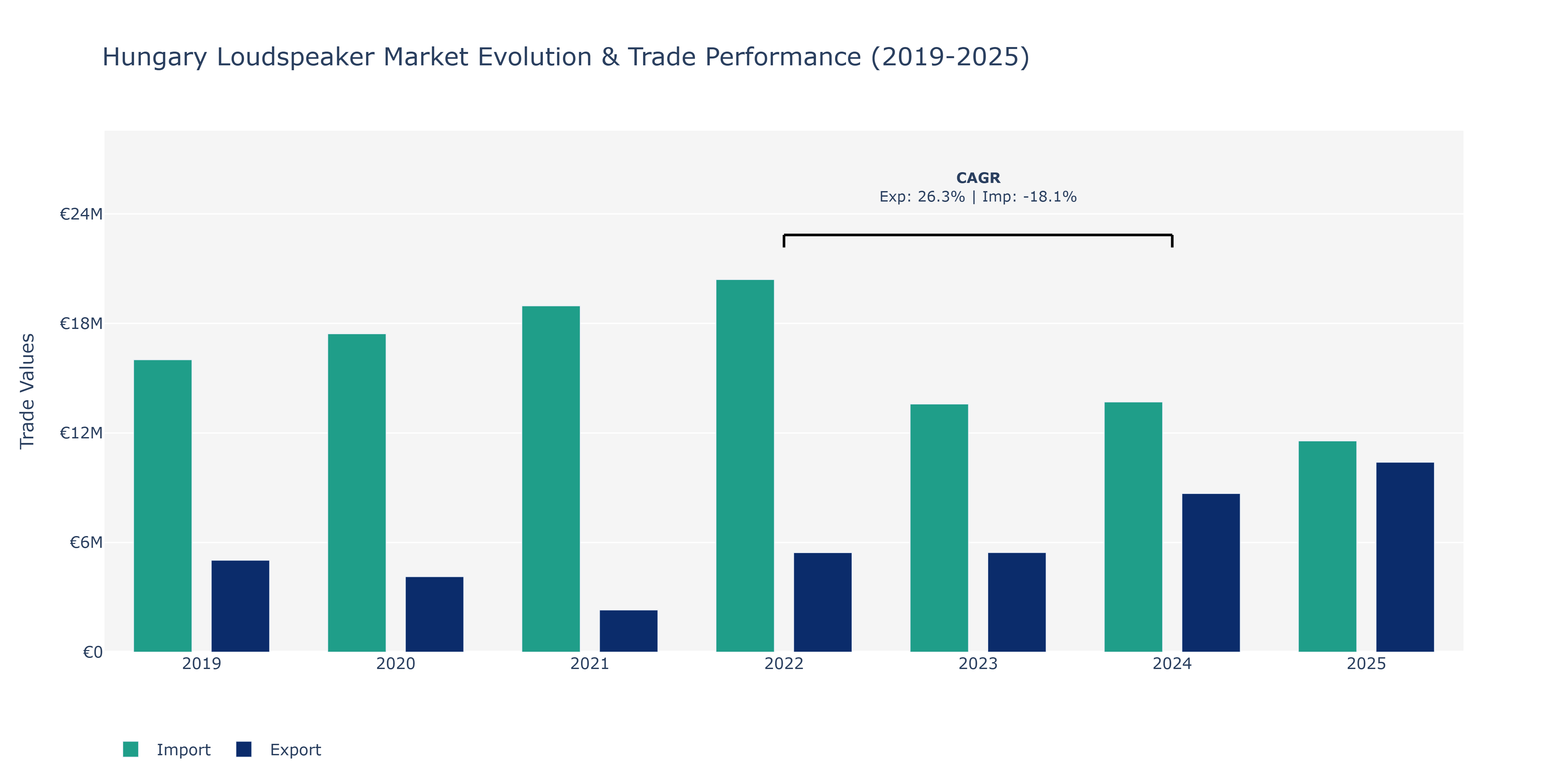
Between 2019 and 2025, Hungary's Loudspeaker Market experienced notable fluctuations in both Exports and Imports. Starting with Exports, the market saw a decrease from €5.02 million in 2019 to €2.3 million in 2021, before rebounding to €10.39 million in 2025. Conversely, Imports showcased a different pattern, rising steadily from €16.01 million in 2019 to €20.4 million in 2022, before declining to €11.56 million in 2025. The peak points for Exports and Imports were observed in 2025 and 2022, respectively. These fluctuations can be attributed to various factors, including shifts in consumer demand, global economic conditions, and technological advancements in the loudspeaker industry. For instance, the surge in Exports in 2025 could be linked to Hungary's innovation in loudspeaker technology, while the decline in Imports may reflect changes in sourcing strategies or trade agreements. The contrasting trends between Exports and Imports highlight the market's dynamism and its responsiveness to both domestic and international factors.
Hungary Loudspeaker Market Synopsis
The Hungary Loudspeaker Market is experiencing steady growth driven by increasing consumer demand for audio equipment across various applications such as home entertainment, automotive, and professional sound systems. The market is witnessing technological advancements in loudspeaker design, including wireless and smart speaker solutions. Key players in the market are focusing on product innovation and expanding their distribution networks to cater to the growing demand. The automotive sector is a significant contributor to market growth, with the integration of advanced sound systems in vehicles. Additionally, the rise in smart home devices and increasing disposable income among consumers are further fueling market expansion. However, competition among market players and fluctuating raw material prices remain key challenges for the Hungary Loudspeaker Market.
Hungary Loudspeaker Market Trends
The Hungary Loudspeaker Market is experiencing growth due to the increasing demand for high-quality audio systems in homes, cars, and commercial spaces. The trend towards smart speakers and wireless audio solutions is driving innovation in the market, with consumers seeking convenience and connectivity in their audio devices. Opportunities exist for companies to capitalize on the growing trend of smart home technology integration, as well as the demand for portable, Bluetooth-enabled speakers. Additionally, there is potential for market expansion through partnerships with electronics manufacturers and retailers to reach a wider consumer base. Overall, the Hungary Loudspeaker Market presents opportunities for companies to differentiate themselves through technological advancements and strategic partnerships to meet the evolving needs of consumers.
Hungary Loudspeaker Market Challenges
In the Hungary Loudspeaker Market, some of the key challenges include intense competition from both domestic and international manufacturers, leading to price wars and margin pressure. Another challenge is the rapid technological advancements in the industry, requiring companies to constantly innovate and upgrade their products to meet consumer demands. Additionally, economic uncertainties and fluctuations in consumer purchasing power can impact the overall demand for loudspeakers in the market. Furthermore, the emergence of alternative audio technologies such as wireless speakers and smart home devices poses a threat to traditional loudspeaker sales. To stay competitive, companies in the Hungary Loudspeaker Market must focus on product differentiation, marketing strategies, and adapting to changing consumer preferences and technological trends.
Hungary Loudspeaker Market Investment Opportunities
The Hungary Loudspeaker Market is being driven by several key factors. Firstly, the growing demand for high-quality audio equipment in various sectors such as entertainment, automotive, and consumer electronics is fueling market growth. Additionally, the increasing popularity of smart speakers and home audio systems is driving the adoption of loudspeakers in households. Technological advancements, such as wireless connectivity and voice control features, are also contributing to market expansion. Furthermore, the rising disposable income levels and changing lifestyle preferences of consumers are leading to an increased focus on audio quality, further boosting the demand for loudspeakers in Hungary. Overall, these drivers are expected to continue propelling the growth of the Hungary Loudspeaker Market in the coming years.
Hungary Loudspeaker Market Government Policie
The Hungary Loudspeaker Market is subject to various government policies that impact its operation and growth. The Hungarian government has regulations in place to ensure compliance with EU standards for product safety, emissions, and energy efficiency. Additionally, there are import tariffs and taxes that affect the pricing of loudspeakers in the market. The government also plays a role in promoting innovation and research in the audio technology sector through grants and funding opportunities. Overall, government policies in Hungary aim to create a competitive and fair market environment for loudspeaker manufacturers and distributors while also ensuring consumer protection and environmental sustainability.
Hungary Loudspeaker Market Future Outlook
The Hungary Loudspeaker Market is expected to experience steady growth in the coming years, driven by factors such as the increasing demand for high-quality audio systems in entertainment venues, commercial spaces, and residential settings. Technological advancements, such as the integration of wireless connectivity and smart features, are likely to further propel market growth. Additionally, the rising popularity of home entertainment systems and the growing adoption of soundbars and portable Bluetooth speakers are expected to contribute to the market expansion. However, factors such as intense competition among key players and fluctuations in raw material prices may pose challenges to market growth. Overall, the Hungary Loudspeaker Market is projected to exhibit positive growth trends in the foreseeable future.
Key Highlights of the Report:
- Hungary Loudspeaker Market Outlook
- Market Size of Hungary Loudspeaker Market, 2025
- Forecast of Hungary Loudspeaker Market, 2032
- Historical Data and Forecast of Hungary Loudspeaker Revenues & Volume for the Period 2022 - 2032F
- Hungary Loudspeaker Market Trend Evolution
- Hungary Loudspeaker Market Drivers and Challenges
- Hungary Loudspeaker Price Trends
- Hungary Loudspeaker Porter's Five Forces
- Hungary Loudspeaker Industry Life Cycle
- Historical Data and Forecast of Hungary Loudspeaker Market Revenues & Volume By Product for the Period 2022 - 2032F
- Historical Data and Forecast of Hungary Loudspeaker Market Revenues & Volume By Soundbar for the Period 2022 - 2032F
- Historical Data and Forecast of Hungary Loudspeaker Market Revenues & Volume By Subwoofer for the Period 2022 - 2032F
- Historical Data and Forecast of Hungary Loudspeaker Market Revenues & Volume By In-wall for the Period 2022 - 2032F
- Historical Data and Forecast of Hungary Loudspeaker Market Revenues & Volume By Outdoor for the Period 2022 - 2032F
- Historical Data and Forecast of Hungary Loudspeaker Market Revenues & Volume By Other Product Types for the Period 2022 - 2032F
- Historical Data and Forecast of Hungary Loudspeaker Market Revenues & Volume By Application for the Period 2022 - 2032F
- Historical Data and Forecast of Hungary Loudspeaker Market Revenues & Volume By Communication for the Period 2022 - 2032F
- Historical Data and Forecast of Hungary Loudspeaker Market Revenues & Volume By Home Entertainment for the Period 2022 - 2032F
- Historical Data and Forecast of Hungary Loudspeaker Market Revenues & Volume By Automotive for the Period 2022 - 2032F
- Historical Data and Forecast of Hungary Loudspeaker Market Revenues & Volume By Events and Outdoor Entertainment for the Period 2022 - 2032F
- Hungary Loudspeaker Import Export Trade Statistics
- Market Opportunity Assessment By Product
- Market Opportunity Assessment By Application
- Hungary Loudspeaker Top Companies Market Share
- Hungary Loudspeaker Competitive Benchmarking By Technical and Operational Parameters
- Hungary Loudspeaker Company Profiles
- Hungary Loudspeaker Key Strategic Recommendations






































