Hungary Pressure Sensor Market: Import Trend Analysis
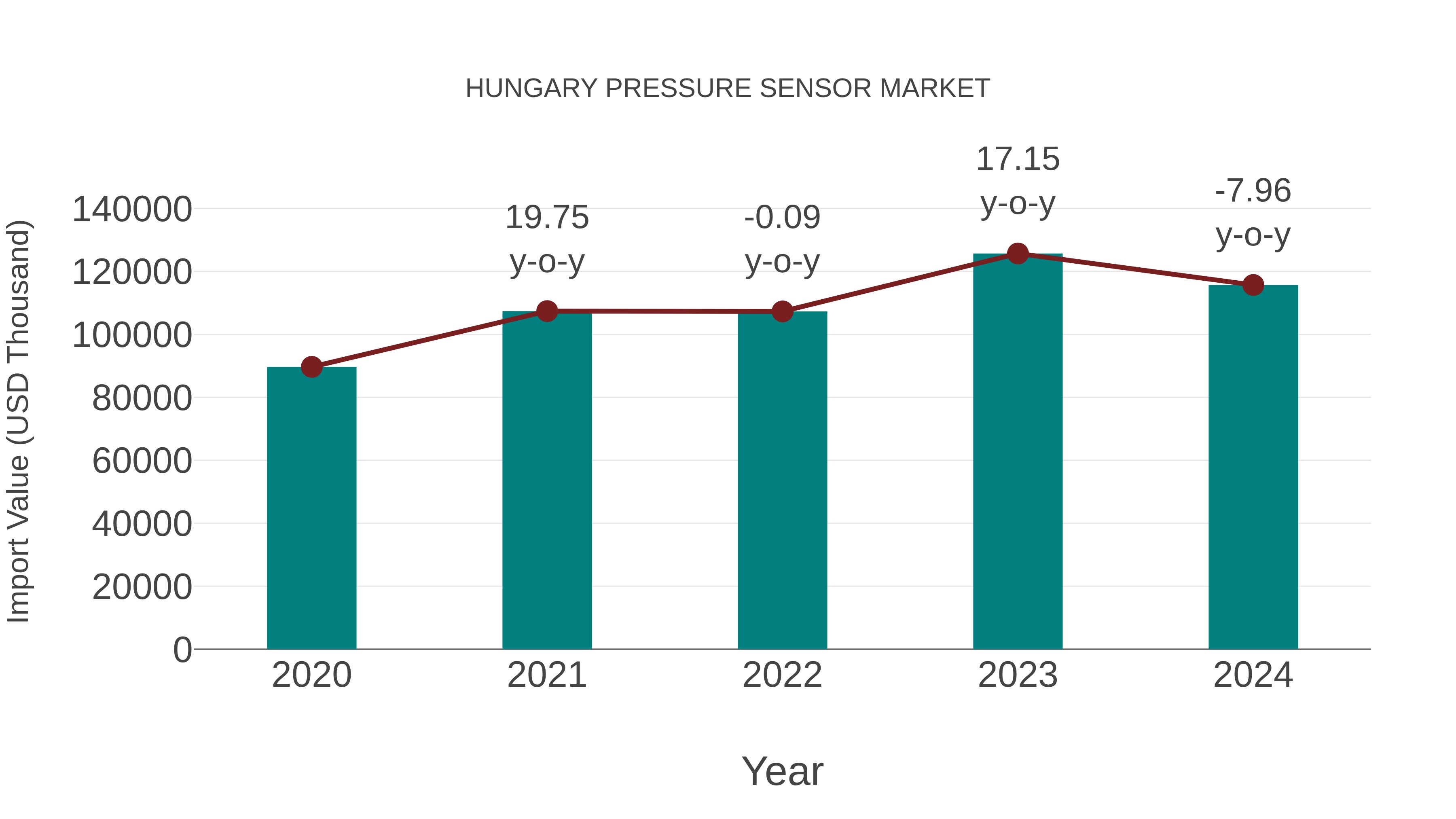
In 2024, Hungary`s import trend for pressure sensors experienced a decline, with a growth rate of -7.96% compared to the previous year. However, the compound annual growth rate (CAGR) from 2020 to 2024 stood at a healthy 6.58%. This dip in import momentum could be attributed to shifting demand patterns or market fluctuations, impacting the stability of the Hungarian pressure sensor market.
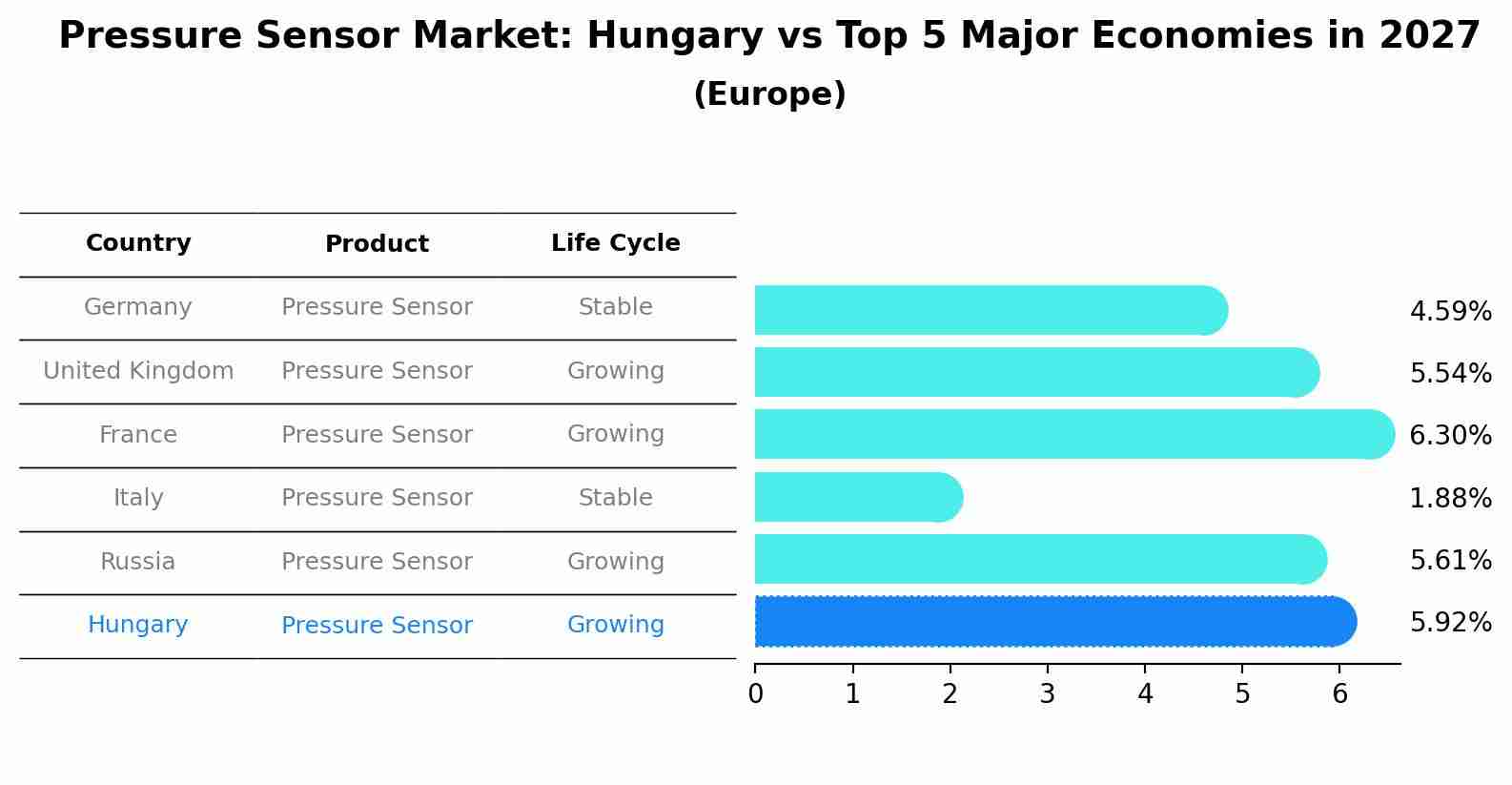
Pressure Sensor Market: Hungary vs Top 5 Major Economies in 2027 (Europe)
The Pressure Sensor market in Hungary is projected to grow at a growing growth rate of 5.92% by 2027, within the Europe region led by Germany, along with other countries like United Kingdom, France, Italy and Russia, collectively shaping a dynamic and evolving market environment driven by innovation and increasing adoption of emerging technologies.
Hungary Pressure Sensor Market Overview
The Hungary Pressure Sensor Market caters to the demand for devices that measure and monitor pressure variations in various industrial, automotive, consumer electronics, and healthcare applications. Pressure sensors play a critical role in controlling processes, ensuring safety, and enhancing performance in diverse systems and equipment. In Hungary, the pressure sensor market is driven by factors such as increasing automation, digitalization of industries, and the proliferation of IoT devices. Key players offer a wide range of pressure sensing technologies, including MEMS-based sensors, piezoelectric sensors, and capacitive sensors, catering to the evolving needs of Hungary industries and contributing to technological innovation and efficiency.
Drivers of the market
The pressure sensor market in Hungary is driven by the increasing demand for accurate and reliable measurement solutions across various industries such as automotive, aerospace, healthcare, and consumer electronics. Factors such as vehicle electrification, emission regulations, and the adoption of smart devices stimulate market growth. Technological advancements in MEMS-based sensors, microcontrollers, and signal processing enable miniaturization, integration, and cost-effective solutions, driving market adoption. Collaboration between sensor manufacturers, OEMs, and system integrators for product development and customization also contributes to market expansion.
Challenges of the market
The Hungary Pressure Sensor Market faces several challenges that stakeholders need to overcome to drive market growth and innovation. Ensuring the accuracy and reliability of pressure measurements across a wide range of applications and operating conditions is essential for maintaining customer trust and confidence. Moreover, addressing miniaturization and integration challenges to meet the size and form factor requirements of modern electronic devices poses technical hurdles for sensor manufacturers. Market fragmentation and the presence of numerous suppliers pose challenges for buyers in terms of product selection and standardization. Additionally, staying abreast of technological advancements, such as MEMS-based sensor innovations, is essential for staying competitive in the rapidly evolving pressure sensor market landscape.
Government Policy of the market
The Hungary government has formulated policies to support the development and adoption of pressure sensor technologies across various industries, including automotive, aerospace, healthcare, and manufacturing. These policies focus on promoting research and innovation in pressure sensor design, materials, and manufacturing processes to enhance performance, reliability, and cost-effectiveness. Additionally, the government may provide funding opportunities, tax incentives, or subsidies to encourage investment in pressure sensor R&D and manufacturing facilities. Furthermore, regulatory frameworks are in place to ensure the accuracy, calibration, and compliance of pressure sensors with international standards and industry specifications, as well as to address concerns related to data security, privacy, and interoperability in sensor networks and systems.
Key Highlights of the Report:
- Hungary Pressure Sensor Market Outlook
- Market Size of Hungary Pressure Sensor Market, 2021
- Forecast of Hungary Pressure Sensor Market, 2028
- Historical Data and Forecast of Hungary Pressure Sensor Revenues & Volume for the Period 2018 - 2028
- Hungary Pressure Sensor Market Trend Evolution
- Hungary Pressure Sensor Market Drivers and Challenges
- Hungary Pressure Sensor Price Trends
- Hungary Pressure Sensor Porter's Five Forces
- Hungary Pressure Sensor Industry Life Cycle
- Historical Data and Forecast of Hungary Pressure Sensor Market Revenues & Volume By Application for the Period 2018 - 2028
- Historical Data and Forecast of Hungary Pressure Sensor Market Revenues & Volume By Automotive for the Period 2018 - 2028
- Historical Data and Forecast of Hungary Pressure Sensor Market Revenues & Volume By Medical for the Period 2018 - 2028
- Historical Data and Forecast of Hungary Pressure Sensor Market Revenues & Volume By Consumer Electronics for the Period 2018 - 2028
- Historical Data and Forecast of Hungary Pressure Sensor Market Revenues & Volume By Industrial for the Period 2018 - 2028
- Historical Data and Forecast of Hungary Pressure Sensor Market Revenues & Volume By Aerospace and Defense for the Period 2018 - 2028
- Historical Data and Forecast of Hungary Pressure Sensor Market Revenues & Volume By Food and Beverage for the Period 2018 - 2028
- Historical Data and Forecast of Hungary Pressure Sensor Market Revenues & Volume By HVAC for the Period 2018 - 2028
- Hungary Pressure Sensor Import Export Trade Statistics
- Market Opportunity Assessment By Application
- Hungary Pressure Sensor Top Companies Market Share
- Hungary Pressure Sensor Competitive Benchmarking By Technical and Operational Parameters
- Hungary Pressure Sensor Company Profiles
- Hungary Pressure Sensor Key Strategic Recommendations






































