Hungary Process Automation And Instrumentation Market Size, Share & Growth Rate
The Hungary Process Automation And Instrumentation Market was estimated at USD 1310 Million in 2025 and is projected to reach USD 2209 Million by 2032, growing at a CAGR of 7.8% from 2026 to 2032. This growth trajectory is predominantly propelled by the increasing adoption of advanced automation technologies aimed at enhancing operational efficiency and reducing costs across industries. The transition towards smart manufacturing and the integration of the Industrial Internet of Things (IIoT) are further amplifying this demand, creating a thriving environment for automation solutions in Hungary.
Hungary Process Automation And Instrumentation Market Year-wise Growth Rate and Key Drivers
This graph highlights how the Hungary Process Automation And Instrumentation Market has steadily grown over the years, supported by major growth factors.
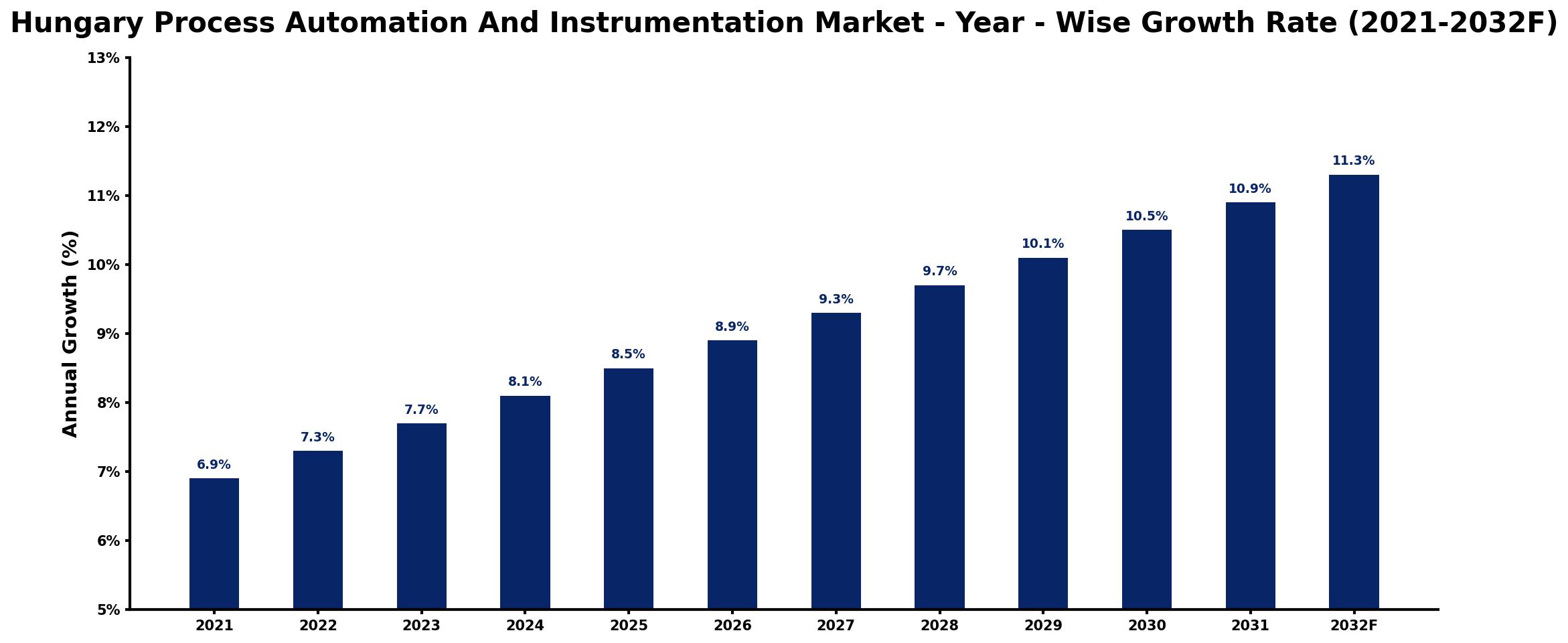
The table below presents the year‑wise growth rates along with the key drivers influencing the market
| Year | Growth Rate | Major Drivers |
| 2021 | 6.9% | Rising manufacturing sector investments |
| 2022 | 7.3% | Increased demand for energy efficiency |
| 2023 | 7.7% | Growth in smart technology adoption |
| 2024 | 8.1% | Expansion of industrial IoT applications |
| 2025 | 8.5% | Enhanced focus on sustainability initiatives |
| 2026 | 8.9% | Surge in renewable energy projects |
| 2027 | 9.3% | Growing need for real-time monitoring |
| 2028 | 9.7% | Higher adoption of predictive maintenance |
| 2029 | 10.1% | Investment in digital transformation strategies |
| 2030 | 10.5% | Increased regulatory compliance requirements |
| 2031 | 10.9% | Rising consumer demand for quality |
| 2032 | 11.3% | Broadening scope of sector collaborations |
Note: Market size estimations and growth projections presented in this report are based on 6Wresearch's proprietary forecasting methodology, utilizing the latest available industry data, government publications, and primary research inputs.
Hungary Process Automation And Instrumentation Market Synopsis
Recently, the Hungary process automation and instrumentation market has gained significant momentum, propelled by rapid advancements in digital technologies. However, as industries increasingly seek integrated automation solutions, the market is expected to evolve further, emphasizing interoperability and scalability. This shift aligns with global trends, pushing Hungarian enterprises to modernize their operations and embrace innovative solutions.
As Hungarian industries forge ahead into an era characterized by digital transformation, the demand for cutting-edge instrumentation technologies will only intensify. Industries like energy, manufacturing, and infrastructure are particularly eager to adopt automated solutions, showcasing a robust commitment to improving productivity and operational safety.
Hungary Process Automation And Instrumentation Market Key Takeaways
- The market is expected to achieve substantial growth, reaching USD 2209 Million by 2032.
- Digital transformation and smart manufacturing are pivotal drivers of market expansion.
- Increased focus on predictive maintenance is pushing demand for advanced instrumentation solutions.
- Legacy infrastructure remains a barrier to rapid adoption of modern automation technologies.
- Government initiatives are fostering a conducive environment for innovation and investment in automation.
Evaluation of Restraints in Hungary Process Automation And Instrumentation Market
Despite the positive outlook, the Hungary process automation and instrumentation market faces notable restraints. Many manufacturing facilities still operate on legacy systems, which complicates the transition to advanced automation solutions. This reliance on outdated technologies can hinder the adoption of innovative practices, requiring significant investment in training and modernization. Furthermore, the challenge of ensuring interoperability among various automation systems is critical, as seamless integration remains a pressing concern for many businesses.
Hungary Process Automation And Instrumentation Market Trends
Key trends influencing the Hungary process automation and instrumentation market include the increasing integration of IIoT technologies and the growing prevalence of cloud-based automation solutions. Companies are leveraging these technologies to enhance connectivity, enabling real-time monitoring and control of industrial processes. Additionally, the focus on sustainability and reducing environmental impact is driving interest in energy-efficient automation solutions that align with global sustainability goals.
Hungary Process Automation And Instrumentation Market Opportunities
The market presents substantial growth and investment opportunities, particularly in the realms of predictive maintenance and asset optimization. As industries seek to improve their operational efficiency, the demand for integrated and intelligent automation solutions will likely rise. Furthermore, the ongoing push for digitalization in manufacturing offers vast potential for companies to capitalize on innovative automation technologies, thereby enhancing their competitive edge.
Government Initiatives in the Hungary Process Automation And Instrumentation Market
The Hungarian government plays a vital role in promoting process automation and instrumentation technologies. Through various policies aimed at incentivizing investment and workforce training, the government is fostering a supportive environment for businesses to modernize their operations. Additionally, standards and certification schemes are being established to ensure the reliability and cybersecurity of automation systems, thus enhancing stakeholder confidence in the evolving industrial landscape.
Future Insights of the Hungary Process Automation And Instrumentation Market
Looking ahead to 2026-2032, the Hungary process automation and instrumentation market is poised for transformative growth. The emphasis on Industry 4.0 principles will drive the demand for increasingly sophisticated automation solutions that can provide real-time data and analytics. As more enterprises embrace digital transformation, the market will see accelerated investment in innovative technologies that not only enhance productivity but also ensure the sustainability of operations.
Hungary Process Automation And Instrumentation Market Latest Developments (2025 - 2026)
In recent months, the Hungary process automation and instrumentation market has witnessed a surge in strategic partnerships aimed at delivering comprehensive automation solutions. Companies are increasingly collaborating to leverage their technological expertise, facilitating the deployment of advanced automation systems across various sectors. Additionally, there is a growing emphasis on the development of cloud-based platforms that enable better data integration and operational efficiency.
Hungary Process Automation And Instrumentation Market - Key Attractiveness of the Report
- 10 Years of Market Numbers
- Historical Data Starting from 2022 to 2025
- Base Year: 2025
- Forecast Data until 2032
- Key Performance Indicators Impacting the Market
- Major Upcoming Developments and Projects
Key Highlights of the Report:
- Hungary Process Automation And Instrumentation Market Outlook
- Market Size of Hungary Process Automation And Instrumentation Market, 2025
- Forecast of Hungary Process Automation And Instrumentation Market, 2032
- Historical Data and Forecast of Hungary Process Automation And Instrumentation Revenues & Volume for the Period 2022-2032F
- Hungary Process Automation And Instrumentation Market Trend Evolution
- Hungary Process Automation And Instrumentation Market Drivers and Challenges
- Hungary Process Automation And Instrumentation Price Trends
- Hungary Process Automation And Instrumentation Porter's Five Forces
- Hungary Process Automation And Instrumentation Industry Life Cycle
- Historical Data and Forecast of Hungary Process Automation And Instrumentation Market Revenues & Volume By Instrument for the Period 2022-2032F
- Historical Data and Forecast of Hungary Process Automation And Instrumentation Market Revenues & Volume By Field Instruments for the Period 2022-2032F
- Historical Data and Forecast of Hungary Process Automation And Instrumentation Market Revenues & Volume By Control Valve for the Period 2022-2032F
- Historical Data and Forecast of Hungary Process Automation And Instrumentation Market Revenues & Volume By Analytical Instruments for the Period 2022-2032F
- Historical Data and Forecast of Hungary Process Automation And Instrumentation Market Revenues & Volume By Solution for the Period 2022-2032F
- Historical Data and Forecast of Hungary Process Automation And Instrumentation Market Revenues & Volume By Advanced Process Control (APC) for the Period 2022-2032F
- Historical Data and Forecast of Hungary Process Automation And Instrumentation Market Revenues & Volume By Distributed Control System (DCS) for the Period 2022-2032F
- Historical Data and Forecast of Hungary Process Automation And Instrumentation Market Revenues & Volume By Human Machine Interaction (HMI) for the Period 2022-2032F
- Historical Data and Forecast of Hungary Process Automation And Instrumentation Market Revenues & Volume By Manufacturing Execution System (MES) for the Period 2022-2032F
- Historical Data and Forecast of Hungary Process Automation And Instrumentation Market Revenues & Volume By Programmable Logic Controller (PLC) for the Period 2022-2032F
- Historical Data and Forecast of Hungary Process Automation And Instrumentation Market Revenues & Volume By Safety Automation for the Period 2022-2032F
- Historical Data and Forecast of Hungary Process Automation And Instrumentation Market Revenues & Volume By Supervisory Control and Data Acquisition (SCADA) for the Period 2022-2032F
- Historical Data and Forecast of Hungary Process Automation And Instrumentation Market Revenues & Volume By End-user Industry for the Period 2022-2032F
- Historical Data and Forecast of Hungary Process Automation And Instrumentation Market Revenues & Volume By Oil and Gas for the Period 2022-2032F
- Historical Data and Forecast of Hungary Process Automation And Instrumentation Market Revenues & Volume By Food and Beverage for the Period 2022-2032F
- Historical Data and Forecast of Hungary Process Automation And Instrumentation Market Revenues & Volume By Pharmaceutical and Biopharma for the Period 2022-2032F
- Historical Data and Forecast of Hungary Process Automation And Instrumentation Market Revenues & Volume By Chemical and Petrochemical for the Period 2022-2032F
- Historical Data and Forecast of Hungary Process Automation And Instrumentation Market Revenues & Volume By Other End-user Industries for the Period 2022-2032F
- Hungary Process Automation And Instrumentation Import Export Trade Statistics
- Market Opportunity Assessment By Instrument
- Market Opportunity Assessment By Solution
- Market Opportunity Assessment By End-user Industry
- Hungary Process Automation And Instrumentation Top Companies Market Share
- Hungary Process Automation And Instrumentation Competitive Benchmarking By Technical and Operational Parameters
- Hungary Process Automation And Instrumentation Company Profiles
- Hungary Process Automation And Instrumentation Key Strategic Recommendations






































