Hungary White Chocolate Market Size (2020-2030)
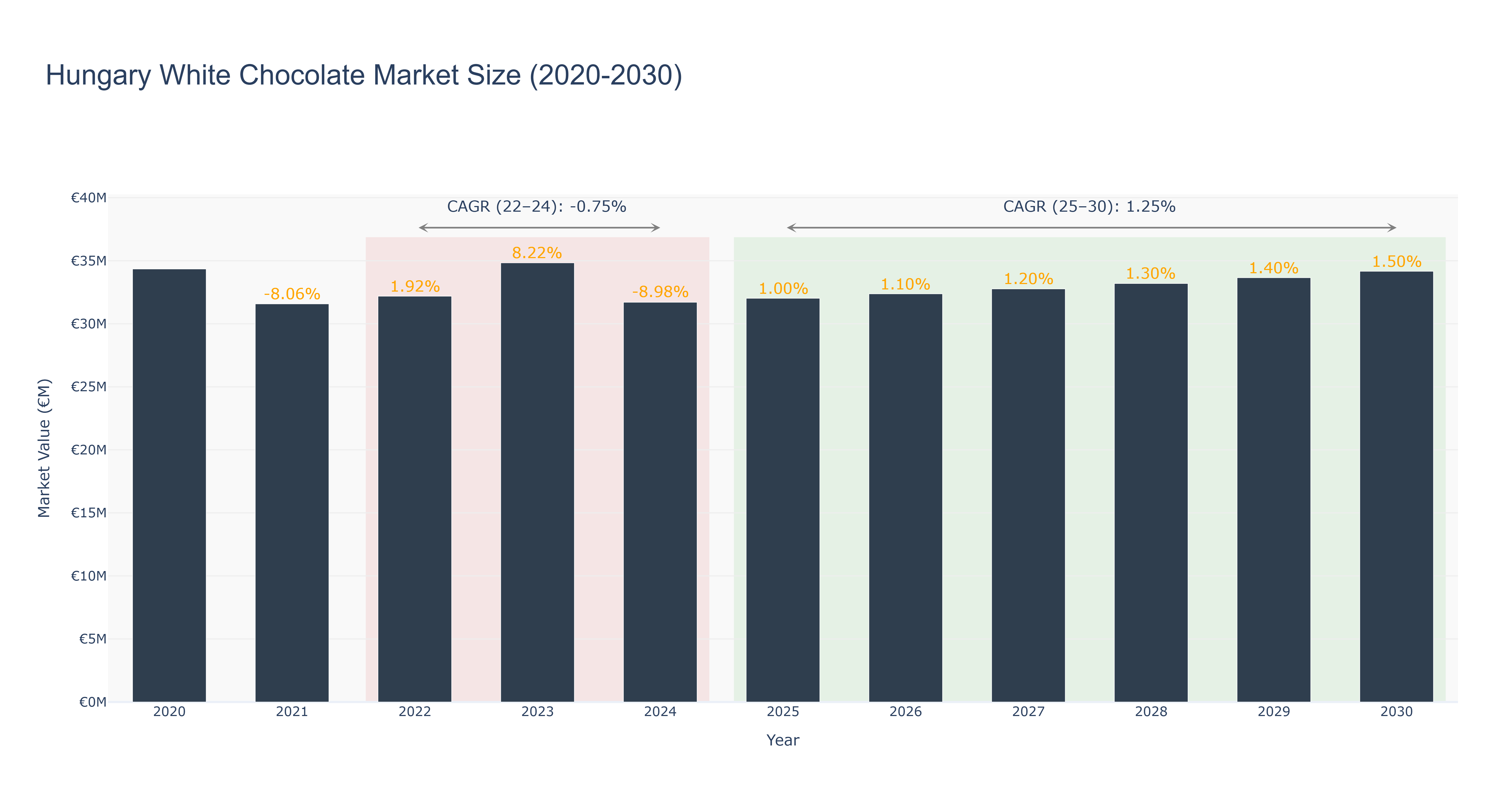
Hungary White Chocolate Market has shown a mixed trend over the past decade. The peak market size of €34.83 million was recorded in 2023, with a subsequent decline to €31.71 million in 2024. However, the market has since rebounded, reaching €32.77 million in 2027 and is forecasted to continue growing steadily to €34.16 million by 2030. The CAGR for the period 2022-24 was -0.75%, reflecting a temporary setback, while the CAGR for 2025-30 is projected at 1.25%, indicating a positive growth trajectory. The market's fluctuations can be attributed to changing consumer preferences, economic conditions, and competitive dynamics within the confectionery industry. Looking ahead, Hungary's White Chocolate Market is expected to benefit from increased focus on premium and organic products, as well as innovative marketing strategies aimed at capturing a larger share of the evolving consumer base.
Hungary White Chocolate Market: Production & Trade Performance (2019-2025)
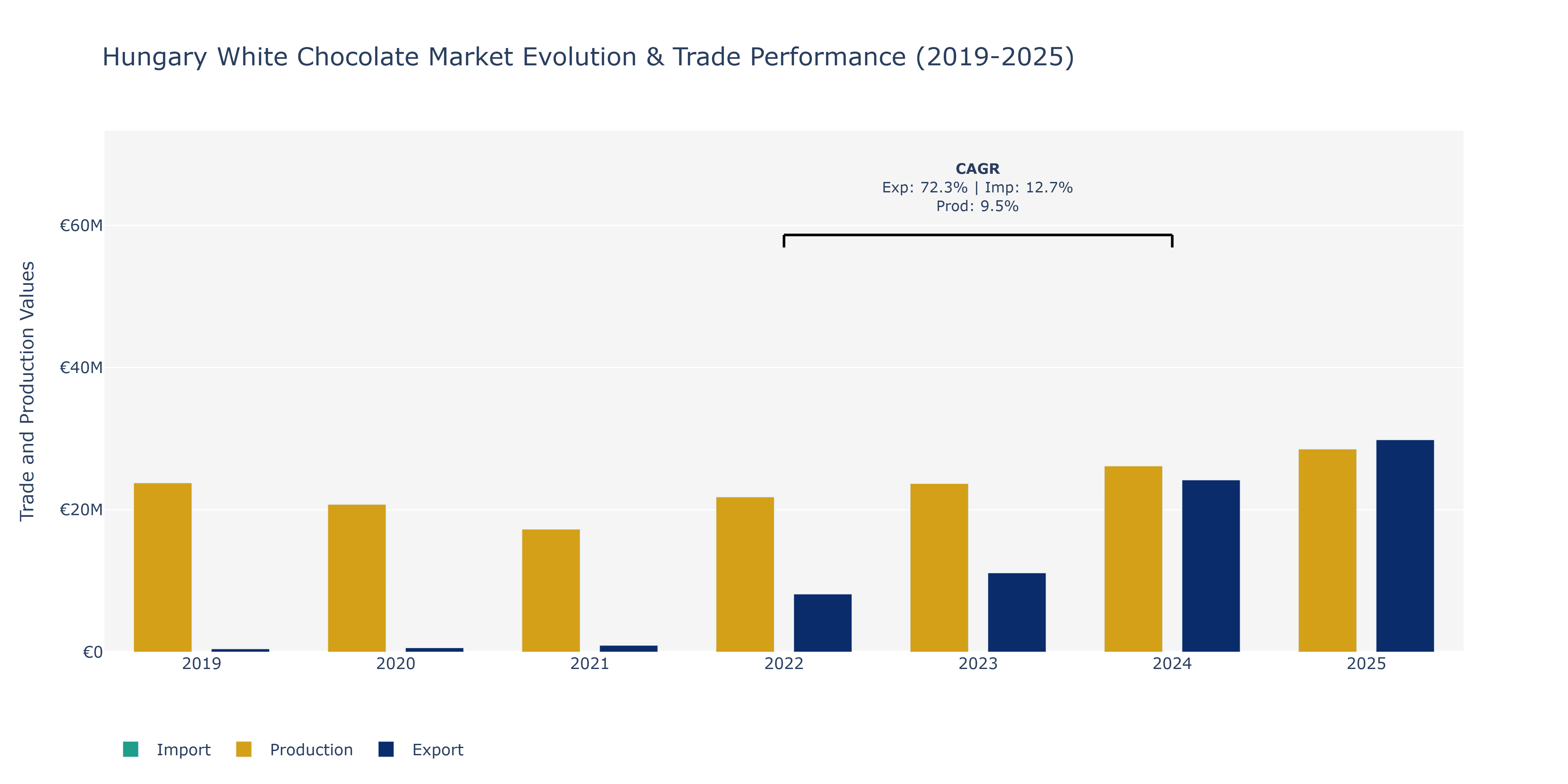
Between 2019 and 2025, the Hungary White Chocolate Market witnessed notable shifts in exports, imports, and production. Exports surged from €448.19 thousand in 2019 to €29.84 million in 2025, showcasing a consistent upward trajectory driven by increasing global demand for Hungarian white chocolate. Imports displayed a different pattern, starting at €10.61 million in 2019, dipping to €10.38 million in 2020, before gradually climbing to €23.82 million in 2025. This rise in imports could be attributed to the need for raw materials or specific ingredients not readily available in the domestic market. Production value fluctuated over the years, hitting a peak at €24.19 million in 2024 after experiencing steady growth. The decrease in production thereafter could be linked to supply chain disruptions or shifts in consumer preferences towards other chocolate variants. To sustain growth, stakeholders could focus on enhancing product quality, leveraging sustainable sourcing practices, and exploring new export markets to capitalize on the increasing demand for Hungarian white chocolate.
Key Highlights of the Report:
- Hungary White Chocolate Market Outlook
- Market Size of Hungary White Chocolate Market, 2025
- Forecast of Hungary White Chocolate Market, 2032
- Historical Data and Forecast of Hungary White Chocolate Revenues & Volume for the Period 2022-2032F
- Hungary White Chocolate Market Trend Evolution
- Hungary White Chocolate Market Drivers and Challenges
- Hungary White Chocolate Price Trends
- Hungary White Chocolate Porter's Five Forces
- Hungary White Chocolate Industry Life Cycle
- Historical Data and Forecast of Hungary White Chocolate Market Revenues & Volume By Type for the Period 2022-2032F
- Historical Data and Forecast of Hungary White Chocolate Market Revenues & Volume By Conventional White Chocolate for the Period 2022-2032F
- Historical Data and Forecast of Hungary White Chocolate Market Revenues & Volume By Organic White Chocolate for the Period 2022-2032F
- Historical Data and Forecast of Hungary White Chocolate Market Revenues & Volume By Application for the Period 2022-2032F
- Historical Data and Forecast of Hungary White Chocolate Market Revenues & Volume By Food & Beverages for the Period 2022-2032F
- Historical Data and Forecast of Hungary White Chocolate Market Revenues & Volume By Pharmaceuticals for the Period 2022-2032F
- Historical Data and Forecast of Hungary White Chocolate Market Revenues & Volume By Cosmetics for the Period 2022-2032F
- Historical Data and Forecast of Hungary White Chocolate Market Revenues & Volume By Other for the Period 2022-2032F
- Hungary White Chocolate Import Export Trade Statistics
- Market Opportunity Assessment By Type
- Market Opportunity Assessment By Application
- Hungary White Chocolate Top Companies Market Share
- Hungary White Chocolate Competitive Benchmarking By Technical and Operational Parameters
- Hungary White Chocolate Company Profiles
- Hungary White Chocolate Key Strategic Recommendations






































