Iceland Decaffeinated Coffee Market Growth Rate Analysis (2025 - 2031)
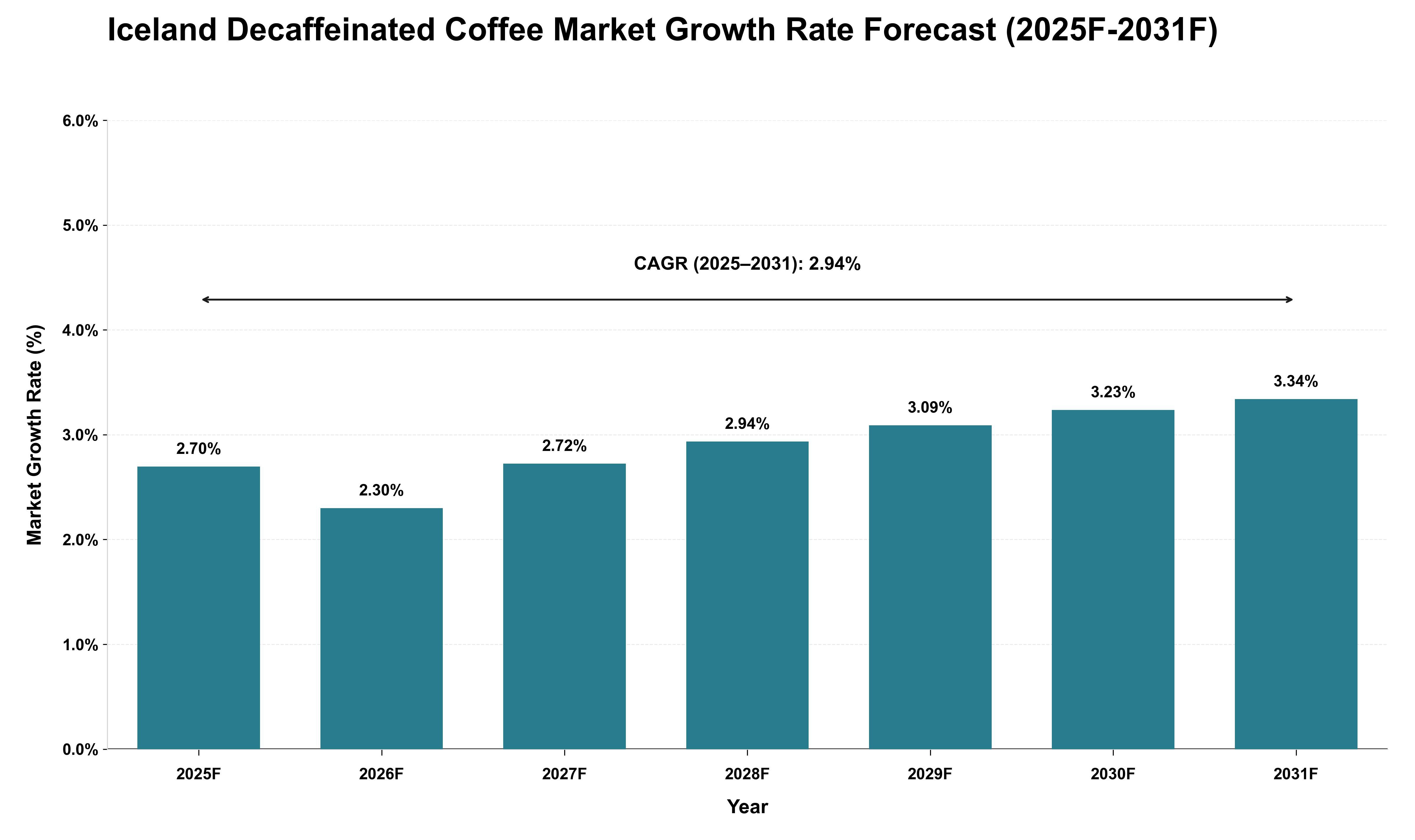
The Iceland decaffeinated coffee market will experience a compound annual growth rate of 2.94% from 2025 to 2031, reflecting a gradual increase in consumer demand driven by health-conscious trends and lifestyle changes. As input costs fluctuate due to global supply chain dynamics, including transportation and raw material prices, the market will likely see varying annual growth rates, peaking at 3.34% in 2031. The reliance on imported coffee beans will introduce vulnerabilities to external shocks, such as geopolitical tensions or climate-related disruptions affecting coffee-producing regions. Additionally, the cyclical nature of consumer preferences may lead to temporary spikes in demand during specific periods, particularly as sustainability concerns drive interest in ethically sourced products. Overall, the interplay between these macroeconomic factors will shape the trajectory of the decaffeinated coffee segment within Iceland's broader beverage landscape.
Key Highlights of the Report:
- Iceland Decaffeinated Coffee Market Outlook
- Market Size of Iceland Decaffeinated Coffee Market, 2025
- Forecast of Iceland Decaffeinated Coffee Market, 2032
- Historical Data and Forecast of Iceland Decaffeinated Coffee Revenues & Volume for the Period 2022-2032F
- Iceland Decaffeinated Coffee Market Trend Evolution
- Iceland Decaffeinated Coffee Market Drivers and Challenges
- Iceland Decaffeinated Coffee Price Trends
- Iceland Decaffeinated Coffee Porter`s Five Forces
- Iceland Decaffeinated Coffee Industry Life Cycle
- Historical Data and Forecast of Iceland Decaffeinated Coffee Market Revenues & Volume By Product for the Period 2022-2032F
- Historical Data and Forecast of Iceland Decaffeinated Coffee Market Revenues & Volume By Roasted for the Period 2022-2032F
- Historical Data and Forecast of Iceland Decaffeinated Coffee Market Revenues & Volume By Raw for the Period 2022-2032F
- Historical Data and Forecast of Iceland Decaffeinated Coffee Market Revenues & Volume By Speciesfor the Period 2022-2032F
- Historical Data and Forecast of Iceland Decaffeinated Coffee Market Revenues & Volume By Arabica for the Period 2022-2032F
- Historical Data and Forecast of Iceland Decaffeinated Coffee Market Revenues & Volume By Robusta for the Period 2022-2032F
- Historical Data and Forecast of Iceland Decaffeinated Coffee Market Revenues & Volume By Distribution Channel for the Period 2022-2032F
- Historical Data and Forecast of Iceland Decaffeinated Coffee Market Revenues & Volume By Online for the Period 2022-2032F
- Historical Data and Forecast of Iceland Decaffeinated Coffee Market Revenues & Volume By Offline for the Period 2022-2032F
- Iceland Decaffeinated Coffee Import Export Trade Statistics
- Market Opportunity Assessment By Product
- Market Opportunity Assessment By Species
- Market Opportunity Assessment By Distribution Channel
- Iceland Decaffeinated Coffee Top Companies Market Share
- Iceland Decaffeinated Coffee Competitive Benchmarking By Technical and Operational Parameters
- Iceland Decaffeinated Coffee Company Profiles
- Iceland Decaffeinated Coffee Key Strategic Recommendations






































