Iceland Malt Extract Market Growth Rate Analysis (2025 - 2031)
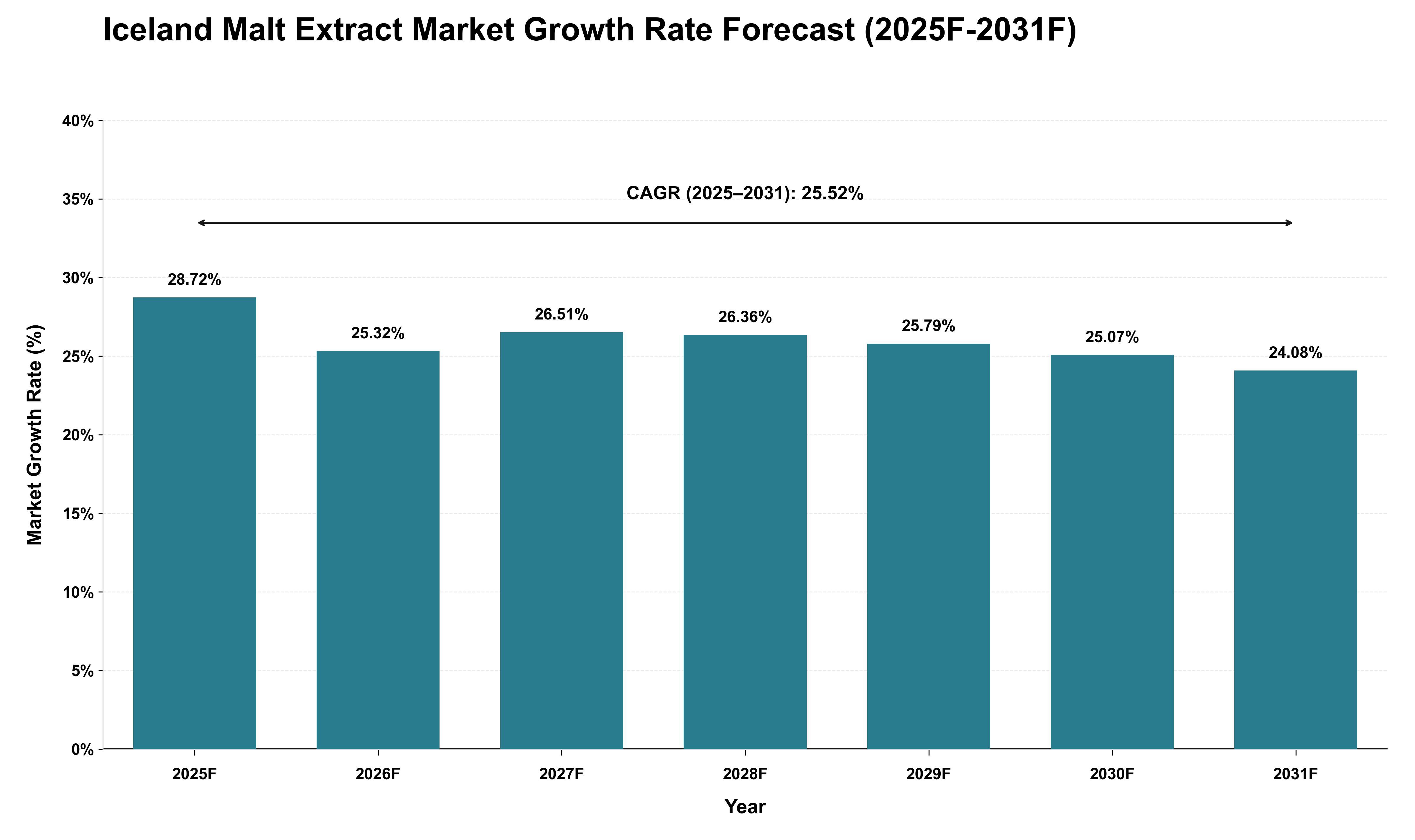
The Iceland malt extract market is projected to experience a robust compound annual growth rate of 25.52% from 2025 to 2031, driven by significant shifts in end-use demand across various sectors, particularly in food and beverage applications. As consumer preferences increasingly favor natural and organic ingredients, the demand for malt extract is expected to surge, with annual growth rates peaking at 28.72% in 2025 before stabilizing around the mid-25% range through the subsequent years. This trend will likely be supported by rising import dependencies as local production may not fully meet the escalating demand, necessitating increased imports to satisfy both domestic and export markets. Additionally, cyclical trends in health-conscious consumption will further bolster this market segment, as consumers gravitate towards products that offer nutritional benefits without artificial additives. Overall, these macroeconomic factors will create a dynamic environment for sustained growth in the Iceland malt extract market during this forecast period.
Key Highlights of the Report:
- Iceland Malt Extract Market Outlook
- Market Size of Iceland Malt Extract Market, 2025
- Forecast of Iceland Malt Extract Market, 2032
- Historical Data and Forecast of Iceland Malt Extract Revenues & Volume for the Period 2022-2032F
- Iceland Malt Extract Market Trend Evolution
- Iceland Malt Extract Market Drivers and Challenges
- Iceland Malt Extract Price Trends
- Iceland Malt Extract Porter`s Five Forces
- Iceland Malt Extract Industry Life Cycle
- Historical Data and Forecast of Iceland Malt Extract Market Revenues & Volume By Application for the Period 2022-2032F
- Historical Data and Forecast of Iceland Malt Extract Market Revenues & Volume By Bakery for the Period 2022-2032F
- Historical Data and Forecast of Iceland Malt Extract Market Revenues & Volume By Confectionary for the Period 2022-2032F
- Historical Data and Forecast of Iceland Malt Extract Market Revenues & Volume By Beverages for the Period 2022-2032F
- Historical Data and Forecast of Iceland Malt Extract Market Revenues & Volume By Animal Feed for the Period 2022-2032F
- Historical Data and Forecast of Iceland Malt Extract Market Revenues & Volume By Pharmaceuticals for the Period 2022-2032F
- Historical Data and Forecast of Iceland Malt Extract Market Revenues & Volume By Source for the Period 2022-2032F
- Historical Data and Forecast of Iceland Malt Extract Market Revenues & Volume By Barley for the Period 2022-2032F
- Historical Data and Forecast of Iceland Malt Extract Market Revenues & Volume By Wheat for the Period 2022-2032F
- Historical Data and Forecast of Iceland Malt Extract Market Revenues & Volume By Rice for the Period 2022-2032F
- Historical Data and Forecast of Iceland Malt Extract Market Revenues & Volume By Rye for the Period 2022-2032F
- Historical Data and Forecast of Iceland Malt Extract Market Revenues & Volume By Product Form for the Period 2022-2032F
- Historical Data and Forecast of Iceland Malt Extract Market Revenues & Volume By Dry for the Period 2022-2032F
- Historical Data and Forecast of Iceland Malt Extract Market Revenues & Volume By Liquid for the Period 2022-2032F
- Historical Data and Forecast of Iceland Malt Extract Market Revenues & Volume By Product Type for the Period 2022-2032F
- Historical Data and Forecast of Iceland Malt Extract Market Revenues & Volume By Standard for the Period 2022-2032F
- Historical Data and Forecast of Iceland Malt Extract Market Revenues & Volume By Speciality for the Period 2022-2032F
- Iceland Malt Extract Import Export Trade Statistics
- Market Opportunity Assessment By Application
- Market Opportunity Assessment By Source
- Market Opportunity Assessment By Product Form
- Market Opportunity Assessment By Product Type
- Iceland Malt Extract Top Companies Market Share
- Iceland Malt Extract Competitive Benchmarking By Technical and Operational Parameters
- Iceland Malt Extract Company Profiles
- Iceland Malt Extract Key Strategic Recommendations






































