Iceland Paint Market Year-wise Growth Rate (2021-2031F)
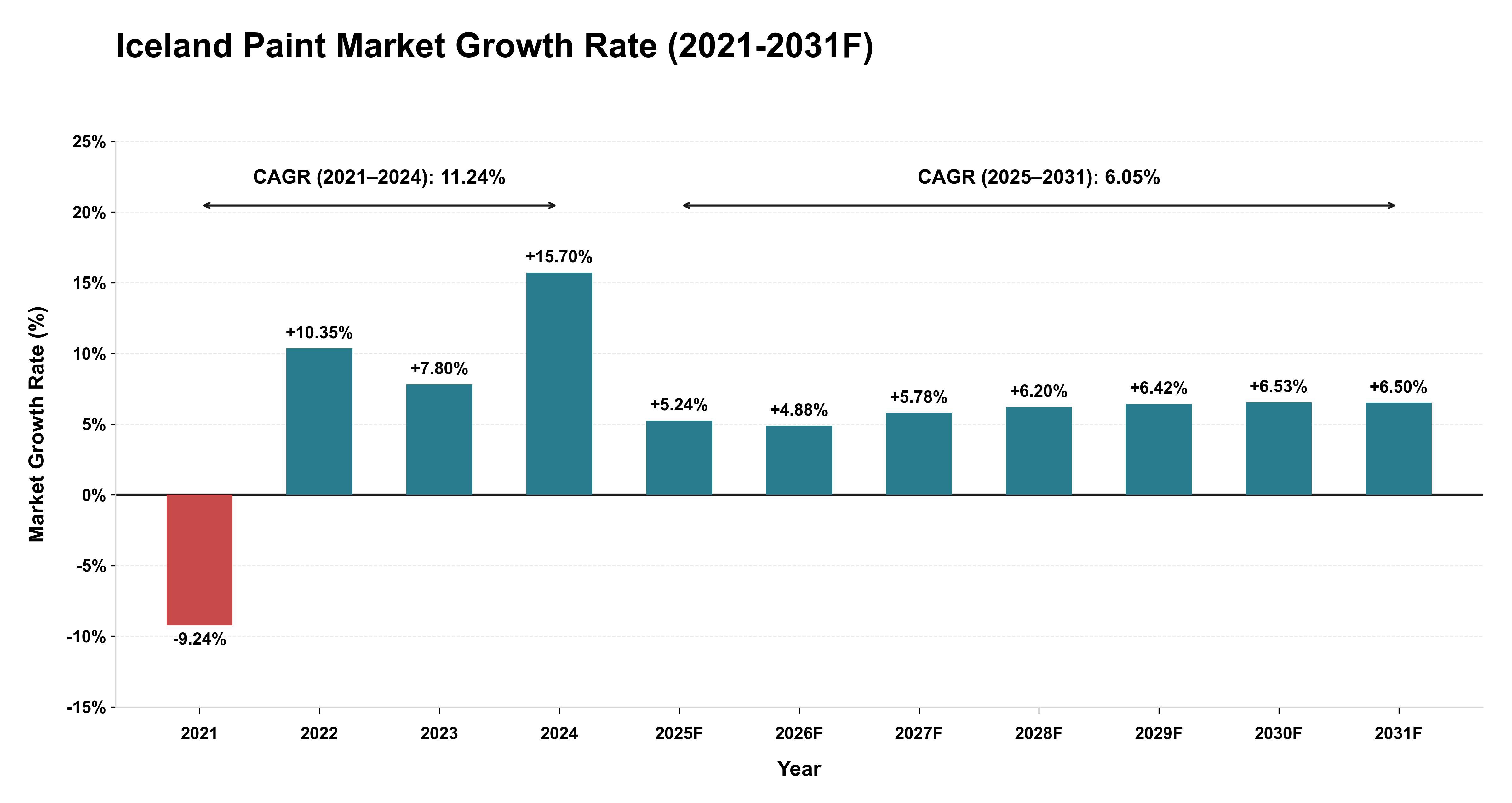
In the period 2021-2024, the Iceland Paint Market faced a challenging start with a negative growth rate of -9.24% in 2021, possibly due to economic downturns or supply chain disruptions. However, a strong rebound followed with growth rates of 10.35%, 7.80%, and 15.70% in the subsequent years, indicating increased demand, potentially driven by infrastructure projects or renovation activities. Transitioning into the forecast period of 2025-2031, the market is expected to stabilize with a lower but sustainable CAGR of 6.05%, reflecting a more mature and steady growth phase. This shift suggests a more balanced market landscape with consistent demand from construction and renovation sectors, possibly influenced by government regulations promoting sustainable practices and energy-efficient buildings.
Key Highlights of the Report:
- Iceland Paint Market Outlook
- Market Size of Iceland Paint Market, 2025
- Forecast of Iceland Paint Market, 2032
- Historical Data and Forecast of Iceland Paint Revenues & Volume for the Period 2022-2032F
- Iceland Paint Market Trend Evolution
- Iceland Paint Market Drivers and Challenges
- Iceland Paint Price Trends
- Iceland Paint Porter's Five Forces
- Iceland Paint Industry Life Cycle
- Historical Data and Forecast of Iceland Paint Market Revenues & Volume By Type for the Period 2022-2032F
- Historical Data and Forecast of Iceland Paint Market Revenues & Volume By Water-Based for the Period 2022-2032F
- Historical Data and Forecast of Iceland Paint Market Revenues & Volume By Oil-Based for the Period 2022-2032F
- Historical Data and Forecast of Iceland Paint Market Revenues & Volume By Latex for the Period 2022-2032F
- Historical Data and Forecast of Iceland Paint Market Revenues & Volume By Enamel for the Period 2022-2032F
- Historical Data and Forecast of Iceland Paint Market Revenues & Volume By Finish Type for the Period 2022-2032F
- Historical Data and Forecast of Iceland Paint Market Revenues & Volume By Matte for the Period 2022-2032F
- Historical Data and Forecast of Iceland Paint Market Revenues & Volume By Glossy for the Period 2022-2032F
- Historical Data and Forecast of Iceland Paint Market Revenues & Volume By Satin for the Period 2022-2032F
- Historical Data and Forecast of Iceland Paint Market Revenues & Volume By Semi-Gloss for the Period 2022-2032F
- Historical Data and Forecast of Iceland Paint Market Revenues & Volume By End User for the Period 2022-2032F
- Historical Data and Forecast of Iceland Paint Market Revenues & Volume By Residential for the Period 2022-2032F
- Historical Data and Forecast of Iceland Paint Market Revenues & Volume By Automotive for the Period 2022-2032F
- Historical Data and Forecast of Iceland Paint Market Revenues & Volume By Industrial for the Period 2022-2032F
- Historical Data and Forecast of Iceland Paint Market Revenues & Volume By Marine for the Period 2022-2032F
- Historical Data and Forecast of Iceland Paint Market Revenues & Volume By Application for the Period 2022-2032F
- Historical Data and Forecast of Iceland Paint Market Revenues & Volume By Walls & Ceilings for the Period 2022-2032F
- Historical Data and Forecast of Iceland Paint Market Revenues & Volume By Cars & Trucks for the Period 2022-2032F
- Historical Data and Forecast of Iceland Paint Market Revenues & Volume By Machinery for the Period 2022-2032F
- Historical Data and Forecast of Iceland Paint Market Revenues & Volume By Boats & Ships for the Period 2022-2032F
- Iceland Paint Import Export Trade Statistics
- Market Opportunity Assessment By Type
- Market Opportunity Assessment By Finish Type
- Market Opportunity Assessment By End User
- Market Opportunity Assessment By Application
- Iceland Paint Top Companies Market Share
- Iceland Paint Competitive Benchmarking By Technical and Operational Parameters
- Iceland Paint Company Profiles
- Iceland Paint Key Strategic Recommendations






































