Iceland Spirits Market Year-wise Growth Rate (2021-2031F)
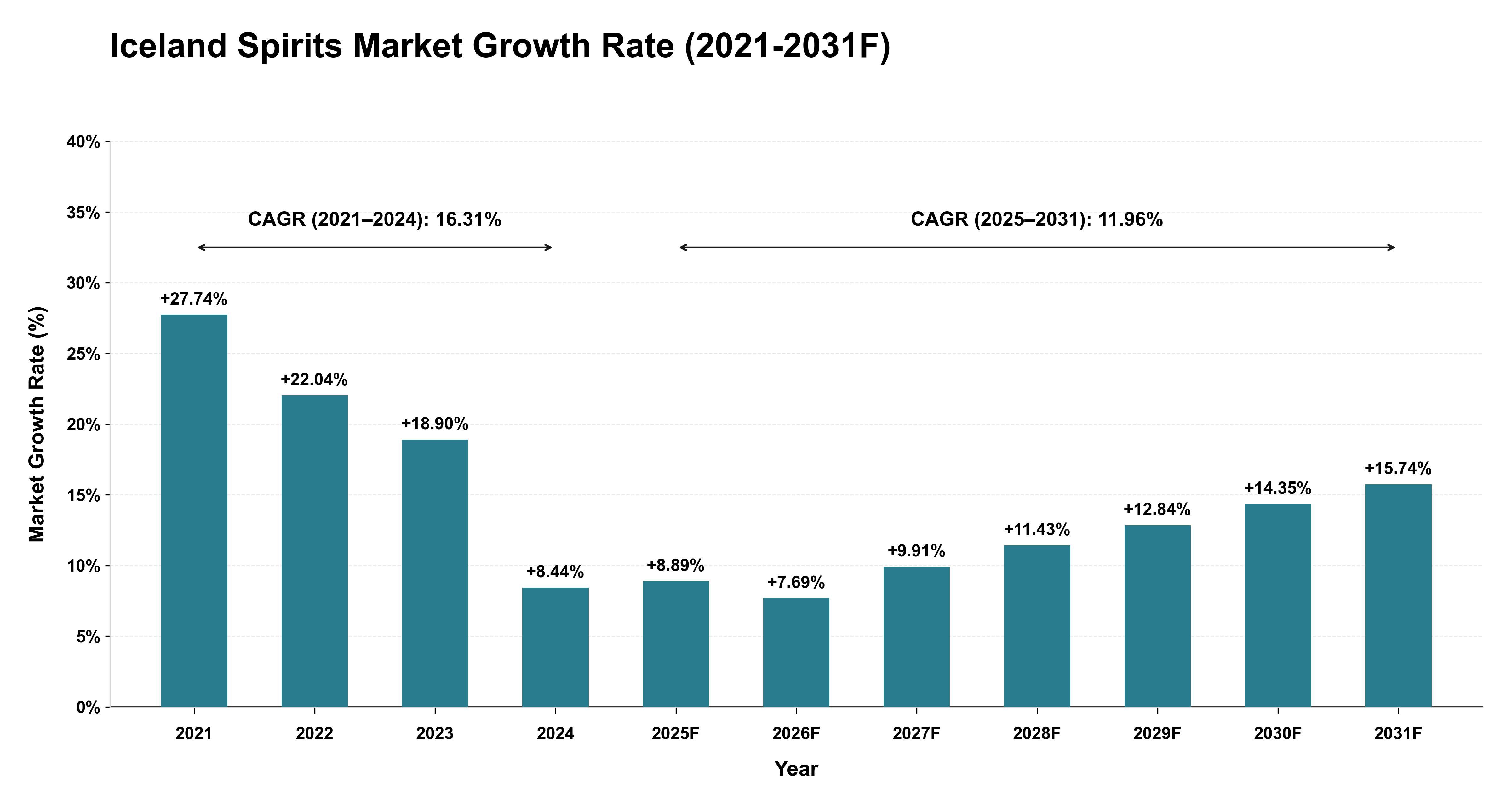
The Iceland Spirits Market witnessed robust growth from 2021 to 2024, with a significant CAGR of 16.31%. This surge was driven by increasing tourism, rising disposable incomes, and a growing preference for premium spirits among consumers. However, in 2024, the growth rate slowed to 8.44%, indicating a temporary saturation point. Looking ahead to 2031, the market is projected to maintain a healthy expansion pace with an expected CAGR of 11.96%. This forecasted growth is supported by innovative product offerings, expanding distribution networks, and evolving consumer preferences towards craft and locally sourced spirits. The trajectory shows a gradual acceleration post-2024, reflecting renewed consumer interest and market dynamism in the coming years.
Key Highlights of the Report:
- Iceland Spirits Market Outlook
- Market Size of Iceland Spirits Market, 2025
- Forecast of Iceland Spirits Market, 2032
- Historical Data and Forecast of Iceland Spirits Revenues & Volume for the Period 2022-2032F
- Iceland Spirits Market Trend Evolution
- Iceland Spirits Market Drivers and Challenges
- Iceland Spirits Price Trends
- Iceland Spirits Porter's Five Forces
- Iceland Spirits Industry Life Cycle
- Historical Data and Forecast of Iceland Spirits Market Revenues & Volume By Product Type for the Period 2022-2032F
- Historical Data and Forecast of Iceland Spirits Market Revenues & Volume By Whiskey for the Period 2022-2032F
- Historical Data and Forecast of Iceland Spirits Market Revenues & Volume By Vodka for the Period 2022-2032F
- Historical Data and Forecast of Iceland Spirits Market Revenues & Volume By Rum for the Period 2022-2032F
- Historical Data and Forecast of Iceland Spirits Market Revenues & Volume By Brandy for the Period 2022-2032F
- Historical Data and Forecast of Iceland Spirits Market Revenues & Volume By Other for the Period 2022-2032F
- Historical Data and Forecast of Iceland Spirits Market Revenues & Volume By Distribution Channel for the Period 2022-2032F
- Historical Data and Forecast of Iceland Spirits Market Revenues & Volume By Specialty/Liquor Stores for the Period 2022-2032F
- Historical Data and Forecast of Iceland Spirits Market Revenues & Volume By Online Retail Stores for the Period 2022-2032F
- Historical Data and Forecast of Iceland Spirits Market Revenues & Volume By On-Trade for the Period 2022-2032F
- Historical Data and Forecast of Iceland Spirits Market Revenues & Volume By Other for the Period 2022-2032F
- Iceland Spirits Import Export Trade Statistics
- Market Opportunity Assessment By Product Type
- Market Opportunity Assessment By Distribution Channel
- Iceland Spirits Top Companies Market Share
- Iceland Spirits Competitive Benchmarking By Technical and Operational Parameters
- Iceland Spirits Company Profiles
- Iceland Spirits Key Strategic Recommendations






































