India 1-decanol Market Top 5 Importing Countries and Market Competition (HHI) Analysis
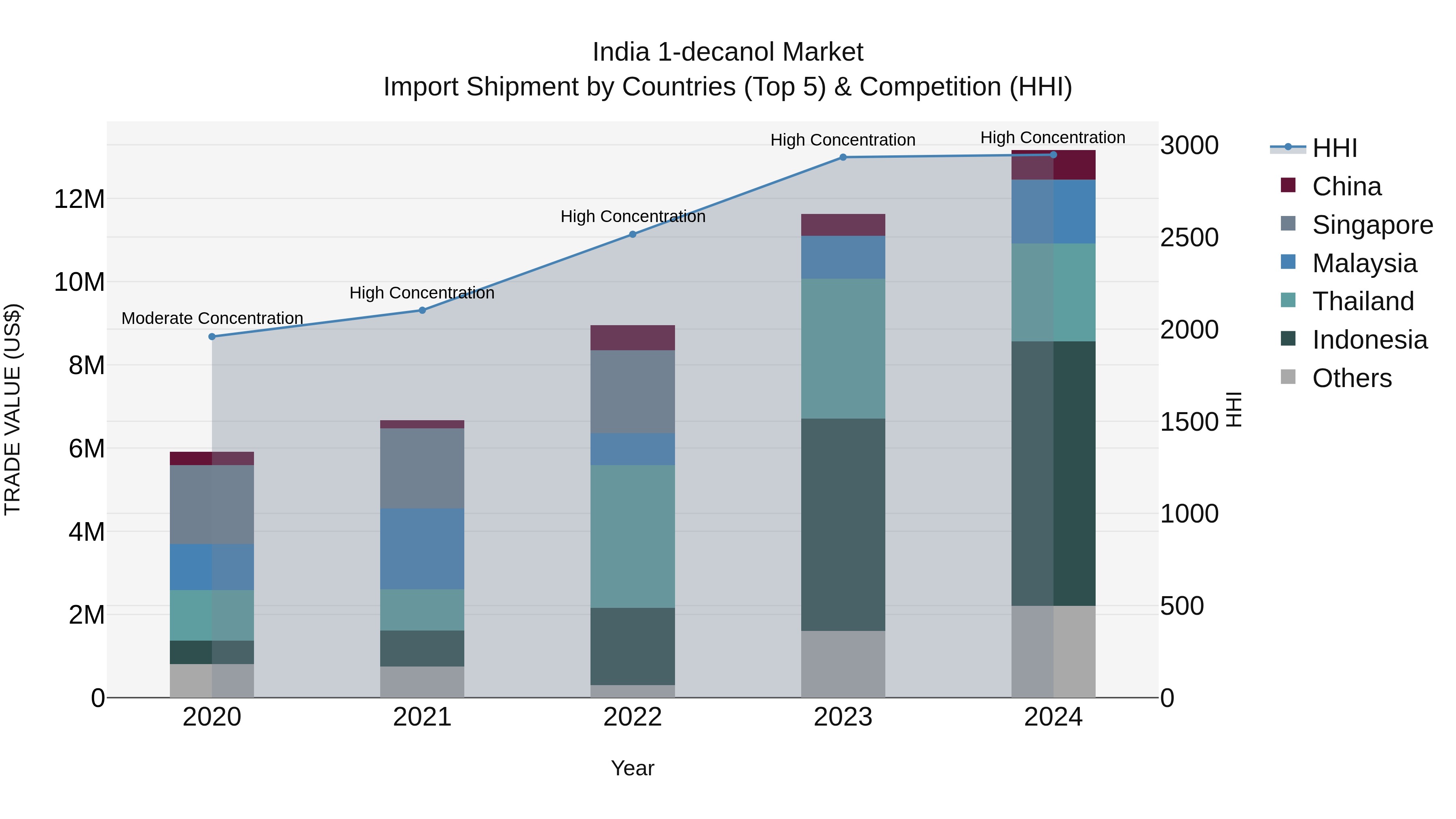
India`s 1-decanol import market saw significant growth in 2024, with top exporters being Indonesia, Thailand, Malaysia, Netherlands, and Germany. The market remained concentrated with high Herfindahl-Hirschman Index (HHI) in 2024. The compound annual growth rate (CAGR) from 2020 to 2024 stood at an impressive 22.17%, indicating a thriving market. Moreover, the growth rate from 2023 to 2024 was recorded at 13.19%, showcasing a strong upward trend in demand for 1-decanol in India.
India 1-Decanol Market Overview
1-Decanol, a fatty alcohol, is used in various applications, including the production of plasticizers and surfactants. The India 1-decanol market is influenced by the demand in these sectors, as well as its use in the manufacture of detergents, emulsifiers, and other specialty chemicals.
Drivers of the Market
The India 1-Decanol market is primarily driven by its extensive use in the production of various chemicals and as a surfactant in personal care products. The growing demand for 1-Decanol can be attributed to its role as an intermediate in the manufacturing of plasticizers, lubricants, and perfumes. Moreover, the increasing consumption of personal care and cosmetic products, where 1-Decanol acts as a stabilizing agent, contributes to its market growth. Additionally, its applications in the manufacture of pharmaceuticals and agrochemicals further fuel its demand.
Challenges of the Market
The India 1-decanol market encounters challenges related to the sourcing of raw materials and cost fluctuations, which can affect production costs. Quality control is essential in applications like cosmetics and surfactants, adding complexity to manufacturing. Additionally, environmental regulations and waste management concerns in 1-decanol production pose obstacles for manufacturers.
COVID-19 Impact on the Market
The 1-decanol market faced challenges during the pandemic due to the disruption of supply chains and reduced demand from end-users in various industries, including chemicals and plastics. Recovery was contingent on the overall economic situation.
Key Players in the Market
Companies involved in the 1-decanol market in India include Finar Limited, Debye Scientific Co, Silverline Chemicals Ltd., Sigma-Aldrich India, and Loba Chemie. These companies produce 1-decanol, a chemical used in various industries, including pharmaceuticals, cosmetics, and chemical synthesis.
Key Highlights of the Report:
- India 1-Decanol Market Outlook
- Market Size of India 1-Decanol Market, 2024
- Forecast of India 1-Decanol Market, 2031
- Historical Data and Forecast of India 1-Decanol Revenues & Volume for the Period 2021-2031
- India 1-Decanol Market Trend Evolution
- India 1-Decanol Market Drivers and Challenges
- India 1-Decanol Price Trends
- India 1-Decanol Porter's Five Forces
- India 1-Decanol Industry Life Cycle
- Historical Data and Forecast of India 1-Decanol Market Revenues & Volume By Source for the Period 2021-2031
- Historical Data and Forecast of India 1-Decanol Market Revenues & Volume By Petrochemical Based for the Period 2021-2031
- Historical Data and Forecast of India 1-Decanol Market Revenues & Volume By Oleochemical Based for the Period 2021-2031
- Historical Data and Forecast of India 1-Decanol Market Revenues & Volume By Application for the Period 2021-2031
- Historical Data and Forecast of India 1-Decanol Market Revenues & Volume By Plasticizers for the Period 2021-2031
- Historical Data and Forecast of India 1-Decanol Market Revenues & Volume By Lubricants for the Period 2021-2031
- Historical Data and Forecast of India 1-Decanol Market Revenues & Volume By Detergents & Cleaners for the Period 2021-2031
- Historical Data and Forecast of India 1-Decanol Market Revenues & Volume By Cosmetics & Personal Care for the Period 2021-2031
- Historical Data and Forecast of India 1-Decanol Market Revenues & Volume By Pharmaceuticals for the Period 2021-2031
- Historical Data and Forecast of India 1-Decanol Market Revenues & Volume By Flavors & Fragrance for the Period 2021-2031
- India 1-Decanol Import Export Trade Statistics
- Market Opportunity Assessment By Source
- Market Opportunity Assessment By Application
- India 1-Decanol Top Companies Market Share
- India 1-Decanol Competitive Benchmarking By Technical and Operational Parameters
- India 1-Decanol Company Profiles
- India 1-Decanol Key Strategic Recommendations






































