India Acrylate Market Top 5 Importing Countries and Market Competition (HHI) Analysis
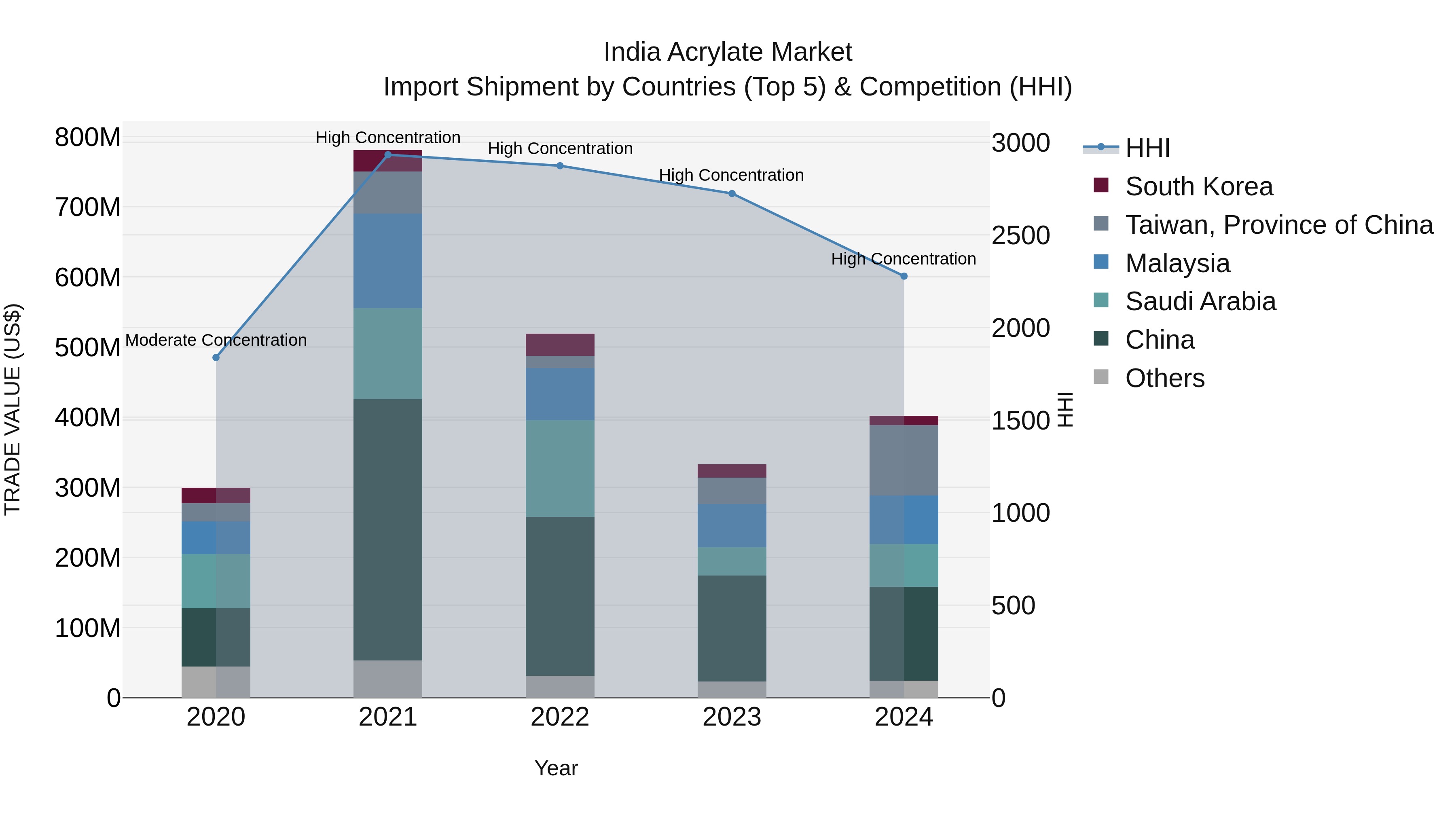
India`s acrylate import market continued to thrive in 2024, with top exporters including China, Taiwan, Malaysia, and South Korea. The high Herfindahl-Hirschman Index (HHI) indicates a concentrated market, while the impressive compound annual growth rate (CAGR) of 7.64% from 2020 to 2024 reflects sustained expansion. Notably, the growth rate spiked to 20.76% from 2023 to 2024, underscoring the increasing demand for acrylate in India. The market dynamics suggest a promising outlook for the acrylate import sector, driven by strong partnerships with key exporting countries.
India Acrylate Market Overview
The India Acrylate market is thriving due to the widespread use of acrylates in adhesives, coatings, and textiles. These versatile compounds are known for their adhesive and structural properties. The market growth is closely linked to the growth of India manufacturing and construction sectors.
Drivers of the Market
The India acrylate market is driven by the thriving construction and adhesive industries. Acrylates are essential components in adhesives and sealants, and with the growth of the construction sector, the demand for acrylate-based products is increasing. Additionally, the expanding automotive and packaging industries are contributing to the growth of the acrylate market in India.
Challenges of the Market
One of the challenges in the acrylate market is the volatility of raw material prices, particularly acrylic acid. Price fluctuations can affect production costs and profit margins. Additionally, the need to meet quality standards and performance requirements while keeping production efficient is an ongoing challenge.
COVID-19 Impact on the Market
The India Acrylate market was significantly affected by the pandemic. With reduced construction and automotive activities, which are major consumers of acrylate-based products, the market witnessed a decline in demand. The disruptions in logistics and transportation also hampered the supply chain, leading to fluctuating prices. As the construction and automotive sectors regain momentum post-pandemic, the acrylate market is expected to recover.
Key Players in the Market
Major contributors to the acrylate market in India include Dow India, BASF India Limited, Mitsubishi Chemical India Pvt. Ltd., and LG Chem India Pvt. Ltd. These companies focus on producing a wide range of acrylate products, catering to diverse applications in adhesives, coatings, and textiles.
Key Highlights of the Report:
- India Acrylate Market Outlook
- Market Size of India Acrylate Market, 2024
- Forecast of India Acrylate Market, 2031
- Historical Data and Forecast of India Acrylate Revenues & Volume for the Period 2021-2031
- India Acrylate Market Trend Evolution
- India Acrylate Market Drivers and Challenges
- India Acrylate Price Trends
- India Acrylate Porter's Five Forces
- India Acrylate Industry Life Cycle
- Historical Data and Forecast of India Acrylate Market Revenues & Volume By Chemistry for the Period 2021-2031
- Historical Data and Forecast of India Acrylate Market Revenues & Volume By Butyl Acrylate for the Period 2021-2031
- Historical Data and Forecast of India Acrylate Market Revenues & Volume By Ethyl Acrylate for the Period 2021-2031
- Historical Data and Forecast of India Acrylate Market Revenues & Volume By Methyl Acrylate for the Period 2021-2031
- Historical Data and Forecast of India Acrylate Market Revenues & Volume By Application for the Period 2021-2031
- Historical Data and Forecast of India Acrylate Market Revenues & Volume By Paints & Coatings for the Period 2021-2031
- Historical Data and Forecast of India Acrylate Market Revenues & Volume By Adhesives for the Period 2021-2031
- Historical Data and Forecast of India Acrylate Market Revenues & Volume By Fabrics for the Period 2021-2031
- Historical Data and Forecast of India Acrylate Market Revenues & Volume By End Use Industry for the Period 2021-2031
- Historical Data and Forecast of India Acrylate Market Revenues & Volume By Packaging for the Period 2021-2031
- Historical Data and Forecast of India Acrylate Market Revenues & Volume By Consumer Goods for the Period 2021-2031
- Historical Data and Forecast of India Acrylate Market Revenues & Volume By Building & Construction for the Period 2021-2031
- Historical Data and Forecast of India Acrylate Market Revenues & Volume By Automotive for the Period 2021-2031
- India Acrylate Import Export Trade Statistics
- Market Opportunity Assessment By Chemistry
- Market Opportunity Assessment By Application
- Market Opportunity Assessment By End Use Industry
- India Acrylate Top Companies Market Share
- India Acrylate Competitive Benchmarking By Technical and Operational Parameters
- India Acrylate Company Profiles
- India Acrylate Key Strategic Recommendations






































