India Aircraft Seat Upholstery Market Size, Share & Growth Rate
The India Aircraft Seat Upholstery Market was estimated at USD 928 Million in 2025 and is projected to reach USD 1536 Million by 2032, growing at a CAGR of 7.5% from 2026 to 2032. This growth trajectory is driven by a robust increase in air passenger traffic fueled by rising disposable incomes and improved living standards across the nation. Additionally, government initiatives aimed at enhancing regional connectivity are further propelling demand for upgraded aircraft interiors, solidifying the importance of quality upholstery in the aviation sector.
India Aircraft Seat Upholstery Market Year-wise Growth Rate and Key Drivers
This graph highlights how the India Aircraft Seat Upholstery Market has steadily grown over the years, supported by major growth factors.
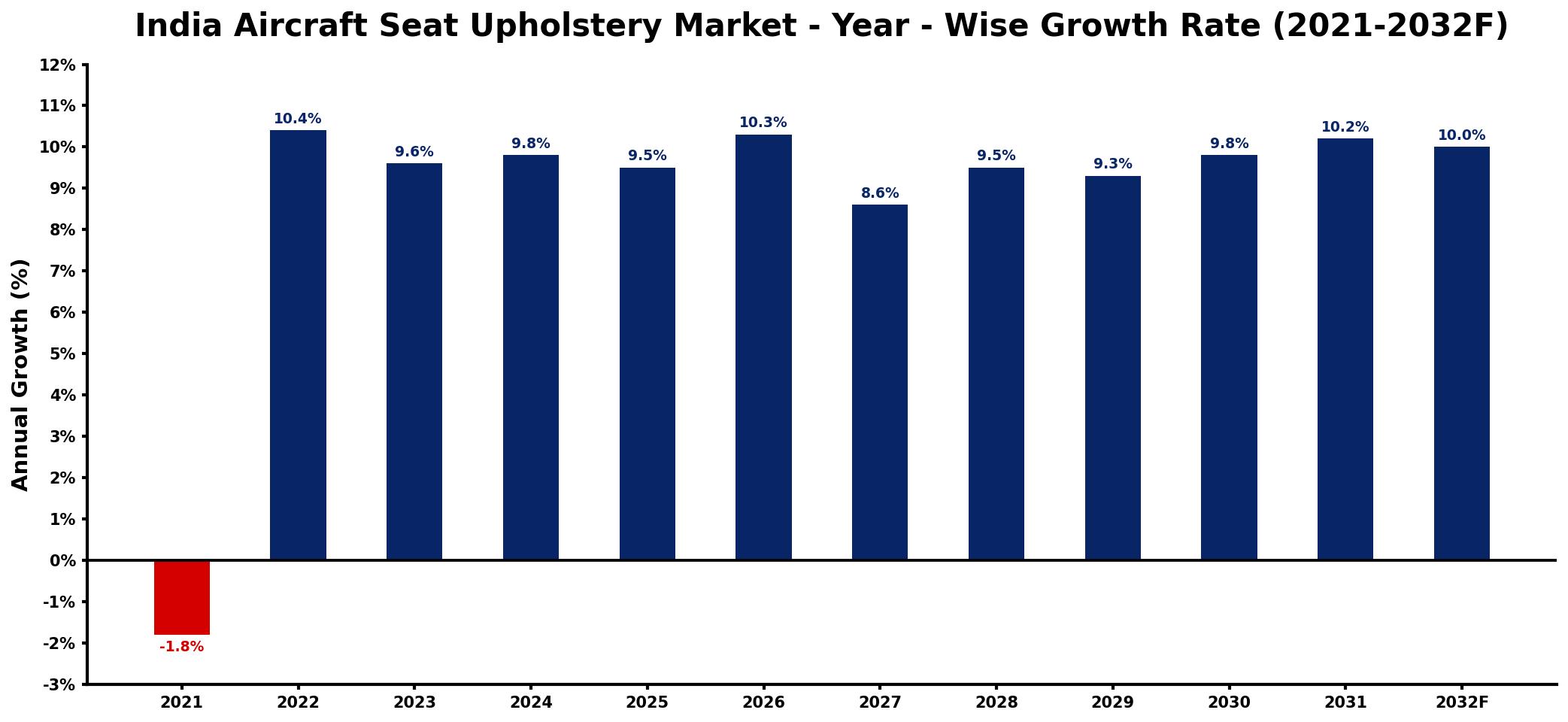
The table below presents the year‑wise growth rates along with the key drivers influencing the market
| Year | Growth Rate | Major Drivers |
| 2021 | -1.8% | decreased demand from airlines |
| 2022 | 10.4% | increased travel post pandemic |
| 2023 | 9.6% | rising manufacturing capabilities growth |
| 2024 | 9.8% | expansion of airline fleets |
| 2025 | 9.5% | growing luxury travel market |
| 2026 | 10.3% | investments in aviation technology |
| 2027 | 8.6% | enhanced passenger comfort requirements |
| 2028 | 9.5% | sustainability trends in aviation |
| 2029 | 9.3% | emerging markets driving demand |
| 2030 | 9.8% | technological advancements in materials |
| 2031 | 10.2% | increased focus on design innovation |
| 2032 | 10.0% | growing partnerships with manufacturers |
Note: Market size estimations and growth projections presented in this report are based on 6Wresearch's proprietary forecasting methodology, utilizing the latest available industry data, government publications, and primary research inputs.
India Aircraft Seat Upholstery Market Synopsis
In recent years, the India Aircraft Seat Upholstery Market has witnessed a notable transformation, aligning with the burgeoning aviation landscape. As airlines aim to enhance passenger experience, a significant emphasis has been placed on modernizing cabin interiors, including seat upholstery, to create a more inviting and comfortable environment.
The market is not just adapting to aesthetic demands but is also increasingly compliant with stringent safety and hygiene regulations. With innovations in materials that combine durability with lightweight characteristics, the upholstery sector is evolving to meet the dual needs of comfort and operational efficiency in aircraft design.
India Aircraft Seat Upholstery Market Key Takeaways
- The market is poised for substantial growth, driven by increasing air travel demand and passenger comfort expectations.
- Innovative materials are becoming essential as airlines focus on lightweight and fuel-efficient aircraft designs.
- Compliance with safety regulations presents both a challenge and an opportunity for manufacturers.
- Government initiatives are set to enhance regional air connectivity, stimulating further investments in aircraft refurbishment.
- The post-COVID recovery phase is creating renewed interest in cabin upgrades and upholstery enhancements.
Evaluation of Restraints in India Aircraft Seat Upholstery Market
While the India Aircraft Seat Upholstery Market is on an upward trajectory, several constraints are hindering its full potential. One significant issue is the complexity of adhering to stringent aviation safety standards. Manufacturers often find it challenging to keep pace with these evolving regulations, which can delay product development and compliance. Moreover, fluctuations in raw material costs, particularly for high-quality, fire-resistant textiles, pose additional financial risks. The scarcity of skilled craftsmen also presents a challenge, limiting the supply of expertly crafted upholstery essential for premium aircraft interiors.
India Aircraft Seat Upholstery Market Trends
Current trends in the India Aircraft Seat Upholstery Market reflect a strong shift towards sustainable and innovative materials. Airlines are increasingly prioritizing eco-friendly textiles that reduce environmental impact without compromising on passenger comfort. Additionally, technological advancements are enabling the development of fabrics with enhanced stain resistance and ease of maintenance, which are vital in ensuring passenger satisfaction. Furthermore, the integration of smart textiles that offer adjustable seating comfort is becoming a notable trend as airlines seek to differentiate themselves in a competitive market.
India Aircraft Seat Upholstery Market Opportunities
The Indian Aircraft Seat Upholstery Market offers several promising growth avenues. The increasing trend of refurbishing existing aircraft rather than investing in new ones presents significant opportunities for upholstery providers. This cost-effective approach allows airlines to upgrade their cabin experiences without incurring the full cost of new aircraft. Furthermore, as regional connectivity initiatives gain momentum, there will be heightened demand for upholstery solutions tailored to meet specific airline requirements, paving the way for customization and specialized offerings in this sector.
Government Initiatives in the India Aircraft Seat Upholstery Market
The Indian government has been proactive in boosting the aviation sector through various initiatives. Policies promoting regional connectivity and investment in airport infrastructure are expected to stimulate growth within the aviation industry, which in turn, will elevate demand for aircraft seat upholstery. Moreover, governmental support for enhancing safety standards and promoting sustainable practices is likely to encourage innovation and compliance among manufacturers in this market.
Future Insights of the India Aircraft Seat Upholstery Market
Looking ahead to 2026-2032, the India Aircraft Seat Upholstery Market is anticipated to evolve significantly. Continued growth in air travel, alongside increasing consumer expectations for comfort and aesthetics, will drive innovation in upholstery materials and designs. The convergence of technological advancements and heightened regulatory frameworks will set the stage for emerging players while compelling existing manufacturers to adapt and innovate. As the market recovers from past disruptions, its foundation is likely to become more resilient, paving the way for robust long-term growth.
India Aircraft Seat Upholstery Market Latest Developments (2025 - 2026)
In the latest developments, industry players have been focusing on enhancing product offerings by integrating advanced technologies into their upholstery solutions. A noticeable trend is the partnership between manufacturers and airlines to develop customized seat upholstery that aligns with specific branding needs. Additionally, manufacturers are exploring collaborations with textile innovators to create fabrics that are not only durable but also environmentally sustainable, addressing the growing demand for greener aviation practices.
India Aircraft Seat Upholstery Market - Key Attractiveness of the Report
- 10 Years of Market Numbers
- Historical Data Starting from 2022 to 2025
- Base Year: 2025
- Forecast Data until 2032
- Key Performance Indicators Impacting the Market
- Major Upcoming Developments and Projects
Key Highlights of the Report:
- India Aircraft Seat Upholstery Market Outlook
- Market Size of India Aircraft Seat Upholstery Market, 2025
- Forecast of India Aircraft Seat Upholstery Market, 2032
- Historical Data and Forecast of India Aircraft Seat Upholstery Revenues & Volume for the Period 2022-2032F
- India Aircraft Seat Upholstery Market Trend Evolution
- India Aircraft Seat Upholstery Market Drivers and Challenges
- India Aircraft Seat Upholstery Price Trends
- India Aircraft Seat Upholstery Porter's Five Forces
- India Aircraft Seat Upholstery Industry Life Cycle
- Historical Data and Forecast of India Aircraft Seat Upholstery Market Revenues & Volume By Material Type for the Period 2022-2032F
- Historical Data and Forecast of India Aircraft Seat Upholstery Market Revenues & Volume By Fabric for the Period 2022-2032F
- Historical Data and Forecast of India Aircraft Seat Upholstery Market Revenues & Volume By Leather for the Period 2022-2032F
- Historical Data and Forecast of India Aircraft Seat Upholstery Market Revenues & Volume By Vinyl for the Period 2022-2032F
- Historical Data and Forecast of India Aircraft Seat Upholstery Market Revenues & Volume By Seat Cover Type for the Period 2022-2032F
- Historical Data and Forecast of India Aircraft Seat Upholstery Market Revenues & Volume By Bottom Covers for the Period 2022-2032F
- Historical Data and Forecast of India Aircraft Seat Upholstery Market Revenues & Volume By Back Rest for the Period 2022-2032F
- Historical Data and Forecast of India Aircraft Seat Upholstery Market Revenues & Volume By Armrests for the Period 2022-2032F
- Historical Data and Forecast of India Aircraft Seat Upholstery Market Revenues & Volume By Headrests for the Period 2022-2032F
- Historical Data and Forecast of India Aircraft Seat Upholstery Market Revenues & Volume By Seat Rear Pockets for the Period 2022-2032F
- Historical Data and Forecast of India Aircraft Seat Upholstery Market Revenues & Volume By Seat Type for the Period 2022-2032F
- Historical Data and Forecast of India Aircraft Seat Upholstery Market Revenues & Volume By First Class for the Period 2022-2032F
- Historical Data and Forecast of India Aircraft Seat Upholstery Market Revenues & Volume By Business Class for the Period 2022-2032F
- Historical Data and Forecast of India Aircraft Seat Upholstery Market Revenues & Volume By Premium Economy Class for the Period 2022-2032F
- Historical Data and Forecast of India Aircraft Seat Upholstery Market Revenues & Volume By Economy Class for the Period 2022-2032F
- Historical Data and Forecast of India Aircraft Seat Upholstery Market Revenues & Volume By Aircraft Type for the Period 2022-2032F
- Historical Data and Forecast of India Aircraft Seat Upholstery Market Revenues & Volume By Narrow-body Aircraft for the Period 2022-2032F
- Historical Data and Forecast of India Aircraft Seat Upholstery Market Revenues & Volume By Wide-body Aircraft for the Period 2022-2032F
- Historical Data and Forecast of India Aircraft Seat Upholstery Market Revenues & Volume By Very Large Aircraft for the Period 2022-2032F
- Historical Data and Forecast of India Aircraft Seat Upholstery Market Revenues & Volume By Regional Transport Aircraft for the Period 2022-2032F
- Historical Data and Forecast of India Aircraft Seat Upholstery Market Revenues & Volume By Business Jets for the Period 2022-2032F
- Historical Data and Forecast of India Aircraft Seat Upholstery Market Revenues & Volume By General Aviation Aircraft for the Period 2022-2032F
- Historical Data and Forecast of India Aircraft Seat Upholstery Market Revenues & Volume By Helicopters for the Period 2022-2032F
- India Aircraft Seat Upholstery Import Export Trade Statistics
- Market Opportunity Assessment By Material Type
- Market Opportunity Assessment By Seat Cover Type
- Market Opportunity Assessment By Seat Type
- Market Opportunity Assessment By Aircraft Type
- India Aircraft Seat Upholstery Top Companies Market Share
- India Aircraft Seat Upholstery Competitive Benchmarking By Technical and Operational Parameters
- India Aircraft Seat Upholstery Company Profiles
- India Aircraft Seat Upholstery Key Strategic Recommendations






































