India Applicant Tracking System Market Size & Growth Rate (2026-2032)
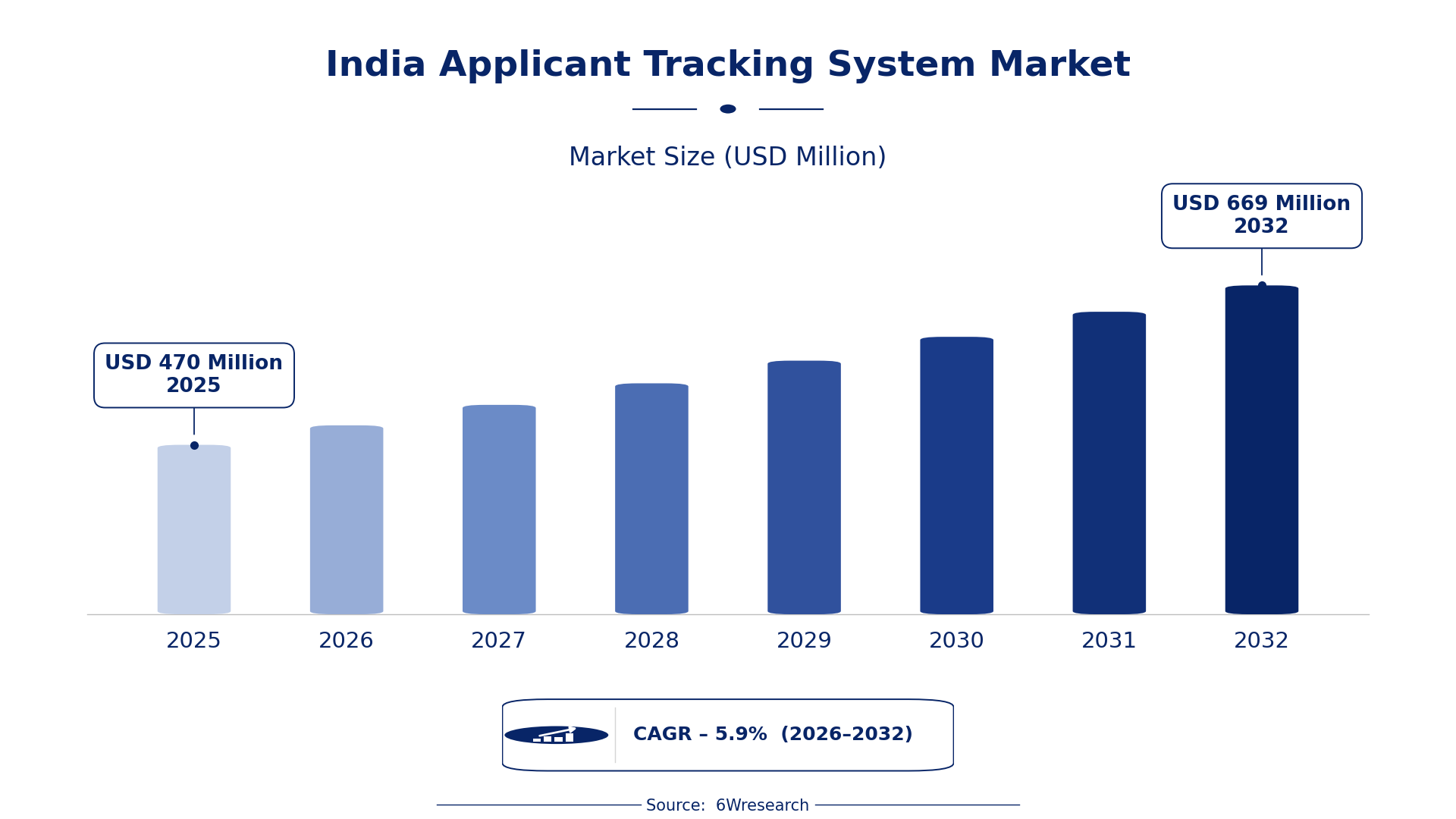
The India Applicant Tracking System Market was estimated at USD 470 Million in 2025 and is projected to reach USD 669 Million by 2032, growing at a CAGR of 5.9% from 2026 to 2032.
India Applicant Tracking System Market Synopsis
The demand for applicant tracking systems (ATS) in India is escalating rapidly, driven by an influx of job applications and a competitive job market. Businesses across sectors are increasingly recognizing the value of ATS solutions to enhance their recruitment processes, from job postings to candidate onboarding.
As organizations aim to improve hiring efficiency, they are investing in technology that automates tedious HR tasks. This shift not only streamlines recruitment but also elevates the overall candidate experience, making it a crucial element for companies striving to attract top talent.
India Applicant Tracking System Market Year-wise Growth Rate and Key Drivers
This graph illustrates the annual growth rates of the India Applicant Tracking System Market from 2021 to 2032, highlighting a steady upward trajectory and projected expansion over the forecast period.
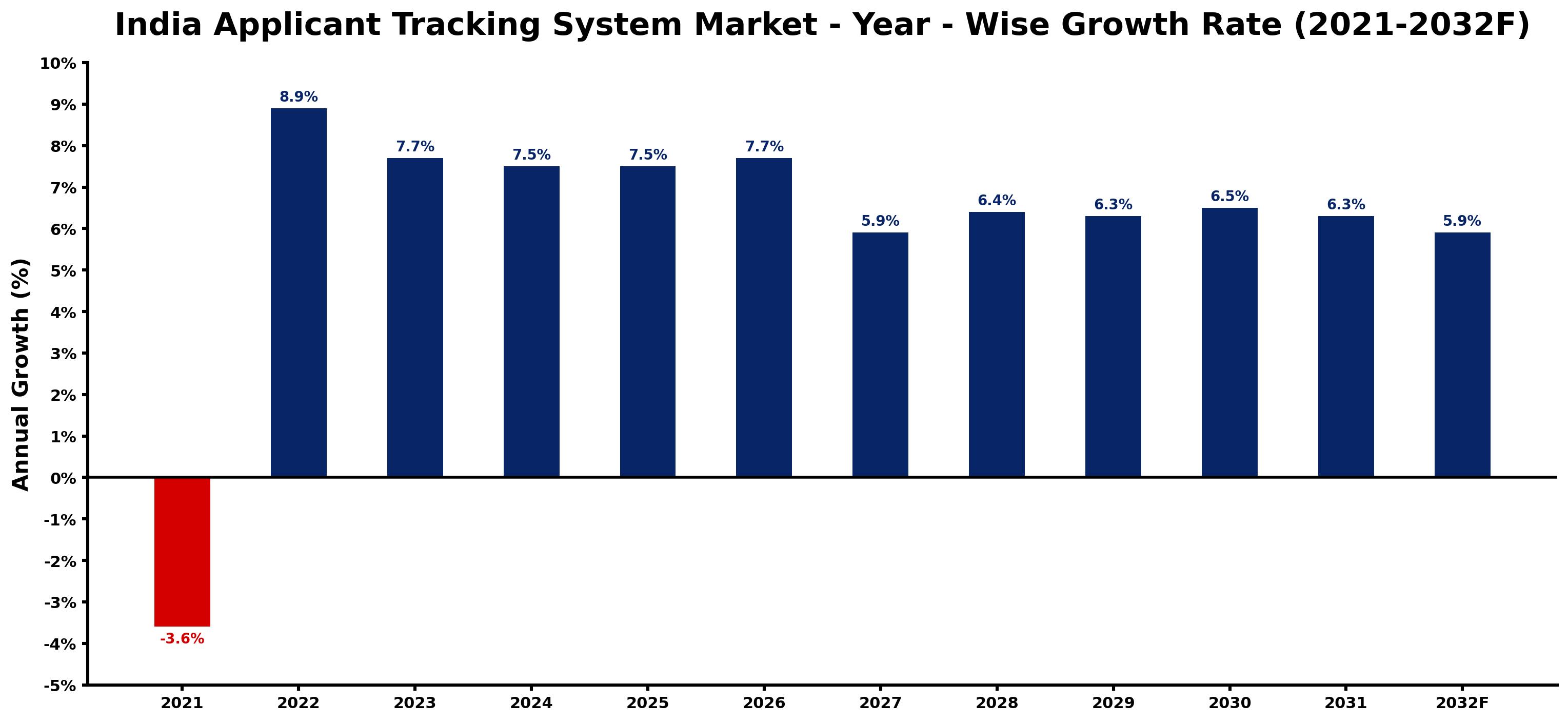
The table below presents the year‑wise growth rates along with the key drivers influencing the market
| Year | Growth Rate | Major Drivers |
| 2021 | -3.6% | Delayed implementation of new labor regulations by NASSCOM. |
| 2022 | 8.9% | Talent acquisition challenges driving ATS software demand. |
| 2023 | 7.7% | Government skill development programs increasing workforce adaptability. |
| 2024 | 7.5% | Rising remote work policies enhancing recruitment technology adoption. |
| 2025 | 7.5% | Increased competition for skilled labor propelling ATS usage. |
| 2026 | 7.7% | Growing start-up ecosystem necessitating efficient hiring solutions. |
| 2027 | 5.9% | Focus on diversity recruitment boosting ATS market interest. |
| 2028 | 6.4% | HR tech investments rising due to digital transformation. |
| 2029 | 6.3% | Enhanced employer branding strategies leveraging ATS analytics. |
| 2030 | 6.5% | Shift towards data-driven recruitment practices accelerating ATS growth. |
| 2031 | 6.3% | Increased industry-specific compliance driving ATS enhancements. |
| 2032 | 5.9% | Continued digitalization of HR processes fueling ATS demand. |
Note: Market size estimations and growth projections presented in this report are based on 6Wresearch's proprietary forecasting methodology, utilizing the latest available industry data, government publications, and primary research inputs.
India Applicant Tracking System Market Key Takeaways
Below are some of the specific key takeaways from the market, including:
- The increasing volume of job applications necessitates efficient recruitment processes.
- Automation in HR tasks is becoming a priority for businesses to enhance productivity.
- Ensuring data privacy and compliance with recruitment regulations remains a critical challenge.
- The diversity of job applicants complicates candidate filtering and shortlisting.
- Integrating ATS with existing HR systems is a technical hurdle many companies face.
Evaluation of Restraints in India Applicant Tracking System Market
The India Applicant Tracking System market is hindered by a few notable restraints. One major issue is the overwhelming volume of job applications received by organizations, which complicates the screening process. This influx makes it challenging to efficiently filter candidates while maintaining a high-quality applicant experience.
Additionally, the linguistic and educational diversity among applicants adds layers of complexity to recruitment efforts. Companies must also navigate stringent data privacy regulations, and the need to continuously update ATS technology to align with evolving market demands poses ongoing challenges.
India Applicant Tracking System Market Trends
Several trends are emerging that significantly influence the India Applicant Tracking System market. The shift toward remote recruitment practices has accelerated, with companies prioritizing digital solutions for recruitment and onboarding processes. This transition is partly driven by a need for flexibility in hiring practices and adaptability to market changes.
on top of that, the integration of artificial intelligence into ATS platforms is gaining traction, enhancing capabilities in candidate sourcing, screening, and communication. This technology aims to reduce human bias and improve the efficiency of recruitment operations.
India Applicant Tracking System Market Opportunities
The India Applicant Tracking System market presents several lucrative opportunities for growth and investment. As organizations continue to prioritize tech-driven recruitment solutions, there is a demand for innovative ATS features that enhance user experience and functionality.
Startups focused on niche ATS solutions catering to specific industries can carve out significant market share. Additionally, partnerships between technology vendors and HR consultancy firms could lead to the development of tailored ATS solutions that address unique market needs.
Government Initiatives in the India Applicant Tracking System Market
The Indian government is increasingly acknowledging the importance of technology in recruitment processes. Various public policy initiatives are being implemented to foster a more efficient labor market and enhance the employment landscape. Regulatory frameworks are evolving to support digital recruitment solutions, ensuring compliance while promoting innovation in the ATS sector.
- A national digital infrastructure upgrade programme launched in early 2025 aims to improve access to technology for recruitment processes.
- Currently ongoing efforts include the implementation of a regulatory framework introduced in 2025 to ensure data privacy in recruitment practices.
- Upcoming initiatives are expected to focus on public-private partnerships aimed at enhancing digital recruitment capabilities by 2027.
- The government is also promoting skill development programs to align the workforce with the needs of modern recruitment technologies.
Future Insights of the India Applicant Tracking System Market
Looking ahead to 2026-2032, the India Applicant Tracking System market is expected to continue its upward trajectory. As the competition for talent intensifies, organizations will increasingly rely on advanced ATS solutions to streamline their hiring processes and improve candidate engagement.
The integration of AI and machine learning will likely become standard, allowing for more precise candidate matching and improved recruitment analytics. This technological evolution will not only enhance hiring efficiency but also support strategic workforce planning for businesses across various sectors.
India Applicant Tracking System Market Latest Developments
In the past year, the India Applicant Tracking System market has witnessed a surge in activity, reflecting the growing importance of technology in recruitment. Companies are investing in new ATS features and capabilities to better manage the influx of job applications and enhance the recruitment experience.
- A major technology vendor announced a platform upgrade in early 2025, introducing enhanced AI-driven candidate screening features.
- An initiative focusing on the integration of ATS with existing HR software began in mid-2025 and remains ongoing, aiming to streamline user experience.
- A prominent startup is set to launch a specialized ATS for the tech industry, expected in Q3 2025, designed to address specific recruitment challenges faced in that sector.
- By late 2025, a collaborative project between industry leaders and academic institutions is anticipated, focusing on developing new ATS functionalities driven by real-time labor market data.
India Applicant Tracking System Market - Key Attractiveness of the Report
- 10 Years of Market Numbers
- Historical Data Starting from 2022 to 2025
- Base Year: 2025
- Forecast Data until 2032
- Key Performance Indicators Impacting the Market
- Major Upcoming Developments and Projects
Key Highlights of the Report:
- India Applicant Tracking System Market Outlook
- Market Size of India Applicant Tracking System Market, 2025
- Forecast of India Applicant Tracking System Market, 2032
- Historical Data and Forecast of India Applicant Tracking System Revenues & Volume for the Period 2022-2032F
- India Applicant Tracking System Market Trend Evolution
- India Applicant Tracking System Market Drivers and Challenges
- India Applicant Tracking System Price Trends
- India Applicant Tracking System Porter's Five Forces
- India Applicant Tracking System Industry Life Cycle
- Historical Data and Forecast of India Applicant Tracking System Market Revenues & Volume By Component for the Period 2022-2032F
- Historical Data and Forecast of India Applicant Tracking System Market Revenues & Volume By Software for the Period 2022-2032F
- Historical Data and Forecast of India Applicant Tracking System Market Revenues & Volume By Services for the Period 2022-2032F
- Historical Data and Forecast of India Applicant Tracking System Market Revenues & Volume By Organization Size for the Period 2022-2032F
- Historical Data and Forecast of India Applicant Tracking System Market Revenues & Volume By SMEs for the Period 2022-2032F
- Historical Data and Forecast of India Applicant Tracking System Market Revenues & Volume By Large Enterprises for the Period 2022-2032F
- Historical Data and Forecast of India Applicant Tracking System Market Revenues & Volume By Deployment Mode for the Period 2022-2032F
- Historical Data and Forecast of India Applicant Tracking System Market Revenues & Volume By On-Premises for the Period 2022-2032F
- Historical Data and Forecast of India Applicant Tracking System Market Revenues & Volume By Cloud for the Period 2022-2032F
- Historical Data and Forecast of India Applicant Tracking System Market Revenues & Volume By Vertical for the Period 2022-2032F
- Historical Data and Forecast of India Applicant Tracking System Market Revenues & Volume By BFSI for the Period 2022-2032F
- Historical Data and Forecast of India Applicant Tracking System Market Revenues & Volume By Government for the Period 2022-2032F
- Historical Data and Forecast of India Applicant Tracking System Market Revenues & Volume By Manufacturing for the Period 2022-2032F
- Historical Data and Forecast of India Applicant Tracking System Market Revenues & Volume By Telecom and IT for the Period 2022-2032F
- Historical Data and Forecast of India Applicant Tracking System Market Revenues & Volume By Consumer Goods and Retail for the Period 2022-2032F
- Historical Data and Forecast of India Applicant Tracking System Market Revenues & Volume By Healthcare and Lifesciencs for the Period 2022-2032F
- Historical Data and Forecast of India Applicant Tracking System Market Revenues & Volume By Energy and Utilities for the Period 2022-2032F
- Historical Data and Forecast of India Applicant Tracking System Market Revenues & Volume By Transportation and Logistics for the Period 2022-2032F
- India Applicant Tracking System Import Export Trade Statistics
- Market Opportunity Assessment By Component
- Market Opportunity Assessment By Organization Size
- Market Opportunity Assessment By Deployment Mode
- Market Opportunity Assessment By Vertical
- India Applicant Tracking System Top Companies Market Share
- India Applicant Tracking System Competitive Benchmarking By Technical and Operational Parameters
- India Applicant Tracking System Company Profiles
- India Applicant Tracking System Key Strategic Recommendations






































