India Auto Dimming Mirror Market Top 5 Importing Countries and Market Competition (HHI) Analysis
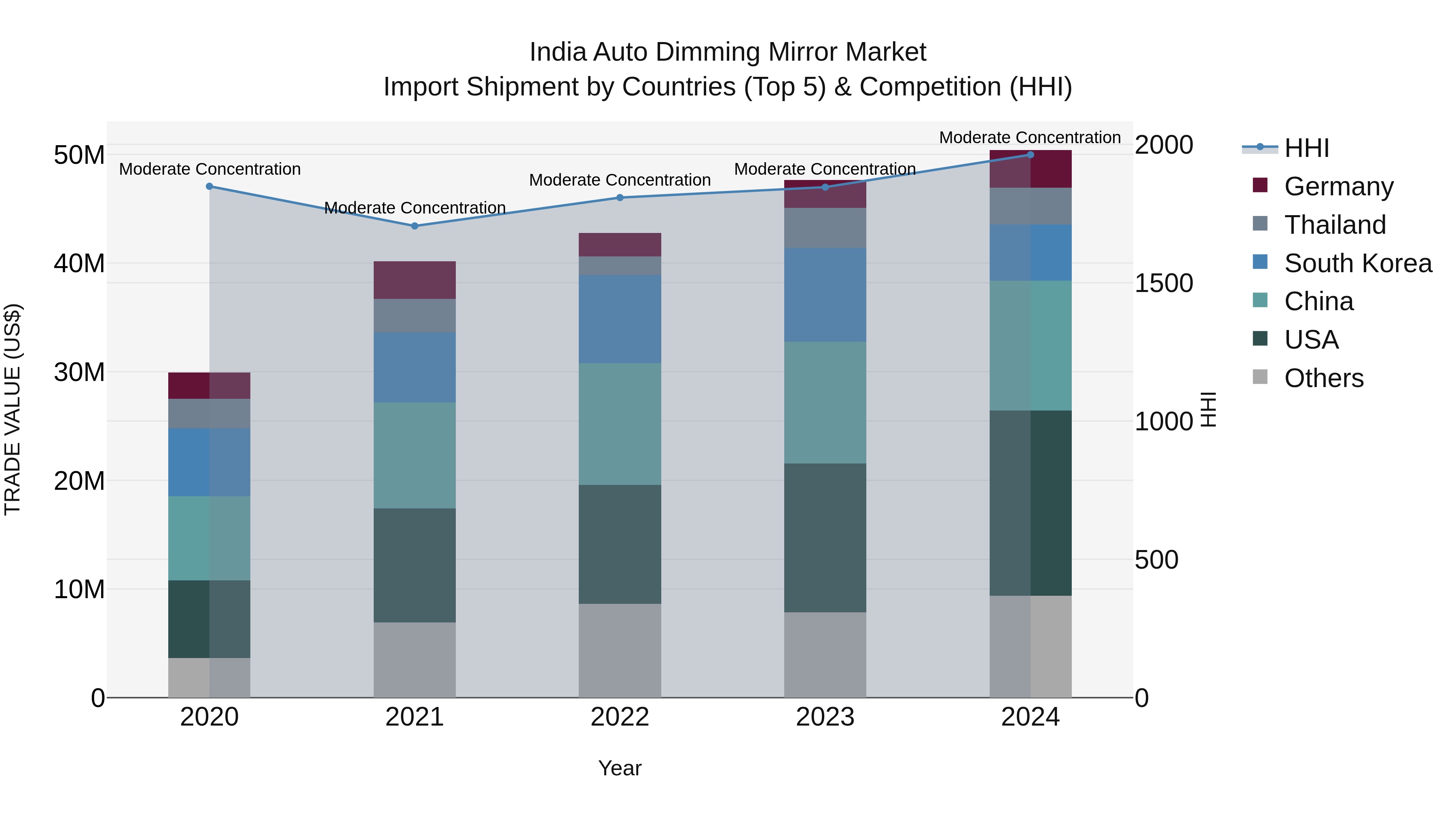
The import shipments of auto dimming mirrors in India from top exporting countries like USA, China, South Korea, Germany, and Thailand reflect a growing trend in 2024. With a moderate concentration indicated by the Herfindahl-Hirschman Index (HHI), the market is competitive. The impressive compound annual growth rate (CAGR) of 13.91% from 2020 to 2024 underscores the increasing demand for advanced automotive technology in India. Moreover, the growth rate of 5.73% from 2023 to 2024 signals a steady momentum in the import market for auto dimming mirrors, indicating a positive outlook for the industry.
India Auto Dimming Mirror Market Overview
The India Auto-Dimming Mirror market is expanding as safety and convenience features in vehicles become more important. Auto-dimming mirrors automatically adjust their reflection level based on the brightness of headlights from vehicles behind, reducing glare and enhancing nighttime driving safety. As India consumers prioritize safety and comfort, this market is expected to grow, particularly in higher-end vehicle segments.
Drivers of the Market
The India auto-dimming mirror market is being driven by factors like increased road safety awareness and the desire for enhanced driving comfort. Auto-dimming mirrors reduce glare from headlights of vehicles behind, thus improving driver visibility and safety. As consumers become more safety-conscious, the demand for these mirrors is rising. The incorporation of advanced technologies like electrochromic mirrors and the integration of features such as cameras and sensors for additional safety contribute to the market`s growth.
Challenges of the Market
The India auto-dimming mirror market faces challenges in providing reliable and cost-effective solutions that enhance driver safety. Developing mirror technology that adapts to the diverse driving conditions in India is crucial.
COVID-19 Impact on the Market
The auto-dimming mirror market experienced a temporary setback during the pandemic due to disruptions in the automotive supply chain. However, as consumers continued to prioritize safety features, the market saw a resurgence in demand. Auto-dimming mirrors became more popular for their ability to reduce glare and improve visibility, which was essential for safe driving.
Key Players in the Market
Major contributors in this sector encompass Gentex Corporation, Magna International, Murakami Corporation, and Ficosa.
Key Highlights of the Report:
- India Auto Dimming Mirror Market Outlook
- Market Size of India Auto Dimming Mirror Market, 2024
- Forecast of India Auto Dimming Mirror Market, 2031
- Historical Data and Forecast of India Auto Dimming Mirror Revenues & Volume for the Period 2021-2031
- India Auto Dimming Mirror Market Trend Evolution
- India Auto Dimming Mirror Market Drivers and Challenges
- India Auto Dimming Mirror Price Trends
- India Auto Dimming Mirror Porter's Five Forces
- India Auto Dimming Mirror Industry Life Cycle
- Historical Data and Forecast of India Auto Dimming Mirror Market Revenues & Volume By Fuel Type for the Period 2021-2031
- Historical Data and Forecast of India Auto Dimming Mirror Market Revenues & Volume By BEV for the Period 2021-2031
- Historical Data and Forecast of India Auto Dimming Mirror Market Revenues & Volume By ICE for the Period 2021-2031
- Historical Data and Forecast of India Auto Dimming Mirror Market Revenues & Volume By Hybrid for the Period 2021-2031
- Historical Data and Forecast of India Auto Dimming Mirror Market Revenues & Volume By Application for the Period 2021-2031
- Historical Data and Forecast of India Auto Dimming Mirror Market Revenues & Volume By IRVM for the Period 2021-2031
- Historical Data and Forecast of India Auto Dimming Mirror Market Revenues & Volume By ORVM for the Period 2021-2031
- Historical Data and Forecast of India Auto Dimming Mirror Market Revenues & Volume By Functionality for the Period 2021-2031
- Historical Data and Forecast of India Auto Dimming Mirror Market Revenues & Volume By Connected for the Period 2021-2031
- Historical Data and Forecast of India Auto Dimming Mirror Market Revenues & Volume By Non-Connected for the Period 2021-2031
- India Auto Dimming Mirror Import Export Trade Statistics
- Market Opportunity Assessment By Fuel Type
- Market Opportunity Assessment By Application
- Market Opportunity Assessment By Functionality
- India Auto Dimming Mirror Top Companies Market Share
- India Auto Dimming Mirror Competitive Benchmarking By Technical and Operational Parameters
- India Auto Dimming Mirror Company Profiles
- India Auto Dimming Mirror Key Strategic Recommendations






































