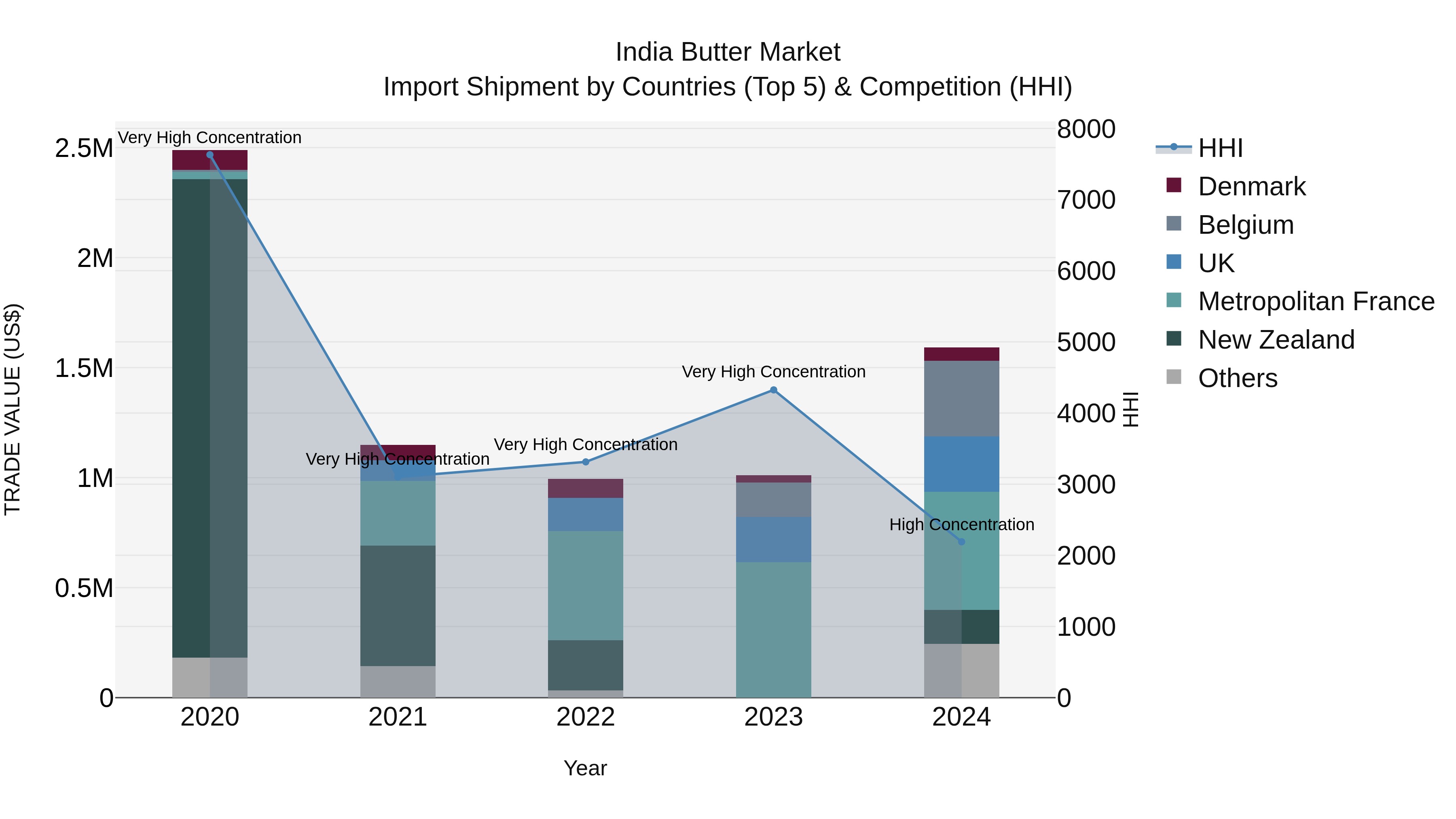
India Butter Market Top 5 Importing Countries and Market Competition (HHI) Analysis
India`s butter import market saw significant growth in 2024, with top exporting countries being Metropolitan France, Belgium, UK, India, and New Zealand. Despite a high Herfindahl-Hirschman Index (HHI) indicating market concentration, the sector witnessed a notable increase in growth rate from 2023 to 2024. However, the compound annual growth rate (CAGR) from 2020 to 2024 was negative at -10.57%, suggesting challenges in the market. The dynamics of butter imports to India are evolving, with key players and market trends shaping the industry landscape.
India Butter Market Growth Rate
According to 6Wresearch internal database and industry insights, the India Butter Market is growing at a compound annual growth rate (CAGR) of 5.84% during the forecast period (2025-2031).
India Butter Market Highlights
| Report Name | India Butter Market |
| Forecast period | 2025-2031 |
| CAGR | 5.84% |
| Growing Sector | Retail |
Topics Covered in the India Butter Market Report
India Butter Market report thoroughly covers the market by product types and distribution channels. The market report provides an unbiased and detailed analysis of ongoing market trends, opportunities/high growth areas, and market drivers, which would help stakeholders devise and align their market strategies according to the current and future market dynamics.
India Butter Market Synopsis
The butter market of India is experiencing continuous growth, the primary factors being the escalating demand for premium and value-added dairy products, urbanization, and the increase in per capita dairy consumption. Along with the lifestyle changes and higher incomes, consumer preference is slowly moving from basic dairy to processed dairy like butter. Besides this, the use of butter in food processing industries, fast food chains, and home cooking is becoming a major factor of the demand rise. The government schemes that are supporting dairy infrastructure and organized milk procurement are also playing a role in the development of the industry.
Evaluation of Growth Drivers in the India Butter Market
Below mentioned some growth drivers and their impact on market dynamics:
| Drivers | Primary Segments Affected | Why It Matters |
| Increasing Dairy Production | Product Type | Stable milk supply supports consistent butter output |
| Urban Lifestyle & Foodservice Demand | Distribution Channels | Boosts retail and out-of-home consumption |
| Shift to Premium Products | Product Type | Consumers prefer better quality and niche variants |
| Rise of Online Grocery Shopping | Distribution Channels | Enables doorstep delivery, wider reach |
| Government Dairy Development Initiatives | All Segments | Infrastructure and financial support to dairies |
The India Butter Market is projected to grow significantly, with a CAGR of 5.84% during the forecast period of 2025-2031. The market expansion can be attributed to a combination of factors, including an increase in health awareness, a corresponding rise in demand for functional and organic butter, and the swift growth of modern retail. The government support in the form of cold storage subsidies and dairy development funds is also a major factor in this regard. The growing popularity of Western-style diets and bakery consumption is further driving the increase in butter consumption in both the household and foodservice sectors.
Evaluation of Restraints in the India Butter Market
Below mentioned are some major restraints and their influence on market dynamics:
| Restraints | Primary Segments Affected | What This Means |
| Milk Price Volatility | All Segments | Affects butter pricing and profitability |
| Storage & Transportation Challenges | Distribution Channels | Limits product availability and shelf life |
| Competition from Margarine and Spreads | Product Type | Lowers butter’s market share in value segment |
| Regulatory Burden | All Segments | Adds cost for compliance and safety certifications |
| Limited Awareness in Rural Markets | Distribution Channels | Slows adoption of premium butter variants |
India Butter Market Challenges
The Indian butter market faces challenges due to raw milk price fluctuations, which directly affect processing costs and consumer pricing. The cold storage infrastructure is still less developed in a few regions of the country, thereby affecting the distribution and shelf life of butter. Moreover, butter is losing ground to low-fat spreads and margarine, especially amongst price-sensitive and health-conscious consumers. Producers are required to maintain quality by making constant investments to comply with FSSAI norms and other regulatory standards. In the villages, people are less aware of the differences in butter classes, hence the demand for high-end products is lower.
India Butter Market Trends
Some major trends contributing to the development of the India Butter Market growth are:
- Growing Demand for Organic Butter — Consumers are shifting towards chemical-free, organic dairy products with health certifications.
- Rise of Flavored and Fortified Butter — Introduction of garlic, herb, and vitamin-enriched butter is gaining popularity.
- Expansion of E-Commerce Dairy Brands — Direct-to-consumer models for fresh butter delivery are expanding, especially in metro cities.
- Single-Serve and Travel Packs — Rising nuclear families and on-the-go eating habits are driving demand for compact butter packaging.
- Cultured Butter Adoption — Urban consumers are increasingly trying cultured and European-style butter for taste and baking purposes.
Investment Opportunities in the India Butter Industry
Here are some investment opportunities in the India Butter Industry:
- Cold Chain Infrastructure — Investment in refrigerated logistics and storage facilities to support regional butter distribution.
- Organic and Premium Segments — Develop high-margin organic, A2-milk, or grass-fed butter products for niche markets.
- Online Dairy Retail — Launch D2C platforms for butter and dairy products, leveraging subscription-based delivery.
- Butter for HoReCa Segment — Establish B2B partnerships with hotels, restaurants, and bakeries for bulk supply.
- Private Labeling and Contract Manufacturing — Provide butter under retail chain brands or for international exports.
Top 5 Leading Players in the India Butter Market
Here are some top companies contributing to India Butter Market Share:
1. Amul (GCMMF)
| Field | Value |
|---|---|
| Company Name | Amul (GCMMF) |
| Headquarters | Anand, Gujarat |
| Established Year | 1946 |
| Official Website | Click Here |
Amul dominates the Indian butter market with its extensive retail and distribution network. It offers a range of butter products including salted, unsalted, and single-serve packs. Known for quality and affordability, Amul maintains strong rural and urban penetration.
2. Mother Dairy
| Field | Value |
|---|---|
| Company Name | Mother Dairy |
| Headquarters | New Delhi, India |
| Established Year | 1974 |
| Official Website | Click Here |
Mother Dairy is a leading supplier of dairy products, including table butter and white butter. The brand is particularly strong in North India and is backed by robust sourcing and cooperative support.
3. Britannia Industries
| Field | Value |
|---|---|
| Company Name | Britannia Industries |
| Headquarters | Bengaluru, India |
| Established Year | 1892 |
| Official Website | Click Here |
Britannia has expanded into the dairy sector with a focus on premium butter and spreads. It capitalizes on its bakery heritage and offers butter as part of its complementary product line.
4. Parag Milk Foods (Gowardhan)
| Field | Value |
|---|---|
| Company Name | Parag Milk Foods (Gowardhan) |
| Headquarters | Mumbai, India |
| Established Year | 1992 |
| Official Website | Click Here |
Parag Milk Foods offers premium butter products under the Gowardhan and Go brands. It targets both consumer and institutional segments with cow milk-based butter.
5. Pride of Cows (a brand by Parag Milk Foods)
| Field | Value |
|---|---|
| Company Name | Pride of Cows (a brand by Parag Milk Foods) |
| Headquarters | Mumbai, India |
| Established Year | 2011 |
| Official Website | Click Here |
Focused on ultra-premium butter, Pride of Cows delivers fresh, farm-to-home dairy. The brand is known for its exclusivity and high-end positioning in metro cities.
Government Regulations Introduced in the India Butter Market
According to Indian government data, the butter market is regulated by the Food Safety and Standards Authority of India (FSSAI), which defines the composition, labeling, and hygiene standards for butter products. The Dairy Processing and Infrastructure Development Fund (DIDF) provides financial assistance to set up processing units and cold chain facilities. The Rashtriya Gokul Mission and National Programme for Dairy Development also support milk productivity, indirectly impacting butter supply.
Future Insights of the India Butter Market
The prognosis for the Indian butter market is favorable, driven by the expected rise in organized retail and a burgeoning preference for premium and organic butter. The alteration of dietary patterns, increased disposable incomes, and the rising appeal of bakery products will persist in bolstering butter demand. Ongoing digital penetration will enhance online sales. The government's initiative to enhance milk production and processing capabilities will guarantee sufficient butter supply and quality, establishing India as an emerging player in the global dairy industry.
Market Segmentation Analysis
The report offers a comprehensive study of the subsequent market segments and their leading categories.
Uncultured Butter to Dominate the Market – By Product Type
According to Guneet Kaur, Senior Research Analyst, uncultured butter dominates the market as it remains the most widely consumed type of butter in India due to its affordability, availability, and familiarity. It is used extensively in households and food services for cooking, baking, and spreading purposes.
Supermarkets/Hypermarkets to Dominate the Market – By Distribution Channel
Supermarkets and hypermarkets lead the distribution channel segment due to their strong presence in urban and semi-urban markets. They offer better visibility, refrigerated storage, and variety, influencing customer preference. Additionally, modern retail enables promotional campaigns and bundling strategies that increase butter sales.
Key Attractiveness of the Report
- 10 Years Market Numbers
- Historical Data Starting from 2021 to 2024
- Base Year: 2024
- Forecast Data until 2031
- Key Performance Indicators Impacting the Market
- Major Upcoming Developments and Projects
Key Highlights of the Report:
- India Butter Market Outlook
- Market Size of India Butter Market, 2023
- Forecast of India Butter Market, 2030
- Historical Data and Forecast of India Butter Revenues & Volume for the Period 2020-2030
- India Butter Market Trend Evolution
- India Butter Market Drivers and Challenges
- India Butter Price Trends
- India Butter Porter's Five Forces
- India Butter Industry Life Cycle
- Historical Data and Forecast of India Butter Market Revenues & Volume By Product Type for the Period 2020-2030
- Historical Data and Forecast of India Butter Market Revenues & Volume By Cultured Butter for the Period 2020-2030
- Historical Data and Forecast of India Butter Market Revenues & Volume By Uncultured Butter for the Period 2020-2030
- Historical Data and Forecast of India Butter Market Revenues & Volume By Others for the Period 2020-2030
- Historical Data and Forecast of India Butter Market Revenues & Volume By Distribution Channel for the Period 2020-2030
- Historical Data and Forecast of India Butter Market Revenues & Volume By Supermarkets/Hypermarkets for the Period 2020-2030
- Historical Data and Forecast of India Butter Market Revenues & Volume By Convenience Stores for the Period 2020-2030
- Historical Data and Forecast of India Butter Market Revenues & Volume By Specialty Stores for the Period 2020-2030
- Historical Data and Forecast of India Butter Market Revenues & Volume By Online Retail Stores for the Period 2020-2030
- Historical Data and Forecast of India Butter Market Revenues & Volume By Other Distribution Channels for the Period 2020-2030
- India Butter Import Export Trade Statistics
- Market Opportunity Assessment By Product Type
- Market Opportunity Assessment By Distribution Channel
- India Butter Top Companies Market Share
- India Butter Competitive Benchmarking By Technical and Operational Parameters
- India Butter Company Profiles
- India Butter Key Strategic Recommendations
Market Covered
The report subsequently covers the market by the following segments and subsegments.
By Product Type
- Cultured Butter
- Uncultured Butter
- Others
By Distribution Channel
- Supermarkets/Hypermarkets
- Convenience Stores
- Specialty Stores
- Online Retail Stores
- Other Distribution Channels






































