India Concrete Aggregate Market Top 5 Importing Countries and Market Competition (HHI) Analysis
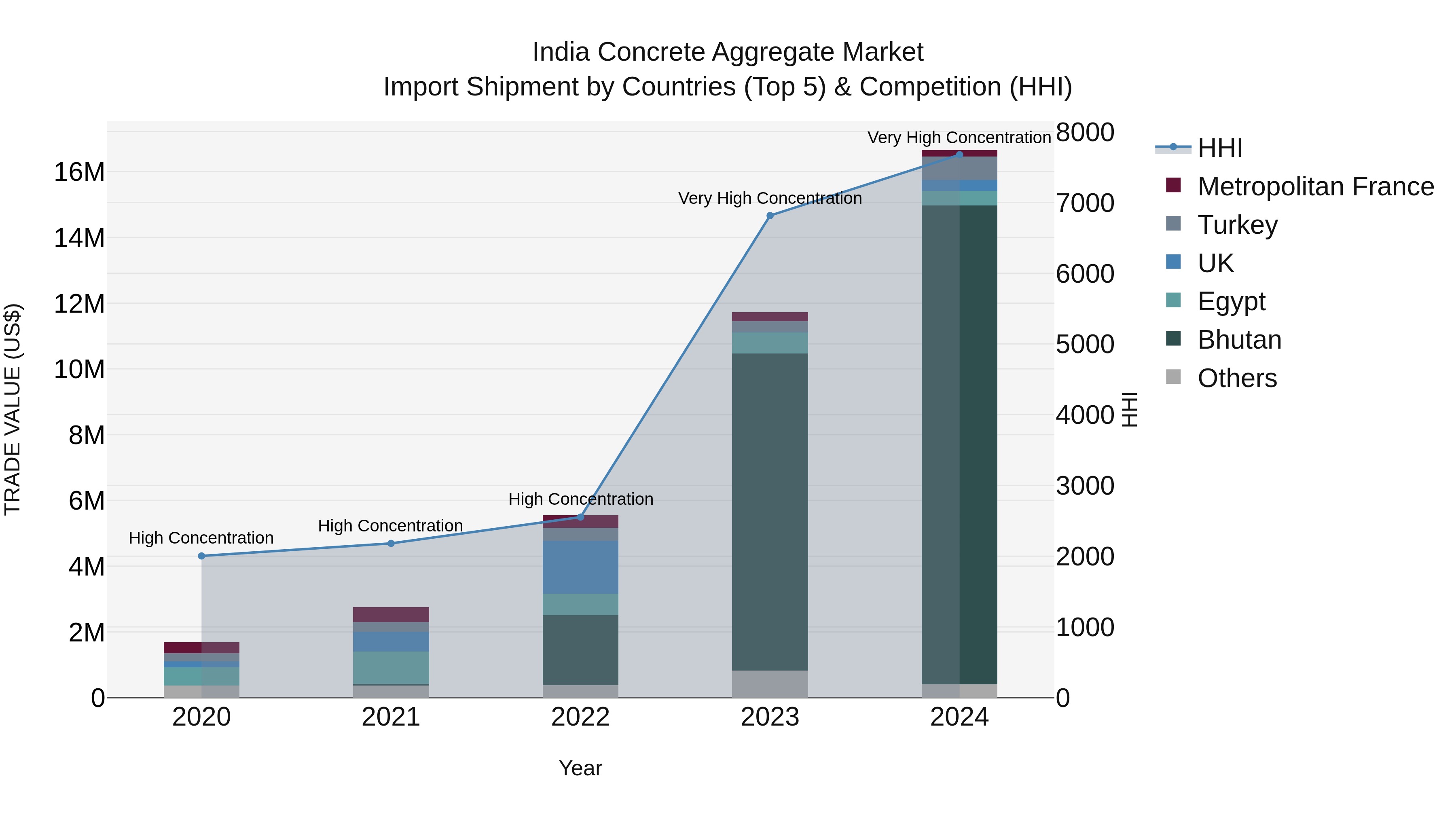
India`s concrete aggregate import market in 2024 saw significant contributions from top exporting countries including Bhutan, Turkey, Egypt, UK, and Bangladesh. The high Herfindahl-Hirschman Index (HHI) indicates a concentrated market landscape. With a remarkable compound annual growth rate (CAGR) of 77.19% from 2020 to 2024, the sector continues to expand rapidly. Notably, the growth rate spiked even further in 2024, reaching 42.02%. This data suggests a strong demand for concrete aggregate in India, driven by various infrastructure and construction projects.
India Concrete Aggregate Market Synopsis
The India concrete aggregate market is witnessing significant growth as the construction and infrastructure industries utilize aggregates for various applications. This market`s outlook is driven by factors such as the increasing demand for concrete aggregates in roads, bridges, buildings, and other construction projects, the growth of the construction and real estate sectors, and the adoption of aggregates for their structural and durability properties. Additionally, the development of advanced and sustainable aggregate sourcing methods and the rising focus on infrastructure development and urbanization are further contributing to market growth. Market players should consider collaborations with construction companies and government agencies to supply aggregates for major infrastructure projects.
Drivers of the market
The India concrete aggregate market is expected to witness steady growth due to the increasing construction and infrastructure development activities in the country. Concrete aggregates, including sand, gravel, crushed stone, and recycled aggregates, are essential components in the production of concrete, used widely in various construction projects. The market`s growth is primarily driven by factors such as the government`s focus on infrastructure development, the expansion of the construction and real estate sectors, and the increasing demand for sustainable and durable construction materials. Additionally, the rise in urbanization and the implementation of green building practices further contribute to market expansion.
Challenges of the Market
The India concrete aggregate market is witnessing steady growth as the construction and infrastructure sectors utilize aggregates for concrete production. This market`s outlook is driven by factors such as the increasing demand for concrete aggregates in building construction, infrastructure development, and road projects, the growth of the construction and real estate industries, and the adoption of high-quality aggregates for ensuring concrete strength and durability. However, the market also faces challenges, such as the availability of suitable sources for aggregates, and the impact of fluctuations in construction activities and government policies on aggregate demand.
Covid-19 Impact on the Market
The COVID-19 pandemic has impacted construction projects and supply chain operations, which may have affected the demand for concrete aggregates. Market players should address these challenges by exploring alternative sources for aggregates, adopting sustainable and eco-friendly practices in aggregate extraction, and diversifying their product offerings to cater to various construction applications.
Key Players of the Market
Key players in the India concrete aggregate market include BuildTech Aggregates, ConCreteCo Solutions, and StoneMax Industries.
Key Highlights of the Report:
- India Concrete Aggregate Market Outlook
- Market Size of India Concrete Aggregate Market, 2024
- Forecast of India Concrete Aggregate Market, 2031
- Historical Data and Forecast of India Concrete Aggregate Revenues & Volume for the Period 2021-2031
- India Concrete Aggregate Market Trend Evolution
- India Concrete Aggregate Market Drivers and Challenges
- India Concrete Aggregate Price Trends
- India Concrete Aggregate Porter's Five Forces
- India Concrete Aggregate Industry Life Cycle
- Historical Data and Forecast of India Concrete Aggregate Market Revenues & Volume By Production for the Period 2021-2031
- Historical Data and Forecast of India Concrete Aggregate Market Revenues & Volume By Natural for the Period 2021-2031
- Historical Data and Forecast of India Concrete Aggregate Market Revenues & Volume By Artificial for the Period 2021-2031
- Historical Data and Forecast of India Concrete Aggregate Market Revenues & Volume By Processed for the Period 2021-2031
- Historical Data and Forecast of India Concrete Aggregate Market Revenues & Volume By Glass Ceramics for the Period 2021-2031
- Historical Data and Forecast of India Concrete Aggregate Market Revenues & Volume By Manufactured Marbles for the Period 2021-2031
- Historical Data and Forecast of India Concrete Aggregate Market Revenues & Volume By Bulk Density for the Period 2021-2031
- Historical Data and Forecast of India Concrete Aggregate Market Revenues & Volume By ASTM C33 for the Period 2021-2031
- Historical Data and Forecast of India Concrete Aggregate Market Revenues & Volume By mechanical properties for the Period 2021-2031
- Historical Data and Forecast of India Concrete Aggregate Market Revenues & Volume By Abrasive power for the Period 2021-2031
- Historical Data and Forecast of India Concrete Aggregate Market Revenues & Volume By Particle Size for the Period 2021-2031
- Historical Data and Forecast of India Concrete Aggregate Market Revenues & Volume By Fine Aggregates for the Period 2021-2031
- Historical Data and Forecast of India Concrete Aggregate Market Revenues & Volume By Coarse Aggregate for the Period 2021-2031
- India Concrete Aggregate Import Export Trade Statistics
- Market Opportunity Assessment By Production
- Market Opportunity Assessment By Bulk Density
- Market Opportunity Assessment By mechanical properties
- Market Opportunity Assessment By Particle Size
- India Concrete Aggregate Top Companies Market Share
- India Concrete Aggregate Competitive Benchmarking By Technical and Operational Parameters
- India Concrete Aggregate Company Profiles
- India Concrete Aggregate Key Strategic Recommendations






































