India Digital Education Market Size & Growth Rate (2026-2032)
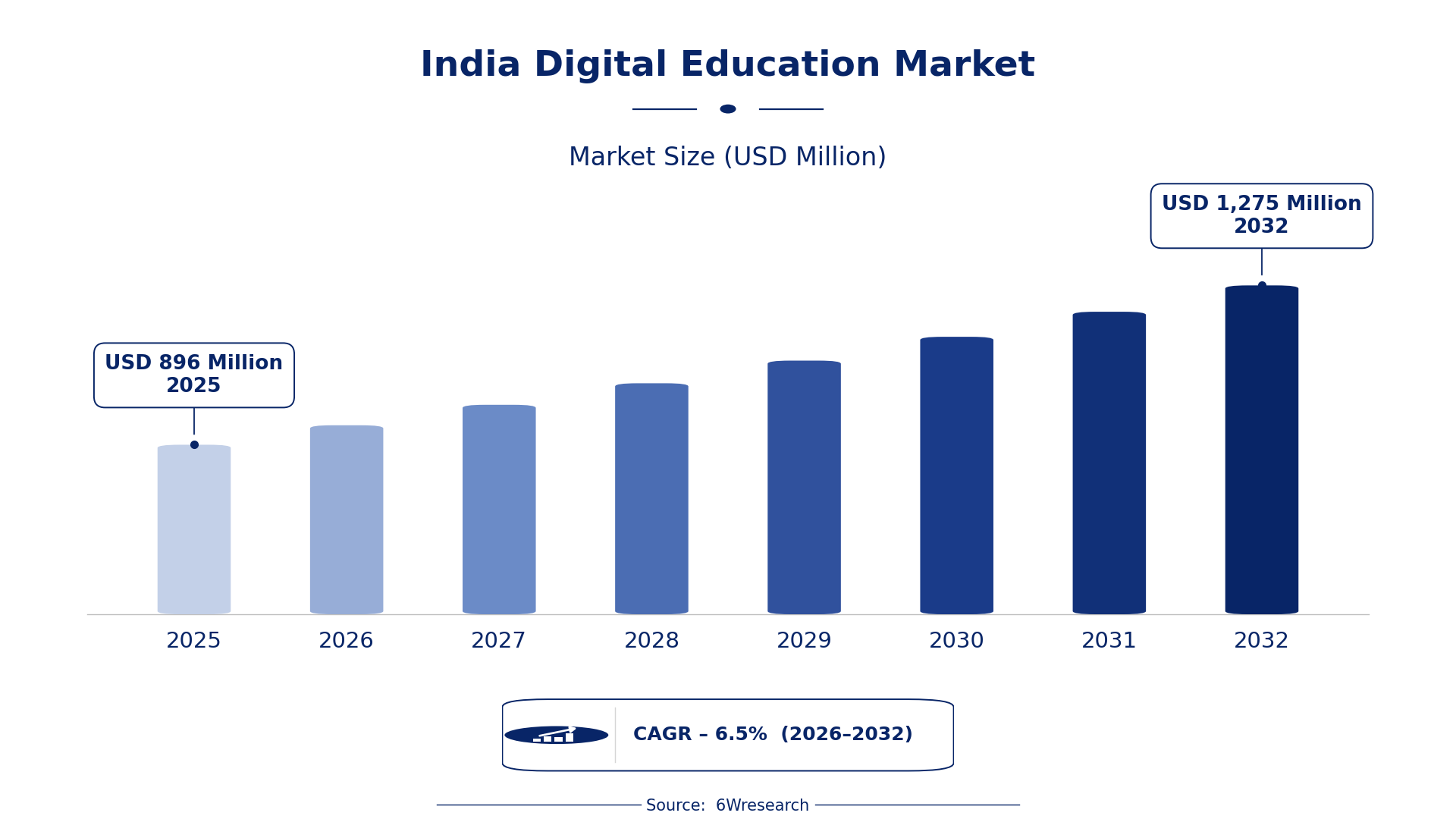
The India Digital Education Market was estimated at USD 896 Million in 2025 and is projected to reach USD 1275 Million by 2032, growing at a CAGR of 6.5% from 2026 to 2032.
India Digital Education Market Synopsis
The increasing adoption of technology in education is the most impactful force shaping the India Digital Education Market. As educational institutions pivot towards digital solutions, there's a growing recognition of the need for high-quality, accessible learning options that cater to diverse demographics.
With a vast population and varied educational requirements, digital education offers a pathway to overcome traditional barriers. The COVID-19 pandemic acted as a catalyst for change, accelerating the shift to online learning and highlighting the importance of flexible education solutions.
India Digital Education Market Year-wise Growth Rate and Key Drivers
This graph illustrates the annual growth rates of the India Digital Education Market from 2021 to 2032, highlighting a steady upward trajectory and projected expansion over the forecast period.
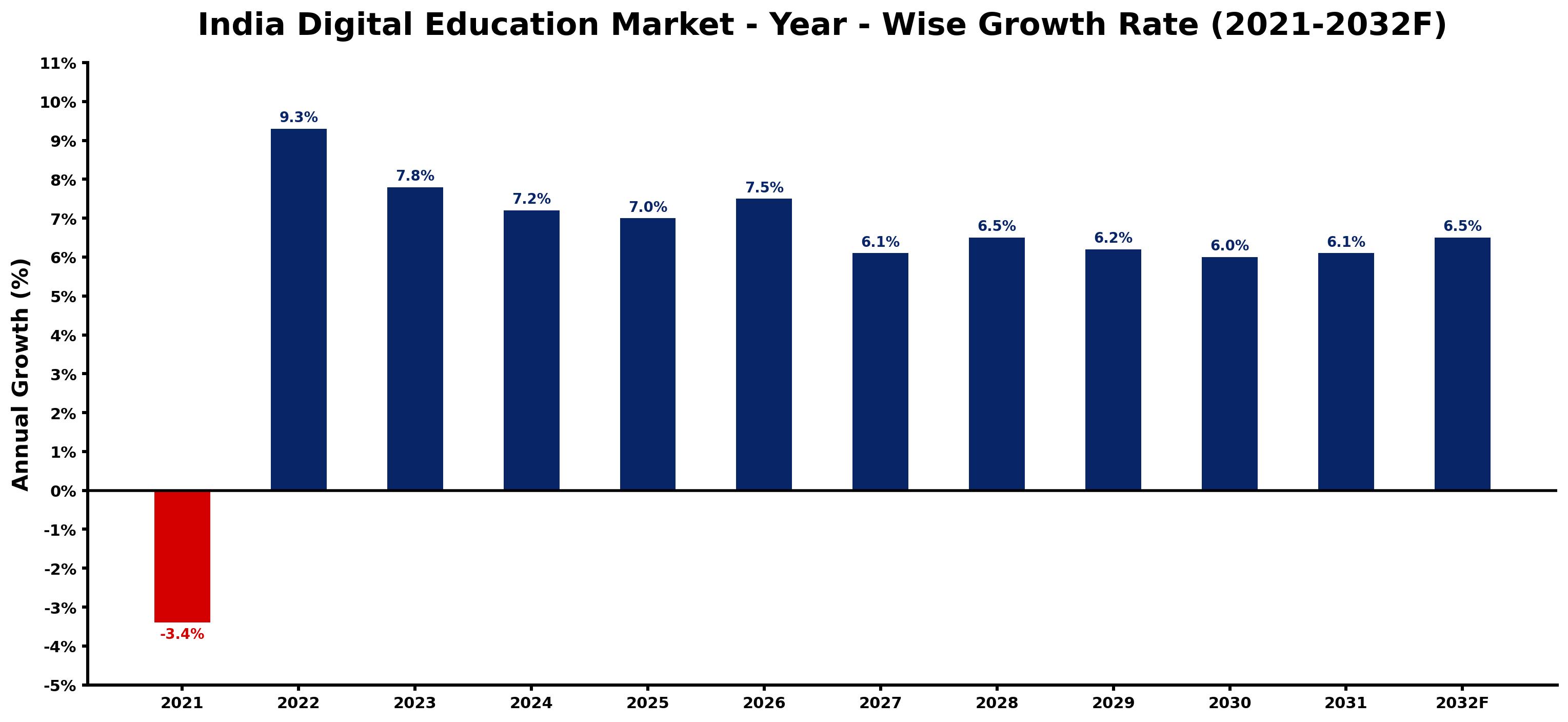
The table below presents the year‑wise growth rates along with the key drivers influencing the market
| Year | Growth Rate | Major Drivers |
| 2021 | -3.4% | Disruption from the National Education Policy implementation delays |
| 2022 | 9.3% | EdTech adoption fueled by NEP 2020 implementation. |
| 2023 | 7.8% | Increased investment from government in digital literacy initiatives. |
| 2024 | 7.2% | Partnerships with local schools for blended learning models. |
| 2025 | 7.0% | Rise of AI-driven personalized learning platforms. |
| 2026 | 7.5% | Increased smartphone penetration enhancing remote education access. |
| 2027 | 6.1% | Development of localized content for diverse languages. |
| 2028 | 6.5% | Incentives for startups in India’s digital education sector. |
| 2029 | 6.2% | Growing awareness of online education benefits among parents. |
| 2030 | 6.0% | Government initiatives promoting vocational training online. |
| 2031 | 6.1% | Curriculum reforms encouraging digital-integrated learning approaches. |
| 2032 | 6.5% | Corporate sponsorships funding educational technology projects. |
Note: Market size estimations and growth projections presented in this report are based on 6Wresearch's proprietary forecasting methodology, utilizing the latest available industry data, government publications, and primary research inputs.
India Digital Education Market Key Takeaways
Below are some of the specific key takeaways from the market, including:
- Digital education is rapidly becoming a primary mode of learning across various age groups.
- Government initiatives are crucial in shaping the digital education ecosystem.
- Quality control and content standardization remain significant challenges for growth.
- Investment in technology infrastructure is essential to bridge the digital divide.
- Online learning platforms are diversifying their offerings to cater to specific learning needs.
Evaluation of Restraints in India Digital Education Market
Despite its rapid growth, the India Digital Education Market faces real constraints that hinder its potential. One major issue is the digital divide; many regions still lack reliable internet access and adequate technological infrastructure. This gap in access can lead to unequal opportunities in education, creating a two-tier system where urban areas thrive while rural regions struggle. Additionally, ensuring that educational content meets diverse curricula and is available in multiple languages poses a significant challenge. Quality assurance in content creation also demands attention, as the market is flooded with various educational materials. Educator training is another hurdle, as many teachers need support in effectively utilizing digital tools.
India Digital Education Market Trends
Several trends are currently influencing the India Digital Education Market. The rise of hybrid learning models, blending online and offline approaches, is gaining traction as institutions seek flexibility in delivery methods. Personalized learning experiences powered by artificial intelligence are becoming more prevalent, allowing for tailored educational journeys. on top of that, gamification is increasingly being integrated into educational content to enhance engagement and motivation. As a result, content providers are innovating to create interactive and immersive learning experiences.
India Digital Education Market Opportunities
There are numerous opportunities for growth and investment in the India Digital Education Market. Expanding internet access and mobile connectivity opens doors for reaching underserved populations. Collaborations between educational institutions and technology companies can lead to the development of cutting-edge solutions that cater to local needs. Additionally, the increasing acceptance of online certifications by employers presents a chance for platforms that offer skill-based learning and vocational training. Lastly, a focus on continuous professional development for educators can further enhance the effectiveness of digital learning.
Government Initiatives in the India Digital Education Market
Government policies play a crucial role in shaping the India Digital Education Market. With a focus on enhancing digital literacy and improving educational access, various initiatives are being implemented to support this sector. These efforts are aimed at reducing barriers and fostering an environment conducive to digital learning.
- A recently completed national initiative aimed at upgrading digital infrastructure in rural areas has improved internet connectivity for educational institutions.
- A current programme is underway to develop a standardized digital curriculum that incorporates regional languages and cultural contexts.
- There is a planned public-private partnership expected to launch in the next year, aimed at providing training workshops for educators on the effective use of digital tools.
- A regulatory framework introduced in 2025 is mandating transparency in billing practices for online education services.
- A new scholarship scheme targeting underprivileged students to access online learning platforms is currently being rolled out.
Future Insights of the India Digital Education Market
Looking ahead to 2026-2032, the India Digital Education Market is set to evolve significantly. The focus will likely shift towards enhancing user experiences and integrating advanced technologies such as virtual reality and augmented reality into educational practices. As digital tools become more sophisticated, the demand for high-quality, interactive content will grow. on top of that, as the workforce becomes increasingly digital-savvy, the necessity for continuous learning and skill enhancement will drive market expansion. The combination of government support and technological advancement will further propel the digital education sector, making it an essential component of India's educational framework.
India Digital Education Market Latest Developments
Recent months have seen dynamic developments within the India Digital Education Market, reflecting the sector's rapid adaptation to changing educational needs. Companies and institutions are actively launching innovative solutions and enhancing their service offerings to cater to a broader audience.
- A major technology vendor announced an upgrade to its online learning platform, enhancing user interface and accessibility features, with the rollout completed in early 2025.
- An initiative that began in mid-2025 is currently underway, focusing on creating localized educational content for diverse regional languages.
- A leading regional operator is planning a new mobile app set to launch in Q3 2025, designed to facilitate remote learning for students in rural areas.
- A partnership between educational institutions and ed-tech companies has recently been formed to develop joint certification programs, enhancing employability for graduates.
- A comprehensive training program for educators on best practices in digital teaching methods is scheduled to begin in late 2026.
India Digital Education Market - Key Attractiveness of the Report
- 10 Years of Market Numbers
- Historical Data Starting from 2022 to 2025
- Base Year: 2025
- Forecast Data until 2032
- Key Performance Indicators Impacting the Market
- Major Upcoming Developments and Projects
Key Highlights of the Report:
- India Digital Education Market Outlook
- Market Size of India Digital Education Market, 2025
- Forecast of India Digital Education Market, 2032
- Historical Data and Forecast of India Digital Education Revenues & Volume for the Period 2022-2032F
- India Digital Education Market Trend Evolution
- India Digital Education Market Drivers and Challenges
- India Digital Education Price Trends
- India Digital Education Porter's Five Forces
- India Digital Education Industry Life Cycle
- Historical Data and Forecast of India Digital Education Market Revenues & Volume By End User for the Period 2022-2032F
- Historical Data and Forecast of India Digital Education Market Revenues & Volume By Academic Institutions for the Period 2022-2032F
- Historical Data and Forecast of India Digital Education Market Revenues & Volume By Enterprises and Public Sector for the Period 2022-2032F
- Historical Data and Forecast of India Digital Education Market Revenues & Volume By Learning Type for the Period 2022-2032F
- Historical Data and Forecast of India Digital Education Market Revenues & Volume By Self-paced Online Education for the Period 2022-2032F
- Historical Data and Forecast of India Digital Education Market Revenues & Volume By Instructor-led Online Education for the Period 2022-2032F
- Historical Data and Forecast of India Digital Education Market Revenues & Volume By Course Type for the Period 2022-2032F
- Historical Data and Forecast of India Digital Education Market Revenues & Volume By Science and Technology Courses for the Period 2022-2032F
- Historical Data and Forecast of India Digital Education Market Revenues & Volume By Entrepreneurship and Business Management Courses for the Period 2022-2032F
- Historical Data and Forecast of India Digital Education Market Revenues & Volume By Other Courses for the Period 2022-2032F
- India Digital Education Import Export Trade Statistics
- Market Opportunity Assessment By End User
- Market Opportunity Assessment By Learning Type
- Market Opportunity Assessment By Course Type
- India Digital Education Top Companies Market Share
- India Digital Education Competitive Benchmarking By Technical and Operational Parameters
- India Digital Education Company Profiles
- India Digital Education Key Strategic Recommendations






































