India EdTech and Smart Classrooms Market Size & Growth Rate (2026-2032)
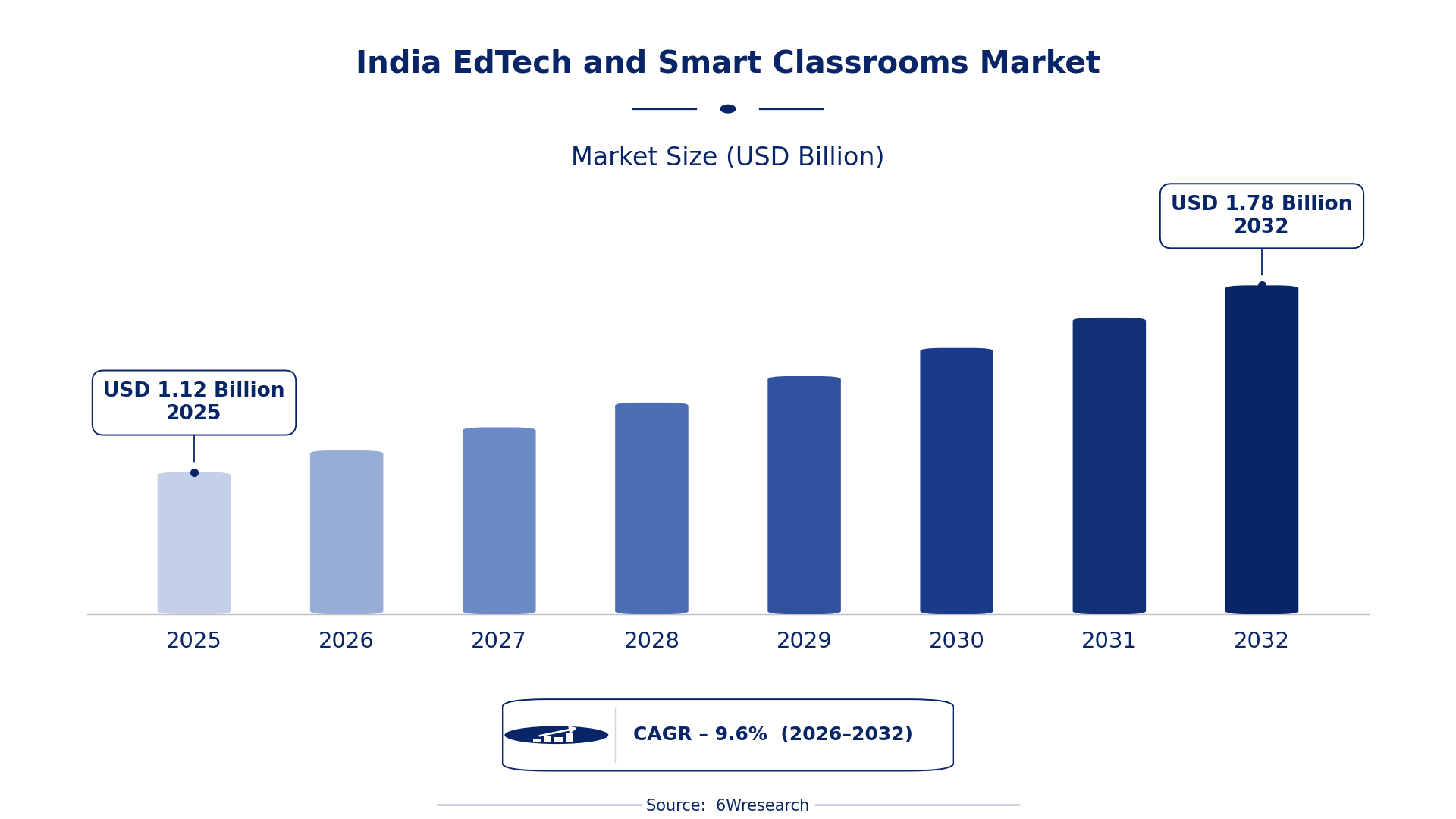
The India EdTech and Smart Classrooms Market was estimated at USD 1116 Million in 2025 and is projected to reach USD 1776 Million by 2032, growing at a CAGR of 9.6% from 2026 to 2032.
India EdTech and Smart Classrooms Market Synopsis
The demand for innovative educational solutions has surged as India embraces digital transformation in learning environments. Institutions are increasingly investing in smart classrooms, equipped with interactive technologies that promote student engagement and improve educational outcomes.
The EdTech sector is evolving rapidly, fueled by an array of online courses and personalized learning platforms that cater to diverse student needs. As traditional teaching methods are augmented by these digital tools, educators and learners alike benefit from a more dynamic educational experience.
India EdTech and Smart Classrooms Market Year-wise Growth Rate and Key Drivers
This graph illustrates the annual growth rates of the India EdTech and Smart Classrooms Market from 2021 to 2032, highlighting a steady upward trajectory and projected expansion over the forecast period.
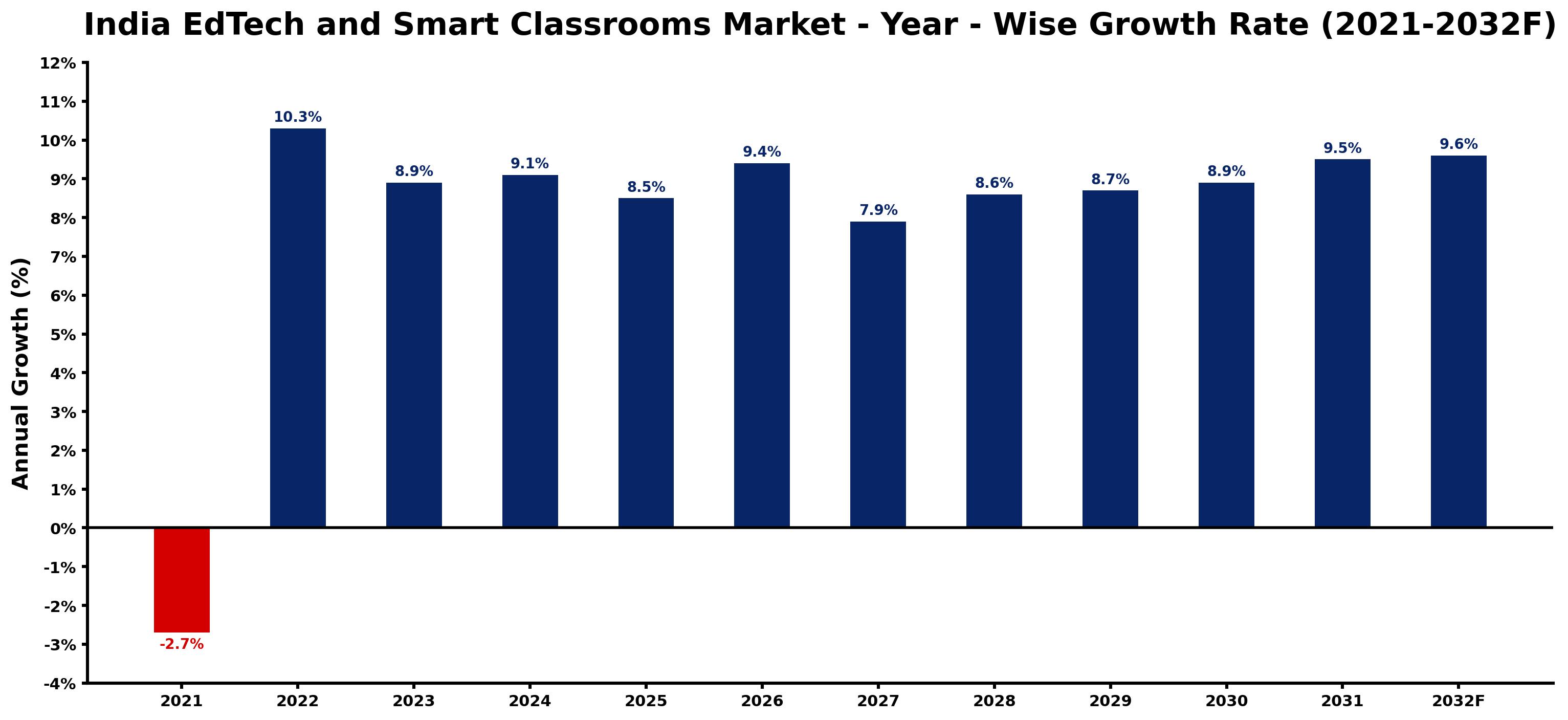
The table below presents the year‑wise growth rates along with the key drivers influencing the market
| Year | Growth Rate | Major Drivers |
| 2021 | -2.7% | School closures due to COVID-19 restrictions hindered adoption. |
| 2022 | 10.3% | National Education Policy promotes digital learning integration. |
| 2023 | 8.9% | Increased smartphone penetration enhances remote learning accessibility. |
| 2024 | 9.1% | Government-funded schemes boost smart classroom implementations. |
| 2025 | 8.5% | Private investments in AI-driven educational tools surge. |
| 2026 | 9.4% | Higher education enrollment drives demand for innovative tech. |
| 2027 | 7.9% | Corporate partnerships enhance training programs in schools. |
| 2028 | 8.6% | Growing focus on STEM education fuels digital content creation. |
| 2029 | 8.7% | Expanding internet infrastructure supports e-learning adoption. |
| 2030 | 8.9% | Government initiatives fund teacher training for digital literacy. |
| 2031 | 9.5% | Local startups innovate personalized learning solutions rapidly. |
| 2032 | 9.6% | Demand for skill-centric education aligns with job market trends. |
Note: Market size estimations and growth projections presented in this report are based on 6Wresearch's proprietary forecasting methodology, utilizing the latest available industry data, government publications, and primary research inputs.
India EdTech and Smart Classrooms Market Key Takeaways
Below are some of the specific key takeaways from the market, including:
- The market is experiencing a shift towards personalized and interactive learning experiences.
- Government initiatives are enhancing the accessibility of digital education across urban and rural areas.
- Smart classroom technologies are becoming essential in modern educational infrastructures.
- The COVID-19 pandemic has accelerated the adoption of online learning solutions.
- There is a growing recognition among parents and educators of the benefits of EdTech solutions.
Evaluation of Restraints in India EdTech and Smart Classrooms Market
Despite impressive growth, the India EdTech market faces notable challenges. The digital divide remains a significant barrier, with many students lacking access to essential internet services and devices, particularly in rural regions. Additionally, ensuring consistent quality and effectiveness in online education is a critical concern, as educators strive to maintain student engagement in virtual settings. on top of that, regulatory hurdles and issues surrounding data privacy continue to complicate the landscape, requiring careful navigation by market participants.
India EdTech and Smart Classrooms Market Trends
Several trends are emerging as key drivers in the India EdTech and Smart Classrooms Market. A notable shift towards hybrid learning models combines traditional and digital learning experiences, which has proven effective in enhancing student outcomes. Artificial intelligence is increasingly being integrated into educational platforms, personalizing learning pathways for students and providing valuable insights for educators. Additionally, gamification is being embraced to make learning more engaging and interactive, appealing to the digital-native generation.
India EdTech and Smart Classrooms Market Opportunities
The potential for growth in the India EdTech market is vast, particularly in underserved areas. Companies that focus on providing affordable and accessible digital learning solutions can tap into a significant customer base. Opportunities also exist in developing specialized platforms for vocational training and skill development, catering to the increasing demand for workforce readiness. Collaborations between educational institutions and technology providers are likely to yield innovative solutions, further propelling market expansion.
Government Initiatives in the India EdTech and Smart Classrooms Market
The Indian government is actively shaping the future of the EdTech market through various initiatives aimed at enhancing digital literacy and access to education. With a focus on bridging the educational gap, these policies are designed to make learning more inclusive and widely available. As the public sector prioritizes digital education, the regulatory environment is becoming increasingly supportive of innovative educational solutions.
- A national digital education policy launched in early 2023 aims to integrate technology into all levels of education.
- Current initiatives are underway to expand internet access in rural areas, enhancing connectivity for educational institutions.
- The "Digital India" program continues to promote digital literacy and skill development across various demographics.
- Upcoming projects include a public-private partnership expected to develop smart classroom infrastructure by 2027.
- Ongoing efforts focus on creating a regulatory framework to ensure data privacy and security in EdTech applications.
Future Insights of the India EdTech and Smart Classrooms Market
Looking ahead to 2026-2032, the India EdTech and Smart Classrooms Market is set to witness transformative changes. The integration of advanced technologies, such as augmented reality and artificial intelligence, will redefine the learning experience. Additionally, as educational institutions increasingly adopt blended learning models, the demand for EdTech solutions that support this hybrid approach will grow. on top of that, collaboration between the public and private sectors is expected to drive innovation and expand access, ensuring that education remains a priority in the digital age.
India EdTech and Smart Classrooms Market Latest Developments
In the past year, the India EdTech and Smart Classrooms Market has seen a flurry of activity, reflecting the ongoing evolution of educational technologies. Companies are focusing on expanding their offerings and improving the learning experience through innovative solutions. As the demand for digital education continues to grow, these developments are crucial for meeting the needs of students and educators alike.
- A major technology vendor recently launched a new interactive learning platform that utilizes gamification to enhance student engagement, with rollout completed by Q3 2023.
- An initiative that began in early 2023 focuses on providing digital training for teachers, aimed at improving the quality of online education.
- A pilot program for smart classroom installations in urban schools is currently underway, with results expected by mid-2024.
- Plans for a comprehensive educational app targeting vocational training are set to be launched by late 2025.
- A collaboration between regional education authorities and tech firms is anticipated to develop digital content for K-12 students, starting in early 2024.
India EdTech and Smart Classrooms Market - Key Attractiveness of the Report
- 10 Years of Market Numbers
- Historical Data Starting from 2022 to 2025
- Base Year: 2025
- Forecast Data until 2032
- Key Performance Indicators Impacting the Market
- Major Upcoming Developments and Projects
Key Highlights of the Report:
- India EdTech and Smart Classrooms Market Outlook
- Market Size of India EdTech and Smart Classrooms Market, 2025
- Forecast of India EdTech and Smart Classrooms Market, 2032
- Historical Data and Forecast of India EdTech and Smart Classrooms Revenues & Volume for the Period 2022-2032F
- India EdTech and Smart Classrooms Market Trend Evolution
- India EdTech and Smart Classrooms Market Drivers and Challenges
- India EdTech and Smart Classrooms Price Trends
- India EdTech and Smart Classrooms Porter's Five Forces
- India EdTech and Smart Classrooms Industry Life Cycle
- Historical Data and Forecast of India EdTech and Smart Classrooms Market Revenues & Volume By Hardware for the Period 2022-2032F
- Historical Data and Forecast of India EdTech and Smart Classrooms Market Revenues & Volume By Interactive Displays for the Period 2022-2032F
- Historical Data and Forecast of India EdTech and Smart Classrooms Market Revenues & Volume By Interactive Projectors for the Period 2022-2032F
- Historical Data and Forecast of India EdTech and Smart Classrooms Market Revenues & Volume By Education System Solution for the Period 2022-2032F
- Historical Data and Forecast of India EdTech and Smart Classrooms Market Revenues & Volume By Learning Management System for the Period 2022-2032F
- Historical Data and Forecast of India EdTech and Smart Classrooms Market Revenues & Volume By Student Information and Administration System for the Period 2022-2032F
- Historical Data and Forecast of India EdTech and Smart Classrooms Market Revenues & Volume By Student Collaboration System for the Period 2022-2032F
- Historical Data and Forecast of India EdTech and Smart Classrooms Market Revenues & Volume By Student Response System for the Period 2022-2032F
- Historical Data and Forecast of India EdTech and Smart Classrooms Market Revenues & Volume By Learning and Gamification for the Period 2022-2032F
- Historical Data and Forecast of India EdTech and Smart Classrooms Market Revenues & Volume By Test Preparation for the Period 2022-2032F
- Historical Data and Forecast of India EdTech and Smart Classrooms Market Revenues & Volume By Classroom Management System for the Period 2022-2032F
- Historical Data and Forecast of India EdTech and Smart Classrooms Market Revenues & Volume By Document Management System for the Period 2022-2032F
- Historical Data and Forecast of India EdTech and Smart Classrooms Market Revenues & Volume By Deployment Type for the Period 2022-2032F
- Historical Data and Forecast of India EdTech and Smart Classrooms Market Revenues & Volume By Cloud for the Period 2022-2032F
- Historical Data and Forecast of India EdTech and Smart Classrooms Market Revenues & Volume By On-Premises for the Period 2022-2032F
- Historical Data and Forecast of India EdTech and Smart Classrooms Market Revenues & Volume By End User for the Period 2022-2032F
- Historical Data and Forecast of India EdTech and Smart Classrooms Market Revenues & Volume By K-12 for the Period 2022-2032F
- Historical Data and Forecast of India EdTech and Smart Classrooms Market Revenues & Volume By Higher Education for the Period 2022-2032F
- India EdTech and Smart Classrooms Import Export Trade Statistics
- Market Opportunity Assessment By Hardware
- Market Opportunity Assessment By Education System Solution
- Market Opportunity Assessment By Deployment Type
- Market Opportunity Assessment By End User
- India EdTech and Smart Classrooms Top Companies Market Share
- India EdTech and Smart Classrooms Competitive Benchmarking By Technical and Operational Parameters
- India EdTech and Smart Classrooms Company Profiles
- India EdTech and Smart Classrooms Key Strategic Recommendations






































