India Electrical Components Market Growth Rate Analysis (2021-2031)
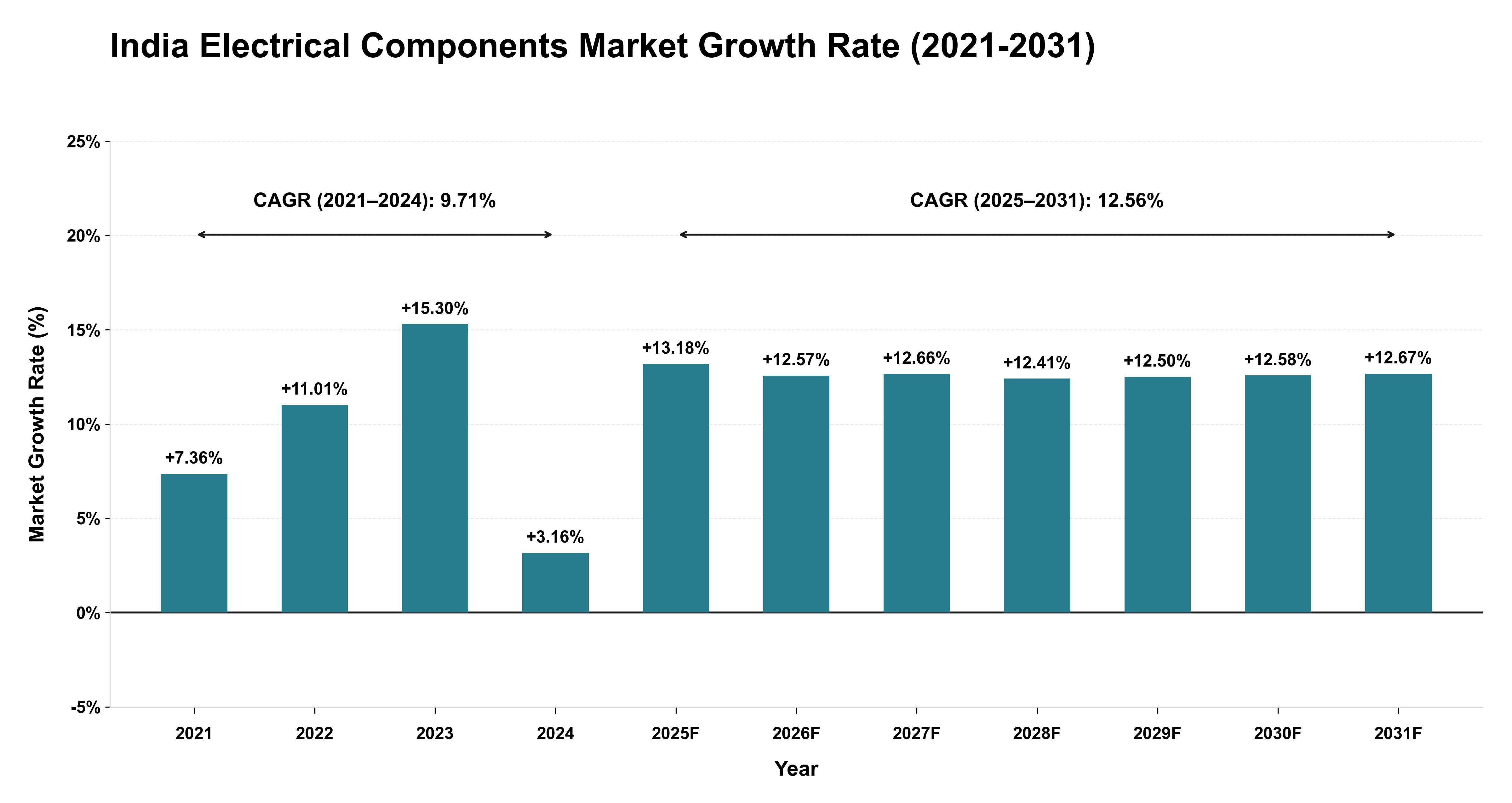
The India Electrical Components Market demonstrated a solid performance from 2021 to 2024, with a CAGR of 9.71%. The market saw varying growth rates during this period, starting with 7.36% in 2021, accelerating to 15.30% in 2023, but experiencing a slowdown in 2024 at 3.16%. Looking ahead to the forecast period from 2025 to 2031, the market is expected to maintain its growth trajectory but at a higher rate, with a forecasted CAGR of 12.56%. The growth rates for the upcoming years show a consistent trend of stabilizing expansion, hovering around the mid-12% range annually. This indicates a maturing market with steady demand and structural consolidation following the fluctuations observed in the earlier years.
India Electrical Components Market Synopsis
The electrical components market in India is anticipated to register robust growth over the forecast period. This can be attributed to rising investments towards developing infrastructure projects such as power plants & smart cities and increasing automobile production due to increased domestic sales across various sectors including IT/ITES, automotive & transportation coupled with government support through Make In India initiative which has attracted investment from both domestic manufacturers as well as foreign companies into manufacturing their products in India. Furthermore, rapid technological advancements such as 3D printing technology used for producing small-size electronic devices will further drive industry growth over the coming years.
Market Drivers of the market
The electrical components market in India is witnessing substantial growth, primarily driven by various factors contributing to the rapid expansion of the power and electronics sectors. The increasing focus on infrastructure development, urbanization, and industrialization has led to a surge in demand for electrical components such as switches, circuit breakers, connectors, and cables. The government`s initiatives to promote renewable energy and the electrification of rural areas have further propelled the demand for electrical components in India. Additionally, the growing electronics and consumer appliances market has created opportunities for electrical component manufacturers as these devices require various electronic parts and components. The shift towards smart technologies and automation in industries and homes has also spurred the demand for advanced electrical components. Moreover, favorable policies encouraging domestic manufacturing and the establishment of Special Economic Zones (SEZs) have attracted significant investments in the electrical components sector, further boosting its growth.
Challenges of the Market
One of the primary challenges is the presence of counterfeit electrical components in the market, which can compromise safety and reliability in electrical systems. This issue requires robust quality control and regulatory measures to ensure the authenticity and safety of electrical components. Moreover, with the rapid pace of technological change, manufacturers face the challenge of keeping up with evolving standards and requirements, particularly in areas such as energy efficiency and sustainability. Additionally, price fluctuations in raw materials, such as copper and aluminum, can impact manufacturing costs and pricing in the electrical components market.
Covid-19 Impact on the Market
The electrical components market in India faced challenges during the COVID-19 pandemic. With disruptions in manufacturing and supply chain activities, the availability of electrical components was affected. The lockdowns and restrictions led to delays in production and distribution, impacting industries dependent on electrical components. Additionally, with economic uncertainties and reduced consumer spending, demand for certain electrical products experienced a decline. However, the increasing focus on digitization and automation, as well as the growth of the renewable energy sector, created opportunities for specific electrical components like connectors, switches, and circuit breakers. As the economy recovered and industrial activities resumed, the electrical components market started showing signs of improvement.
Key Players of the Market
The electrical components market in India has seen significant growth due to infrastructure development, industrialization, and increased demand for electrical equipment. Key players in this market include companies like ABB India Limited, Schneider Electric India Pvt. Ltd., Siemens Limited, and Havells India Limited. These companies offer a wide range of electrical components, including switches, circuit breakers, electrical enclosures, and wiring devices, catering to residential, commercial, and industrial applications. They focus on product innovation, energy efficiency, and safety standards to meet the diverse requirements of the India electrical market. Key players collaborate with electrical contractors, project developers, and electrical distributors to provide a comprehensive range of electrical solutions and maintain their leadership positions in India.
Key Highlights of the Report:
- India Electrical Components Market Outlook
- Market Size of India Electrical Components Market, 2024
- Forecast of India Electrical Components Market, 2031
- Historical Data and Forecast of India Electrical Components Revenues & Volume for the Period 2021-2031
- India Electrical Components Market Trend Evolution
- India Electrical Components Market Drivers and Challenges
- India Electrical Components Price Trends
- India Electrical Components Porter's Five Forces
- India Electrical Components Industry Life Cycle
- Historical Data and Forecast of India Electrical Components Market Revenues & Volume By Building Automation for the Period 2021-2031
- Historical Data and Forecast of India Electrical Components Market Revenues & Volume By Datacom Accessories for the Period 2021-2031
- Historical Data and Forecast of India Electrical Components Market Revenues & Volume By Security & wiring Accessories for the Period 2021-2031
- Historical Data and Forecast of India Electrical Components Market Revenues & Volume By Cables & Wires for the Period 2021-2031
- Historical Data and Forecast of India Electrical Components Market Revenues & Volume By Datacom Cables for the Period 2021-2031
- Historical Data and Forecast of India Electrical Components Market Revenues & Volume By LV Cables for the Period 2021-2031
- Historical Data and Forecast of India Electrical Components Market Revenues & Volume By MV&HV Cables for the Period 2021-2031
- Historical Data and Forecast of India Electrical Components Market Revenues & Volume By Special Cables for the Period 2021-2031
- Historical Data and Forecast of India Electrical Components Market Revenues & Volume By Industrial Automation for the Period 2021-2031
- Historical Data and Forecast of India Electrical Components Market Revenues & Volume By Automation Controls for the Period 2021-2031
- Historical Data and Forecast of India Electrical Components Market Revenues & Volume By Auxiliary Controls for the Period 2021-2031
- Historical Data and Forecast of India Electrical Components Market Revenues & Volume By Drives & Motion Controls for the Period 2021-2031
- Historical Data and Forecast of India Electrical Components Market Revenues & Volume By Measurement Controls and Relays for the Period 2021-2031
- Historical Data and Forecast of India Electrical Components Market Revenues & Volume By Lighting for the Period 2021-2031
- Historical Data and Forecast of India Electrical Components Market Revenues & Volume By Fixtures for the Period 2021-2031
- Historical Data and Forecast of India Electrical Components Market Revenues & Volume By Lamps & LEDs for the Period 2021-2031
- Historical Data and Forecast of India Electrical Components Market Revenues & Volume By Power Distribution for the Period 2021-2031
- Historical Data and Forecast of India Electrical Components Market Revenues & Volume By Cable Management for the Period 2021-2031
- Historical Data and Forecast of India Electrical Components Market Revenues & Volume By Enclosures & Panels for the Period 2021-2031
- Historical Data and Forecast of India Electrical Components Market Revenues & Volume By LV Electrical Distribution for the Period 2021-2031
- Historical Data and Forecast of India Electrical Components Market Revenues & Volume By Renewable Energies for the Period 2021-2031
- Historical Data and Forecast of India Electrical Components Market Revenues & Volume By HVAC for the Period 2021-2031
- Historical Data and Forecast of India Electrical Components Market Revenues & Volume By Renewable energy for the Period 2021-2031
- Historical Data and Forecast of India Electrical Components Market Revenues & Volume By Safety & Tools for the Period 2021-2031
- Historical Data and Forecast of India Electrical Components Market Revenues & Volume By Safety Equipment for the Period 2021-2031
- Historical Data and Forecast of India Electrical Components Market Revenues & Volume By Working Tools & Accessories for the Period 2021-2031
- India Electrical Components Import Export Trade Statistics
- Market Opportunity Assessment By Building Automation
- Market Opportunity Assessment By Cables & Wires
- Market Opportunity Assessment By Industrial Automation
- Market Opportunity Assessment By Lighting
- Market Opportunity Assessment By Power Distribution
- Market Opportunity Assessment By Renewable Energies
- Market Opportunity Assessment By Safety & Tools
- India Electrical Components Top Companies Market Share
- India Electrical Components Competitive Benchmarking By Technical and Operational Parameters
- India Electrical Components Company Profiles
- India Electrical Components Key Strategic Recommendations






































