India Facial Recognition Market Size & Growth Rate (2026-2032)
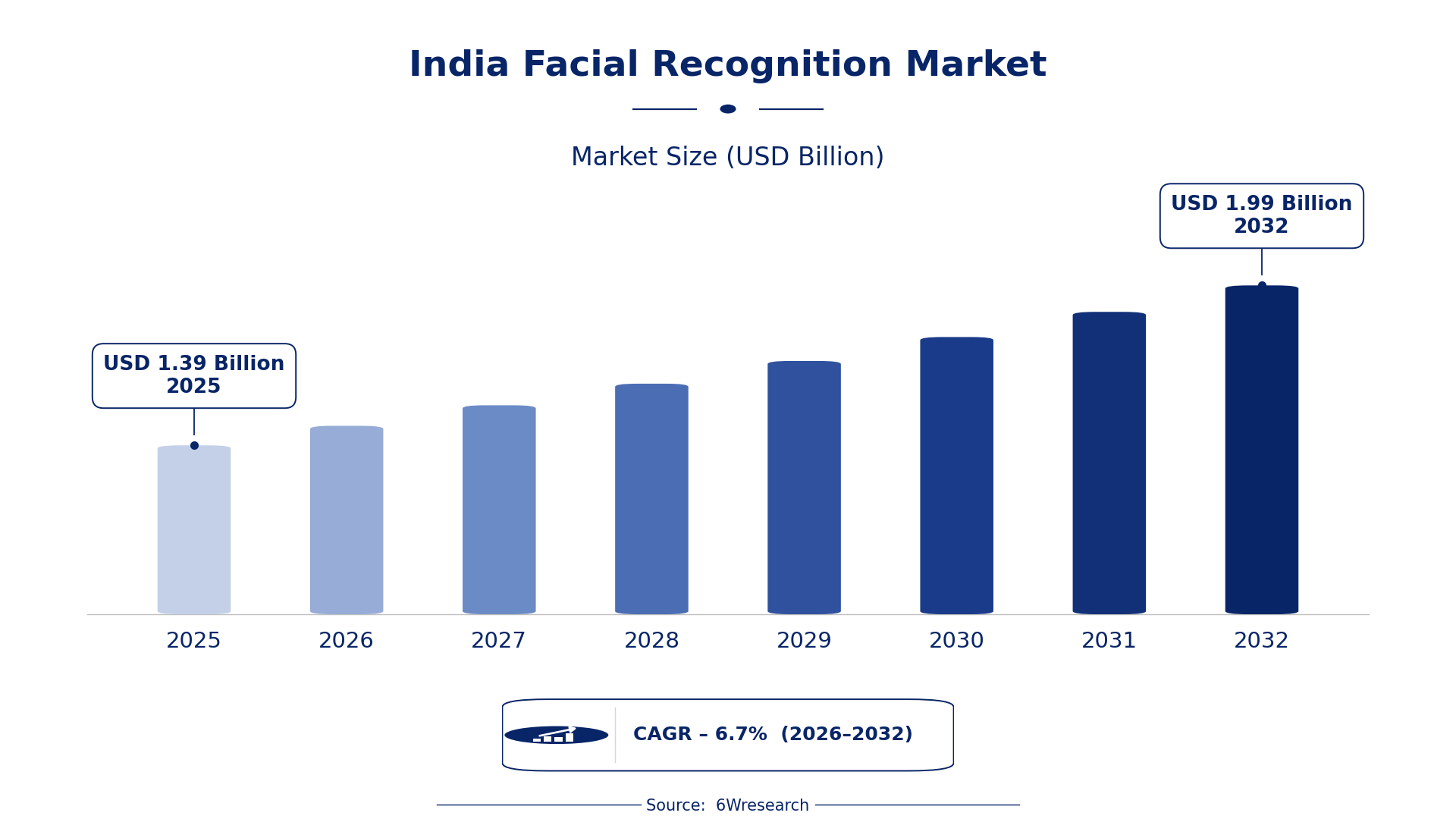
The India Facial Recognition Market was estimated at USD 1394 Million in 2025 and is projected to reach USD 1988 Million by 2032, growing at a CAGR of 6.7% from 2026 to 2032.
India Facial Recognition Market Synopsis
The push for advanced security measures across various sectors has catalyzed the growth of the India Facial Recognition Market. Institutions are increasingly adopting this technology for applications in law enforcement, financial services, and border security, reflecting a demand for efficient identity verification.
The Indian government's initiatives to enhance digital identity solutions are accelerating market expansion. Coupled with the widespread use of smartphones, the adoption of facial recognition technology is becoming an integral part of India's security framework, despite ongoing concerns about privacy and data protection.
India Facial Recognition Market Year-wise Growth Rate and Key Drivers
This graph illustrates the annual growth rates of the India Facial Recognition Market from 2021 to 2032, highlighting a steady upward trajectory and projected expansion over the forecast period.
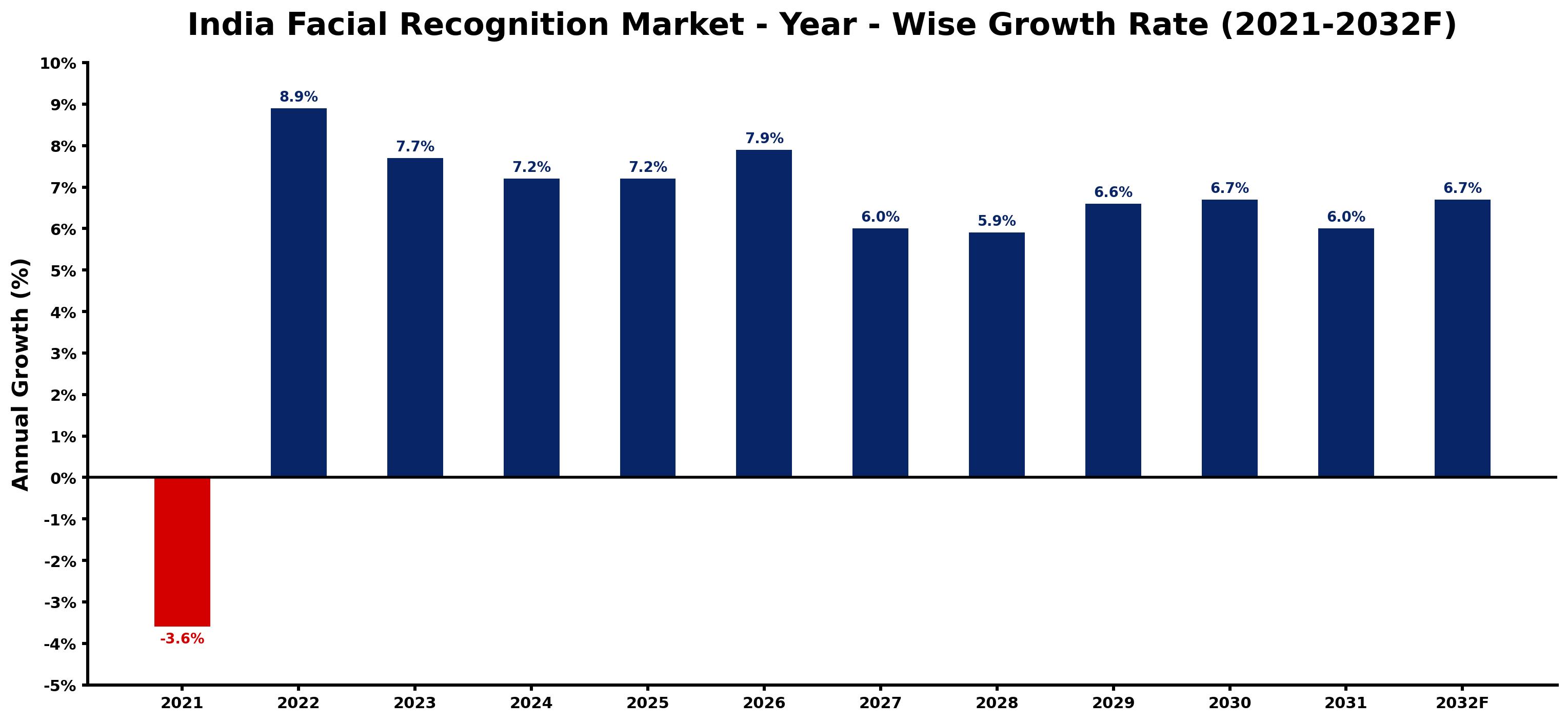
The table below presents the year‑wise growth rates along with the key drivers influencing the market
| Year | Growth Rate | Major Drivers |
| 2021 | -3.6% | Criticism from India's Supreme Court on privacy concerns. |
| 2022 | 8.9% | Increased adoption by Indian law enforcement agencies. |
| 2023 | 7.7% | Government's digital India initiative promoting biometric identity systems. |
| 2024 | 7.2% | Rise in security concerns from urbanization in India. |
| 2025 | 7.2% | Implementation of facial recognition for COVID-19 compliance monitoring. |
| 2026 | 7.9% | Growing interest in smart city projects across major cities. |
| 2027 | 6.0% | Regulatory support for biometric verification in financial services. |
| 2028 | 5.9% | Surge in e-governance initiatives enhancing identity verification. |
| 2029 | 6.6% | Demand for enhanced security in public transportation systems. |
| 2030 | 6.7% | Integration of AI with facial recognition technology advancements. |
| 2031 | 6.0% | Support from local startups developing innovative recognition solutions. |
| 2032 | 6.7% | Increased usage in retail for personalized customer experiences. |
Note: Market size estimations and growth projections presented in this report are based on 6Wresearch's proprietary forecasting methodology, utilizing the latest available industry data, government publications, and primary research inputs.
India Facial Recognition Market Key Takeaways
Below are some of the specific key takeaways from the market, including:
- Growing adoption in law enforcement and security sectors is a primary driver of market expansion.
- Government initiatives are pushing for digital identity solutions and enhancing regulatory frameworks.
- Privacy concerns pose challenges that must be addressed for broader acceptance of the technology.
- The COVID-19 pandemic has accelerated the shift towards contactless authentication methods.
- Major players are focusing on developing reliable and unbiased facial recognition solutions.
Evaluation of Restraints in India Facial Recognition Market
Privacy issues remain a significant restraint on the India Facial Recognition Market. Public concerns about data misuse and surveillance are leading to calls for stricter regulations. Ensuring that technology is accurate and resistant to spoofing is critical. Organizations must strike a balance between leveraging the benefits of facial recognition and protecting individual rights, which remains a delicate challenge.
India Facial Recognition Market Trends
The push towards digital transformation is driving facial recognition technology into new sectors, including healthcare and retail. Organizations are focusing on integrating artificial intelligence with facial recognition for improved accuracy and efficiency. Additionally, the demand for contactless solutions is influencing innovations in user authentication methods, enhancing customer experiences across various industries.
India Facial Recognition Market Opportunities
The market presents numerous opportunities, particularly in enhancing public safety through smart city initiatives. Investments in surveillance systems and infrastructure upgrades are expected to create avenues for growth. on top of that, the integration of facial recognition in mobile applications for secure transactions is a potential growth area, especially in the financial services sector.
Government Initiatives in the India Facial Recognition Market
The Indian government is actively shaping the facial recognition market through various initiatives aimed at enhancing digital identity verification and security. Regulatory frameworks are being established to address privacy concerns while promoting technological adoption. These policies are crucial for ensuring that the implementation of facial recognition technology is responsible and beneficial for society.
- A national digital identity verification program launched in 2025 aims to streamline citizen identification processes.
- Current initiatives include the rollout of enhanced surveillance systems in urban areas to improve public safety.
- Ongoing discussions are focused on developing a comprehensive regulatory framework to address privacy and data security issues.
- A planned initiative expected to commence by 2027 aims to integrate facial recognition technology into the transportation sector for enhanced security.
Future Insights of the India Facial Recognition Market
Looking ahead to 2026-2032, the India Facial Recognition Market is set to grow as technology becomes more sophisticated and widely accepted. Increased governmental support and public awareness will play significant roles in shaping market dynamics. As organizations innovate and address privacy concerns, the integration of this technology into everyday life is likely to expand, driving further growth.
India Facial Recognition Market Latest Developments
In the past year, the India Facial Recognition Market has witnessed a surge in activity, with several noteworthy developments across sectors. Companies are launching new solutions that enhance accuracy and usability, while regulatory frameworks are evolving to keep pace with technology advancements.
- A leading technology vendor announced the launch of a new facial recognition platform in early 2025, aimed at improving security in retail environments.
- Ongoing pilot projects are testing the integration of facial recognition systems in major transportation hubs, enhancing passenger security and experience.
- A collaboration between public and private sectors is underway to develop a nationwide standard for facial recognition technology, expected to be finalized by mid-2026.
- Upcoming initiatives plan to integrate facial recognition into mobile banking applications, with a rollout expected in late 2026.
India Facial Recognition Market - Key Attractiveness of the Report
- 10 Years of Market Numbers
- Historical Data Starting from 2022 to 2025
- Base Year: 2025
- Forecast Data until 2032
- Key Performance Indicators Impacting the Market
- Major Upcoming Developments and Projects
Key Highlights of the Report:
- India Facial Recognition Market Outlook
- Market Size of India Facial Recognition Market, 2025
- Forecast of India Facial Recognition Market, 2032
- Historical Data and Forecast of India Facial Recognition Revenues & Volume for the Period 2022-2032F
- India Facial Recognition Market Trend Evolution
- India Facial Recognition Market Drivers and Challenges
- India Facial Recognition Price Trends
- India Facial Recognition Porter's Five Forces
- India Facial Recognition Industry Life Cycle
- Historical Data and Forecast of India Facial Recognition Market Revenues & Volume By Component for the Period 2022-2032F
- Historical Data and Forecast of India Facial Recognition Market Revenues & Volume By Software for the Period 2022-2032F
- Historical Data and Forecast of India Facial Recognition Market Revenues & Volume By Services for the Period 2022-2032F
- Historical Data and Forecast of India Facial Recognition Market Revenues & Volume By Application for the Period 2022-2032F
- Historical Data and Forecast of India Facial Recognition Market Revenues & Volume By Access Control for the Period 2022-2032F
- Historical Data and Forecast of India Facial Recognition Market Revenues & Volume By Attendance Tracking & Monitoring for the Period 2022-2032F
- Historical Data and Forecast of India Facial Recognition Market Revenues & Volume By Emotion Recognition for the Period 2022-2032F
- Historical Data and Forecast of India Facial Recognition Market Revenues & Volume By Security & Surveillance for the Period 2022-2032F
- Historical Data and Forecast of India Facial Recognition Market Revenues & Volume By Others for the Period 2022-2032F
- Historical Data and Forecast of India Facial Recognition Market Revenues & Volume By Vertical for the Period 2022-2032F
- Historical Data and Forecast of India Facial Recognition Market Revenues & Volume By Retail & E-Commerce for the Period 2022-2032F
- Historical Data and Forecast of India Facial Recognition Market Revenues & Volume By Media & Entertainment for the Period 2022-2032F
- Historical Data and Forecast of India Facial Recognition Market Revenues & Volume By BFSI for the Period 2022-2032F
- Historical Data and Forecast of India Facial Recognition Market Revenues & Volume By Automobile & Transportation for the Period 2022-2032F
- Historical Data and Forecast of India Facial Recognition Market Revenues & Volume By Telecom & IT for the Period 2022-2032F
- Historical Data and Forecast of India Facial Recognition Market Revenues & Volume By Government for the Period 2022-2032F
- Historical Data and Forecast of India Facial Recognition Market Revenues & Volume By Healthcare for the Period 2022-2032F
- Historical Data and Forecast of India Facial Recognition Market Revenues & Volume By Others for the Period 2022-2032F
- Historical Data and Forecast of India Facial Recognition Market Revenues & Volume By Technology for the Period 2022-2032F
- Historical Data and Forecast of India Facial Recognition Market Revenues & Volume By 2D for the Period 2022-2032F
- Historical Data and Forecast of India Facial Recognition Market Revenues & Volume By 3D for the Period 2022-2032F
- Historical Data and Forecast of India Facial Recognition Market Revenues & Volume By Facial Analytics for the Period 2022-2032F
- India Facial Recognition Import Export Trade Statistics
- Market Opportunity Assessment By Component
- Market Opportunity Assessment By Application
- Market Opportunity Assessment By Vertical
- Market Opportunity Assessment By Technology
- India Facial Recognition Top Companies Market Share
- India Facial Recognition Competitive Benchmarking By Technical and Operational Parameters
- India Facial Recognition Company Profiles
- India Facial Recognition Key Strategic Recommendations






































