India Ghee Market Growth Rate
According to 6Wresearch internal database and industry insights, the India Ghee Market is projected to grow at a compound annual growth rate (CAGR) of 7.4% during the forecast period (2025–2031).
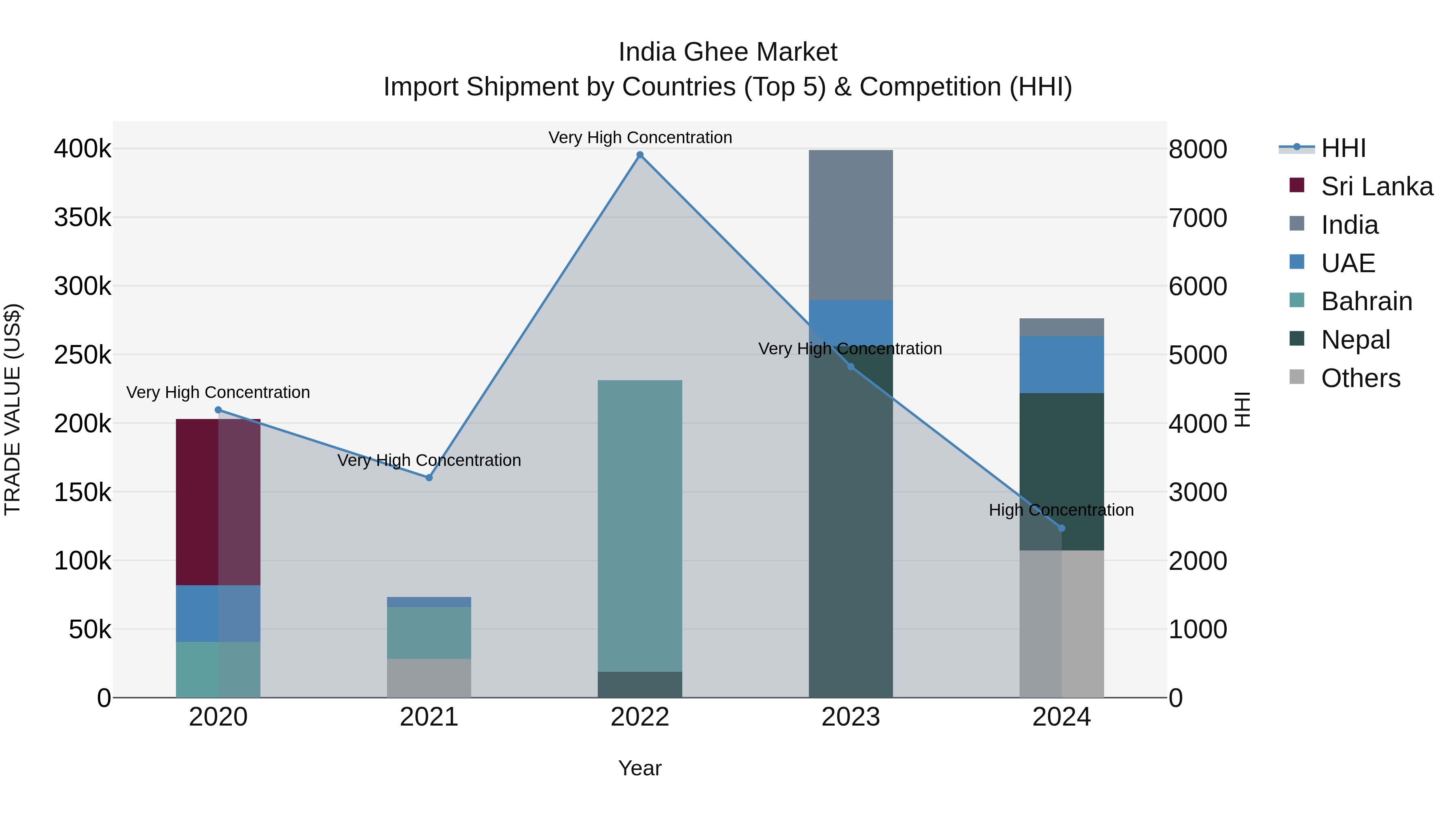
India Ghee Market Top 5 Importing Countries and Market Competition (HHI) Analysis
India`s ghee import market in 2024 saw a shift in top exporting countries, with Nepal, Oman, Saudi Arabia, UAE, and Qatar emerging as key players. The market concentration, as measured by the HHI, remained high in 2024, indicating a competitive landscape. Despite a negative growth rate of -30.73% in 2024, the compound annual growth rate (CAGR) from 2020 to 2024 stood at a healthy 8.02%, reflecting long-term market stability and potential for further growth in the future.
India Ghee Market Highlights
| Report Name | India Ghee Market |
| Forecast period | 2025-2031 |
| CAGR | 7.4% |
| Growing Sector | Food and Beverage |
Five-Year Growth Trajectory of the India Ghee Market with Core Drivers
Below mentioned are the evaluation of year-wise growth rate along with key drivers:
| Years | Est. Annual Growth (%) | Growth Drivers |
| 2020 | 2.10% | Stable consumption patterns in rural regions despite limited urban expansion. |
| 2021 | 3.50% | Rising awareness about traditional dairy fats and steady retail sector revival. |
| 2022 | 4.80% | Growth in e-commerce and regional dairy cooperatives expanding ghee distribution. |
| 2023 | 5.90% | Expanding food processing sector and demand from confectionery manufacturers. |
| 2024 | 6.70% | Growing popularity of cow ghee as a premium product in both domestic and export markets. |
Topics Covered in the India Ghee Market Report
The India Ghee Market report thoroughly covers the market by source, end-use, and distribution channel. The report provides an unbiased and detailed analysis of ongoing market trends, opportunities/high-growth areas, and market drivers that will help stakeholders devise and align strategies according to current and future market dynamics.
India Ghee Market Synopsis
India Ghee Market is anticipated to grow significantly due to the increasing preference for traditional dairy fats, rising disposable incomes, and the expansion of modern retail networks. The increasing demand from the confectionery, bakery, and packaged food segments has fast-tracked the market's value growth. Awareness regarding the purity, health advantages, and Ayurvedic aspects of cow ghee is shifting consumers from vegetable-based fats to ghee. However, government support that improves rural dairy infrastructure and cold chain networks is also contributing towards the market growth.
Evaluation of Growth Drivers in the India Ghee Market
Below mentioned are some prominent drivers and their influence on the India Ghee Market dynamics:
| Drivers | Primary Segments Affected | Why it Matters (Evidence) |
| Rising Health Awareness for Traditional Fats | Retail, Institutional | Consumers increasingly replacing refined oils with traditional ghee for perceived health benefits. |
| Expansion of Dairy Cooperatives and Private Dairies | Cow and Buffalo Source | Cooperatives like Amul and Nandini expanding procurement and processing capacities. |
| Growth in Packaged Food and Bakery Sector | Institutional, Specialty Stores | Demand for bakery fat alternatives and shelf-stable dairy ingredients boosting usage. |
| Increasing Premiumization in Urban Markets | Retail, Online | Cow ghee and organic ghee variants gaining traction as premium wellness products. |
| Rising Export Opportunities | Buffalo and Mixed Source | Expanding exports to the Middle East and Southeast Asia markets create strong growth potential. |
India Ghee Market is expected to grow steadily at 7.4% CAGR between 2025 and 2031. The rising consumer awareness regarding the health benefits of traditional fats, alongside the increase in disposable incomes and the growing power of organized dairy cooperatives, are the major factors that drive the India Ghee Market Growth. Furthermore, the food processing and confectionary sectors are also among the key demand drivers for the Ghee market in India. The preference for organic ghee and A2 cow ghee backed by excellent branding and ayurvedic positioning is one of the reasons that the product is more attractive. The government measures aimed at upgrading dairy infrastructure and funding local cow breeding programs are also a major factor leading to the constant growth of the market.
Evaluation of Restraints in the India Ghee Market
Below mentioned are some major restraints and their influence on the India Ghee Market dynamics:
| Restraints | Primary Segments Affected | What this Means (Evidence) |
| High Price Volatility of Raw Milk | All Sources | Fluctuations in milk supply impact ghee production costs and retail prices. |
| Competition from Low-Cost Substitutes | Retail | Vegetable oils and vanaspati limit market penetration in lower-income groups. |
| Quality Adulteration Issues | Mixed Source | Counterfeit and adulterated ghee products reduce consumer confidence. |
| Limited Cold Chain Infrastructure | Institutional Buyers | Affects long-distance transportation and storage stability in tropical climates. |
| Dependence on Unorganized Dairy Sector | All Segments | Over 60% of ghee production occurs in unorganized channels with inconsistent standards. |
India Ghee Market Challenges
The India Ghee Industry faces several challenges, such as the scattering of production controlled by small-scale dairies with minimal quality control and technology capacity which is difficult to control. The issue of fake and mixed ghee, especially in rural areas, has a negative effect on both the consumers' trust and the brands' reputations. Apart from that, premium ghee products find it hard to penetrate the market due to the high price competition from the low-cost substitutes like vanaspati and butter oil. These problems are interrelated and they prevent the industry from being scalable, export competitive, and capable of having uniform quality standards.
India Ghee Market Trends
Several significant trends are impacting the India Ghee Industry:
- Organic and A2 Cow Ghee Rise: The health-conscious clients are rapidly gaining the premium organic and A2 cow ghee products as well as the regular ghee ones.
- Online Retail Platforms’ Expansion: The e-commerce channels are opening up to the direct delivery model from the farm to the consumer for the branded ghee.
- Premium Packaging and Branding: The manufacturers are using glass jars, resealable pouches, and eco-friendly materials to attract more customers to the products.
- Ayurvedic and Wellness Branding: The Ayurvedic positioning of ghee as a 'superfood' boost its health claim.
- Export Expansion: The Indian companies are growing focusing on the diaspora markets in the US, UAE, and Singapore.
Investment Opportunities in the India Ghee Industry
Some of the notable investment opportunities are:
- Organic and Premium Ghee Production: Establishing plants specializing in A2 or organic ghee variants for export and domestic wellness markets.
- Cold Chain and Logistics Development: Investment in refrigerated transport to improve product quality retention.
- Brand Consolidation and Private Labeling: Emerging brands can partner with supermarkets for exclusive retail products.
- Export-Oriented Dairy Units: Targeting GCC and ASEAN markets for value-added ghee exports.
- Smart Packaging Solutions: Introducing tamper-proof, eco-friendly, and traceable packaging formats.
Top 5 Leading Players in the India Ghee Market
Below is the list of prominent companies leading in the India Ghee Market Share:
1. Amul (Gujarat Cooperative Milk Marketing Federation Ltd.)
| Company Name | Amul (Gujarat Cooperative Milk Marketing Federation Ltd.) |
| Established Year | 1946 |
| Headquarters | Anand, Gujarat, India |
| Official Website | Click Here |
Amul is India largest dairy brand, offering a variety of cow and buffalo ghee products known for their purity and affordability.
2. Mother Dairy Fruit & Vegetable Pvt. Ltd.
| Company Name | Mother Dairy Fruit & Vegetable Pvt. Ltd. |
| Established Year | 1974 |
| Headquarters | New Delhi, India |
| Official Website | Click Here |
Offers premium cow ghee for both retail and institutional use, ensuring quality through cooperative milk procurement systems.
3. Patanjali Ayurved Ltd.
| Company Name | Patanjali Ayurved Ltd. |
| Established Year | 2006 |
| Headquarters | Haridwar, Uttarakhand, India |
| Official Website | Click Here |
Promotes ayurvedic and organic ghee, catering to health-conscious and vegetarian consumers.
4. Nestlé India Ltd.
| Company Name | Nestlé India Ltd. |
| Established Year | 1961 |
| Headquarters | Gurgaon, Haryana, India |
| Official Website | Click Here |
Expanding in value-added dairy fats, supplying ghee for food manufacturing and institutional applications.
5. Verka (Punjab State Cooperative Milk Producers’ Federation Ltd.)
| Company Name | Verka (Punjab State Cooperative Milk Producers’ Federation Ltd.) |
| Established Year | 1973 |
| Headquarters | Chandigarh, India |
| Official Website | - |
Known for pure cow and buffalo ghee across North India, Verka emphasizes cooperative-based milk collection systems.
Government Regulations Introduced in the India Ghee Market
According to the Indian Government data, The Government of India, under initiatives such as the National Dairy Development Program (NDDP) and Operation Flood, continues to strengthen milk processing and rural dairy infrastructure. The National Programme for Dairy Development (NPDD) also promotes modernization of ghee processing units. The FSSAI has introduced stricter purity and labeling norms, ensuring ghee meets clarified butter standards. Additionally, schemes under Rashtriya Gokul Mission promote indigenous cow breeding, directly supporting the production of A2 cow ghee and high-quality dairy output.
Future Insights of the India Ghee Market
The India Ghee Industry is expected to grow rapidly, driven by growing consumer preference for traditional dairy fats, premium organic variants, and expanding export opportunities. Rising investments in modern cold chain infrastructure, digital traceability systems, and value-added cooperative products are enhancing industry efficiency and competitiveness. Over the coming years, stronger brand differentiation, consistent product quality, and greater international presence are expected to position India as a leading supplier of high-quality ghee in both domestic and global markets.
Market Segmentation Analysis
The report offers a comprehensive study of the subsequent market segments and their leading categories.
By Source – Cow Ghee to Dominate the Market
According to Ritika Kalra, Senior Research Analyst, 6Wresearch, Cow Ghee is projected to dominate the India Ghee Market Share due to its superior nutritional value, ayurvedic benefits, and widespread consumer trust. It is preferred for its digestibility and medicinal attributes and is largely consumed in urban and export markets.
By End-use – Retail Segment to Dominate the Market
The Retail Segment holds the largest share due to strong household consumption patterns, brand loyalty, and convenience packaging. Institutional demand is also growing, supported by bakeries, restaurants, and packaged food manufacturers.
By Distribution Channel – Supermarkets/Hypermarkets to Dominate the Market
Supermarkets and Hypermarkets dominate the distribution landscape as consumers prefer assured quality, packaging, and brand visibility. However, online sales are growing rapidly, offering convenience and direct-to-consumer reach.
Key Attractiveness of the Report
- 10 Years of Market Numbers
- Historical Data Starting from 2021 to 2024
- Base Year: 2024
- Forecast Data until 2031
- Key Performance Indicators Impacting the Market
- Major Upcoming Developments and Projects
Key Highlights of the Report:
- India Ghee Market Outlook
- Market Size of India Ghee Market, 2024
- Forecast of India Ghee Market, 2031
- Historical Data and Forecast of India Ghee Revenues & Volume for the Period 2021-2031
- India Ghee Market Trend Evolution
- India Ghee Market Drivers and Challenges
- India Ghee Price Trends
- India Ghee Porter's Five Forces
- India Ghee Industry Life Cycle
- Historical Data and Forecast of India Ghee Market Revenues & Volume By Source for the Period 2021-2031
- Historical Data and Forecast of India Ghee Market Revenues & Volume By Cow for the Period 2021-2031
- Historical Data and Forecast of India Ghee Market Revenues & Volume By Buffalo for the Period 2021-2031
- Historical Data and Forecast of India Ghee Market Revenues & Volume By Mixed for the Period 2021-2031
- Historical Data and Forecast of India Ghee Market Revenues & Volume By End-use for the Period 2021-2031
- Historical Data and Forecast of India Ghee Market Revenues & Volume By Retail for the Period 2021-2031
- Historical Data and Forecast of India Ghee Market Revenues & Volume By Institutional for the Period 2021-2031
- Historical Data and Forecast of India Ghee Market Revenues & Volume By Distribution Channel for the Period 2021-2031
- Historical Data and Forecast of India Ghee Market Revenues & Volume By Supermarkets/Hypermarkets for the Period 2021-2031
- Historical Data and Forecast of India Ghee Market Revenues & Volume By Convenience Stores for the Period 2021-2031
- Historical Data and Forecast of India Ghee Market Revenues & Volume By Specialty Stores for the Period 2021-2031
- Historical Data and Forecast of India Ghee Market Revenues & Volume By Online for the Period 2021-2031
- Historical Data and Forecast of India Ghee Market Revenues & Volume By Others for the Period 2021-2031
- India Ghee Import Export Trade Statistics
- Market Opportunity Assessment By Source
- Market Opportunity Assessment By End-use
- Market Opportunity Assessment By Distribution Channel
- India Ghee Top Companies Market Share
- India Ghee Competitive Benchmarking By Technical and Operational Parameters
- India Ghee Company Profiles
- India Ghee Key Strategic Recommendations
Market Covered
The report offers a comprehensive study of the subsequent market segments:
By Source
- Cow
Buffalo
Mixed
By End-use
- Retail
- Institutional
By Distribution Channel
- Supermarkets/Hypermarkets
- Convenience Stores
- Specialty Stores
- Online
- Others






































