India Hdpe Market Top 5 Importing Countries and Market Competition (HHI) Analysis
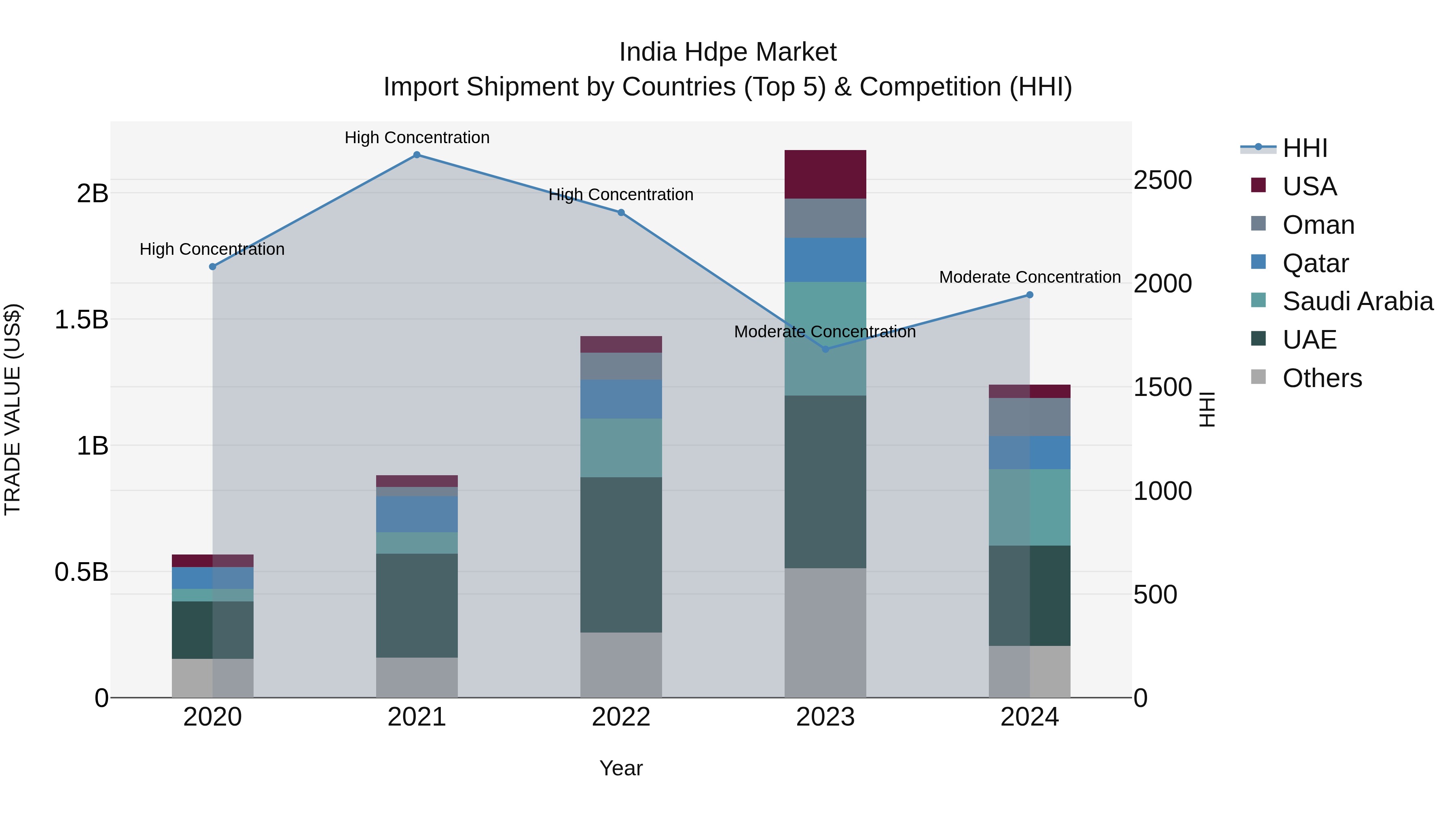
In 2024, India`s HDPE import shipments continued to see significant growth, with a high CAGR of 21.59% from 2020 to 2024. Despite a slight decline in growth rate in 2024 (-42.86%), the market remained competitive with moderate concentration indicated by the Herfindahl-Hirschman Index (HHI). Top exporting countries to India included UAE, Saudi Arabia, Oman, Qatar, and Kuwait, showcasing the strong trade relationships in the region. This data suggests a continued demand for HDPE in India, with key players in the market driving the import trends.
India Hdpe Market Overview
The India HDPE (High-Density Polyethylene) market is experiencing steady growth driven by increasing demand from sectors such as packaging, agriculture, construction, and automotive industries. HDPE is widely used in the manufacturing of pipes, containers, and packaging materials due to its lightweight, durable, and versatile properties. The government`s initiatives to promote infrastructure development, such as the construction of smart cities and irrigation projects, are further fueling the demand for HDPE products. Additionally, the emphasis on sustainable and eco-friendly packaging solutions is driving the adoption of HDPE materials in the packaging industry. Key players in the India HDPE market include Reliance Industries Limited, Indian Oil Corporation Limited, and Supreme Industries Limited, among others. Overall, the India HDPE market is poised for continued growth in the coming years.
India Hdpe Market Trends
The HDPE market in India is experiencing significant growth driven by the increasing demand from industries such as packaging, construction, and agriculture. The rising awareness about the benefits of HDPE such as durability, flexibility, and recyclability is fueling its adoption across various applications. Government initiatives promoting the use of plastic waste recycling and the ban on single-use plastics are also influencing the market dynamics. Additionally, the construction sector`s robust expansion and the growing need for efficient packaging solutions are further contributing to the market`s positive outlook. Companies are focusing on product innovation, capacity expansions, and strategic partnerships to stay competitive in the rapidly evolving Indian HDPE market.
India Hdpe Market Challenges
In the India HDPE market, some of the key challenges faced include intense competition from domestic and international players, fluctuating raw material prices, and regulatory hurdles. The market is highly fragmented with numerous small and medium-sized players, leading to price wars and margin pressures. Additionally, the volatility in crude oil prices directly impacts the cost of HDPE production, making it challenging for manufacturers to maintain profitability. Moreover, stringent environmental regulations and quality standards add complexity to the production process, requiring companies to invest in technology and compliance measures. Overall, navigating these challenges requires companies in the India HDPE market to adopt strategic pricing, supply chain optimization, and innovation in product development to stay competitive and sustain growth in the industry.
India Hdpe Market Investment Opportunities
The India HDPE market presents several promising investment opportunities. With the country`s increasing focus on infrastructure development, the demand for HDPE pipes for applications such as water supply, sewage systems, and agriculture is expected to rise significantly. Additionally, the growing adoption of HDPE in industries like packaging, automotive, and healthcare further boosts the market potential. Investing in manufacturing facilities for HDPE production or distribution networks for HDPE products could be lucrative ventures. Furthermore, there is potential for innovation and product development in the sector to cater to evolving market needs. Overall, the India HDPE market offers a favorable investment landscape driven by the country`s infrastructure growth and diverse industrial applications.
India Hdpe Market Government Policy
The Indian government has implemented various policies related to the HDPE market to encourage domestic production and reduce imports. Some of these policies include the imposition of anti-dumping duties on HDPE imports to protect domestic manufacturers, providing incentives and subsidies for the production of HDPE, promoting the use of recycled HDPE to support sustainability goals, and setting quality standards to ensure product safety and consistency. Additionally, the government has launched initiatives to promote the use of HDPE in various sectors such as packaging, construction, and agriculture to boost demand and support the growth of the domestic HDPE industry. Overall, these policies aim to strengthen the Indian HDPE market, increase self-sufficiency, and promote sustainable growth in line with the government`s Make in India and Atmanirbhar Bharat (Self-Reliant India) initiatives.
India Hdpe Market Future Outlook
The future outlook for the HDPE market in India appears promising due to several factors. The increasing demand for HDPE in various industries such as packaging, construction, agriculture, and automotive is expected to drive market growth. Additionally, the government`s focus on infrastructure development, urbanization, and initiatives like Make in India campaign are likely to boost the demand for HDPE products. Technological advancements leading to the development of new grades of HDPE with enhanced properties and sustainability factors are also expected to propel market growth. However, challenges such as fluctuating raw material prices and environmental concerns regarding plastic usage may pose some limitations. Overall, the India HDPE market is anticipated to witness steady growth in the coming years.
Key Highlights of the Report:
- India HDPE Market Outlook
- Market Size of India HDPE Market,2024
- Forecast of India HDPE Market, 2031
- Historical Data and Forecast of India HDPE Revenues & Volume for the Period 2021-2031
- India HDPE Market Trend Evolution
- India HDPE Market Drivers and Challenges
- India HDPE Price Trends
- India HDPE Porter's Five Forces
- India HDPE Industry Life Cycle
- Historical Data and Forecast of India HDPE Market Revenues & Volume By Type for the Period 2021-2031
- Historical Data and Forecast of India HDPE Market Revenues & Volume By PE80 Pipe for the Period 2021-2031
- Historical Data and Forecast of India HDPE Market Revenues & Volume By PE100 Pipe for the Period 2021-2031
- Historical Data and Forecast of India HDPE Market Revenues & Volume By Sales Channel for the Period 2021-2031
- Historical Data and Forecast of India HDPE Market Revenues & Volume By Direct Sales for the Period 2021-2031
- Historical Data and Forecast of India HDPE Market Revenues & Volume By Distribution Sales for the Period 2021-2031
- Historical Data and Forecast of India HDPE Market Revenues & Volume By Application for the Period 2021-2031
- Historical Data and Forecast of India HDPE Market Revenues & Volume By Water Supply for the Period 2021-2031
- Historical Data and Forecast of India HDPE Market Revenues & Volume By Oil and Gas for the Period 2021-2031
- Historical Data and Forecast of India HDPE Market Revenues & Volume By Sewage Systems for the Period 2021-2031
- Historical Data and Forecast of India HDPE Market Revenues & Volume By Agricultural Applications for the Period 2021-2031
- India HDPE Import Export Trade Statistics
- Market Opportunity Assessment By Type
- Market Opportunity Assessment By Sales Channel
- Market Opportunity Assessment By Application
- India HDPE Top Companies Market Share
- India HDPE Competitive Benchmarking By Technical and Operational Parameters
- India HDPE Company Profiles
- India HDPE Key Strategic Recommendations






































