India Mass Spectrometry Market Size, Share & Growth Rate
The India Mass Spectrometry Market was estimated at USD 1115 Million in 2025 and is projected to reach USD 1598 Million by 2032, growing at a CAGR of 5.3% from 2026 to 2032. This upward trajectory reflects the escalating demand for mass spectrometry applications in pharmaceutical research and environmental monitoring. Moreover, the increasing investments in biotechnology and healthcare innovation are vital factors propelling market expansion.
India Mass Spectrometry Market Year-wise Growth Rate and Key Drivers
This graph highlights how the India Mass Spectrometry Market has steadily grown over the years, supported by major growth factors.
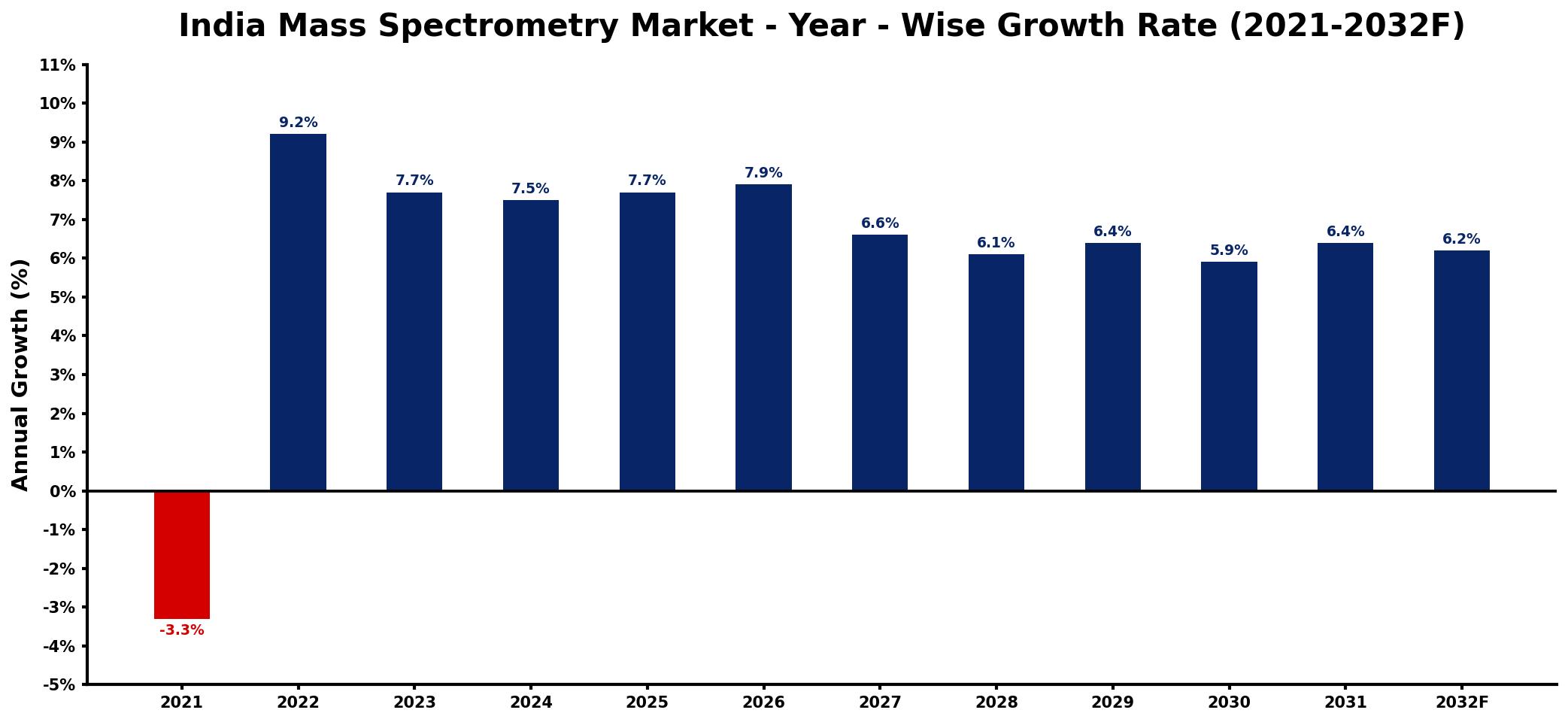
The table below presents the year‑wise growth rates along with the key drivers influencing the market
| Year | Growth Rate | Major Drivers |
| 2021 | -3.3% | decreased research funding availability |
| 2022 | 9.2% | increased pharmaceutical industry investments |
| 2023 | 7.7% | growing environmental testing regulations |
| 2024 | 7.5% | expansion of biotechnology applications |
| 2025 | 7.7% | rise in food safety standards |
| 2026 | 7.9% | enhanced clinical diagnostics demand |
| 2027 | 6.6% | broader adoption in academia |
| 2028 | 6.1% | increased industrial quality control |
| 2029 | 6.4% | growing interest in proteomics |
| 2030 | 5.9% | expanding applications in forensics |
| 2031 | 6.4% | increased focus on personalized medicine |
| 2032 | 6.2% | growing demand for toxicology testing |
Note: Market size estimations and growth projections presented in this report are based on 6Wresearch's proprietary forecasting methodology, utilizing the latest available industry data, government publications, and primary research inputs.
India Mass Spectrometry Market Synopsis
The Indian mass spectrometry market is at a pivotal juncture, driven by the growing need for precision analytical techniques across diverse sectors such as pharmaceuticals, biotechnology, and environmental testing. Significant government funding towards advanced healthcare solutions further supports the market's progression.
As research activities ramp up, especially in drug discovery and development, mass spectrometry has gained unparalleled importance. This growth is not only shaped by technological advancements but also by a surge in demand from food safety regulations and material testing laboratories.
India Mass Spectrometry Market Key Takeaways
- The market is expected to experience robust growth driven by increasing pharmaceutical R&D activities.
- Technological advancements are fostering greater accuracy and efficiency in mass spectrometry applications.
- Emerging sectors such as food & beverage testing are expanding the reach of mass spectrometry.
- Investment in specialized training for professionals is critical to overcoming skills shortages in the market.
- Government initiatives are playing a vital role in enhancing market growth through funding and resources.
Evaluation of Restraints in India Mass Spectrometry Market
Despite its promising growth potential, the India mass spectrometry market faces significant constraints. The high initial costs associated with advanced mass spectrometry equipment deter smaller research institutions and laboratories from investing in this technology. Additionally, the lack of trained personnel who can effectively operate and interpret mass spectrometry data poses a major barrier to widespread adoption. This skills gap highlights the urgent need for focused training programs that can elevate the competency of professionals in this domain.
India Mass Spectrometry Market Trends
Recent trends indicate a growing reliance on mass spectrometry for quality control and assurance in the food and beverage industry, particularly in response to stringent regulatory standards. Furthermore, advancements in ionization techniques and miniaturized mass spectrometry systems are setting the stage for novel applications across various sectors, including clinical diagnostics and forensic analysis. Such innovations are expected to enhance the efficiency and versatility of mass spectrometry tools.
India Mass Spectrometry Market Opportunities
Opportunities abound in the India mass spectrometry market, particularly in the burgeoning sectors of personalized medicine and environmental testing. The increasing focus on sustainability and environmental preservation is driving demand for advanced analytical techniques capable of detecting contaminants and pollutants. Moreover, collaboration between academic institutions and the private sector presents significant avenues for research and development, paving the way for breakthroughs in mass spectrometry applications.
Government Initiatives in the India Mass Spectrometry Market
The Indian government has implemented several initiatives aimed at bolstering the healthcare and biotechnology sectors, directly benefiting the mass spectrometry market. Investments in research infrastructure, public-private partnerships, and grants for innovative projects are paving the way for technological advancements. Furthermore, policy frameworks promoting R&D and emphasizing healthcare innovations reinforce the government's commitment to improving analytical capabilities across the nation.
Future Insights of the India Mass Spectrometry Market
Looking ahead to 2026-2032, the India mass spectrometry market is poised for robust growth driven by ongoing advancements in technology and increasing application across various industries. The integration of AI and machine learning with mass spectrometry is anticipated to revolutionize data analysis and interpretation, making the technology even more accessible. As government support and private investments continue to rise, the future appears bright for mass spectrometry's role in scientific research and industrial applications.
India Mass Spectrometry Market Latest Developments (2025 - 2026)
In the latest developments, the India mass spectrometry market has seen a surge in collaborative research efforts between academia and industry, aimed at refining analytical methodologies. There is also an increasing focus on developing portable mass spectrometry systems to facilitate field analysis. These initiatives highlight a growing recognition of the need for versatile and efficient analytical solutions across a range of applications.
India Mass Spectrometry Market - Key Attractiveness of the Report
- 10 Years of Market Numbers
- Historical Data Starting from 2022 to 2025
- Base Year: 2025
- Forecast Data until 2032
- Key Performance Indicators Impacting the Market
- Major Upcoming Developments and Projects
Key Highlights of the Report:
- India Mass Spectrometry Market Outlook
- Market Size of India Mass Spectrometry Market, 2025
- Forecast of India Mass Spectrometry Market, 2032
- Historical Data and Forecast of India Mass Spectrometry Revenues & Volume for the Period 2022-2032F
- India Mass Spectrometry Market Trend Evolution
- India Mass Spectrometry Market Drivers and Challenges
- India Mass Spectrometry Price Trends
- India Mass Spectrometry Porter's Five Forces
- India Mass Spectrometry Industry Life Cycle
- Historical Data and Forecast of India Mass Spectrometry Market Revenues & Volume By Technology for the Period 2022-2032F
- Historical Data and Forecast of India Mass Spectrometry Market Revenues & Volume By Hybrid Mass Spectrometry for the Period 2022-2032F
- Historical Data and Forecast of India Mass Spectrometry Market Revenues & Volume By Single Mass Spectrometry for the Period 2022-2032F
- Historical Data and Forecast of India Mass Spectrometry Market Revenues & Volume By Application for the Period 2022-2032F
- Historical Data and Forecast of India Mass Spectrometry Market Revenues & Volume By Pharmaceutical for the Period 2022-2032F
- Historical Data and Forecast of India Mass Spectrometry Market Revenues & Volume By Biotechnology for the Period 2022-2032F
- Historical Data and Forecast of India Mass Spectrometry Market Revenues & Volume By Security for the Period 2022-2032F
- Historical Data and Forecast of India Mass Spectrometry Market Revenues & Volume By Industrial chemistry for the Period 2022-2032F
- Historical Data and Forecast of India Mass Spectrometry Market Revenues & Volume By Environmental testing for the Period 2022-2032F
- Historical Data and Forecast of India Mass Spectrometry Market Revenues & Volume By Food & beverage testing for the Period 2022-2032F
- Historical Data and Forecast of India Mass Spectrometry Market Revenues & Volume By Forensic for the Period 2022-2032F
- Historical Data and Forecast of India Mass Spectrometry Market Revenues & Volume By Clinical for the Period 2022-2032F
- India Mass Spectrometry Import Export Trade Statistics
- Market Opportunity Assessment By Technology
- Market Opportunity Assessment By Application
- India Mass Spectrometry Top Companies Market Share
- India Mass Spectrometry Competitive Benchmarking By Technical and Operational Parameters
- India Mass Spectrometry Company Profiles
- India Mass Spectrometry Key Strategic Recommendations






































