India Methyl Cellulose Market Top 5 Importing Countries and Market Competition (HHI) Analysis
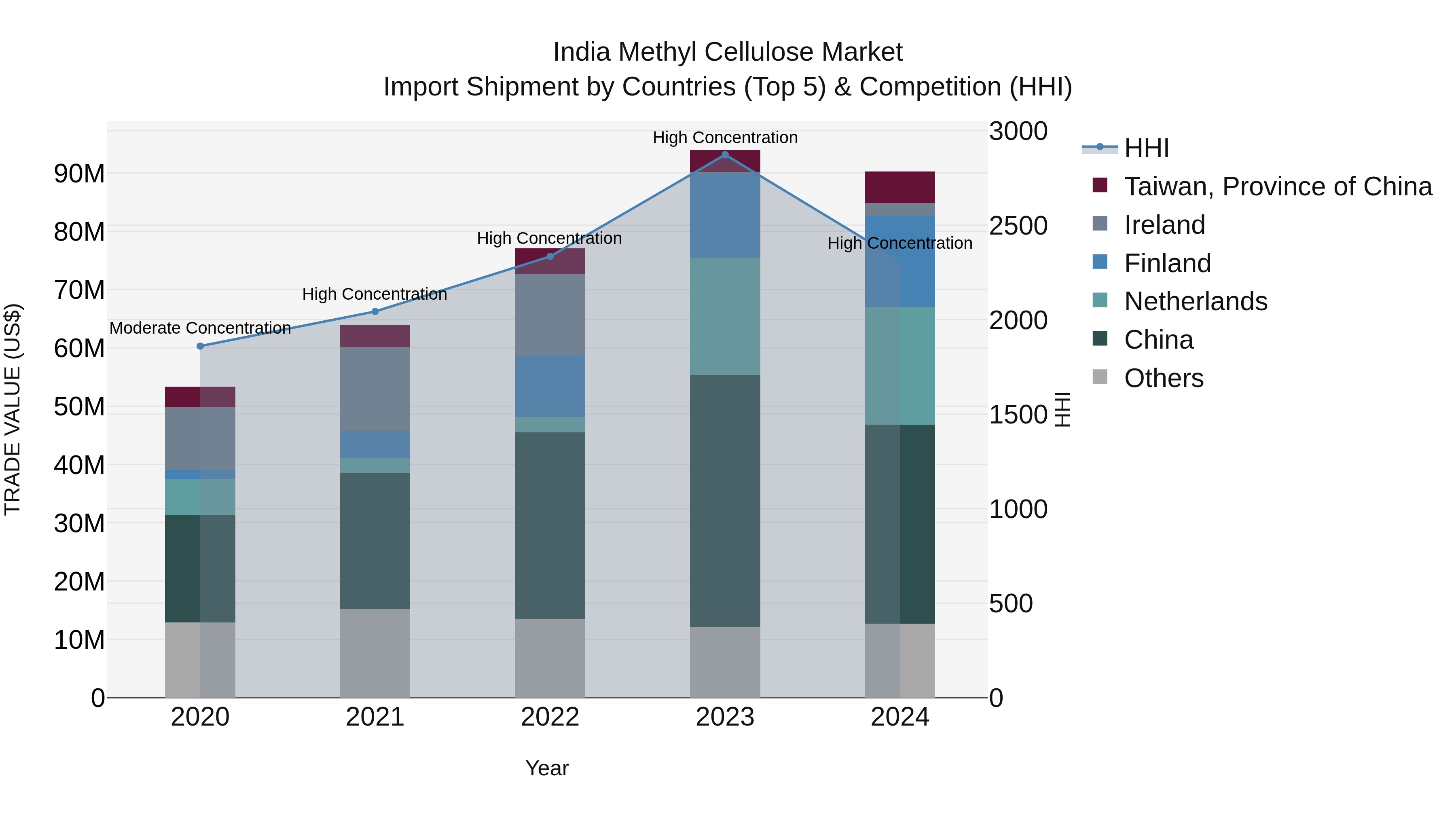
India`s methyl cellulose import market in 2024 saw consistent growth with a notable CAGR of 14.04% from 2020 to 2024. Despite a slight decrease in growth rate from 2023 to 2024 at -3.91%, the market remained strong. Top exporting countries to India included China, Netherlands, Finland, Taiwan, and Metropolitan France, indicating a diverse range of sources. However, the market concentration, as measured by the HHI index, remained high in 2024, suggesting a degree of dominance by key suppliers.
India Methyl Cellulose Market Overview
The India methyl cellulose market is experiencing steady growth due to increasing demand in various industries such as construction, pharmaceuticals, food and beverages, and personal care. Methyl cellulose, a versatile polymer derived from cellulose, is widely used as a thickener, stabilizer, emulsifier, and film-former in these industries. The growing construction sector in India is a key driver for the methyl cellulose market, as it is extensively used in dry mix mortars, cement-based plasters, and tile adhesives. Additionally, the pharmaceutical and food industries are also significant consumers of methyl cellulose due to its non-toxic nature and ability to improve product texture and stability. With the increasing focus on sustainable and eco-friendly products, the demand for methyl cellulose is expected to continue rising in India.
India Methyl Cellulose Market Trends
The India methyl cellulose market is experiencing steady growth due to the increasing demand for the chemical in various industries such as construction, pharmaceuticals, food and beverages, and personal care. The construction sector is a key driver of the market, with methyl cellulose being widely used in applications such as cement-based tile adhesives, dry mix mortars, and plasters due to its water retention and thickening properties. In the pharmaceutical industry, methyl cellulose is utilized in drug formulations and as a binder in tablet manufacturing. The food and beverage industry also contributes to the market demand with the use of methyl cellulose as a thickener and stabilizer in products like sauces, dressings, and ice creams. Overall, the India methyl cellulose market is expected to continue its growth trajectory in the coming years.
India Methyl Cellulose Market Challenges
In the India methyl cellulose market, some of the key challenges faced include intense competition among manufacturers leading to price wars and margin pressures. Additionally, fluctuations in raw material prices can impact the overall production costs, affecting profitability for manufacturers. Quality control and product consistency are also significant challenges, as maintaining high standards is crucial for customer satisfaction and retention. Furthermore, regulatory compliance and government policies can create obstacles for market players, requiring continuous monitoring and adaptation to meet changing requirements. Lastly, the market is influenced by foreign players and global trends, making it essential for domestic companies to stay competitive and innovative to secure their position in the industry.
India Methyl Cellulose Market Investment Opportunities
Investment opportunities in the India methyl cellulose market include the growing demand for the product in various industries such as construction, pharmaceuticals, food, and personal care. With increasing urbanization and infrastructure development projects in the country, there is a rising need for methyl cellulose in the construction sector as a thickening agent in cement and mortar formulations. Additionally, the pharmaceutical industry utilizes methyl cellulose in drug delivery systems due to its ability to control the release of active ingredients. The food industry also presents opportunities for investment in methyl cellulose as a stabilizer and thickening agent in various products. Furthermore, the personal care industry uses methyl cellulose in cosmetics and skincare products for its emulsifying properties. Overall, investing in the India methyl cellulose market offers potential for growth and diversification across multiple sectors.
India Methyl Cellulose Market Government Policy
The Indian government has implemented various policies related to the methyl cellulose market to promote growth and ensure sustainability. These policies include import regulations to protect domestic manufacturers, quality standards to maintain product integrity, and incentives to encourage research and development in the industry. Additionally, the government has introduced measures to promote environmental sustainability by encouraging the use of eco-friendly production practices and promoting the adoption of renewable sources of raw materials. Overall, these policies aim to support the growth of the methyl cellulose market in India while ensuring compliance with regulatory standards and promoting sustainable practices.
India Methyl Cellulose Market Future Outlook
The India methyl cellulose market is expected to experience steady growth in the coming years due to increasing demand from industries such as construction, pharmaceuticals, food and beverages, and personal care. The rise in construction activities, driven by infrastructure development and urbanization, is expected to be a key factor driving the demand for methyl cellulose as a thickener and stabilizer in construction materials. Additionally, the growing awareness regarding the benefits of methyl cellulose in pharmaceutical formulations, food products, and cosmetics is anticipated to further boost market growth. Technological advancements and innovations in product development are likely to create new opportunities for market expansion. However, challenges such as fluctuating raw material prices and regulatory constraints may pose some obstacles to market growth.
Key Highlights of the Report:
- India Methyl Cellulose Market Outlook
- Market Size of India Methyl Cellulose Market,2024
- Forecast of India Methyl Cellulose Market, 2031
- Historical Data and Forecast of India Methyl Cellulose Revenues & Volume for the Period 2021-2031
- India Methyl Cellulose Market Trend Evolution
- India Methyl Cellulose Market Drivers and Challenges
- India Methyl Cellulose Price Trends
- India Methyl Cellulose Porter's Five Forces
- India Methyl Cellulose Industry Life Cycle
- Historical Data and Forecast of India Methyl Cellulose Market Revenues & Volume By Type for the Period 2021-2031
- Historical Data and Forecast of India Methyl Cellulose Market Revenues & Volume By Powder for the Period 2021-2031
- Historical Data and Forecast of India Methyl Cellulose Market Revenues & Volume By Granules for the Period 2021-2031
- Historical Data and Forecast of India Methyl Cellulose Market Revenues & Volume By Liquid for the Period 2021-2031
- Historical Data and Forecast of India Methyl Cellulose Market Revenues & Volume By Application for the Period 2021-2031
- Historical Data and Forecast of India Methyl Cellulose Market Revenues & Volume By Pharmaceuticals for the Period 2021-2031
- Historical Data and Forecast of India Methyl Cellulose Market Revenues & Volume By Food Additives for the Period 2021-2031
- Historical Data and Forecast of India Methyl Cellulose Market Revenues & Volume By Coatings for the Period 2021-2031
- Historical Data and Forecast of India Methyl Cellulose Market Revenues & Volume By End Use for the Period 2021-2031
- Historical Data and Forecast of India Methyl Cellulose Market Revenues & Volume By Construction for the Period 2021-2031
- Historical Data and Forecast of India Methyl Cellulose Market Revenues & Volume By Personal Care for the Period 2021-2031
- Historical Data and Forecast of India Methyl Cellulose Market Revenues & Volume By Paper & Textiles for the Period 2021-2031
- Historical Data and Forecast of India Methyl Cellulose Market Revenues & Volume By Purity Level for the Period 2021-2031
- Historical Data and Forecast of India Methyl Cellulose Market Revenues & Volume By High Purity for the Period 2021-2031
- Historical Data and Forecast of India Methyl Cellulose Market Revenues & Volume By Industrial Grade for the Period 2021-2031
- Historical Data and Forecast of India Methyl Cellulose Market Revenues & Volume By Low Purity for the Period 2021-2031
- Historical Data and Forecast of India Methyl Cellulose Market Revenues & Volume By Manufacturing Process for the Period 2021-2031
- Historical Data and Forecast of India Methyl Cellulose Market Revenues & Volume By Etherification for the Period 2021-2031
- Historical Data and Forecast of India Methyl Cellulose Market Revenues & Volume By Hydroxypropylation for the Period 2021-2031
- Historical Data and Forecast of India Methyl Cellulose Market Revenues & Volume By Others for the Period 2021-2031
- India Methyl Cellulose Import Export Trade Statistics
- Market Opportunity Assessment By Type
- Market Opportunity Assessment By Application
- Market Opportunity Assessment By End Use
- Market Opportunity Assessment By Purity Level
- Market Opportunity Assessment By Manufacturing Process
- India Methyl Cellulose Top Companies Market Share
- India Methyl Cellulose Competitive Benchmarking By Technical and Operational Parameters
- India Methyl Cellulose Company Profiles
- India Methyl Cellulose Key Strategic Recommendations






































