India Optical Transceiver Market Growth Rate
According to 6Wresearch internal database and industry insights, the India Optical Transceiver Market is projected to grow at a compound annual growth rate (CAGR) of 11.2% during the forecast period (2026-2032).
India Optical Transceiver Market Year-wise Growth Rate and Key Drivers
This graph highlights how the India Optical Transceiver Market has steadily grown over the past five years, supported by major growth Factors.
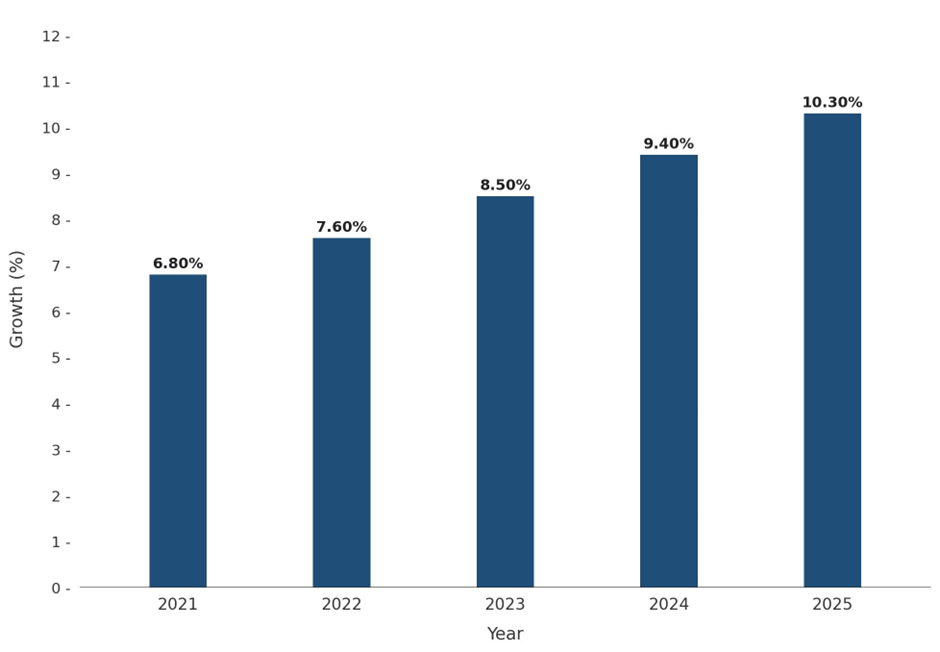
The table below presents the year‑wise growth rates along with the key drivers influencing the market
| Year | Est. Annual Growth (%) | Growth Drivers |
| 2021 | 6.8% | Increasing deployment of fiber-optic networks and broadband infrastructure |
| 2022 | 7.6% | Rising demand for high-speed internet and data consumption |
| 2023 | 8.5% | Expansion of data centers and cloud computing services |
| 2024 | 9.4% | Growth in 5G network rollout and telecom infrastructure |
| 2025 | 10.3% | Increasing adoption of advanced optical communication technologies |
Topics Covered in the India Optical Transceiver Market Report
The India Optical Transceiver Market report thoroughly covers the market by product type and applications. The market report provides an unbiased and detailed analysis of ongoing market trends, opportunities/high growth areas, and market drivers, which help stakeholders devise and align their market strategies according to the current and future market dynamics.
India Optical Transceiver Market Highlights
| Report Name |
India Optical Transceiver Market |
| Forecast period | 2026-2032 |
| CAGR | 11.2% |
| Market Size |
Data Center |
India Optical Transceiver Market Synopsis
India Optical Transceiver Market is anticipated to record notable growth due to the rising demand for fast data transfer, the rapid development of telecom infrastructure, and increasing use of cloud computing services. The increase in smartphone and internet usage is leading to the demand for effective optical communication systems. Moreover, the introduction of 5G networks and data center expansion has been adding to the demand for optical transceivers. Digital connectivity initiatives and fiber optic network expansions by governments have also been contributing to market growth.
Evaluation of Growth Drivers in the India Optical Transceiver Market (2026-2032)
Below mentioned are some prominent drivers and their influence on the market dynamics:
| Drivers | Primary Segments Affected | Why it Matters (Evidence) |
| Expansion of 5G Networks | QSFP & SFP; Telecommunication | High-speed connectivity requires advanced optical transceivers. |
| Growth of Data Centers | QSFP-DD & QSFP28; Data Center | Increasing cloud usage drives demand for high-capacity modules. |
| Rising Internet Penetration | SFP+ & SFP28; Enterprise | Increased data consumption boosts network infrastructure upgrades. |
| Government Digital Initiatives | All Types; Telecommunication | Programs like Digital India enhance fiber network deployment. |
| Technological Advancements | All Types; Data Center & Enterprise | Improved performance and efficiency drive adoption across sectors. |
India Optical Transceiver Market is expected to grow at the CAGR of 11.2% during the forecast period of 2026-2032. The factors fueling the growth include fast digitalization, growing need for fast connectivity, and telecom network expansion. The installation of 5G networks is leading to an increase in the requirement for optical modules. Furthermore, the adoption of cloud computing and increased data center investments is helping market development. The government’s policies, including BharatNet and Digital India, are contributing to the development of optical fiber networks. Technological innovations in optical communication keep adding to the growth.
Evaluation of Restraints in the India Optical Transceiver Market
Below mentioned are some major restraints and their influence on the market dynamics:
| Restraints | Primary Segments Affected | What This Means (Evidence) |
| High Initial Costs | CFP & XFP; Telecommunication | Expensive deployment limits adoption for smaller operators. |
| Complexity in Integration | All Types; Enterprise | Integration with existing infrastructure can be challenging. |
| Dependence on Imports | All Types; Data Center | Limited domestic manufacturing increases reliance on imports. |
| Power Consumption Issues | QSFP-DD; Data Center | High-performance modules require efficient power management. |
| Network Security Concerns | All Types; Enterprise | Increased connectivity raises risks of data breaches. |
India Optical Transceiver Industry Challenges
Despite strong growth prospects, the India Optical Transceiver Industry faces several practical challenges. Another challenge that is associated with using highly sophisticated optical technologies is the high cost involved in deployment. It is more challenging for small-scale telco firms to meet the initial investment required. Besides, integration of such sophisticated optical systems with existing technologies may pose a lot of problems since it requires much time. The telecom sector is dependent on imported goods; therefore, supply constraints and price issues may affect the implementation of optical technologies.
India Optical Transceiver Market Trends
Major trends shaping the India Optical Transceiver Market Growth include:
- Use of 400G/above Speed Transceivers: With growing requirements for ultrafast data transfer speeds, the use of latest generation modules has seen growth.
- Increase in Cloud and Edge Computing: Growth in cloud computing and edge networking is encouraging higher adoption rates for optical connectivity.
- Trends toward Energy Efficiency: Companies are paying more attention to energy efficiency in optical transceivers.
- AI Integration: AI-assisted network management has led to better performance in optical networks.
- Higher FTTH Penetration: Growing adoption of fiber-optic technology in homes has spurred demand for optical technologies.
Investment Opportunities in the India Optical Transceiver Market
Some major investment opportunities areas in the India Optical Transceiver Market Share include:
- Domestic Manufacturing Units – Setting up manufacturing units at home to lessen the dependence on imports.
- Development of 5G Telecom Networks – Investment in optical technologies to facilitate the development of next-generation telecom network.
- Data Centers Setup – Construction of data centers that need faster optical communication.
- Optical Technology R&D – Development of optical technology to enhance performance.
- Fiber Optics Expansion – Expansion of fiber-optic network in urban and rural areas.
Top 5 Leading Players in the India Optical Transceiver Market
Some leading players operating in the India Optical Transceiver Market include:
1. Cisco Systems Inc
| Company Name | Cisco Systems Inc. |
|---|---|
| Established Year | 1984 |
| Headquarters | California, USA |
| Official Website | Click Here |
Cisco provides advanced optical transceivers and networking solutions for telecom and data center applications. The company focuses on high-performance connectivity, innovation, and scalable solutions, supporting India’s growing demand for high-speed communication infrastructure.
2. Huawei Technologies Co Ltd
| Company Name | Huawei Technologies Co., Ltd. |
|---|---|
| Established Year | 1987 |
| Headquarters | Shenzhen, China |
| Official Website | Click Here |
Huawei offers a wide range of optical communication products, including transceivers for telecom and enterprise networks. The company emphasizes innovation and cost-effective solutions, playing a significant role in expanding India’s telecom infrastructure.
3. Finisar Corporation
| Company Name | Finisar Corporation (now part of II-VI Incorporated) |
|---|---|
| Established Year | 1988 |
| Headquarters | California, USA |
| Official Website | - |
Finisar specializes in optical communication components, including high-speed transceivers. The company focuses on advanced technologies and reliable performance, supporting data center and telecom applications in India’s growing digital ecosystem.
4. Broadcom Inc
| Company Name | Broadcom Inc. |
|---|---|
| Established Year | 1961 |
| Headquarters | California, USA |
| Official Website | Click Here |
Broadcom develops semiconductor and optical solutions, including high-performance transceivers. The company supports networking, data center, and telecom industries with innovative technologies that enhance connectivity and data transmission efficiency.
5. Fujitsu Limited
| Company Name | Fujitsu Limited |
|---|---|
| Established Year | 1935 |
| Headquarters | Tokyo, Japan |
| Official Website | Click Here |
Fujitsu provides optical networking solutions, including transceivers for telecom and enterprise applications. The company focuses on reliable, high-speed communication technologies and supports digital transformation initiatives across India.
Government Regulations Introduced in the India Optical Transceiver Market
According to India’s Government Data, several factors are contributing to the increase in the optical transceivers market. Schemes like Digital India and BharatNet seek to provide increased connectivity through fiber optics across the country. Moreover, the government seeks to deploy the 5G network by allocating the required spectrum, thus increasing the demand for optical components. Furthermore, the PLI Scheme will encourage indigenous production of telecom and networking products. There are also laws that provide for data security and network standards.
Future Insights of the India Optical Transceiver Market
India Optical Transceiver Market is expected to witness strong growth driven by increasing demand for high-speed connectivity, expansion of 5G networks, and rising investments in data centers. Growth in cloud computing and digital solutions will drive more demands for optical communication systems. Government policies that encourage fiber optic network expansions and production within the nation will help increase market opportunities. Advances in technology through the integration of artificial intelligence (AI) will make the system better performing and cost-efficient. Overall, the market looks forward to experiencing rapid growth, backed by strong infrastructural developments.
Market Segmentation Analysis
The report offers a comprehensive study of the subsequent market segments and their leading categories.
QSFP and QSFP28 to Dominate the Market – By Form Factor
According to Rahul, Senior Research Analyst, 6Wresearch, QSFP and QSFP28 segment dominates the India Optical Transceiver Market. This dominance is attributable to their ability to transmit large amounts of data and being widely used in data centers and telecommunications systems. The form factors ensure fast connection speeds, which makes them suitable for modern network needs. Their dominance will only be enhanced by the rising demand for flexible and efficient systems. Technology developments have also improved their functionality.
Telecommunication to Dominate the Market – By Application
The Telecommunication segment leads the India Optical Transceiver Market due to the rapid expansion of telecom networks and 5G deployment. High-speed data transmission needs optical transceivers. Long-haul and metro segments will see the advantage from the rising need for seamless connectivity and upgrades in the network.
Key Attractiveness of the Report
- 10 Years of Market Numbers.
- Historical Data Starting from 2022 to 2025.
- Base Year: 2025.
- Forecast Data until 2032.
- Key Performance Indicators Impacting the Market.
- Major Upcoming Developments and Projects.
Key Highlights of the Report:
- India Optical Transceiver Market Outlook
- Market Size of India Optical Transceiver Market, 2025
- Forecast of India Optical Transceiver Market, 2032
- Historical Data and Forecast of India Optical Transceiver Revenues & Volume for the Period 2022- 2032
- India Optical Transceiver Market Trend Evolution
- India Optical Transceiver Market Drivers and Challenges
- India Optical Transceiver Price Trends
- India Optical Transceiver Porter Five Forces
- India Optical Transceiver Industry Life Cycle
- Historical Data and Forecast of India Optical Transceiver Market Revenues & Volume By Form Factor for the Period 2022- 2032
- Historical Data and Forecast of India Optical Transceiver Market Revenues & Volume By QSFP, QSFP+, QSFP-DD, and QSFP28 for the Period 2022- 2032
- Historical Data and Forecast of India Optical Transceiver Market Revenues & Volume By SFP+ and SFP28 for the Period 2022- 2032
- Historical Data and Forecast of India Optical Transceiver Market Revenues & Volume By SFF and SFP for the Period 2022- 2032
- Historical Data and Forecast of India Optical Transceiver Market Revenues & Volume By CFP, CFP2, and CFP4 for the Period 2022- 2032
- Historical Data and Forecast of India Optical Transceiver Market Revenues & Volume By CXP for the Period 2022- 2032
- Historical Data and Forecast of India Optical Transceiver Market Revenues & Volume By XFP for the Period 2022- 2032
- Historical Data and Forecast of India Optical Transceiver Market Revenues & Volume By Application for the Period 2022- 2032
- Historical Data and Forecast of India Optical Transceiver Market Revenues & Volume By Telecommunication (Ultra-long-haul Network, Long-haul Network, Metro Network) for the Period 2022- 2032
- Historical Data and Forecast of India Optical Transceiver Market Revenues & Volume By Data Center (Data Center Interconnect, Intra-Data Center Connection) for the Period 2022- 2032
- Historical Data and Forecast of India Optical Transceiver Market Revenues & Volume By Enterprise (Enterprise Routing, Enterprise Switching) for the Period 2022- 2032
- Historical Data and Forecast of India Optical Transceiver Market Revenues & Volume By Protocol for the Period 2022- 2032
- Historical Data and Forecast of India Optical Transceiver Market Revenues & Volume By Ethernet for the Period 2022- 2032
- Historical Data and Forecast of India Optical Transceiver Market Revenues & Volume By Fiber Channel for the Period 2022- 2032
- Historical Data and Forecast of India Optical Transceiver Market Revenues & Volume By CWDM/DWDM for the Period 2022- 2032
- Historical Data and Forecast of India Optical Transceiver Market Revenues & Volume By FTTx for the Period 2022- 2032
- Historical Data and Forecast of India Optical Transceiver Market Revenues & Volume By Connector for the Period 2022- 2032
- Historical Data and Forecast of India Optical Transceiver Market Revenues & Volume By LC for the Period 2022- 2032
- Historical Data and Forecast of India Optical Transceiver Market Revenues & Volume By SC for the Period 2022- 2032
- Historical Data and Forecast of India Optical Transceiver Market Revenues & Volume By MPO for the Period 2022- 2032
- Historical Data and Forecast of India Optical Transceiver Market Revenues & Volume By RJ-45 for the Period 2022- 2032
- Historical Data and Forecast of India Optical Transceiver Market Revenues & Volume By Wavelength for the Period 2022- 2032
- Historical Data and Forecast of India Optical Transceiver Market Revenues & Volume By 850 nm Band for the Period 2022- 2032
- Historical Data and Forecast of India Optical Transceiver Market Revenues & Volume By 1310 nm Band for the Period 2022- 2032
- Historical Data and Forecast of India Optical Transceiver Market Revenues & Volume By 1550 nm Band for the Period 2022- 2032
- Historical Data and Forecast of India Optical Transceiver Market Revenues & Volume By Others for the Period 2022- 2032
- India Optical Transceiver Import Export Trade Statistics
- Market Opportunity Assessment By Form Factor
- Market Opportunity Assessment By Application
- India Optical Transceiver Top Companies Market Share
- India Optical Transceiver Competitive Benchmarking By Technical and Operational Parameters
- India Optical Transceiver Company Profiles
- India Optical Transceiver Key Strategic Recommendations
Market Covered
The report offers a comprehensive study of the subsequent market segments:
By Form Factor
- QSFP, QSFP+, QSFP-DD, and QSFP28
- SFP+ and SFP28
- SFF and SFP
- CFP, CFP2, and CFP4
- CXP
- XFP
By Application
- Telecommunication (Ultra-long-haul Network, Long-haul Network, Metro Network)
- Data Center (Data Center Interconnect, Intra-Data Center Connection)
- Enterprise (Enterprise Routing, Enterprise Switching)
By Protocol
- Ethernet
- Fiber Channel
- CWDM/DWDM
- FTTx
By Connector
- LC
- SC
- MPO
- RJ-45
By Wavelength
- 850 nm Band
- 1310 nm Band
- 1550 nm Band
- Others






































