India POS Security Market Size & Growth Rate (2026-2032)
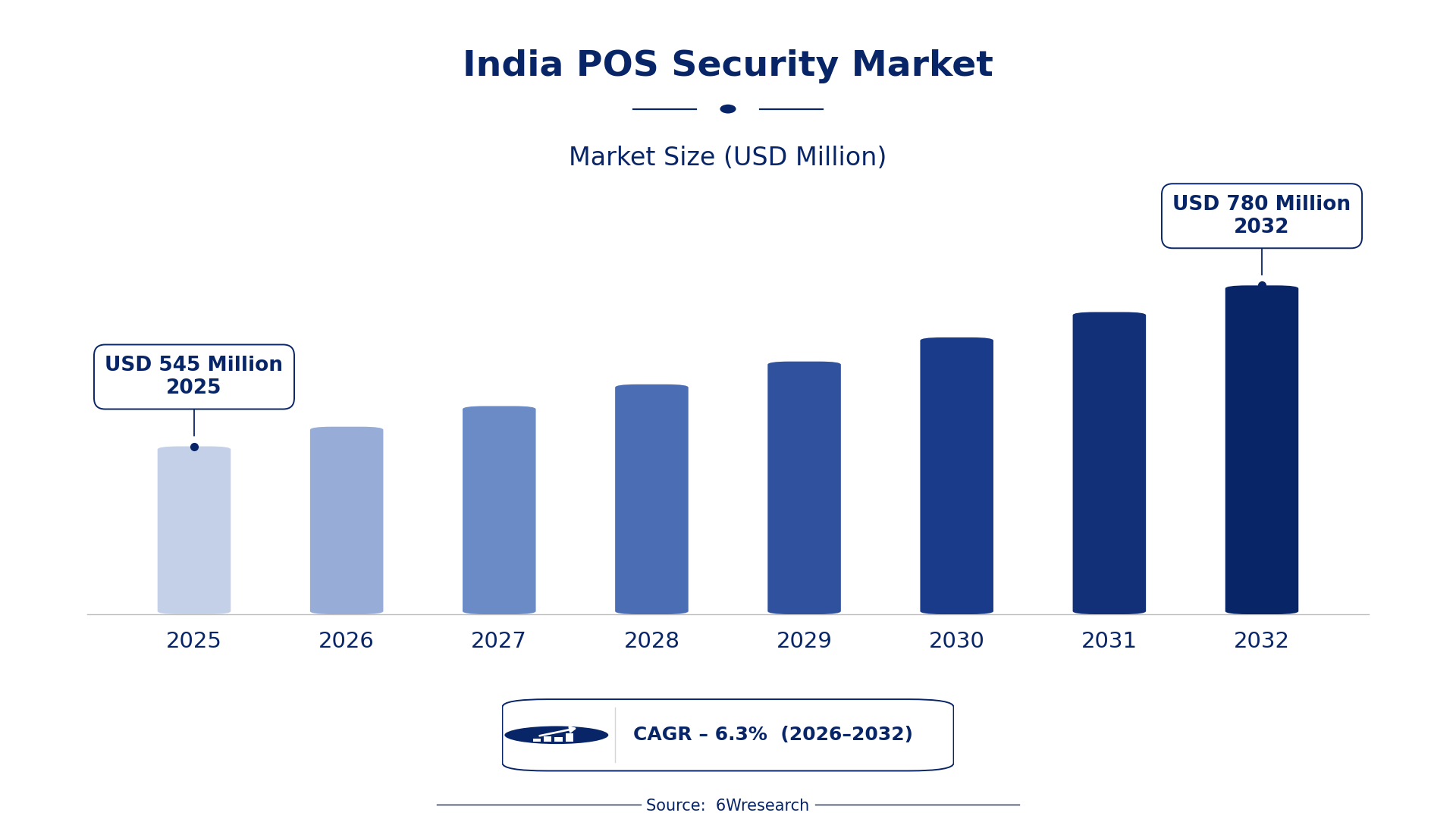
The India POS Security Market was estimated at USD 545 Million in 2025 and is projected to reach USD 780 Million by 2032, growing at a CAGR of 6.3% from 2026 to 2032.
India POS Security Market Synopsis
A primary driver currently shaping the India POS Security Market is the explosive growth in electronic payments. As the retail sector embraces digital wallets and contactless transactions, the urgency to secure POS systems has never been greater. Businesses are scrambling to implement security measures to protect sensitive consumer data, motivated by both compliance pressures and the need to maintain customer trust.
The increasing frequency of cyberattacks on payment systems compounds the urgency for robust security solutions. Retailers, hospitality entities, and service providers face the daunting task of securing both new and legacy systems, a challenge that often goes unaddressed. In this environment, security is not merely an option; it’s a necessity for survival in a fiercely competitive market.
India POS Security Market Year-wise Growth Rate and Key Drivers
This graph illustrates the annual growth rates of the India POS Security Market from 2021 to 2032, highlighting a steady upward trajectory and projected expansion over the forecast period.
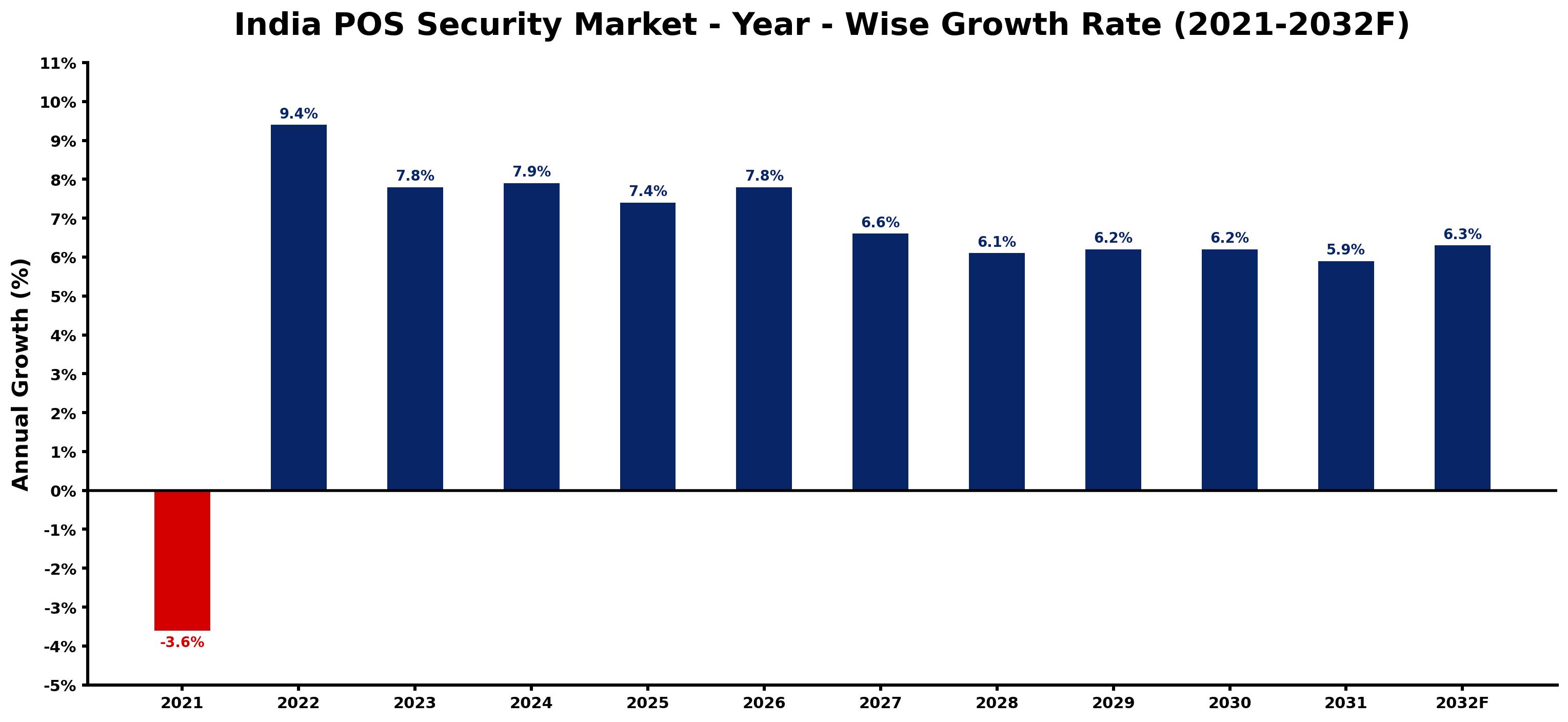
The table below presents the year‑wise growth rates along with the key drivers influencing the market
| Year | Growth Rate | Major Drivers |
| 2021 | -3.6% | Demonetization effects lingered on consumer spending behavior. |
| 2022 | 9.4% | Demonetization drives demand for secure payment solutions. |
| 2023 | 7.8% | RBI mandates for enhanced payment security measures. |
| 2024 | 7.9% | Growth in e-commerce raises POS security needs. |
| 2025 | 7.4% | Increase in cyberattacks prompts better security investments. |
| 2026 | 7.8% | Mobile wallet adoption increases demand for secure transactions. |
| 2027 | 6.6% | Rise in online fraud raises awareness for security. |
| 2028 | 6.1% | Government support for digital payments encourages security upgrades. |
| 2029 | 6.2% | Local retailers invest in advanced POS security technologies. |
| 2030 | 6.2% | Increased regulatory scrutiny boosts compliance-driven security spending. |
| 2031 | 5.9% | Consumer data protection laws mandate enhanced security protocols. |
| 2032 | 6.3% | Growing preference for contactless payments increases security focus. |
Note: Market size estimations and growth projections presented in this report are based on 6Wresearch's proprietary forecasting methodology, utilizing the latest available industry data, government publications, and primary research inputs.
India POS Security Market Key Takeaways
Below are some of the specific key takeaways from the market, including:
- The rise in mobile payments significantly drives demand for advanced POS security solutions.
- Compliance with PCI DSS requirements is increasingly becoming a hurdle for businesses.
- Businesses are investing heavily in upgrading existing systems to counteract vulnerabilities.
- Consumer expectations for secure transactions are influencing market dynamics heavily.
- The COVID-19 pandemic has accelerated the shift to contactless payment methods.
Evaluation of Restraints in India POS Security Market
Despite the rapid growth of the India POS Security Market, certain restraints hinder its full potential. A significant concern lies in the security of legacy systems, which many businesses still rely on. These outdated systems often cannot keep up with contemporary threats, making them prime targets for cybercriminals. Moreover, the lack of regular updates and vulnerability management practices within organizations further exacerbates the risks. Businesses often struggle with the technical and financial implications of implementing comprehensive security solutions, leading to lapses in adherence to critical PCI DSS standards.
India POS Security Market Trends
A noteworthy trend is the growing integration of artificial intelligence and machine learning technologies in POS security systems. These advancements allow for real-time fraud detection and enhanced monitoring capabilities. Additionally, businesses are increasingly seeking multi-layered security solutions, combining hardware and software to fortify their defenses. As customer trust becomes paramount, there's a palpable shift toward solutions that not only meet compliance but also enhance customer experience through seamless security features.
India POS Security Market Opportunities
The market presents promising opportunities for investment in advanced security technologies, particularly in biometric authentication and encryption methods. These innovations not only enhance security but also streamline customer interactions. Furthermore, as small and medium enterprises (SMEs) embrace digital payment systems, there is a significant gap for tailored security solutions targeting these businesses. Collaborative ventures between tech firms and retail chains can also pave the way for innovative security offerings that address specific market needs.
Government Initiatives in the India POS Security Market
Government policies are increasingly influencing the direction of the India POS Security Market. Regulatory frameworks focused on enhancing cybersecurity standards are being introduced. The importance of securing payment systems is emphasized as part of broader national digital security strategies. With the rise in online transactions, government initiatives are crucial in establishing trust and compliance across the financial ecosystem.
- A national digital infrastructure upgrade programme was recently completed to enhance cybersecurity measures across financial systems.
- The Reserve Bank of India is currently overseeing a review of regulations aimed at reinforcing compliance with PCI DSS among payment service providers.
- Upcoming legislation is set to mandate stricter data privacy measures for businesses handling payment information.
- A public-private initiative is being planned to develop advanced fraud detection frameworks by 2026.
- In 2025, a new cybersecurity awareness campaign was launched, targeting small and medium-sized enterprises (SMEs).
Future Insights of the India POS Security Market
Looking ahead to 2026-2032, the India POS Security Market is expected to witness substantial evolution. As digital payments continue to surge, businesses will increasingly prioritize security investments. The integration of next-gen technologies such as blockchain and advanced analytics will redefine security strategies. Furthermore, as more industries recognize the importance of cybersecurity, collaboration among technology providers, retailers, and regulatory bodies will become increasingly vital to create a secure and efficient payment ecosystem.
India POS Security Market Latest Developments
In the last 12-14 months, the India POS Security Market has experienced a series of significant developments. Companies have been actively investing in new technologies and partnerships to enhance their security offerings in response to emerging threats. The ongoing transition to digital payments has prompted a more urgent focus on securing POS systems, resulting in innovative solutions being rolled out.
- A major technology vendor announced a partnership in early 2025 to develop an AI-driven fraud detection system for POS terminals.
- A leading regional operator initiated a pilot program in Q2 2025 to deploy end-to-end encryption solutions across its network of retail clients.
- Currently underway is an industry consortium working on standardized security protocols for mobile payment platforms.
- Plans are in place for a comprehensive software update scheduled for late 2026, enhancing the security features of existing POS systems.
- A newly launched cloud-based security solution is being rolled out by a prominent firm, aimed at protecting payment data with advanced encryption techniques.
India POS Security Market - Key Attractiveness of the Report
- 10 Years of Market Numbers
- Historical Data Starting from 2022 to 2025
- Base Year: 2025
- Forecast Data until 2032
- Key Performance Indicators Impacting the Market
- Major Upcoming Developments and Projects
Key Highlights of the Report:
- India POS Security Market Outlook
- Market Size of India POS Security Market, 2025
- Forecast of India POS Security Market, 2032
- Historical Data and Forecast of India POS Security Revenues & Volume for the Period 2022-2032F
- India POS Security Market Trend Evolution
- India POS Security Market Drivers and Challenges
- India POS Security Price Trends
- India POS Security Porter's Five Forces
- India POS Security Industry Life Cycle
- Historical Data and Forecast of India POS Security Market Revenues & Volume By Offering for the Period 2022-2032F
- Historical Data and Forecast of India POS Security Market Revenues & Volume By Solutions for the Period 2022-2032F
- Historical Data and Forecast of India POS Security Market Revenues & Volume By Services for the Period 2022-2032F
- Historical Data and Forecast of India POS Security Market Revenues & Volume By Organization Size for the Period 2022-2032F
- Historical Data and Forecast of India POS Security Market Revenues & Volume By SMEs for the Period 2022-2032F
- Historical Data and Forecast of India POS Security Market Revenues & Volume By Large Enterprises for the Period 2022-2032F
- Historical Data and Forecast of India POS Security Market Revenues & Volume By Vertical for the Period 2022-2032F
- Historical Data and Forecast of India POS Security Market Revenues & Volume By Retail for the Period 2022-2032F
- Historical Data and Forecast of India POS Security Market Revenues & Volume By Restaurants for the Period 2022-2032F
- Historical Data and Forecast of India POS Security Market Revenues & Volume By Hospitality for the Period 2022-2032F
- India POS Security Import Export Trade Statistics
- Market Opportunity Assessment By Offering
- Market Opportunity Assessment By Organization Size
- Market Opportunity Assessment By Vertical
- India POS Security Top Companies Market Share
- India POS Security Competitive Benchmarking By Technical and Operational Parameters
- India POS Security Company Profiles
- India POS Security Key Strategic Recommendations






































