India Printed Electronics Market Size, Share & Growth Rate
The India Printed Electronics Market was estimated at USD 927 Million in 2025 and is projected to reach USD 1324 Million by 2032, growing at a CAGR of 5.2% from 2026 to 2032. This positive trajectory is primarily fueled by the increasing demand for flexible and lightweight electronics, particularly in the realms of wearables and IoT applications. As manufacturers innovate with printing techniques and materials, the market is becoming more cost-effective and environmentally sustainable, contributing significantly to growth.
India Printed Electronics Market Year-wise Growth Rate and Key Drivers
This graph highlights how the India Printed Electronics Market has steadily grown over the years, supported by major growth factors.
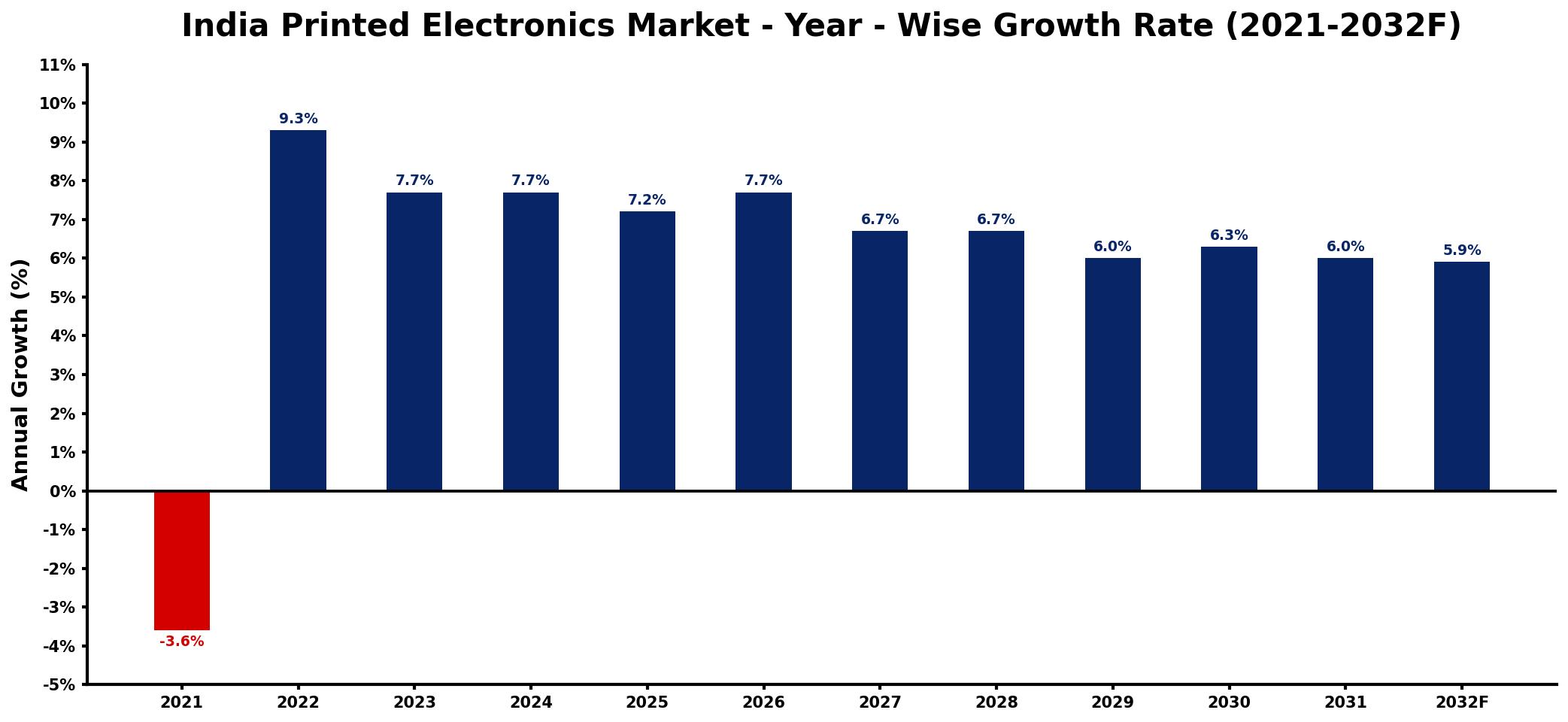
The table below presents the year‑wise growth rates along with the key drivers influencing the market
| Year | Growth Rate | Major Drivers |
| 2021 | -3.6% | Supply chain disruptions impact demand |
| 2022 | 9.3% | Rising consumer interest in innovation |
| 2023 | 7.7% | Increased funding for technology startups |
| 2024 | 7.7% | Expansion of smart packaging solutions |
| 2025 | 7.2% | Growing demand for sustainable materials |
| 2026 | 7.7% | Emergence of wearable health solutions |
| 2027 | 6.7% | Adoption of IoT applications increases |
| 2028 | 6.7% | Investments in research and development |
| 2029 | 6.0% | Integration with renewable energy systems |
| 2030 | 6.3% | Collaboration between tech companies expands |
| 2031 | 6.0% | Focus on urban infrastructure projects |
| 2032 | 5.9% | Advancements in manufacturing techniques |
Note: Market size estimations and growth projections presented in this report are based on 6Wresearch's proprietary forecasting methodology, utilizing the latest available industry data, government publications, and primary research inputs.
India Printed Electronics Market Synopsis
The most compelling force shaping the India printed electronics market is the surging interest in flexible and lightweight electronic devices. These products, which often use printed technology, are not only versatile but also drive new applications in sectors like healthcare, automotive, and consumer electronics.
Additionally, advancements in printing technology are revolutionizing the landscape, making it feasible to produce high-quality electronics at lower costs. This shift is not only beneficial for manufacturers aiming to scale but also aligns with the growing consumer demand for sustainable products, positioning printed electronics as a key player in the future of manufacturing.
India Printed Electronics Market Key Takeaways
- The market is projected to grow significantly, reflecting a robust CAGR of 5.2% from 2026 to 2032.
- Wearable technology and IoT applications are primary drivers of printed electronics demand.
- Advancements in printing technologies are enabling more cost-effective and scalable production.
- Environmental sustainability is becoming a crucial factor influencing manufacturing processes.
- There is a noticeable lack of awareness regarding printed electronics in traditional sectors, presenting a need for educational initiatives.
Evaluation of Restraints in India Printed Electronics Market
Despite its growth potential, the India printed electronics market faces significant barriers. One of the primary challenges is the limited awareness and understanding of printed electronics technology among manufacturers and end-users. This gap in knowledge hinders adoption across various sectors, which are often more accustomed to traditional electronic manufacturing processes. Moreover, competition from established semiconductor technologies poses a hurdle, as businesses may perceive printed electronics as less proven or reliable. Addressing these challenges through targeted education and awareness campaigns can enhance acceptance and spur market growth.
India Printed Electronics Market Trends
Several current and emerging trends are shaping the India printed electronics market. The transition towards smart packaging solutions is gaining traction, where printed electronics are used to enhance product interactivity and consumer engagement. Furthermore, the rise of sustainable manufacturing practices is pushing companies to explore eco-friendly materials and processes. The demand for customization in electronic products is also on the rise, leading to innovations in design and functionality. Collectively, these trends indicate a vibrant and evolving market landscape that is well-poised for future growth.
India Printed Electronics Market Opportunities
The potential for growth and investment in the India printed electronics market is substantial. One of the most promising areas is the integration of printed electronics in healthcare devices, particularly for diagnostics and monitoring applications. Additionally, industries such as automotive and consumer electronics are increasingly adopting printed electronics for their lightweight and flexible characteristics. Opportunities for research and development in materials science will further drive innovation, opening new avenues for applications. As these sectors continue to expand, the printed electronics market stands to gain significantly.
Government Initiatives in the India Printed Electronics Market
The Indian government is recognizing the importance of printed electronics as part of its broader initiative to promote electronics manufacturing within the country. Various programs are being launched to support research and development, alongside incentives aimed at fostering innovation in the electronics sector. Public investments in technology and infrastructure development are also paving the way for improved manufacturing capabilities, positioning India as a potential hub for printed electronics production.
Future Insights of the India Printed Electronics Market
Looking ahead to 2026-2032, the India printed electronics market is expected to evolve significantly. The anticipated growth in demand for flexible electronics will encourage manufacturers to enhance their capabilities and innovate their product offerings. As consumer preferences shift towards more sustainable and customizable options, the market is likely to see an influx of new players and technologies. Additionally, increased government support for the electronics sector may further bolster growth, making India a key player in the global printed electronics landscape.
India Printed Electronics Market Latest Developments (2025 - 2026)
Recent developments in the India printed electronics market reflect a keen interest in collaboration and innovation. Industry players are increasingly engaging in partnerships to enhance research and development efforts, focusing on materials and production techniques. Innovations are emerging in the realm of smart packaging and healthcare applications, indicating a shift towards more specialized and advanced printed electronics solutions. Additionally, there is an observable trend towards investment in sustainability, with companies exploring eco-friendly printing methods and materials.
India Printed Electronics Market - Key Attractiveness of the Report
- 10 Years of Market Numbers
- Historical Data Starting from 2022 to 2025
- Base Year: 2025
- Forecast Data until 2032
- Key Performance Indicators Impacting the Market
- Major Upcoming Developments and Projects
Key Highlights of the Report:
- India Printed Electronics Market Outlook
- Market Size of India Printed Electronics Market, 2025
- Forecast of India Printed Electronics Market, 2032
- Historical Data and Forecast of India Printed Electronics Revenues & Volume for the Period 2022-2032F
- India Printed Electronics Market Trend Evolution
- India Printed Electronics Market Drivers and Challenges
- India Printed Electronics Price Trends
- India Printed Electronics Porter's Five Forces
- India Printed Electronics Industry Life Cycle
- Historical Data and Forecast of India Printed Electronics Market Revenues & Volume By Material for the Period 2022-2032F
- Historical Data and Forecast of India Printed Electronics Market Revenues & Volume By Ink for the Period 2022-2032F
- Historical Data and Forecast of India Printed Electronics Market Revenues & Volume By Substrate for the Period 2022-2032F
- Historical Data and Forecast of India Printed Electronics Market Revenues & Volume By Technology for the Period 2022-2032F
- Historical Data and Forecast of India Printed Electronics Market Revenues & Volume By Screen for the Period 2022-2032F
- Historical Data and Forecast of India Printed Electronics Market Revenues & Volume By Inkjet for the Period 2022-2032F
- Historical Data and Forecast of India Printed Electronics Market Revenues & Volume By Flexographic for the Period 2022-2032F
- Historical Data and Forecast of India Printed Electronics Market Revenues & Volume By Gravure for the Period 2022-2032F
- Historical Data and Forecast of India Printed Electronics Market Revenues & Volume By Device for the Period 2022-2032F
- Historical Data and Forecast of India Printed Electronics Market Revenues & Volume By Displays for the Period 2022-2032F
- Historical Data and Forecast of India Printed Electronics Market Revenues & Volume By Photovoltaic for the Period 2022-2032F
- Historical Data and Forecast of India Printed Electronics Market Revenues & Volume By Lighting for the Period 2022-2032F
- Historical Data and Forecast of India Printed Electronics Market Revenues & Volume By RFID for the Period 2022-2032F
- Historical Data and Forecast of India Printed Electronics Market Revenues & Volume By Others for the Period 2022-2032F
- India Printed Electronics Import Export Trade Statistics
- Market Opportunity Assessment By Material
- Market Opportunity Assessment By Technology
- Market Opportunity Assessment By Device
- India Printed Electronics Top Companies Market Share
- India Printed Electronics Competitive Benchmarking By Technical and Operational Parameters
- India Printed Electronics Company Profiles
- India Printed Electronics Key Strategic Recommendations






































