India Processed Meat Market Top 5 Importing Countries and Market Competition (HHI) Analysis
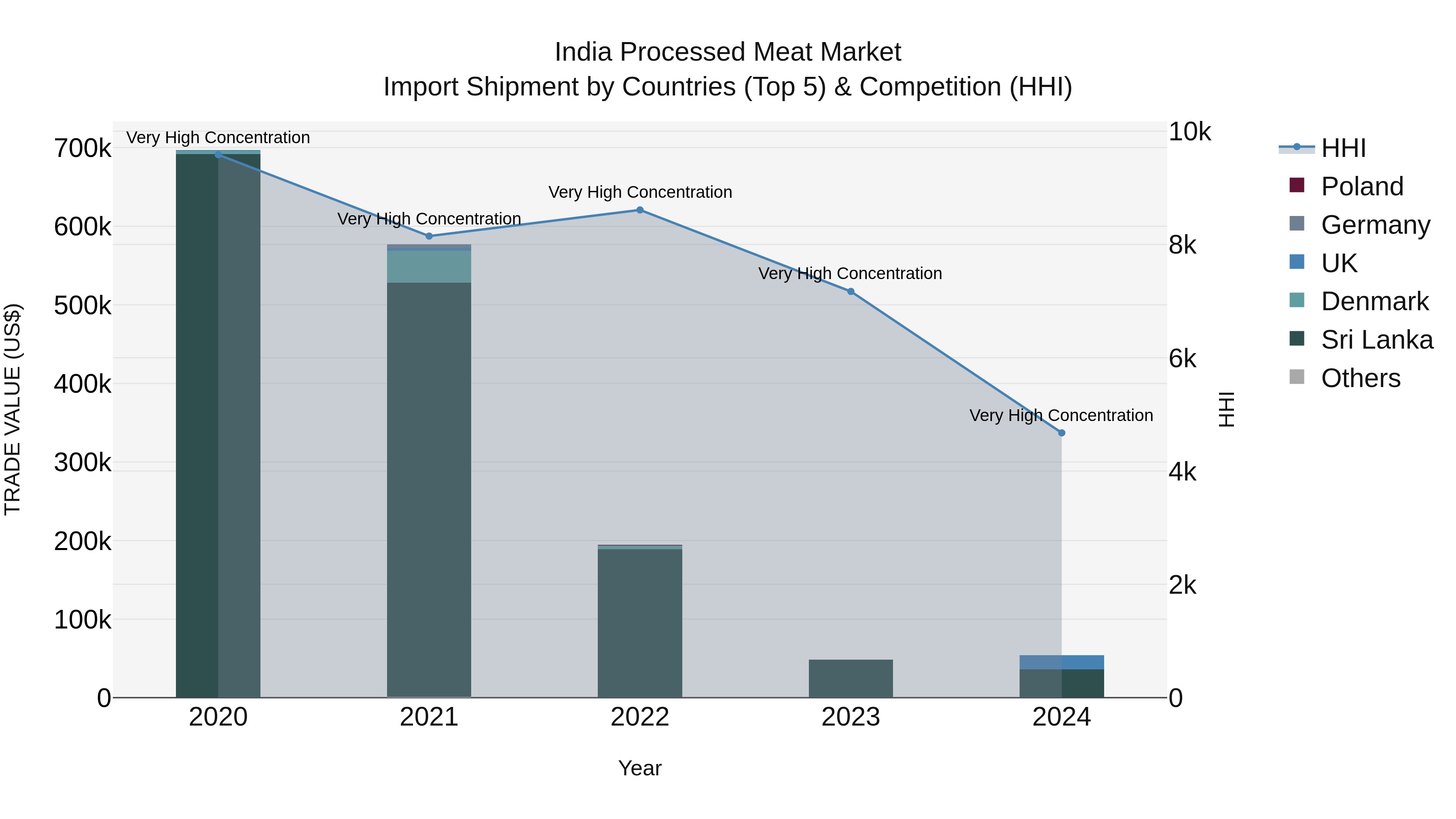
India`s processed meat import market in 2024 saw a notable influx of shipments from top exporting countries including Sri Lanka, UK, Germany, Denmark, and South Korea. Despite a high Herfindahl-Hirschman Index indicating significant market concentration, the industry experienced a sharp decline in compound annual growth rate (CAGR) from 2020 to 2024. However, there was a positive growth rate in 2024, indicating a potential rebound in the market. This trend suggests dynamic shifts in the import landscape and potential opportunities for market players to capitalize on emerging trends in the processed meat sector in India.
India Export Potential Assessment For Processed Meat Market (Values in USD Thousand)
India Processed Meat Market Synopsis
The processed meat market in India was estimated to be worth INR 101,817 crore (US$ 14.1 billion) and is anticipated to grow at a CAGR of 9% during the forecast period. The increasing demand for convenience food products due to the busy lifestyle among working professionals has been driving the growth of the processed meat market in India. Rising disposable income levels along with an increase in health awareness have been contributing significantly towards the growing popularity of these products across the country. Moreover, companies are introducing new flavors and formats such as frozen ready-to-cook snacks which are expected to further drive up sales.
Market Drivers of the market
In the India processed meat market, the drivers include changing consumer lifestyles and preferences, increased demand for convenience foods, and the expansion of the fast-food industry. Processed meat products offer convenience and longer shelf life, making them a popular choice among busy consumers.
Challenges of the Market
While the processed meat market in India is expanding due to urbanization and changing consumer preferences, it faces obstacles related to hygiene and quality control. Ensuring consistent product quality and implementing proper food safety standards are critical challenges for processed meat manufacturers. Additionally, managing supply chain complexities and optimizing distribution networks are essential for market growth.
Covid-19 Impact on the Market
The processed meat market saw a shift in consumer preferences during the pandemic. The demand for frozen and ready-to-eat processed meat products increased, driven by convenience and longer shelf life.
Key Players of the Market
Allanasons Pvt. Ltd., Venky`s India Ltd., Al Kabeer Group, Godrej Tyson Foods Ltd., and Cremica Agro Foods Ltd.
Key Highlights of the Report:
- India Processed Meat Market Outlook
- Market Size of India Processed Meat Market, 2024
- Forecast of India Processed Meat Market, 2031
- Historical Data and Forecast of India Processed Meat Revenues & Volume for the Period 2021-2031
- India Processed Meat Market Trend Evolution
- India Processed Meat Market Drivers and Challenges
- India Processed Meat Price Trends
- India Processed Meat Porter's Five Forces
- India Processed Meat Industry Life Cycle
- Historical Data and Forecast of India Processed Meat Market Revenues & Volume By Meat Type for the Period 2021-2031
- Historical Data and Forecast of India Processed Meat Market Revenues & Volume By Poultry for the Period 2021-2031
- Historical Data and Forecast of India Processed Meat Market Revenues & Volume By Beef for the Period 2021-2031
- Historical Data and Forecast of India Processed Meat Market Revenues & Volume By Pork for the Period 2021-2031
- Historical Data and Forecast of India Processed Meat Market Revenues & Volume By Others for the Period 2021-2031
- Historical Data and Forecast of India Processed Meat Market Revenues & Volume By Product Type for the Period 2021-2031
- Historical Data and Forecast of India Processed Meat Market Revenues & Volume By Frozen for the Period 2021-2031
- Historical Data and Forecast of India Processed Meat Market Revenues & Volume By Chilled for the Period 2021-2031
- Historical Data and Forecast of India Processed Meat Market Revenues & Volume By Canned for the Period 2021-2031
- Historical Data and Forecast of India Processed Meat Market Revenues & Volume By Application for the Period 2021-2031
- Historical Data and Forecast of India Processed Meat Market Revenues & Volume By Commercial for the Period 2021-2031
- Historical Data and Forecast of India Processed Meat Market Revenues & Volume By Residential for the Period 2021-2031
- Historical Data and Forecast of India Processed Meat Market Revenues & Volume By Distribution Channel for the Period 2021-2031
- Historical Data and Forecast of India Processed Meat Market Revenues & Volume By HoReCa for the Period 2021-2031
- Historical Data and Forecast of India Processed Meat Market Revenues & Volume By Supermarkets/Hypermarkets for the Period 2021-2031
- Historical Data and Forecast of India Processed Meat Market Revenues & Volume By Convenience Stores for the Period 2021-2031
- Historical Data and Forecast of India Processed Meat Market Revenues & Volume By Independent Retailers for the Period 2021-2031
- Historical Data and Forecast of India Processed Meat Market Revenues & Volume By Others for the Period 2021-2031
- India Processed Meat Import Export Trade Statistics
- Market Opportunity Assessment By Meat Type
- Market Opportunity Assessment By Product Type
- Market Opportunity Assessment By Application
- Market Opportunity Assessment By Distribution Channel
- India Processed Meat Top Companies Market Share
- India Processed Meat Competitive Benchmarking By Technical and Operational Parameters
- India Processed Meat Company Profiles
- India Processed Meat Key Strategic Recommendations






































