India Silk Market Growth Rate Analysis (2021-2031)
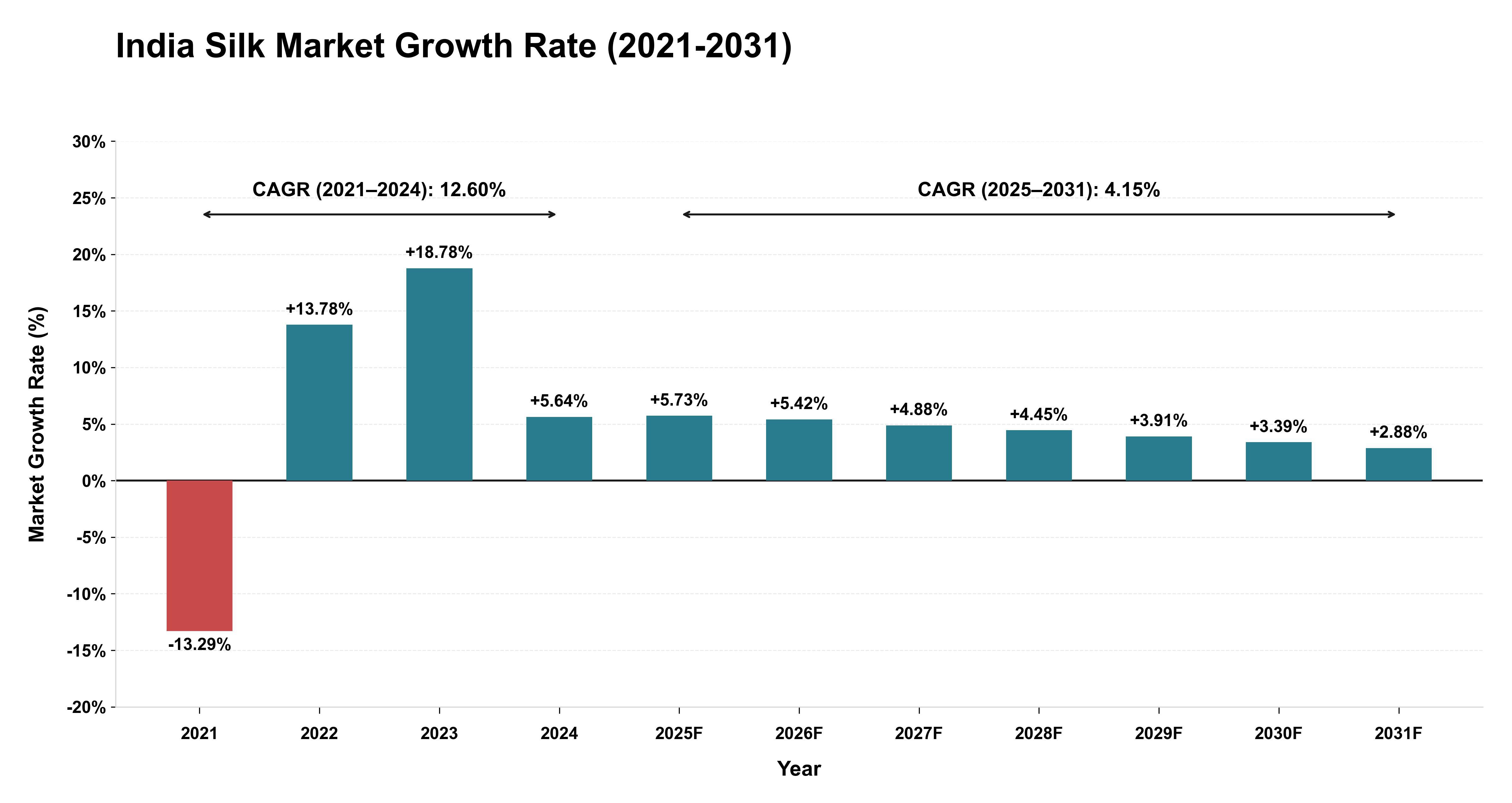
The India Silk Market experienced a turbulent period from 2021 to 2024, marked by a significant contraction in 2021 followed by a robust recovery in the subsequent years, with growth rates oscillating between negative and high positive figures. The market's overall CAGR of 12.60% during this period reflects the sector's resilience and adaptability. Looking ahead to the forecast period from 2025 to 2031, the market is expected to undergo a phase of stabilization, with a projected CAGR of 4.15%. This deceleration indicates a structural consolidation phase as the market matures and adjusts to new demand dynamics. Despite the gradual slowdown in growth rates post-2024, the India Silk Market is poised for steady expansion, albeit at a more moderate pace, reflecting a more stable and mature market landscape.
India Silk Market Synopsis
India is one of the largest producers and exporters of silk in the world. The market for India silk is expected to reach USD 38,753 million by 2025, registering a compound annual growth rate (CAGR) of 12.9%. Increasing demand from home decor industry and fashion apparel sector will be some major drivers for the market over the coming years.
Market Drivers
Growing demand from home decor industry, booming fashion apparel sector, increasing disposable incomes and growing awareness about health benefits are driving growth in India silk market. Additionally, increased government initiatives like subsidies on raw materials used in production processes have helped boost domestic production and exports significantly over recent years.
Challenges of the Market
The main challenges faced by this industry include volatile prices due to fluctuations in supply & demand, lack of skilled labor force resulting in low productivity levels as well as high cost of production which make it difficult to compete with other international vendors offering cheaper products at better quality standards than those available domestically within India itself. Additionally limited diversification into newer product categories has also hindered potential sales opportunities newly untapped markets globally thereby limiting overall revenue generation capability across sectors or countries outside its traditional stronghold regionally speaking within Asia Pacific specifically South East Asian Nations where most major multinationals typically source their raw material requirements from year after year respectively without fail or much variation whatsoever until now that is.
Key Players in the Market
Major players operating in the India silk market include Vardhaman Textiles Limited (VTL), Birla Cellulose Ltd., Morarjee Mills Pvt Ltd., SEL Group, EID Parry Ltd., Grasim Industries Ltd., YarnsandFibers News Desk - India leading manufacturers among others.
Key Highlights of the Report:
- India Silk Market Outlook
- Market Size of India Silk Market, 2024
- Forecast of India Silk Market, 2031
- Historical Data and Forecast of India Silk Revenues & Volume for the Period 2021-2031
- India Silk Market Trend Evolution
- India Silk Market Drivers and Challenges
- India Silk Price Trends
- India Silk Porter's Five Forces
- India Silk Industry Life Cycle
- Historical Data and Forecast of India Silk Market Revenues & Volume By Production process for the Period 2021-2031
- Historical Data and Forecast of India Silk Market Revenues & Volume By Cocoon Production for the Period 2021-2031
- Historical Data and Forecast of India Silk Market Revenues & Volume By Reeling for the Period 2021-2031
- Historical Data and Forecast of India Silk Market Revenues & Volume By Throwing for the Period 2021-2031
- Historical Data and Forecast of India Silk Market Revenues & Volume By Weaving for the Period 2021-2031
- Historical Data and Forecast of India Silk Market Revenues & Volume By Dyeing for the Period 2021-2031
- Historical Data and Forecast of India Silk Market Revenues & Volume By Type for the Period 2021-2031
- Historical Data and Forecast of India Silk Market Revenues & Volume By Mulberry Silk for the Period 2021-2031
- Historical Data and Forecast of India Silk Market Revenues & Volume By Tussar Silk for the Period 2021-2031
- Historical Data and Forecast of India Silk Market Revenues & Volume By Eri Silk for the Period 2021-2031
- Historical Data and Forecast of India Silk Market Revenues & Volume By Spider Silk for the Period 2021-2031
- Historical Data and Forecast of India Silk Market Revenues & Volume By Application for the Period 2021-2031
- Historical Data and Forecast of India Silk Market Revenues & Volume By Textile for the Period 2021-2031
- Historical Data and Forecast of India Silk Market Revenues & Volume By Cosmetics for the Period 2021-2031
- Historical Data and Forecast of India Silk Market Revenues & Volume By Medicine for the Period 2021-2031
- India Silk Import Export Trade Statistics
- Market Opportunity Assessment By Production process
- Market Opportunity Assessment By Type
- Market Opportunity Assessment By Application
- India Silk Top Companies Market Share
- India Silk Competitive Benchmarking By Technical and Operational Parameters
- India Silk Company Profiles
- India Silk Key Strategic Recommendations






































