India SIP Trunking Services Market Size & Growth Rate (2026-2032)
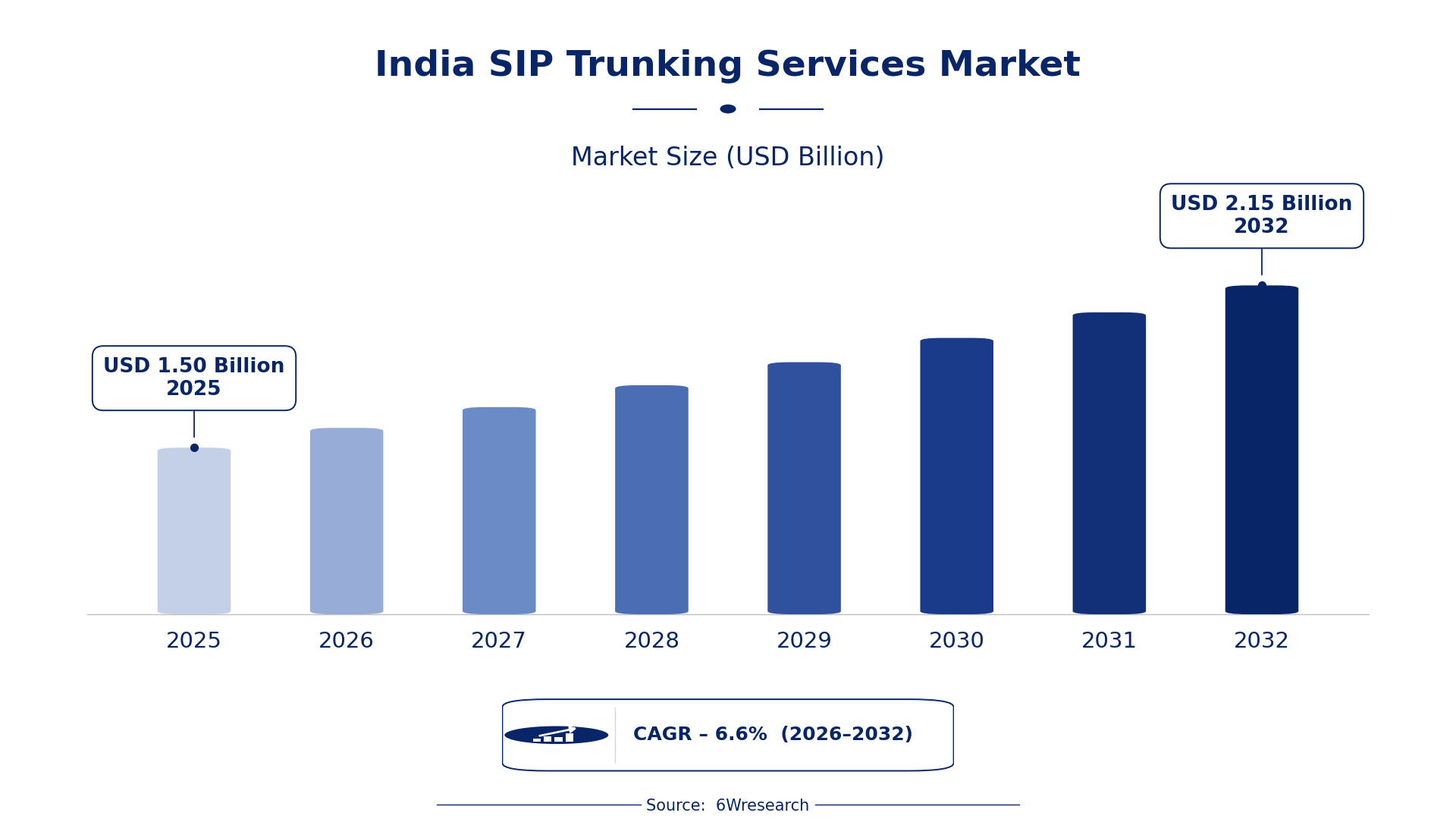
The India SIP Trunking Services Market was estimated at USD 1495 Million in 2025 and is projected to reach USD 2150 Million by 2032, growing at a CAGR of 6.6% from 2026 to 2032.
India SIP Trunking Services Market Synopsis
With the increasing reliance on unified communications, the India SIP Trunking Services Market is evolving rapidly. Companies are turning to SIP trunking as a solution to streamline their telephony needs and bolster connectivity across various digital channels.
Businesses in sectors ranging from IT to finance are adopting SIP trunking services to achieve cost efficiencies while improving communication capabilities. This trend is transforming traditional telephony approaches and driving a shift towards more modern, flexible communication infrastructures.
India SIP Trunking Services Market Year-wise Growth Rate and Key Drivers
This graph illustrates the annual growth rates of the India SIP Trunking Services Market from 2021 to 2032, highlighting a steady upward trajectory and projected expansion over the forecast period.
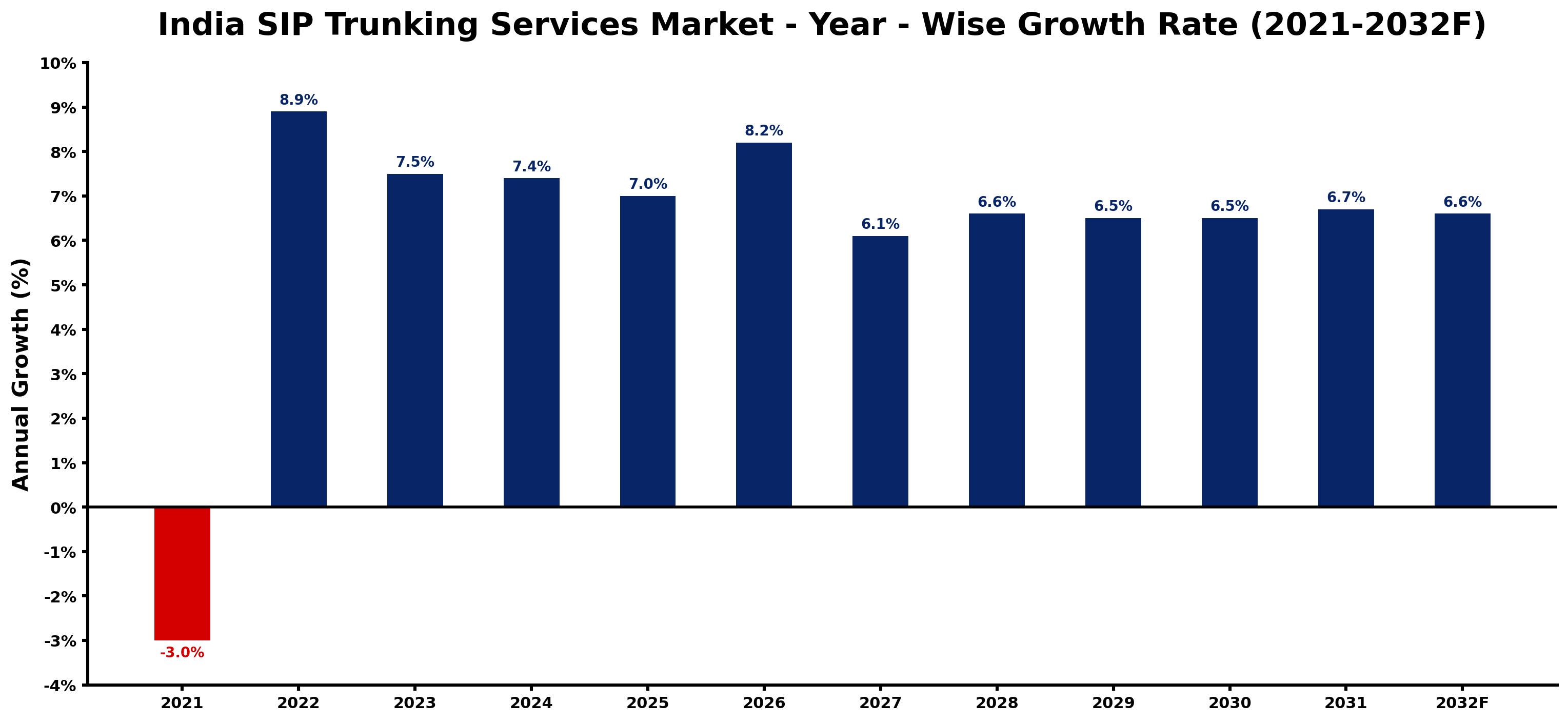
The table below presents the year‑wise growth rates along with the key drivers influencing the market
| Year | Growth Rate | Major Drivers |
| 2021 | -3.0% | Telecom Regulatory Authority of India reduced interconnect charges. |
| 2022 | 8.9% | Increased VoIP adoption among Indian enterprises. |
| 2023 | 7.5% | Government initiatives promoting digital transformation in telecom. |
| 2024 | 7.4% | Growth in remote work leading to higher SIP usage. |
| 2025 | 7.0% | Regulatory push for seamless connectivity by TRAI. |
| 2026 | 8.2% | Surge in SMEs migrating to cloud-based communications. |
| 2027 | 6.1% | Investment in improved broadband infrastructure by ISPs. |
| 2028 | 6.6% | Adoption of AI-driven customer support solutions in India. |
| 2029 | 6.5% | Rise in demand for disaster recovery solutions. |
| 2030 | 6.5% | Emergence of 5G facilitating advanced communication technologies. |
| 2031 | 6.7% | Boost in contact center outsourcing services. |
| 2032 | 6.6% | Increasing cybersecurity regulations driving SIP service adoption. |
Note: Market size estimations and growth projections presented in this report are based on 6Wresearch's proprietary forecasting methodology, utilizing the latest available industry data, government publications, and primary research inputs.
India SIP Trunking Services Market Key Takeaways
Below are some of the specific key takeaways from the market, including:
- The market is driven by the need for integrated voice, video, and data communication solutions.
- Cost reduction and enhanced flexibility are primary motivators for businesses adopting SIP trunking.
- Concerns regarding security and compatibility with existing systems remain prevalent.
- The COVID-19 pandemic accelerated the shift to SIP trunking as companies adapted to remote working models.
- Leading telecommunications providers are expanding their SIP trunking portfolios to capture market demand.
Evaluation of Restraints in India SIP Trunking Services Market
The growth of the India SIP Trunking Services Market faces several hurdles. Businesses often grapple with integrating SIP trunking into their existing communication frameworks, which can lead to compatibility issues. Security is another major concern; organizations need assurance that their communications are safeguarded against potential cyber threats. Lastly, while companies aim to save costs, achieving this while maintaining high call quality can be a tricky balance, complicating the decision-making process.
India SIP Trunking Services Market Trends
One prominent trend in this market is the push towards cloud-based SIP trunking solutions. As organizations move to cloud infrastructures, SIP services are increasingly being hosted on cloud platforms, which provide scalability and lower capital expenditures. Additionally, the growing acceptance of remote working has led to an uptick in demand for mobile-friendly SIP solutions that ensure seamless connectivity regardless of location.
Another trend is the integration of artificial intelligence into SIP trunking services. AI can enhance call quality, optimize traffic management, and provide valuable insights into communication patterns, enabling organizations to refine their strategies for customer engagement and support.
India SIP Trunking Services Market Opportunities
The opportunities within the India SIP Trunking Services Market are expanding significantly. As more businesses recognize the advantages of adopting integrated communication systems, demand is expected to surge. Small and medium enterprises (SMEs), in particular, are now prioritizing SIP trunking as a cost-effective means to enhance their telephony solutions and compete in their respective markets.
Furthermore, government initiatives aimed at boosting digital infrastructure are likely to catalyze investments in SIP trunking services, making it an attractive area for providers looking to grow their footprint in the telecommunications sector.
Government Initiatives in the India SIP Trunking Services Market
The Indian government is actively working to improve digital communication frameworks, which greatly influences the SIP trunking services market. Recent policies focus on expanding telecommunications infrastructure and fostering an environment conducive to technological advancements. Such initiatives are crucial, especially as businesses seek to modernize their communication systems amidst increasing digital demands.
- A national digital infrastructure upgrade programme now in its rollout phase aims to improve connectivity in rural and urban areas.
- A regulatory framework introduced in 2025 mandates billing transparency and competitive pricing in the telecommunications sector.
- Current initiatives focus on enhancing cybersecurity measures for SIP trunking services, addressing growing concerns in the market.
- A planned public-private initiative is expected to expand telecom infrastructure access by 2028, enhancing availability of SIP services across regions.
Future Insights of the India SIP Trunking Services Market
Looking ahead to 2026-2032, the India SIP Trunking Services Market is set for significant transformation. With the growing adoption of 5G technology, businesses will increasingly look for high-speed connectivity to support advanced communication needs. This will further drive the shift from traditional telephony to more integrated, technology-driven solutions.
As organizations embrace digital transformation, SIP trunking will play a crucial role in supporting their communication strategies, making it a vital area for investment and development within the telecommunications sector.
India SIP Trunking Services Market Latest Developments
The past year has seen dynamic developments in the India SIP Trunking Services Market, reflecting the sector's rapid adaptation to new technology and market demands. Companies are increasingly focusing on enhancing their service offerings to meet the growing expectations of businesses for efficient and reliable communication solutions.
- A leading regional operator launched a new SIP trunking service in early 2025, designed to cater to SMEs with enhanced features at competitive pricing.
- An ongoing initiative aimed at integrating AI capabilities into existing SIP services began in mid-2025, focusing on improving call routing and quality analytics.
- A major technology vendor is expected to roll out an upgraded SIP trunking platform by late 2025, which promises advanced features like real-time analytics and predictive dialing.
- In Q1 2025, a partnership was formed between two telecom giants to enhance infrastructure capabilities specifically for SIP trunking services.
India SIP Trunking Services Market - Key Attractiveness of the Report
- 10 Years of Market Numbers
- Historical Data Starting from 2022 to 2025
- Base Year: 2025
- Forecast Data until 2032
- Key Performance Indicators Impacting the Market
- Major Upcoming Developments and Projects
Key Highlights of the Report:
- India SIP Trunking Services Market Outlook
- Market Size of India SIP Trunking Services Market, 2025
- Forecast of India SIP Trunking Services Market, 2032
- Historical Data and Forecast of India SIP Trunking Services Revenues & Volume for the Period 2022-2032F
- India SIP Trunking Services Market Trend Evolution
- India SIP Trunking Services Market Drivers and Challenges
- India SIP Trunking Services Price Trends
- India SIP Trunking Services Porter's Five Forces
- India SIP Trunking Services Industry Life Cycle
- Historical Data and Forecast of India SIP Trunking Services Market Revenues & Volume By Organization Size for the Period 2022-2032F
- Historical Data and Forecast of India SIP Trunking Services Market Revenues & Volume By Small Businesses for the Period 2022-2032F
- Historical Data and Forecast of India SIP Trunking Services Market Revenues & Volume By Mid-sized Businesses for the Period 2022-2032F
- Historical Data and Forecast of India SIP Trunking Services Market Revenues & Volume By Enterprises for the Period 2022-2032F
- Historical Data and Forecast of India SIP Trunking Services Market Revenues & Volume By End-user for the Period 2022-2032F
- Historical Data and Forecast of India SIP Trunking Services Market Revenues & Volume By Verticals (BFSI, High-Tech, Government, Healthcare, Education, Retail, Transportation and Logistics, Manufacturing, Travel and Hospitality) for the Period 2022-2032F
- Historical Data and Forecast of India SIP Trunking Services Market Revenues & Volume By Wholesale for the Period 2022-2032F
- India SIP Trunking Services Import Export Trade Statistics
- Market Opportunity Assessment By Organization Size
- Market Opportunity Assessment By End-user
- India SIP Trunking Services Top Companies Market Share
- India SIP Trunking Services Competitive Benchmarking By Technical and Operational Parameters
- India SIP Trunking Services Company Profiles
- India SIP Trunking Services Key Strategic Recommendations






































