India Trolley Market Size, Share & Growth Rate
The India Trolley Market was estimated at USD 1319 Million in 2025 and is projected to reach USD 1899 Million by 2032, growing at a CAGR of 5.3% from 2026 to 2032. This growth is primarily driven by increased investments in efficient material handling across sectors, particularly as the logistics, e-commerce, and manufacturing industries rapidly expand. The market's momentum is further enhanced by innovations in trolley technology, including automation and ergonomic designs.
India Trolley Market Year-wise Growth Rate and Key Drivers
This graph highlights how the India Trolley Market has steadily grown over the years, supported by major growth factors.
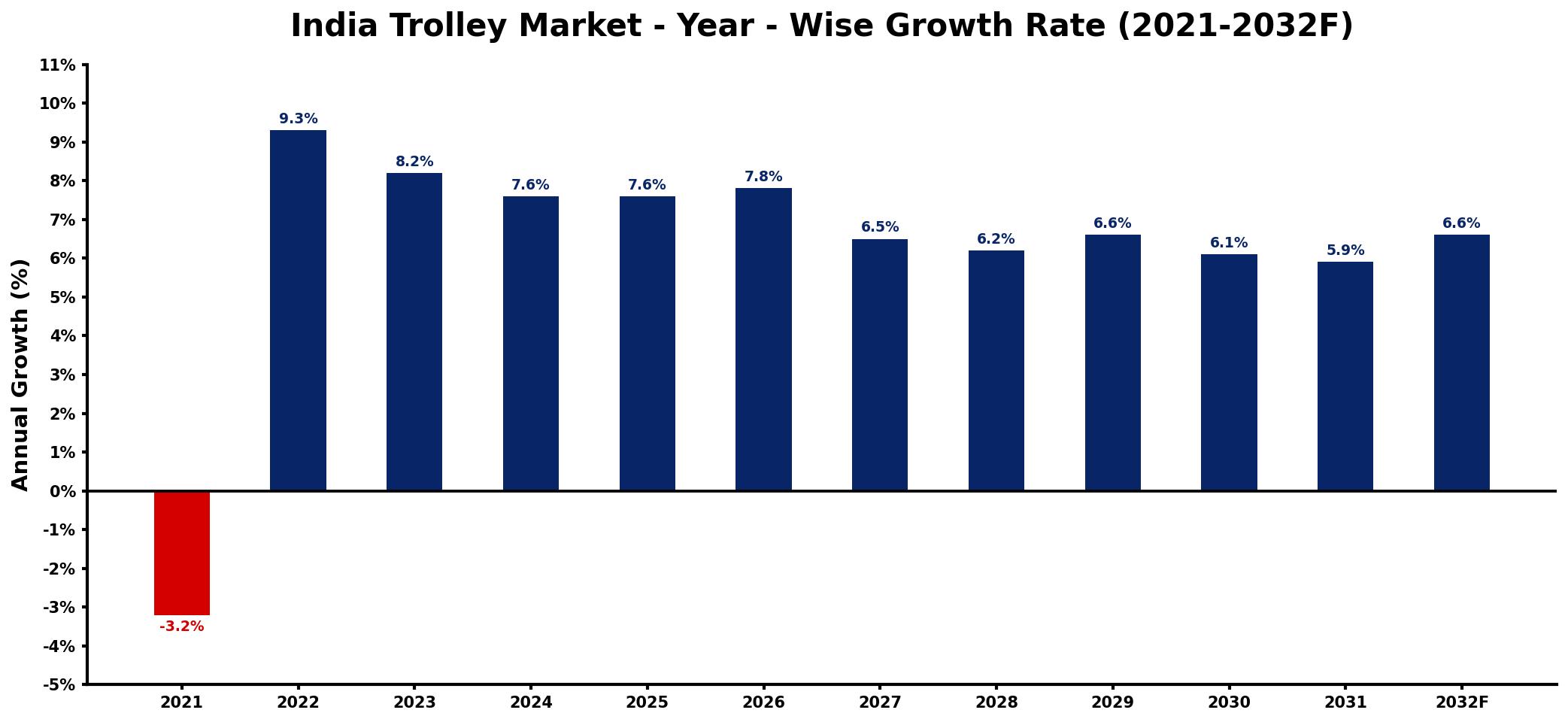
The table below presents the year‑wise growth rates along with the key drivers influencing the market
| Year | Growth Rate | Major Drivers |
| 2021 | -3.2% | decreased consumer spending on logistics |
| 2022 | 9.3% | rising e-commerce logistics investments |
| 2023 | 8.2% | increased demand for last mile |
| 2024 | 7.6% | growing urban population density |
| 2025 | 7.6% | higher disposable income levels |
| 2026 | 7.8% | improvement in supply chain efficiency |
| 2027 | 6.5% | expansion of retail distribution networks |
| 2028 | 6.2% | increased focus on sustainability practices |
| 2029 | 6.6% | growth in online grocery shopping |
| 2030 | 6.1% | rising demand for home deliveries |
| 2031 | 5.9% | enhanced infrastructure development projects |
| 2032 | 6.6% | increased urban logistics innovations |
Note: Market size estimations and growth projections presented in this report are based on 6Wresearch's proprietary forecasting methodology, utilizing the latest available industry data, government publications, and primary research inputs.
India Trolley Market Synopsis
The Indian trolley market has shown a resilient recovery trajectory post-COVID-19, bouncing back from sharp declines due to pandemic-induced disruptions. As various industries resume operations, the demand for trolleys is on a steady upswing, propelled by the growing focus on efficient material handling solutions.
Looking ahead, the market is set to benefit from robust demand in sectors like e-commerce, food processing, and warehousing. Enhanced supply chain strategies and government initiatives aimed at improving logistics infrastructure are expected to further catalyze growth.
India Trolley Market Key Takeaways
- The market is rebounding steadily after COVID-19 disruptions, with robust growth projected in the coming years.
- Increased demand in sectors like logistics and e-commerce is driving trolley adoption.
- Technological advancements, including automation and electric trolleys, are enhancing market potential.
- Government initiatives to bolster logistics infrastructure are expected to positively influence the market.
- Ergonomics and safety features in trolley design are becoming increasingly important to meet industry standards.
Evaluation of Restraints in India Trolley Market
One of the significant restraints facing the India trolley market is the competition posed by advanced material handling solutions like automated guided vehicles (AGVs) and robotic systems. These alternatives offer enhanced operational efficiency and reduced labor costs, which may make traditional trolleys less appealing to some sectors. To counter this challenge, manufacturers must prioritize innovation, focusing on integrating automation capabilities and expanding functionalities within their trolley designs.
India Trolley Market Trends
Current trends indicate a clear shift toward electric and automated trolleys, aligning with global sustainability goals. The increasing focus on ergonomics in design is also shaping consumer preferences, as industries aim to enhance workplace safety and employee comfort. Additionally, the rise of smart technology in material handling is paving the way for more sophisticated trolley systems, which cater to the evolving demands of the logistics and manufacturing sectors.
India Trolley Market Opportunities
Opportunities for growth in the India trolley market are abundant, especially as urbanization and industrialization continue to expand. Investment in e-commerce logistics presents a significant avenue for trolley manufacturers, given the surge in online shopping and home delivery services. Moreover, as businesses increasingly prioritize automation and efficient supply chain solutions, there is a clear demand for innovative trolley systems that can adapt to a variety of applications and environments.
Government Initiatives in the India Trolley Market
The Indian government has been proactive in enhancing logistics and supply chain infrastructure, which directly benefits the trolley market. Various initiatives aimed at improving transportation efficiency, investing in warehousing facilities, and promoting e-commerce are creating a conducive environment for growth. Additionally, incentives for adopting automation in industries are driving the demand for modern material handling solutions, including advanced trolleys.
Future Insights of the India Trolley Market
As we look forward to the period from 2026 to 2032, the India trolley market is expected to continue its upward trajectory, fueled by the integration of technology and increased demand across sectors. Innovations in design and functionality will play a crucial role in ensuring that trolleys remain a staple in material handling. Moreover, the increasing focus on sustainability will likely encourage manufacturers to develop eco-friendly options, further expanding the market's appeal.
India Trolley Market Latest Developments (2025 - 2026)
Recent developments within the India trolley market indicate a shift toward digitalization and smart solutions. Several manufacturers have begun to incorporate IoT technology into their designs, allowing for better inventory management and tracking. Furthermore, collaborative efforts among industry stakeholders are leading to enhanced safety protocols and ergonomic standards, reflecting the growing importance of worker welfare in the sector.
India Trolley Market - Key Attractiveness of the Report
- 10 Years of Market Numbers
- Historical Data Starting from 2022 to 2025
- Base Year: 2025
- Forecast Data until 2032
- Key Performance Indicators Impacting the Market
- Major Upcoming Developments and Projects
Key Highlights of the Report:
- India Trolley Market Outlook
- Market Size of India Trolley Market, 2025
- Forecast of India Trolley Market, 2032
- Historical Data and Forecast of India Trolley Revenues & Volume for the Period 2022-2032F
- India Trolley Market Trend Evolution
- India Trolley Market Drivers and Challenges
- India Trolley Price Trends
- India Trolley Porter's Five Forces
- India Trolley Industry Life Cycle
- Historical Data and Forecast of India Trolley Market Revenues & Volume By Product for the Period 2022-2032F
- Historical Data and Forecast of India Trolley Market Revenues & Volume By Manual for the Period 2022-2032F
- Historical Data and Forecast of India Trolley Market Revenues & Volume By Electric for the Period 2022-2032F
- Historical Data and Forecast of India Trolley Market Revenues & Volume By Application for the Period 2022-2032F
- Historical Data and Forecast of India Trolley Market Revenues & Volume By Commercial for the Period 2022-2032F
- Historical Data and Forecast of India Trolley Market Revenues & Volume By Non-commercial for the Period 2022-2032F
- Historical Data and Forecast of India Trolley Market Revenues & Volume By Distribution for the Period 2022-2032F
- Historical Data and Forecast of India Trolley Market Revenues & Volume By Offline for the Period 2022-2032F
- Historical Data and Forecast of India Trolley Market Revenues & Volume By Online for the Period 2022-2032F
- India Trolley Import Export Trade Statistics
- Market Opportunity Assessment By Product
- Market Opportunity Assessment By Application
- Market Opportunity Assessment By Distribution
- India Trolley Top Companies Market Share
- India Trolley Competitive Benchmarking By Technical and Operational Parameters
- India Trolley Company Profiles
- India Trolley Key Strategic Recommendations






































